Page 225 of 368
First Edition for Buick LeSabre Owner's Manual ± 1999
yellowblue
5-23 Removing Wheel Covers and Wheel
Nut Caps
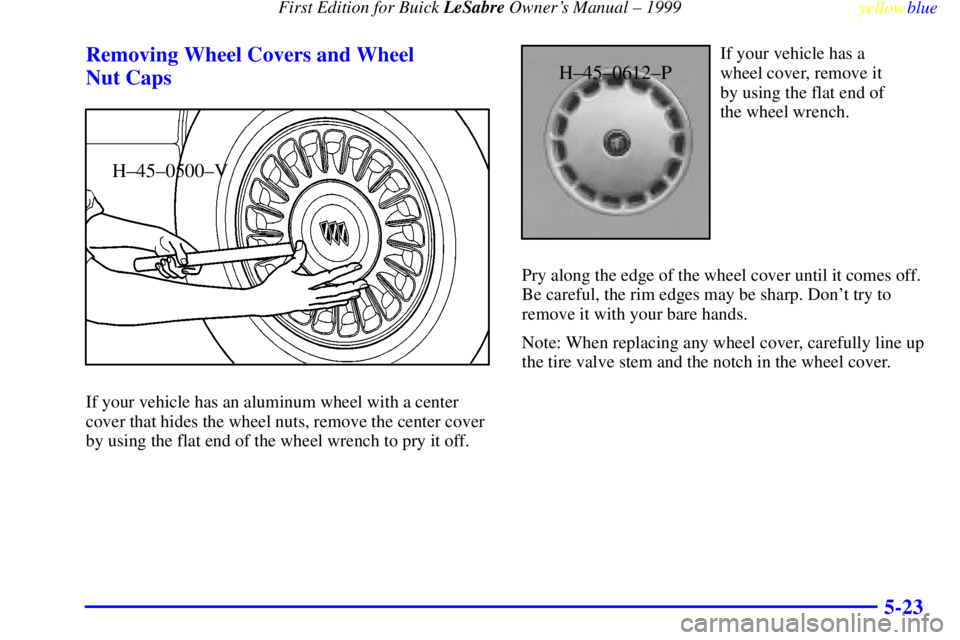
H±45±0500±V
If your vehicle has an aluminum wheel with a center
cover that hides the wheel nuts, remove the center cover
by using the flat end of the wheel wrench to pry it off.
H±45±0612±P
If your vehicle has a
wheel cover, remove it
by using the flat end of
the wheel wrench.
Pry along the edge of the wheel cover until it comes off.
Be careful, the rim edges may be sharp. Don't try to
remove it with your bare hands.
Note: When replacing any wheel cover, carefully line up
the tire valve stem and the notch in the wheel cover.
Page 227 of 368
First Edition for Buick LeSabre Owner's Manual ± 1999
yellowblue
5-25
H±45±4613±P
3. Remove the
theft
-deterrent nut by
placing the key end of
the wire wheel key
wrench over the nut and
turning it
counterclockwise.
4. Pull off the wire wheel cover. Store it in the trunk
until the flat tire is repaired or replaced.
NOTE: When replacing the wheel cover, carefully line
up the tire valve stem and the notch in the wheel cover.Removing the Flat Tire and Installing the
Spare Tire
H±35±6012±R
1. Use the wheel wrench to loosen the wheel nuts, but
don't remove them.
Page 228 of 368
First Edition for Buick LeSabre Owner's Manual ± 1999
yellowblue
5-26
H±35±5061±R
2. Turn the wheel wrench clockwise by hand to raise
the jack head until it fits under the vehicle.
C±53±5053±T
3. Put the jack into a notch in the frame which is
located near each wheel well. The front notch is
10 inches (25 cm) back from the front wheel well.
The rear notch is 8 inches (20 cm) forward from the
rear wheel well.
4. Position the jack and raise the jack head until it fits
firmly on the ridge in the vehicle's frame nearest the
flat tire. Do not raise the vehicle yet. Put the compact
spare tire near you.
Page 229 of 368
First Edition for Buick LeSabre Owner's Manual ± 1999
yellowblue
5-27
CAUTION:
Getting under a vehicle when it is jacked up is
dangerous. If the vehicle slips off the jack, you
could be badly injured or killed. Never get under
a vehicle when it is supported only by a jack.
CAUTION:
Raising your vehicle with the jack improperly
positioned can damage the vehicle and even make
the vehicle fall. To help avoid personal injury and
vehicle damage, be sure to fit the jack lift head
into the proper location before raising
the vehicle.
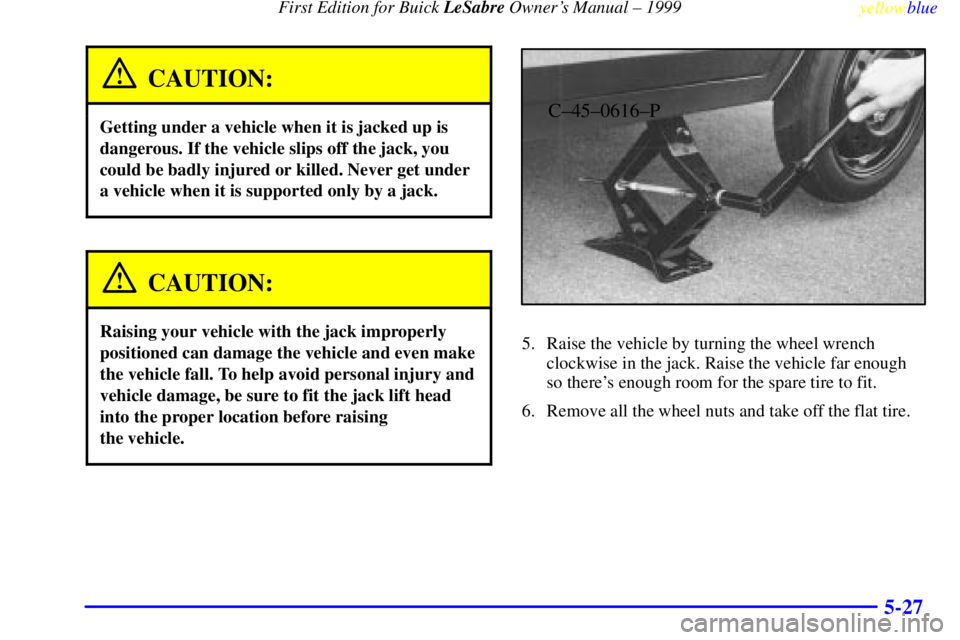
C±45±0616±P
5. Raise the vehicle by turning the wheel wrench
clockwise in the jack. Raise the vehicle far enough
so there's enough room for the spare tire to fit.
6. Remove all the wheel nuts and take off the flat tire.
Page 232 of 368
First Edition for Buick LeSabre Owner's Manual ± 1999
yellowblue
5-30
NOTICE:
Improperly tightened wheel nuts can lead to
brake pulsation and rotor damage. To avoid
expensive brake repairs, evenly tighten the wheel
nuts in the proper sequence and to the proper
torque specification.
NOTICE:
Wheel covers won't fit on your compact spare. If
you try to put a wheel cover on your compact
spare, you could damage the cover or the spare.
Storing the Flat Tire and Tools
CAUTION:
Storing a jack, a tire or other equipment in the
passenger compartment of the vehicle could
cause injury. In a sudden stop or collision, loose
equipment could strike someone. Store all these
in the proper place.
After you've put the compact spare tire on your vehicle,
you'll need to store the flat tire in your trunk. Use the
following procedure to secure the flat tire in the trunk.
Store the flat tire as far forward in the trunk as possible.
Store the jack and wheel wrench in their box in the trunk
on the passenger's side.
Page 234 of 368
First Edition for Buick LeSabre Owner's Manual ± 1999
yellowblue
5-32
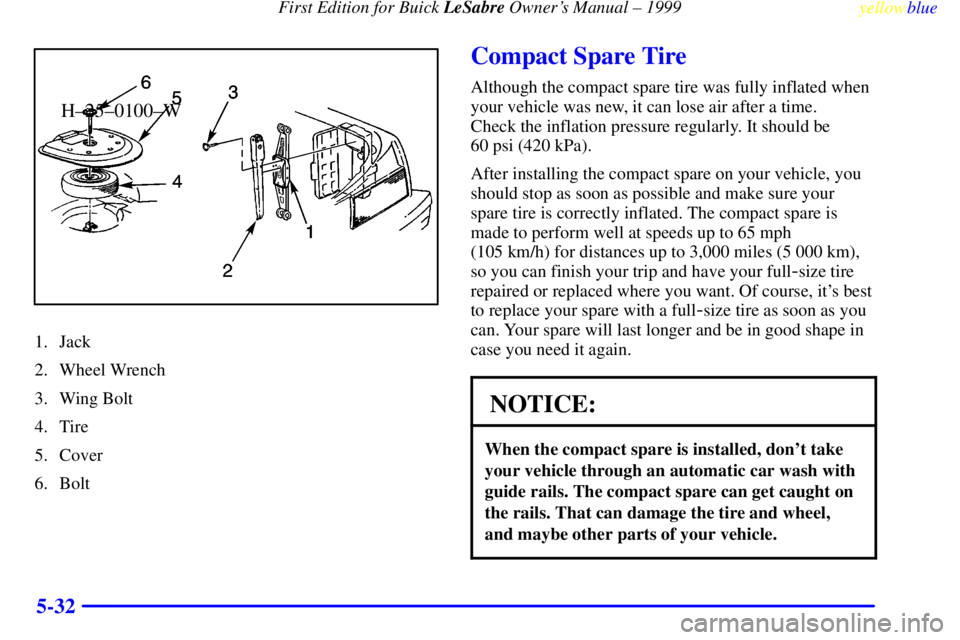
H±25±0100±W
1. Jack
2. Wheel Wrench
3. Wing Bolt
4. Tire
5. Cover
6. Bolt
Compact Spare Tire
Although the compact spare tire was fully inflated when
your vehicle was new, it can lose air after a time.
Check the inflation pressure regularly. It should be
60 psi (420 kPa).
After installing the compact spare on your vehicle, you
should stop as soon as possible and make sure your
spare tire is correctly inflated. The compact spare is
made to perform well at speeds up to 65 mph
(105 km/h) for distances up to 3,000 miles (5 000 km),
so you can finish your trip and have your full
-size tire
repaired or replaced where you want. Of course, it's best
to replace your spare with a full
-size tire as soon as you
can. Your spare will last longer and be in good shape in
case you need it again.
NOTICE:
When the compact spare is installed, don't take
your vehicle through an automatic car wash with
guide rails. The compact spare can get caught on
the rails. That can damage the tire and wheel,
and maybe other parts of your vehicle.
Page 271 of 368
yellowblue
6-35
The vehicle should be properly prepared as follows:
�The vehicle must have all four tires on a perfectly
level surface.
�If necessary, pads may be used on an uneven surface.
�The vehicle should not have any snow, ice or mud
attached to it.
�The vehicle should be fully assembled and all other
work stopped while headlamp aiming is being done.
�There should not be any cargo or loading of the
vehicle, except it should have a full tank of fuel and
one person or 160 lbs. (75 kg) on the driver's seat.
�Close all doors.
�Tires should be properly inflated.
�Rock the vehicle to stabilize the suspension.
The headlamp aiming devices are under the hood near
the headlamps.
A. Horizontal Aiming Screw
B. Vertical Aiming Screw
Start with the horizontal aim. The adjustment screws
can be turned with an E8 Torx
� socket or
T15 Torx screwdriver.
Once the horizontal aim is adjusted, then adjust the
vertical aim.
Page 277 of 368
yellowblue
6-41
CAUTION:
Poorly maintained and improperly used tires
are dangerous.
�Overloading your tires can cause
overheating as a result of too much friction.
You could have an air
-out and a serious
accident. See ªLoading Your Vehicleº in
the Index.
�Underinflated tires pose the same danger as
overloaded tires. The resulting accident
could cause serious injury. Check all tires
frequently to maintain the recommended
pressure. Tire pressure should be checked
when your tires are cold.
�Overinflated tires are more likely to be
cut, punctured or broken by a sudden
impact
-- such as when you hit a pothole.
Keep tires at the recommended pressure.
�Worn, old tires can cause accidents. If your
tread is badly worn, or if your tires have
been damaged, replace them.
Inflation -- Tire Pressure
The Tire-Loading Information label, which is on the
rear edge of the driver's door, shows the correct
inflation pressures for your tires when they're cold.
ªColdº means your vehicle has been sitting for at least
three hours or driven no more than 1 mile (1.6 km).
NOTICE:
Don't let anyone tell you that underinflation or
overinflation is all right. It's not. If your tires
don't have enough air (underinflation), you can
get the following:
�Too much flexing
�Too much heat
�Tire overloading
�Bad wear
�Bad handling
�Bad fuel economy.
NOTICE: (Continued)