Page 105 of 344

yellowblue
2-45 Rear Storage Armrest (If Equipped)
You may also have an armrest located within the center
back seat of your vehicle. It may have a storage area and
cupholders. To open, pull up on the lever at the end of
the armrest and lift. Two cupholders will then be
accessible and you will have access to the storage
compartment area.
Trunk Convenience Net (If Equipped)
Your vehicle may have a convenience net. You'll see it
on the back wall of the trunk.
Put small loads, like grocery bags, behind the net. It can
help keep them from falling over during sharp turns or
quick starts and stops.
The net isn't for larger, heavier loads. Store those in the
trunk as far forward as you can.
You can unhook the net so that it will lie flat when
you're not using it.
Ashtrays and Lighter
The center front ashtray is located on the instrument
panel, just below the comfort controls. To remove the
ashtray, open the lid and lift it out.The rear ashtray is located within a small door at the back
of your vehicle's front seat armrest. Push on the right side
of the door. The ashtray will then rotate to the right for
usage. You can only access the ashtray by pushing on the
door's right side. To remove the ashtray, push down on the
snuffer located in the middle of the ashtray and lift it out.
NOTICE:
Don't put papers and other things that burn into
your ashtrays. If you do, cigarettes or other smoking
materials could set them on fire, causing damage.
To use the lighter, just push it in all the way and let go.
When it's ready, it will pop back by itself.
NOTICE:
Don't hold a cigarette lighter in with your hand
while it is heating. If you do, it won't be able to
back away from the heating element when it's
ready. That can make it overheat, damaging the
lighter and the heating element.
Page 108 of 344
yellowblue
2-48
The Instrument Panel -- Your Information System
A. Lamp Controls
B. Instrument Cluster
C. VentsD. Glove Box
E. Audio System
F. Climate Controls
Page 109 of 344
yellowblue
2-49
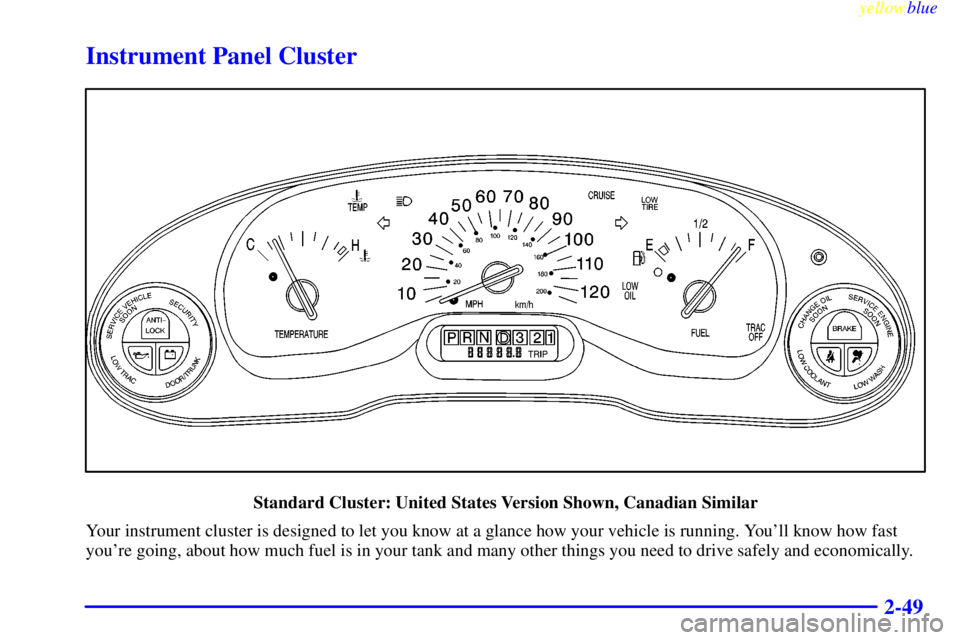
Instrument Panel Cluster
Standard Cluster: United States Version Shown, Canadian Similar
Your instrument cluster is designed to let you know at a glance how your vehicle is running. You'll know how fast
you're going, about how much fuel is in your tank and many other things you need to drive safely and economically.
Page 111 of 344

yellowblue
2-51
When one of the warning lights comes on and stays on
when you are driving, or when one of the gages shows
there may be a problem, check the section that tells you
what to do about it. Please follow this manual's advice.
Waiting to do repairs can be costly
-- and even
dangerous. So please get to know your warning lights
and gages. They're a big help.
Safety Belt Reminder Light
When the key is turned to RUN or START, a chime will
come on for about eight seconds to remind people to
fasten their safety belts, unless the driver's safety belt is
already buckled.
The safety belt light will
also come on and stay on
for about 20 seconds, then it
will flash for about
55 seconds. If the driver's
belt is already buckled,
neither the chime nor the
light will come on.
Air Bag Readiness Light
There is an air bag readiness light on the instrument
panel, which shows the air bag symbol. The system
checks the air bag's electrical system for malfunctions.
The light tells you if there is an electrical problem. The
system check includes the air bag modules, the wiring
and the crash sensing and diagnostic module. For more
information on the air bag system, see ªAir Bagº in
the Index.
This light will come on
when you start your engine,
and it will flash for a few
seconds. Then the light
should go out. This means
the system is ready.
If the air bag readiness light stays on after you start the
engine or comes on when you are driving, your air bag
system may not work properly. Have your vehicle
serviced right away.
The air bag readiness light should flash for a few
seconds when you turn the ignition key to RUN. If the
light doesn't come on then, have it fixed so it will be
ready to warn you if there is a problem.
Page 124 of 344
yellowblue
2-64
Here are four things that some owners ask about. All
these things are normal and do not indicate that anything
is wrong with the fuel gage:
�At the gas station, the pump shuts off before the gage
reads FULL (F).
�It takes more (or less) fuel to fill up than the gage
reads. For example, the gage reads half full, but it
took more (or less) than half of the tank's capacity to
fill it.
�The gage pointer may move while cornering, braking
or speeding up.
�The gage may not indicate EMPTY (E) when the
ignition is turned off.Low Fuel Light
If your fuel is low, a circular
light on your instrument
panel will come on and
stay on and a chime will
sound periodically until
you add fuel.
It will also come on for a few seconds when you first
turn on the ignition as a check to show you it's working.
If it doesn't come on then, have it fixed.
Page 126 of 344

yellowblue
3-2
Comfort Controls
Manual Single Zone Climate Control
With this system, you can control the heating, cooling
and ventilation in your vehicle. The system works best if
you keep your windows closed while using it.
Fan Knob
The left knob controls the amount of air you want. To
turn the fan off, turn the knob to OFF.
If the airflow seems very low when the fan knob is turned
to the highest setting, regardless of the mode setting, your
passenger compartment air filter may need to be replaced.
See ªMaintenance Scheduleº or ªPassenger Compartment
Air Filterº in the Index.Temperature Knob
The center knob changes the temperature of the air
coming through the system. Turn this knob toward red
(clockwise) for warmer air. Turn it toward blue
(counterclockwise) for cooler air.
Mode Knob
The right knob has several settings to control the
direction of airflow:
MAX: This setting recirculates much of the air inside
your vehicle and sends it through the instrument panel
outlets. The air conditioning compressor will run
automatically in this setting unless the outside
temperature is below 40�F (4�C). (Even when the
compressor is running, you can control the temperature.)
NORM: This setting brings in outside air and sends it
through the instrument panel outlets. The air
conditioning compressor will run automatically in this
setting unless the outside temperature is below 40�F
(4�C). (Even when the compressor is running, you can
control the temperature.)
Page 127 of 344

yellowblue
3-3
BI-LEV: This setting brings in outside air and directs it
two ways. Half of the air is directed through the
instrument panel outlets. Most of the remaining air is
directed through the floor ducts and a little to the defrost
and side window vents. The air conditioning compressor
will run automatically in this setting unless the outside
temperature is below 40�F (4�C).
VENT: This setting brings in outside air and directs it
through the instrument panel outlets.
HTR: This setting sends most of the air through the
ducts near the floor. The rest comes out of the defroster
and side window vents.
BLEND: This setting allows half of the air to go to the
floor ducts and half to the defroster and side window
vents. The air conditioning compressor will run
automatically in this setting unless the outside
temperature is below 40�F (4�C).
FRONT: This setting directs most of the air
through the defroster and side window vents. Some of
the air also goes to the floor ducts. The air conditioning
compressor will run automatically in this setting unless
the outside temperature is below 40�F (4�C).Air Conditioning
On very hot days, open the windows long enough to let
hot, inside air escape. This reduces the time for the
vehicle to cool down.
For a quick cool
-down on very hot days, use MAX with
the temperature knob all the way in the blue area. If this
setting is used for long periods of time, the air in your
vehicle may become too dry.
For normal cooling on hot days, use NORM with the
temperature knob in the blue area. The system will bring
in outside air and cool it.
On cool, but sunny days, the sun may warm your upper
body, but your lower body may not be warm enough.
You can use BI
-LEV and set the temperature knob to a
comfortable setting. The system will bring in outside air
and direct it to your upper body, while sending slightly
warmed air to your lower body. You may notice this
temperature difference more at some times than others.
Page 129 of 344

yellowblue
3-5
Driver's Temperature Knob
The center knob sets the temperature for the driver's
outlets. Turn the knob toward red (clockwise) for
warmer air. Turn it toward blue (counterclockwise) for
cooler air.
Passenger's Temperature Lever
The bottom lever adjusts the air temperature on the
passenger's side independent of the temperature set by
the driver. Slide the lever toward the right to raise the
temperature. Slide the lever toward the left to lower
the temperature.
Mode Knob
The right knob has several settings to control the
direction of airflow. To access the various modes
available, turn the mode knob to the desired mode.
MAX: This setting recirculates much of the air inside
your vehicle and sends it through the instrument panel
outlets. The air conditioning compressor will run
automatically in this setting unless the outside
temperature is below 40�F (4�C). (Even when the
compressor is running, you can control the temperature.)NORM: This setting brings in outside air and sends it
through the instrument panel outlets. The air
conditioning compressor will run automatically in this
setting unless the outside temperature is below 40�F
(4�C). (Even when the compressor is running, you can
control the temperature.)
BI
-LEV: This setting brings in outside air and directs it
two ways. Half of the air is directed through the
instrument panel outlets. Most of the remaining air is
directed through the floor ducts and a little to the defrost
and side window vents. The air conditioning compressor
will run automatically in this setting unless the outside
temperature is below 40�F (4�C). (Even when the
compressor is running, you can control the temperature.)
VENT: This setting brings in outside air and directs it
through the instrument panel outlets.
HTR: This setting sends most of the air through the
ducts near the floor. The rest comes out of the defroster
and side window vents.
BLEND: This setting allows half of the air to go to the
floor ducts and half to the defroster and side window
vents. The air conditioning compressor will run
automatically in this setting unless the outside
temperature is below 40�F (4�C). (Even when the
compressor is running, you can control the temperature.)