Page 235 of 344
yellowblue
6-5
Fuels in Foreign Countries
If you plan on driving in another country outside the
United States or Canada, the proper fuel may be hard to
find. Never use leaded gasoline or any other fuel not
recommended in the previous text on fuel. Costly repairs
caused by use of improper fuel wouldn't be covered by
your warranty.
To check on fuel availability, ask an auto club, or
contact a major oil company that does business in the
country where you'll be driving.
You can also write us at the following address for
advice. Just tell us where you're going and give your
Vehicle Identification Number (VIN).
General Motors Overseas Distribution Corporation
1908 Colonel Sam Drive
Oshawa, Ontario L1H 8P7
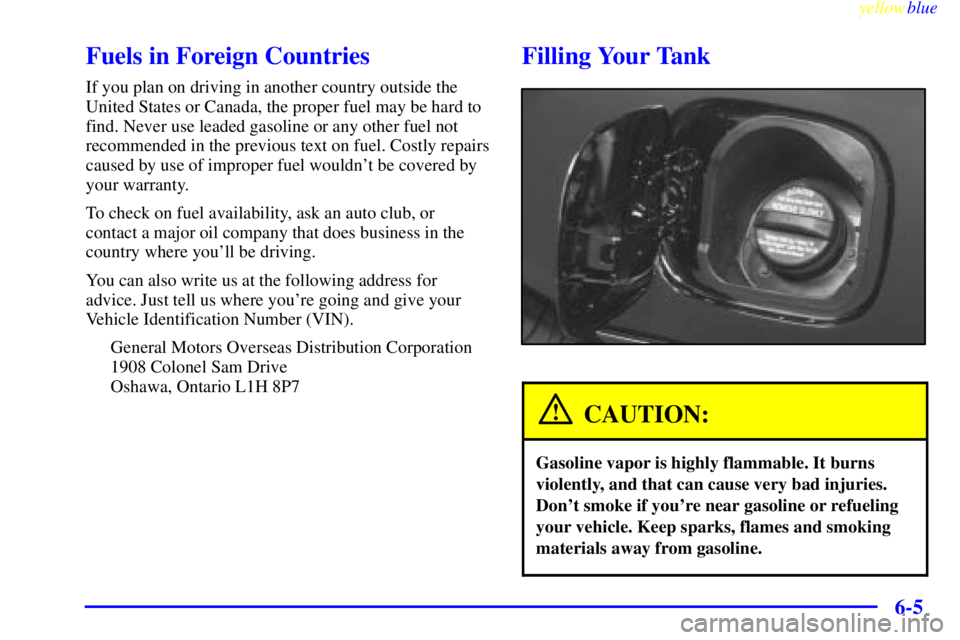
Filling Your Tank
CAUTION:
Gasoline vapor is highly flammable. It burns
violently, and that can cause very bad injuries.
Don't smoke if you're near gasoline or refueling
your vehicle. Keep sparks, flames and smoking
materials away from gasoline.
Page 238 of 344
yellowblue
6-8
Checking Things Under the Hood
CAUTION:
An electric fan under the hood can start up and
injure you even when the engine is not running.
Keep hands, clothing and tools away from any
underhood electric fan.
CAUTION:
Things that burn can get on hot engine parts and
start a fire. These include liquids like gasoline,
oil, coolant, brake fluid, windshield washer and
other fluids, and plastic or rubber. You or others
could be burned. Be careful not to drop or spill
things that will burn onto a hot engine.
Page 241 of 344
yellowblue
6-11
Before closing the hood, be sure all the filler caps are
on properly. Then just pull the hood down and close
it firmly.
Engine Oil
If the LOW OIL light on the
instrument panel comes on,
it means you need to check
your engine oil level
right away.
For more information, see ªLow Oil Level Lightº in the
Index. You should check your engine oil level regularly;
this is an added reminder.
It's a good idea to check your engine oil every time you
get fuel. In order to get an accurate reading, the oil must
be warm and the vehicle must be on level ground.
The engine oil dipstick handle is the yellow loop near
the front of the engine.
Turn off the engine and give the oil several minutes to
drain back into the oil pan. If you don't, the oil dipstick
might not show the actual level.
Page 242 of 344
yellowblue
6-12 Checking Engine Oil
Pull out the dipstick and clean it with a paper towel or
cloth, then push it back in all the way. Remove it again,
keeping the tip down, and check the level.
When to Add Engine Oil
If the oil is at or below the ADD mark, then you'll need
to add at least one quart of oil. But you must use the
right kind. This part explains what kind of oil to use. For
crankcase capacity, see ªCapacities and Specificationsº
in the Index.
NOTICE:
Don't add too much oil. If your engine has so
much oil that the oil level gets above the
cross
-hatched area that shows the proper
operating range, your engine could be damaged.
Page 248 of 344

yellowblue
6-18
Automatic Transaxle Fluid
When to Check and Change
A good time to check your automatic transaxle fluid
level is when the engine oil is changed.
Change both the fluid and filter every 50,000 miles
(83 000 km) if the vehicle is mainly driven under one or
more of these conditions:
�In heavy city traffic where the outside temperature
regularly reaches 90�F (32�C) or higher.
�In hilly or mountainous terrain.
�When doing frequent trailer towing.
�Uses such as found in taxi, police or delivery service.
If you do not use your vehicle under any of these
conditions, change the fluid and filter at 100,000 miles
(166 000 km).
See ªScheduled Maintenance Servicesº in the Index.
How to Check
Because this operation can be a little difficult, you
may choose to have this done at the dealership
service department.
If you do it yourself, be sure to follow all the instructions
here, or you could get a false reading on the dipstick.
NOTICE:
Too much or too little fluid can damage your
transaxle. Too much can mean that some of the
fluid could come out and fall on hot engine parts
or exhaust system parts, starting a fire. Be sure to
get an accurate reading if you check your
transaxle fluid.
Page 301 of 344

yellowblue
Scheduled Maintenance
7-5
The services shown in this schedule up to 100,000 miles
(166 000 km) should be performed after 100,000 miles
(166 000 km) at the same intervals. The services shown
at 150,000 miles (240 000 km) should be performed at
the same interval after 150,000 miles (240 000 km).
See ªOwner Checks and Servicesº and ªPeriodic
Maintenance Inspectionsº following.
Footnotes
� The U.S. Environmental Protection Agency or the
California Air Resources Board has determined that the
failure to perform this maintenance item will not nullify
the emission warranty or limit recall liability prior to the
completion of the vehicle's useful life. We, however,
urge that all recommended maintenance services be
performed at the indicated intervals and the maintenance
be recorded.* Your vehicle has an Engine Oil Life Monitor. This
monitor will show you when to change the engine oil
and filter
-- usually between 3,000 miles (5 000 km) and
7,500 miles (12 500 km) since your last oil change.
Under severe conditions, the indicator may come on
before 3,000 miles (5 000 km). Never drive your vehicle
more than 7,500 miles (12 500 km) or 12 months
without an oil and filter change.
The system won't detect dust in the oil. So if you drive
in a dusty area, be sure to change your oil and filter
every 3,000 miles (5 000 km) or sooner if the CHANGE
OIL SOON light comes on. Remember to reset the Oil
Life Monitor whenever the oil is changed. For more
information, see ªChange Oil Soon Lightº in the Index.
+ A good time to check your brakes is during tire
rotation. See ªBrake System Inspectionº under ªPeriodic
Maintenance Inspectionsº in Part C of this schedule.
Page 302 of 344

Scheduled Maintenance
yellowblue
7-6
7,500 Miles (12 500 km)
�Check Oil Life Monitor. If engine oil and filter are changed, reset monitor.
See ªEngine Oilº in the Index.
An Emission Control Service. (See footnote *.)
�Rotate tires. See ªTire Inspection and Rotationº in the Index for proper
rotation pattern and additional information. (See footnote +.)
15,000 Miles (25 000 km)
�Check Oil Life Monitor. If engine oil and filter are changed, reset monitor.
See ªEngine Oilº in the Index.
An Emission Control Service. (See footnote *.)
�Inspect air cleaner filter if you are driving in dusty conditions. Replace filter
if necessary.
An Emission Control Service. (See footnote �.)
�Replace passenger compartment air filter.
�Rotate tires. See ªTire Inspection and Rotationº in the Index for proper
rotation pattern and additional information. (See footnote +.)
22,500 Miles (37 500 km)
�Check Oil Life Monitor. If engine oil and filter are changed, reset monitor.
See ªEngine Oilº in the Index.
An Emission Control Service. (See footnote *.)
ACTUAL
SERVICED BY:MILEAGE
DATE
ACTUAL
SERVICED BY:MILEAGE
DATE
ACTUAL
SERVICED BY:MILEAGE
DATE
Page 303 of 344

yellowblue
Scheduled Maintenance
7-7
�Rotate tires. See ªTire Inspection and Rotationº in the Index for proper
rotation pattern and additional information. (See footnote +.)
30,000 Miles (50 000 km)
�Check Oil Life Monitor. If engine oil and filter are changed, reset monitor.
See ªEngine Oilº in the Index.
An Emission Control Service. (See footnote *.)
�Replace passenger compartment air filter.
�Rotate tires. See ªTire Inspection and Rotationº in the Index for proper
rotation pattern and additional information. (See footnote +.)
�Replace air cleaner filter.
An Emission Control Service.
�Inspect fuel tank, cap and lines for damage or leaks. Inspect fuel cap gasket
for any damage. Replace parts as needed.
An Emission Control Service. (See footnote�.)
37,500 Miles (62 500 km)
�Check Oil Life Monitor. If engine oil and filter are changed, reset monitor.
See ªEngine Oilº in the Index.
An Emission Control Service. (See footnote *.)
�Rotate tires. See ªTire Inspection and Rotationº in the Index for proper
rotation pattern and additional information. (See footnote +.)
ACTUAL
SERVICED BY:MILEAGE
DATE
ACTUAL
SERVICED BY:MILEAGE
DATE