Page 169 of 194

'98 TERCEL (U)173
Look at the see- through coolant reser-
voir when the engine is cold. The cool-
ant level is satisfactory if it is between
the ºFULLº and ºLOWº lines on the
reservoir. If the level is low, add ethyl-
ene- glycol type coolant.
The coolant level in the reservoir will vary
with engine temperature. However, if the
level is on or below the ºLOWº line, add
coolant. Bring the level up to the ºFULLº
line.
Use only ethylene- glycol type coolant.
See information in the next column.
If the coolant level drops within a short
time after replenishing, there may be a
leak in the system. Visually check the
radiator, hoses, radiator cap and drain
cock and water pump.
If you can find no leak, have your Toyota
dealer test the cap pressure and check
for leaks in the cooling system.
CAUTION
To prevent burning yourself, do not
remove the radiator cap when the en-
gine is hot.
Coolant type selection
Your coolant must contain ethylene- glycol
antifreeze. In addition to preventing freez-
ing and subsequent damage to the engine,
this will also prevent corrosion. Further
supplemental inhibitors or additives are
neither needed nor recommended.
Read the antifreeze container for informa-
tion on freeze protection. Follow the
manufacturer 's directions for how much to
mix with water. The total capacity of the
cooling system is given in Part 8. We
recommend 50% solution be used for your
Toyota, or a sufficient quantity to provide
protection to about -35
5C (- 31 5F).
NOTICE
Do not use alcohol type antifreeze or
plain water alone.
Checking brake fluid
Ty p e A
Ty p e B
Checking the engine coolant level
Page 170 of 194

'98 TERCEL (U)
174
To check the fluid level, simply look at
the see- through reservoir. The level
should be between the ºMAXº and
ºMINº lines on the reservoir.
It is normal for the brake fluid level to go
down slightly as the brake pads wear. So
be sure to keep the reservoir filled.
If the reservoir needs frequent ref
illing, it
may indicate a serious mechanical prob-
lem.
If the level is low, add SAE J1703 or
FMVSS No.116 DOT 3 brake fluid to the
brake reservoir.
Remove and replace the reservoir cover
by hand. Fill the brake fluid to the dotted
line. This brings the fluid to the correct
level when you put the cover back on.
Use only newly opened brake fluid. Once
opened, brake fluid absorbs moisture from
the air, and excess moisture can cause a
dangerous loss of braking.
CAUTION
Take care when filling the r eservoir
because brake fluid can harm your
eyes and damage painted surfaces. If
fluid gets in your eyes, flush your
eyes with clean water.
NOTICE
If you spill the fluid, be sure to wash
it off with water to prevent it fromdamaging the parts or paint.
Checking power steering fluid
If cold add
If cold O.K.
If hot add If hot O.K.
Check the fluid level on the dipstick. If
necessary, add automatic transmission
fluid DEXRON II or III.
If the vehicle has been driven around 80
km/h (50 mph) for 20 minutes (a little
more in frigid temperatures), the fluid is
hot (60 5CÐ80 5C or 140 5FÐ175 5F). You
may also check the level when the fluid
is cold (about room temperature,10 5CÐ30 5C or 50 5FÐ85 5F) if the engine
has not been run for about five hours.
a. Clean all dirt from outside of the reser-
voir tank.
b. Remove the filler cap by turning it
counterclockwise and wipe the dipstick
clean.
Page 178 of 194
'98 TERCEL (U)
182
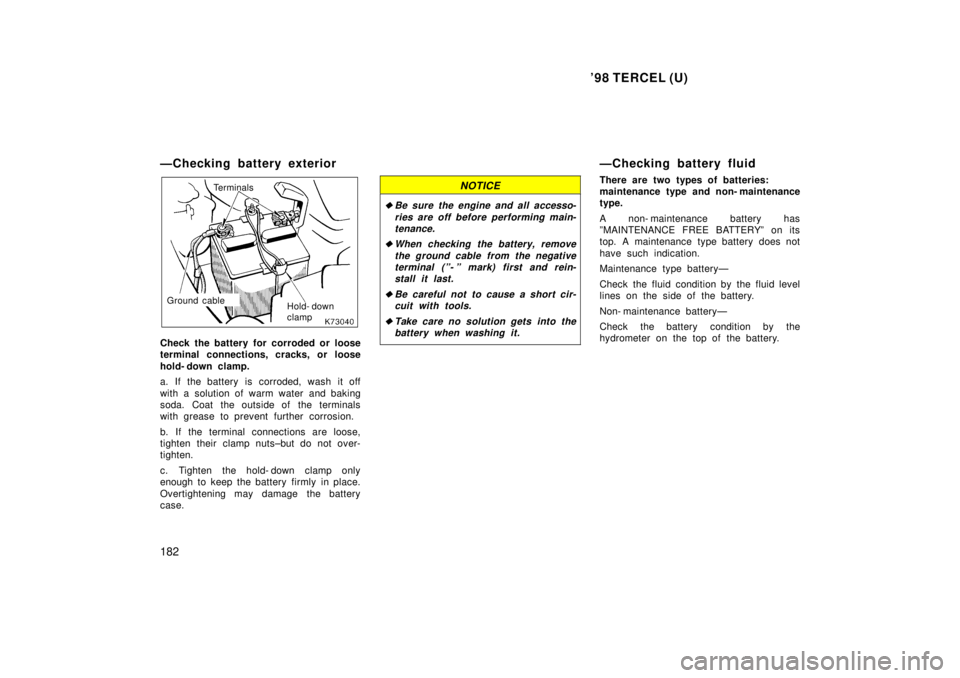
ÐChecking battery exterior
Terminals
Hold- down
clamp
Ground cable
Check the battery for corroded or loose
terminal connections, cracks, or loose
hold- down clamp.
a. If the battery is corroded, wash it off
with a solution of warm water and baking
soda. Coat the outside of the terminals
with grease to prevent further corrosion.
b. If the terminal connections are loose,
tighten their clamp nuts±but do not over-
tighten.
c. Tighten the hold- down clamp only
enough to keep the battery firmly in place.
Overtightening may damage the battery
case.
NOTICE
Be sure the engine and all accesso- ries are off before performing main-tenance.
When checking the battery, remove
the ground cable from the negativeterminal (º- º mark) first and rein-stall it last.
Be careful not to cause a short cir- cuit with tools.
Take care no solution gets into thebattery when washing it.
ÐChecking battery fluid
There are two types of batteries:
maintenance type and non- maintenance
type.
A non- maintenance battery has
ºMAINTENANCE FREE BATTERYº on its
top. A maintenance type battery does not
have such indication.
Maintenance type batteryÐ
Check the fluid condition by the fluid level
lines on the side of the battery.
Non- maintenance batteryÐ
Check the battery condition by the
hydrometer on the top of the battery.
Page 180 of 194

'98 TERCEL (U)
184
NOTICE
Do not overfill the cells. Excess elec- trolyte could squirt out of the batteryduring heavy charging, causing corro-sion or damage.
Battery recharging precautions
During recharging, the battery is pro-
ducing hydrogen gas.
Therefore, before recharging:
1. Maintenance type batteriesÐRemove the vent plugs.
2. If recharging with the battery installed on the vehicle, be sure to disconnect
the ground cable.
3. Be sure the power switch on the re- charger is off when connecting the
charger cables to the battery and when
disconnecting them.
CAUTION
Always charge the battery in an un-
confined area. Do not charge the
battery in a garage or closed room
where there is not sufficient ventila-
tion.
Non- maintenance batteries: Only do
a slow charge (5A or less). Charg-
ing at a quicker rate is dangerous.
The battery may explode, causing
personal injuries.
Maintenance type batteries: Be sure
to remove the vent plugs before re-
charging.
NOTICE
Never recharge the battery while the
engine is running. Also, be sure allaccessories are turned off.
Page 182 of 194

'98 TERCEL (U)
186
If the new fuse immediately blows out,
there is a problem with the electrical sys-
tem. Have your Toyota dealer correct it as
soon as possible.
CAUTION
Never use a fuse with a higher am-
perage rating, or any other object, in
place of a fuse. This may cause ex-
tensive damage and possibly a fire.
Adding washer fluid
If any washer does not work, the wash-
er tank may be empty. Add washer
fluid.
You may use plain water as washer fluid.
However, in cold areas where tempera-
tures range below freezing point, use
washer fluid containing antifreeze. This
product is available at your Toyota dealer
and most auto parts stores. Follow the
manufacturer 's directions for how much to
mix with water.
NOTICE
Do not use engine antifreeze or any
other substitute because it may dam-age your vehicle's paint.
Replacing light bulbsÐ
The following illustrations show how to
gain access to the bulbs. When replacing
a bulb, make sure the ignition switch and
light switch are off. Use bulbs with the
wattage ratings given in the table.
CAUTION
Halogen bulbs have pressurized gas
inside and require special handling.
They can burst or shatter if scratched
or dropped. Hold a bulb only by its
plastic or metal case. Do not touch
the glass part of a bulb with barehands.
NOTICE
Only use a bulb of the listed type.
Page 187 of 194
'98 TERCEL (U)191
Part 8
SPECIFICATIONS
Dimensions and weight
Engine
Fuel
Service specifications
Ti r es
Fuses
Dimensions and weight
Overall length mm (in.) 4130 (162.6)
Overall width mm (in.) 1660 ( 65.4)
Overall height mm (in.) 1375 ( 54.1)
*
Wheelbase mm (in.) 2380 ( 93.7)
Front tread mm (in.) 1400 ( 55.1)
Rear tread mm (in.) 1395 ( 54.9)
Vehicle capacity weight
(occupants + luggage) kg (lb.) 352 (775)
* : Unladen vehicle Engine
Model:
5E- FE
Type: 4 cylinder in line, 4 cycle, gasoline
Bore and stroke, mm (in.): 74.0 y 87.0 (2.91 y 3.43)
Displacement, cm 3
(cu. in.):
1497 (91.3)
Page 188 of 194

'98 TERCEL (U)
192
Fuel
Fuel type:
Unleaded gasoline, Octane Rating 87
(Research Octane Number 91) or higher
Fuel tank capacity, L (gal., Imp. gal.): 45 (11.9, 9.9) Service specifications
ENGINE
Valve clearance (engine cold), mm (in.):
Intake 0.15Ð0.25 (0.006Ð0.010)
Exhaust 0.31Ð0.41 (0.012Ð0.016)
Spark plug type: DENSO K16TR11
NGK BKR5EKB11
Spark plug gap, mm (in.): 1.1 (0.043)
Drive belt tension measured with Borroughs
drive belt tension gauge No.BT- 33- 73F
(used belt), Ibf: 100 20
ENGINE LUBRICATION
Oil capacity (drain and refill), L (qt., Imp. qt.):
With filter 2.8 (3.0, 2.5)
Without filter 2.6 (2.7, 2.3)
Oil grade: API grade SH, ºEnergy-Conserving IIº or
SJ, Energy- Conservingº multigrade en-
gine oil or ILSAC multigrade engine oil
is recommended. Recommended oil viscosity (SAE):
COOLING SYSTEM
Total capacity, L (qt., Imp. qt.):
Automatic transmission Vehiecles sold in Puerto Rico
4.8 (5.1, 4.2)
Vehiecles sold outside Puerto Rico 5.3 (5.6, 4.7)
Manual transmission 4.9 (5.2, 4.3)
Coolant type: With ethylene- glycol antifreeze
(Do not use alcohol type.)
Page 189 of 194

'98 TERCEL (U)193
BATTERY �
Maintenance type battery
Specific gravity reading at 20 C(68 F):
1.250Ð1.290 Fully charged
1.160Ð1.200 Half charged
1.060Ð1.100 Discharged
�Non−maintenance battery Open voltage *
at 20 C (68 F):
12.6 VÐ12.8 V Fully charged
12.2 VÐ12.4 V Half charged
11.8 VÐ12.0 V Discharged
* : Voltage that is checked 20 minutes after
the key is removed with all the lights
turned off
Charging rates: Non−maintenance battery 5 A max .
Maintenance type battery
Quick charge 15 A max.
Slow charge 5 A max.
CLUTCH
Pedal freeplay, mm (in.): 5Ð15 (0.2Ð0.6)
Fluid type: SAE J1703 or FMVSS No.116 DOT 3 MANUAL TRANSAXLE
Oil capacity, L (qt., Imp. qt.):
1.9 (2.0, 1.7)
Oil type: Gear oil API GL- 4 or GL- 5
Recommended oil viscosity: SAE 75W- 90
AUTOMATIC TRANSAXLE
3- speed type automatic transmission Automatic transmission Fluid capacity (drain and ref ill),
L (qt., Imp. qt.):
Up to 2.5 (2.6, 2.2)
Diffarencial Fluid capacity, L (qt., Imp. qt.): 1.4 (1.5, 1.2)
4- speed type automatic transmission Fluid capacity (drain and ref ill),
L (qt., Imp. qt.): Up to 3.1 (3.3, 2.7)
Fluid type: Automatic transmission fluid D- II or DEXRON III (DEXRON II) BRAKES
Minimum pedal clearance when depressed
with the pressure of 490 N (50 kgf, 110 lbf)
with the engine running, mm (in.):
With anti- lock brake system 55 (2.2)
Without anti- lock brake system
60 (2.4)
Pedal freeplay, mm (in.): 1Ð6 (0.04Ð0.24)
Pad wear limit, in. (mm): 1.0 (0.04)
Lining wear limit, in. (mm): 1.0 (0.04)
Parking brake adjustment when pulled with
the force of 196 N (20 kgf, 44 lbf): 5Ð8 clicks
Fluid type: SAE J1703 or FMVSS No.116 DOT 3
STEERING
Wheel freeplay: Less than 30 mm (1.2 in.)
Power steering fluid type: Automatic transmission fluid DEXRON II or III
