Page 28 of 191
SUPRA (U)
28
Do not allow the child to stand up or
kneel on either rear or front seats. An
unrestrained child could suffer serious in-
jury or death during emergency braking or
a collision. Also, do not let the child sit
on your lap. It does not provide sufficient
restraint.
Pregnant woman.
Toyota recommends the
use of a seat belt. Ask your doctor for
specific recommendations. The lap belt
should be worn securely and as low as
possible over the hips and not on the
waist.
Injured person. Toyota recommends the
use of a seat belt. Depending on the inju-
ry, first check with your doctor for specific
recommendations.
CAUTION
Persons should ride in their seats
properly wearing their seat belts
whenever the vehicle is moving.
Otherwise, they are much more likely
to suffer serious bodily injury or
death in the event of sudden braking
or a collision.
When using the seat belts, observe
the following:
Use the belt for only one person at
a time. Do not use a single belt for
two or more peopleÐeven children.
Avoid reclining the seatbacks too
much. The seat belts provide maxi-
mum protection when the seatbacks
are in the upright position. (Refer
to the seat adjustment instructions.)
Be careful not to damage the belt
webbing or hardware. Take care that
they do not get caught or pinched
in the seat or doors.
Inspect the belt system periodically.
Check for cuts, fraying, and loose
parts. Damaged parts should be re-
placed. Do not disassemble or
modify the system.
Keep the belts clean and dry. If
they need cleaning, use a mild soap
solution or lukewarm water. Never
use bleach, dye, or abrasive clean-
ersÐthey may severely weaken the
belts.
Replace the belt assembly (includ-
ing bolts) if it has been used in a
severe impact. The entire assembly
should be replaced even if damage
is not obvious.
ÐSeat belts
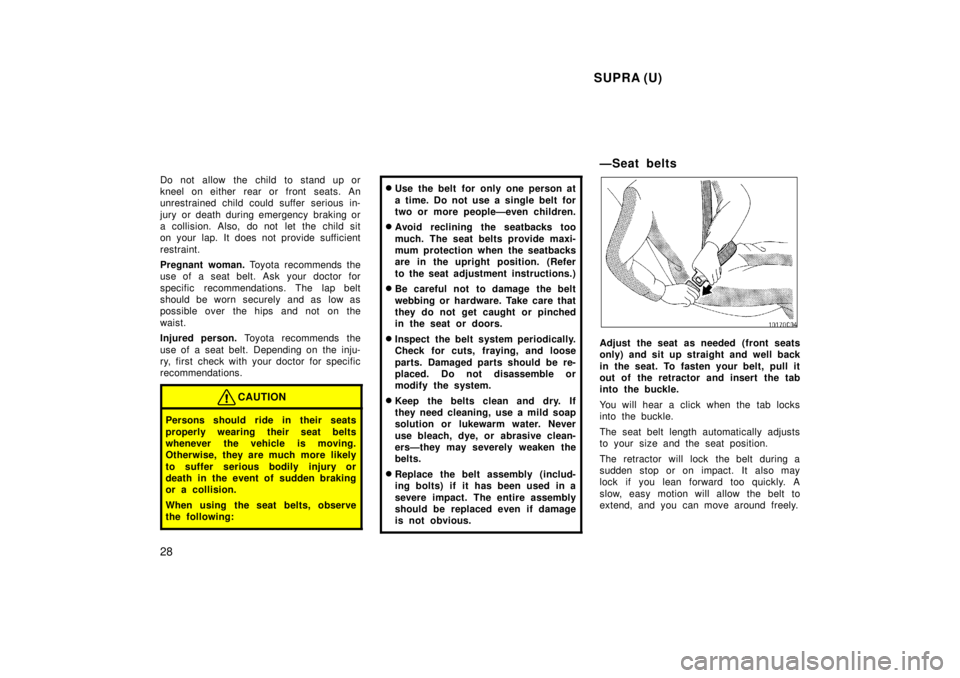
Adjust the seat as needed (front seats
only) and sit up straight and well back
in the seat. To fasten your belt, pull it
out of the retractor and insert the tab
into the buckle.
You will hear a click when the tab locks
into the buckle.
The seat belt length automatically adjusts
to your size and the seat position.
The retractor will lock the belt during a
sudden stop or on impact. It also may
lock if you lean forward too quickly. A
slow, easy motion will allow the belt to
extend, and you can move around freely.
Page 30 of 191
SUPRA (U)
30
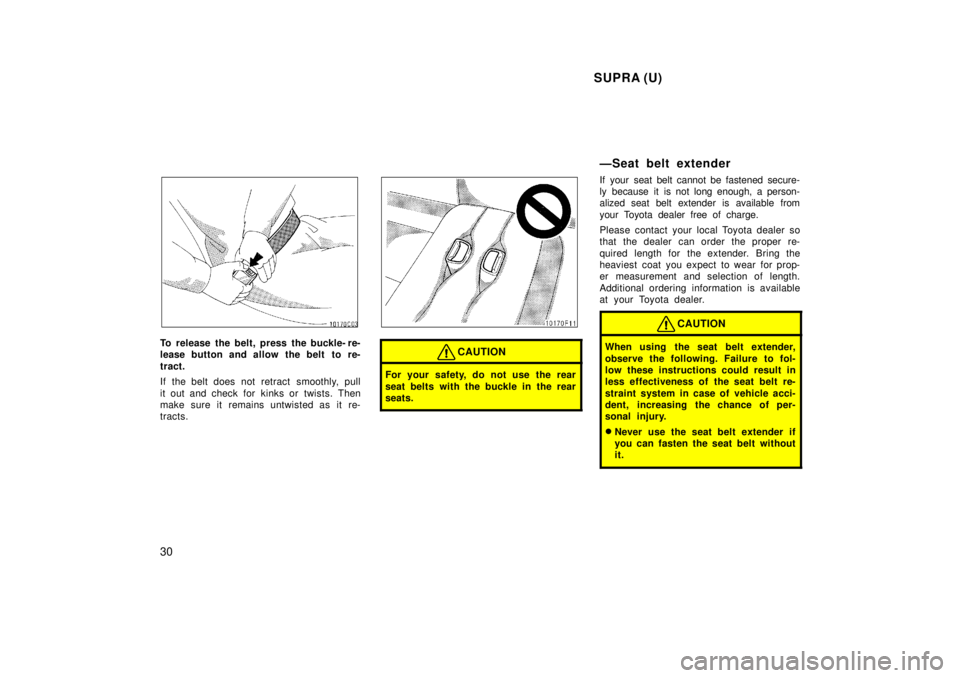
To release the belt, press the buckle- re-
lease button and allow the belt to re-
tract.
If the belt does not retract smoothly, pull
it out and check for kinks or twists. Then
make sure it remains untwisted as it re-
tracts.CAUTION
For your safety, do not use the rear
seat belts with the buckle in the rear
seats.
ÐSeat belt extender
If your seat belt cannot be fastened secure-
ly because it is not long enough, a person-
alized seat belt extender is available from
your Toyota dealer free of charge.
Please contact your local Toyota dealer so
that the dealer can order the proper re-
quired length for the extender. Bring the
heaviest coat you expect to wear for prop-
er measurement and selection of length.
Additional ordering information is available
at your Toyota dealer.
CAUTION
When using the seat belt extender,
observe the following. Failure to fol-
low these instructions could result in
less effectiveness of the seat belt re-
straint system in case of vehicle acci-
dent, increasing the chance of per-
sonal injury. Never use the seat belt extender if
you can fasten the seat belt withoutit.
Page 123 of 191

SUPRA (U)123
Trailer towing
Toyota does not recommend towing a trail-
er with your Supra. It is not designed for
trailer towing.
Getting more kilometers/mileage from a
liter/gallon of fuel is easyÐjust take it
easy. It will help make your vehicle last
longer, too. Here are some specific tips
on how to save money on both fuel and
repairs:
Keep your tires inflated at the cor-
rect pressure. Underinflation causes
tire wear and wastes fuel. See Chapter
7- 2 for instructions.
Do not carry unneeded weight in
your vehicle. Excess weight puts a
heavier load on the engine, causing
greater fuel consumption.
Avoid lengthy warm- up idling. Once
the engine is running smoothly, begin
drivingÐbut gently. Remember, howev-
er, that on cold winter days this may
take a little longer.
Accelerate slowly and smoothly.
Avoid jackrabbit starts. Get into high
gear as quickly as possible.
Avoid long engine idling. If you have
a long wait and you are not in traffic,
it is better to turn off the engine and
start again later.
Avoid engine lug or overrevving. Use
a gear position suitable for the road on
which you are travelling.
Avoid continuous speeding up and
slowing down. Stop- and- go driving
wastes fuel.
Avoid unnecessary stopping and
braking. Maintain a steady pace. Try
to time the traffic signals so you only
need to stop as little as possible or
take advantage of through streets to
avoid traffic lights. Keep a proper dis-
tance from other vehicles to avoid sud-
den braking. This will also reduce wear
on your brakes.
Avoid heavy traffic or traffic jams
whenever possible.
Do not rest your foot on the clutch
or brake pedal. This causes needless
wear, overheating and poor fuel econo-
my.
Maintain a moderate speed on high-ways. The faster you drive, the greater
the fuel consumption. By reducing your
speed, you will cut down on fuel con-
sumption.
Keep the front wheels in proper
alignment. Avoid hitting the curb and
slow down on rough roads. Improper
alignment not only causes faster tire
wear but also puts an extra load on
the engine, which, in turn, wastes fuel.
How to save fuel and make
your vehicle last longer, too
Page 184 of 191
SUPRA (U)185
Part 8
SPECIFICATIONS
Dimensions and weight
Engine
Fuel
Service specifications
Ti r es
Fuses
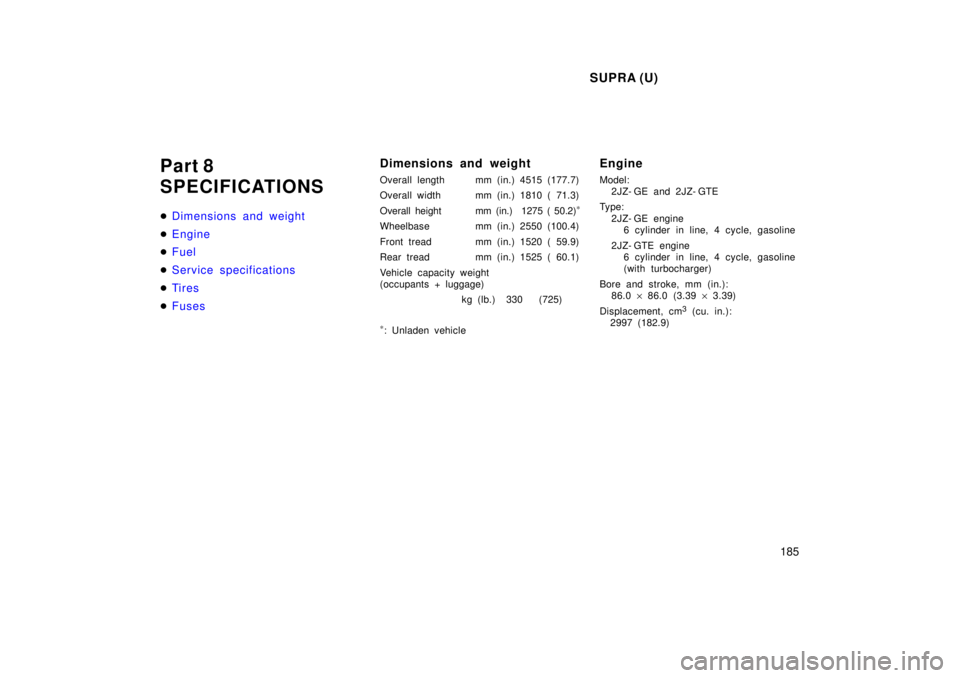
Dimensions and weight
Overall length mm (in.) 4515 (177.7)
Overall width mm (in.) 1810 ( 71.3)
Overall height mm (in.) 1275 ( 50.2)
*
Wheelbase mm (in.) 2550 (100.4)
Front tread mm (in.) 1520 ( 59.9)
Rear tread mm (in.) 1525 ( 60.1)
Vehicle capacity weight
(occupants + luggage) kg (lb.) 330 (725)
* : Unladen vehicle Engine
Model:
2JZ- GE and 2JZ- GTE
Type:
2JZ- GE engine
6 cylinder in line, 4 cycle, gasoline
2JZ- GTE engine
6 cylinder in line, 4 cycle, gasoline
(with turbocharger)
Bore and stroke, mm (in.):
86.0
y 86.0 (3.39 y 3.39)
Displacement, cm 3
(cu. in.):
2997 (182.9)