1998 TOYOTA RAV4 brake
[x] Cancel search: brakePage 2 of 227

'98 Rav4U
2
Instrument panel overview
1. Side vents
2. Instrument cluster
3. Center vents
4. Electric moon roof switch and personallights
5. Glovebox
6. Power door lock switches
7. Power window switches
8. Parking brake lever
9. Automatic transmission selector lever or manual transmission gear shift lever
10. Ashtray 11. Hood lock release lever
Page 5 of 227

'98 Rav4.U5
Indicator symbols on the instrument panel
Brake system warning light
*
1
Discharge warning light *
1
Low oil pressure warning light *
1
Malfunction indicator lamp *
1
Headlight high beam indicator light
SRS airbag warning light
*
1
Turn signal indicator lights
Seat belt reminder light *
1
Open door warning light*
1
Low fuel level warning light *
1 Automatic transmission fluid temperature
warning light
*
1
Anti-lock brake system warning light *
1
(type A)
(type B)
(type A)
(type B)
(type A) (type B)
Low windshield washer fluid level
warning light *
1
Page 55 of 227

'98 Rav4.U55
ÐChild restraint system
A child restraint system for a small
child or baby must itself be properly
restrained on the seat with either the
lap belt or the lap portion of the lap/
shoulder belt. You must carefully con-
sult the manufacturer 's instructions
which accompany your child restraint
system.
To provide proper restraint, use a child
restraint system following the manufactur-
er 's instructions about the appropriate age
and size of the child for the child restraint
system.
Install the child restraint system correctly
following the instructions provided by its
manufacturer of the system. General
directions are also provided under the fol-
lowing illustrations.
The child restraint system should be
installed on the rear seat. According to
accident statistics, the child is safer when
properly restrained in the rear seat than
in the front seat.
CAUTION
Never put a rear- facing child re-
straint system on the front seat. In
the event of an accident, the force
of the rapid inflation of the airbag
can cause death or serious injury if
a rear- facing child restraint system
is put on the front seat.
Unless it is unavoidable, do not put
a forward- facing child restraint sys-
tem on the front seat.
A forward- facing child restraint sys-
tem should be allowed to put on
the front seat only when it is un-
avoidable. Always move the seat as
far back as possible, because the
force of a deploying airbag could
cause death or serious injury to the
child.
After installing the child restraint
system, make sure it is secured in
place following the manufacturer 's
instructions. If it is not restrained
securely, it may cause death or se-
rious injury to the child in the
event of a sudden stop or accident.
When not using the child restraint system,
keep it secured with the seat belt or place
it somewhere other than the passenger
compartment. This will prevent it from in-
juring passengers in the event of a sud-
den stop or accident.
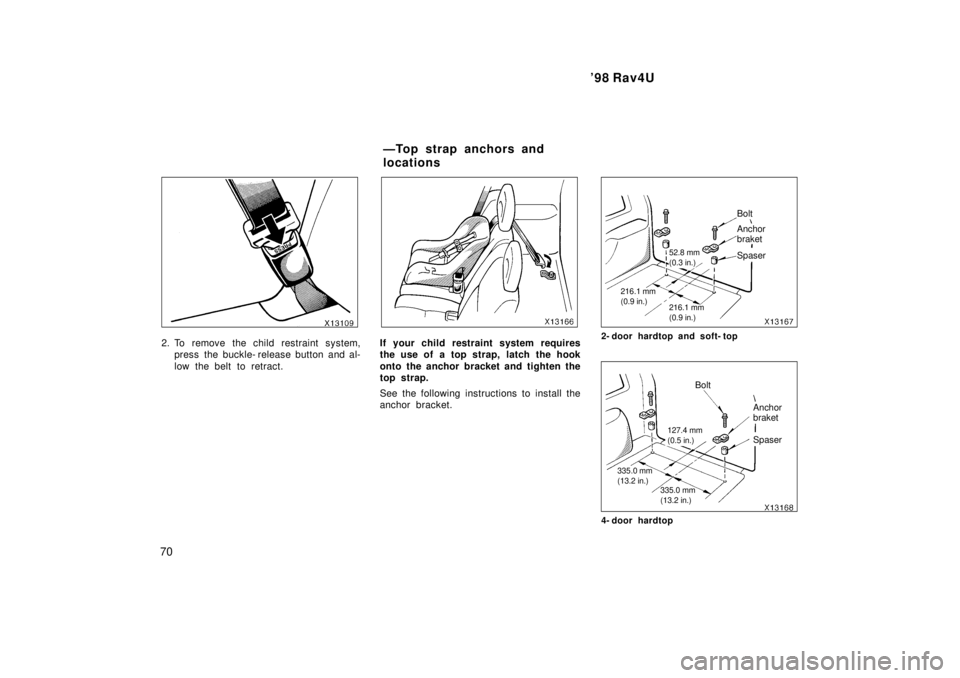
Your vehicle has anchors for securing the
top strap of a child restraint system. The
anchor nuts are welded beneath the sheet
metal to permit installation of an anchor
bracket for a child restraint system.
To install an anchor bracket, use an 8 mm
X 30 mm X 1.25 mm coarse thread metric
bolt and a 10 mm (0.4 in.) spacer. Note
that the bolts accompanying many child
restraint systems are not metric. You can
damage the anchor nuts on your vehicle
if you force bolts with different thread into
the anchor nuts.
For instructions about how to install the
anchor braket, see ºTop strap anchors and
locationsº.
If your child restraint system does not
provide any of the necessary parts, you
can purchase the following items from
your Toyota dealer.
* CRS installation kit
(Part No. 04731- 22012) Ðcontains 1
bolt, 3 types of spacers and 1 locking
clip.
Page 70 of 227
'98 Rav4U
70
2. To remove the child restraint system, press the buckle- release button and al-
low the belt to retract.If your child restraint system requires
the use of a top strap, latch the hook
onto the anchor bracket and tighten the
top strap.
See the following instructions to install the
anchor bracket.
Bolt
216.1 mm (0.9 in.)
Anchor braket
Spaser52.8 mm (0.3 in.)
216.1 mm (0.9 in.)
2- door hardtop and soft- top
Bolt
Anchor braket Spaser
335.0 mm (13.2 in.) 335.0 mm(13.2 in.)
127.4 mm (0.5 in.)
4- door hardtop
ÐTop strap anchors and
locations
Page 78 of 227

'98 Rav4U
78
Headlights and turn signals
HEADLIGHTS
To turn on the following lights: Twist
the headlight/turn signal lever knob.
Position 1ÐParking, tail, license plate,
side marker and instrument panel lights
Position 2ÐHeadlights and all of the
above
If you remove the key with the headlights
left on, a buzzer reminds you to turn the
lights off when you open the driver 's door.
NOTICE
To prevent the battery from being dis-
charged, do not leave the lights onfor a long period when the engine is not running.
Daytime running light system (Canada
only)
The headlights turn on when the parking
brake is released with the engine started,
even with the light switch in the ºOFFº
position. They will not go off until the
ignition switch is turned off.
To turn on the other exterior lights and
instrument panel lights, twist the knob to
the position 1.
Under the daytime running light system,
the headlights turn on at reduced intensity.
Twist the knob to the position 2 to turn
to full intensity for driving at night.
High- Low beams ÐFor high beams, turn
the headlights on and push the lever away
from you (position 1). Pull the lever to-
ward you (position 2) for low beams.
The headlight high beam indicator light
(blue light) on the instrument panel will
tell you that the high beams are on.
Flashing the high beam headlights
(position 3)ÐPull the lever all the way
back. The high beam headlights turn off
when you release the lever.
You can flash the high beam headlights
with the knob turned to ºOFFº.
Page 86 of 227

'98 Rav4U
86
Odometer and two trip meters
This meter displays the odometer and
two trip meters.
1. OdometerÐIt shows the total distance the vehicle has been driven.
2. Two trip metersÐThey show two differ- ent distances independently driven
since the last time each trip meter was
set to zero.
You can use one trip meter to calculate
the fuel economy and the other to
measure the distance on each trip. All
trip meter data is cancelled if the elec-
trical power source is disconnected. 3. Trip meter reset knobÐIt can reset the
two trip meters to zero, and also
change the meter display.
To change the meter display, quickly
push and release the knob. The meter
display changes in the order from the
odometer to trip meter A to trip meter
B, then back to the odometer each
time you push.
To reset the trip meter A to zero, dis-
play the meter A reading, then push
and hold the knob until the meter is
set to zero. The same process can be
applied for resetting the trip meter B. (a) If parking brake
is off, stop and
check.
(b) Fasten seat belts.
If the indicator or Do this.
buzzer comes on...
(c) Stop and check. (Indicator and buzzer)
(d) Stop and check. (type A)
(type B)
Service reminder indicators
and warning buzzers
Page 87 of 227

'98 Rav4.U87
(g) Take vehicle to
Toyota dealer.
If the indicator or Do this.
buzzer comes on...
(type A)
(type B)
(f) Fill up tank.
(e) Take vehicle to
Toyota dealer.
(type A)
(type B)
(m) Remove key. (i) Stop and check.
(j) Take vehicle to
Toyota dealer
immediately.
(l) Turn off light. Light reminder
buzzer
Key reminder
buzzer
If the indicator or Do this.
buzzer comes on...
(h) Close all side doors, back door
(hardtop) and
tail gate (soft- top).
(k) Add washer fluid. (a) Brake System Warning Light
This light has the following functions:
Parking brake reminder
If this light is on, make sure the parking
brake is fully released. The light should
go off.
Low brake fluid level warning
If this light comes on and stays on while
you are driving, slowdown and pull off the
road. Then stop the vehicle carefully. Re-
member that stopping distance and pedal
effort may be increased. There maybe a
problem somewhere in the brake system.
Check the fluid level of the see- through
reservoir.
To make sure the parking brake has not
caused the warning light to come on,
check to see that the parking brake is
fully released.
If the brake fluid level is low...
At a safe place, test your brakes by start-
ing and stopping.
If you judge that the brakes still work
adequately, drive cautiously to your
nearest dealer or shop for repairs.
If the brakes are not working, have the
vehicle towed in for repairs. (For tow-
ing information, see Part 4.)
Page 88 of 227

'98 Rav4U
88
CAUTION
It is dangerous to continue driving
normally when the brake fluid level is
low.
If the brake fluid level is correct...
Have the warning system checked by your
Toyota dealer.
(b) Seat Belt Reminder Light and Buzz- er
The light and buzzer remind you to buckle
up the driver 's seat belt.
Once the ignition key is turned to ºONº or
ºSTARTº, the reminder light flashes and
buzzer sounds if the driver 's seat belt is
not pulled out. Unless the driver starts to
pull the shoulder belt out of the retractor,
the light keeps flashing and the buzzer
stops after about 4 to 8 seconds.
(c) Discharge Warning Light
This light warns that the battery is being
discharged.
If it comes on while you are driving, there
is a problem somewhere in the charging
system. The engine ignition will continue to oper-
ate, however, until the battery is dis-
charged. Turn off the air conditioning,
blower, radio,etc., and drive directly to the
nearest Toyota dealer or repair shop.
NOTICE
Do not continue driving if the engine
drive belt is broken or loose.
(d) Low Oil Pressure Warning Light
This light warns that the engine oil pres-
sure is too low.
If it flickers or stays on while you are
driving, pull off the road to a safe place
and stop the engine immediately. Call a
Toyota dealer or qualified repair shop for
assistance.
The light may occasionally flicker when
the engine is idling or it may come on
briefly after a hard stop. There is no
cause for concern if it then goes out when
the engine is accelerated slightly.
The light may come on when the oil level
is extremely low. It is not designed to
indicate low oil level, and the oil level
must be checked using the level dipstick.
NOTICE
Do not drive the vehicle with thewarning light onÐeven for one block.It may ruin the engine.
(e) Malfunction Indicator Lamp
This lamp comes on in the following
cases.
a. The fuel tank is completely empty. (See
ºFuel gaugeº in Chapter 1- 5 for instruc-
tions.)
b. The fuel tank cap is not tightened se-
curely. (See ºFuel tank capº in Chapter
1- 2 for instructions.)
c. There is a problem somewhere in your
engine or automatic transmission electrical
system.
If it comes on while you are driving in
case c, have your vehicle checked/re-
paired by your Toyota dealer as soon as
possible.