1998 COROLLA(U)
145
CAUTION
�Do not exceed 72 km/h (45 mph) or
the posted towing speed lim-
it,whichever is lower. Because insta-
bility (swaying) of a towing vehicle−
trailer combination usually in-
creases as the speed increases, ex-
ceeding 72 km/h (45 mph) may
cause loss of control.
�Slow down and downshift before
descending steep or long downhill
grades. Do not make sudden down-
shifts.
�Avoid holding the brake pedal down
too long or too frequently. This
could cause the brakes to overheat
and result in reduced braking effi-
ciency.
Getting more kilometers/mileage from a
liter/gallon of fuel is easy–just take it
easy. It will help make your vehicle last
longer, too. Here are some specific tips
on how to save money on both fuel and
repairs:
�Keep your tires inflated at the cor-
rect pressure. Underinflation causes
tire wear and wastes fuel. See Chapter
7−2 for instructions.
�Do not carry unneeded weight in
your vehicle. Excess weight puts a
heavier load on the engine, causing
greater fuel consumption.
�Avoid lengthy warm−up idling. Once
the engine is running smoothly, begin
driving—but gently. Remember, howev-
er, that on cold winter days this may
take a little longer.
�Accelerate slowly and smoothly.
Avoid jackrabbit starts. Get into high
gear as quickly as possible.
�Avoid long engine idling. If you have
a long wait and you are not in traffic,
it is better to turn off the engine and
start again later.
�Avoid engine lug or overrevving. Use
a gear position suitable for the road on
which you are travelling.
�Avoid continuous speeding up and
slowing down. Stop−and−go driving
wastes fuel.
�Avoid unnecessary stopping and
braking. Maintain a steady pace. Try
to time the traffic signals so you only
need to stop as little as possible or
take advantage of through streets to
avoid traffic lights. Keep a proper dis-
tance from other vehicles to avoid sud-
den braking. This will also reduce wear
on your brakes.
�Avoid heavy traffic or traffic jams
whenever possible.
�Do not rest your foot on the clutch
or brake pedal. This causes needless
wear, overheating and poor fuel econo-
my.
�Maintain a moderate speed on high-
ways. The faster you drive,the greater
the fuel consumption. By reducing your
speed, you will cut down on fuel con-
sumption.
�Keep the front wheels in proper
alignment. Avoid hitting the curb and
slow down on rough roads. Improper
alignment not only causes faster tire
wear but also puts an extra load on
the engine, which, in turn, wastes fuel.
How to save fuel and make
your vehicle last longer, too
ProCarManuals.com
1998 COROLLA(U)
189
CAUTION
�Do not mix radial, bias belted, or
bias−ply tires on your vehicle. It
can cause dangerous handling char-
acteristics, resulting in loss of con-
trol.
�Do not use tires or wheels other
than the manufacturer ’s recom-
mended size.
Toyota recommends all four tires, or at
least both of the front or rear tires be
replaced at a time as a set.
See ”If you have a flat tire” in Part 4 for
tire change procedure.
When a tire is replaced, the wheel
should always be balanced.
An unbalanced wheel may affect vehicle
handling and tire life. Wheels can get out
of balance with regular use and should
therefore be balanced occasionally.
When replacing a tubeless tire, the air
valve should also be replaced with a
new one.
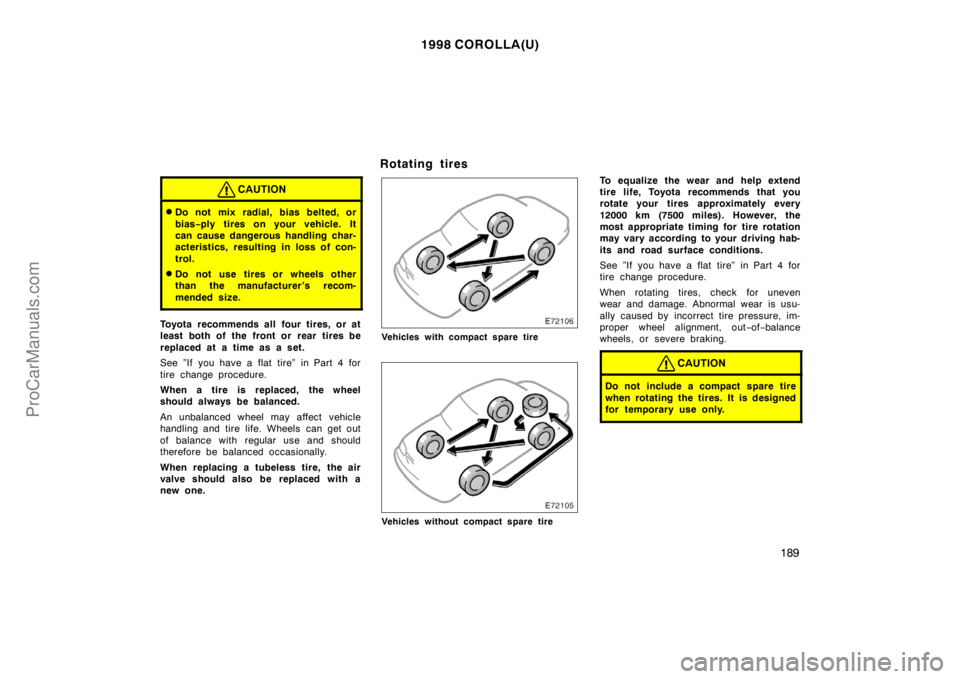
Rotating tires
Vehicles with compact spare tire
Vehicles without compact spare tire
To equalize the wear and help extend
tire life, Toyota recommends that you
rotate your tires approximately every
12000 km (7500 miles). However, the
most appropriate timing for tire rotation
may vary according to your driving hab-
its and road surface conditions.
See ”If you have a flat tire” in Part 4 for
tire change procedure.
When rotating tires, check for uneven
wear and damage. Abnormal wear is usu-
ally caused by incorrect tire pressure, im-
proper wheel alignment, out−of−balance
wheels, or severe braking.
CAUTION
Do not include a compact spare tire
when rotating the tires. It is designed
for temporary use only.
ProCarManuals.com