Page 178 of 204
1998 COROLLA(U)
186
To check the fluid level, simply look at
the see−through reservoir. The level
should be between the ”MAX” and
”MIN” lines on the reservoir.
It is normal for the brake fluid level to go
down slightly as the brake pads wear. So
be sure to keep the reservoir filled.
If the reservoir needs frequent refilling, it
may indicate a serious mechanical prob-
lem.
If the level is low, add SAE J1703 or
FMVSS No. 116 DOT 3 brake fluid to
the brake reservoir.
Remove and replace the reservoir cover
by hand.Use only newly opened brake fluid. Once
opened, brake fluid absorbs moisture from
the air, and excess moisture can cause a
dangerous loss of braking.
CAUTION
Take care when filling the reservoir
because brake fluid can harm your
eyes and damage painted surfaces. If
fluid gets in your eyes, flush your
eyes with clean water.
NOTICE
If you spill some of the fluid, be sure
to wash it off with water to prevent
it from damaging the parts or paint.
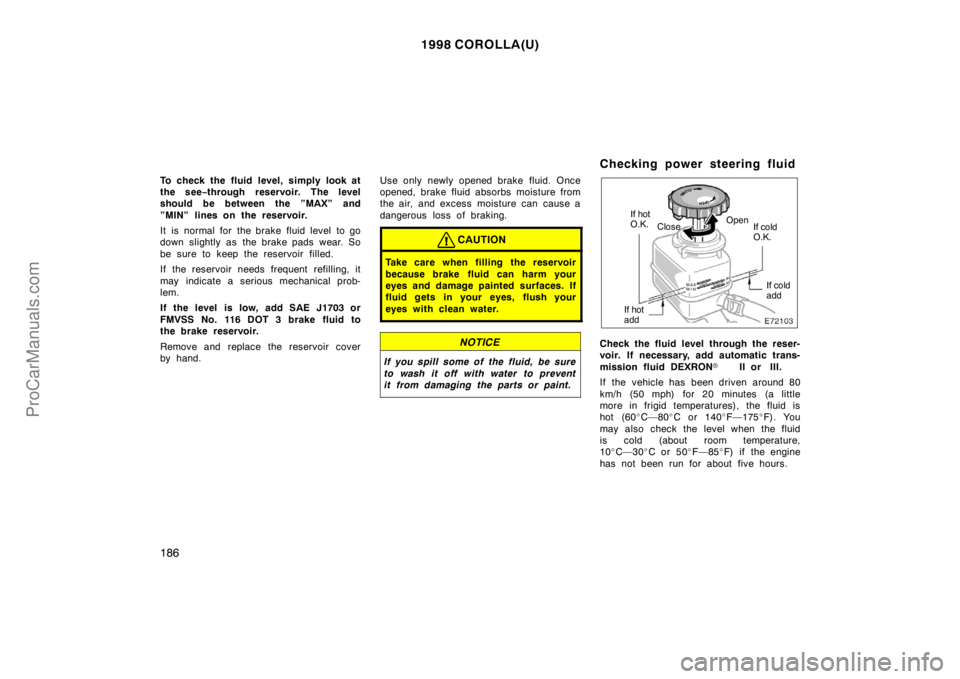
Checking power steering fluid
Close If hot
O.K.
If cold
O.K.
If cold
add
If hot
addOpen
Check the fluid level through the reser-
voir. If necessary, add automatic trans-
mission fluid DEXRON� II or III.
If the vehicle has been driven around 80
km/h (50 mph) for 20 minutes (a little
more in frigid temperatures), the fluid is
hot (60�C—80�C or 140�F—175�F). You
may also check the level when the fluid
is cold (about room temperature,
10�C—30�C or 50�F—85�F) if the engine
has not been run for about five hours.
ProCarManuals.com
Page 186 of 204
1998 COROLLA(U)
194
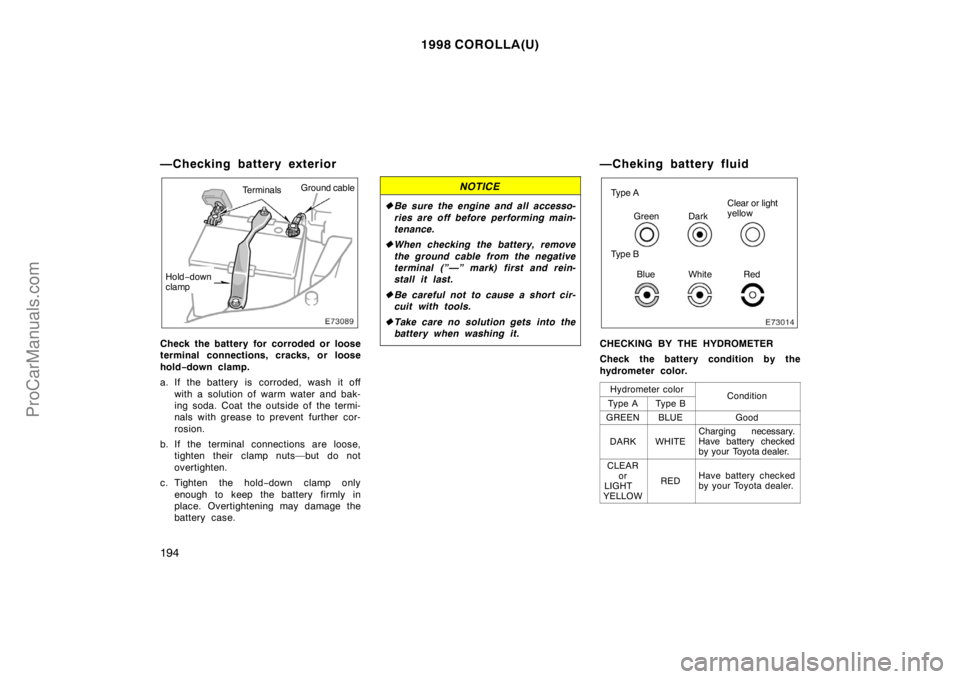
—Checking battery exterior
TerminalsGround cable
Hold−down
clamp
Check the battery for corroded or loose
terminal connections, cracks, or loose
hold−down clamp.
a. If the battery is corroded, wash it off
with a solution of warm water and bak-
ing soda. Coat the outside of the termi-
nals with grease to prevent further cor-
rosion.
b. If the terminal connections are loose,
tighten their clamp nuts—but do not
overtighten.
c. Tighten the hold−down clamp only
enough to keep the battery firmly in
place. Overtightening may damage the
battery case.
NOTICE
�Be sure the engine and all accesso-
ries are off before performing main-
tenance.
�When checking the battery, remove
the ground cable from the negative
terminal (”—” mark) first and rein-
stall it last.
�Be careful not to cause a short cir-
cuit with tools.
�Take care no solution gets into the
battery when washing it.
—Cheking battery fluid
Type A
Type BGreen DarkClear or light
yellow
Blue White Red
CHECKING BY THE HYDROMETER
Check the battery condition by the
hydrometer color.
Hydrometer colorConditionTy p e ATy p e B
GREENBLUEGood
DARKWHITECharging necessary.
Have battery checked
by your Toyota dealer.
CLEAR
or
LIGHT
YELLOW
REDHave battery checked
by your Toyota dealer.
ProCarManuals.com
Page 187 of 204
1998 COROLLA(U)
195
Battery recharging precautions
During recharging, the battery is pro-
ducing hydrogen gas.
Therefore, before recharging:
1. If recharging with the battery installed
on the vehicle, be sure to disconnect
the ground cable.
2. Be sure the power switch on the re-
charger is off when connecting the
charger cables to the battery and when
disconnecting them.
CAUTION
�Always charge the battery in an un-
confined area. Do not charge the
battery in a garage or closed room
where there is not sufficient ventila-
tion.
�Only do a slow charge (5A or less).
Charging at a quicker rate is dan-
gerous. The battery may explode,
causing personal injuries.
NOTICE
Never recharge the battery while the
engine is running. Also, be sure all
accessories are turned off.
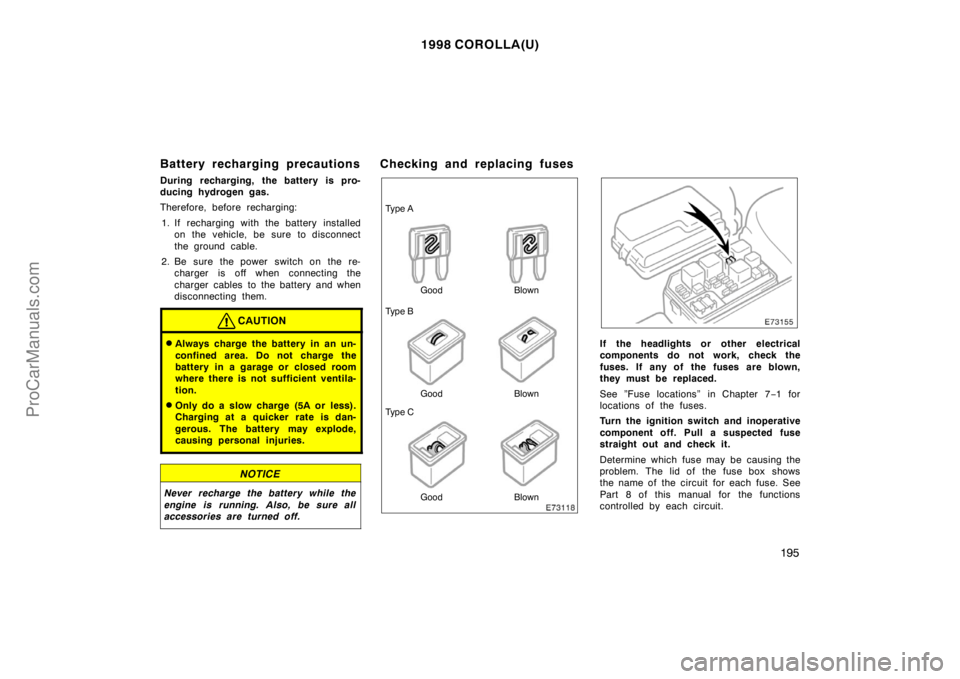
Checking and replacing fuses
Type A
Type C Type BGood Blown
Good Good
Blown Blown
If the headlights or other electrical
components do not work, check the
fuses. If any of the fuses are blown,
they must be replaced.
See ”Fuse locations” in Chapter 7−1 for
locations of the fuses.
Turn the ignition switch and inoperative
component off. Pull a suspected fuse
straight out and check it.
Determine which fuse may be causing the
problem. The lid of the fuse box shows
the name of the circuit for each fuse. See
Part 8 of this manual for the functions
controlled by each circuit.
ProCarManuals.com
Page 188 of 204
1998 COROLLA(U)
196
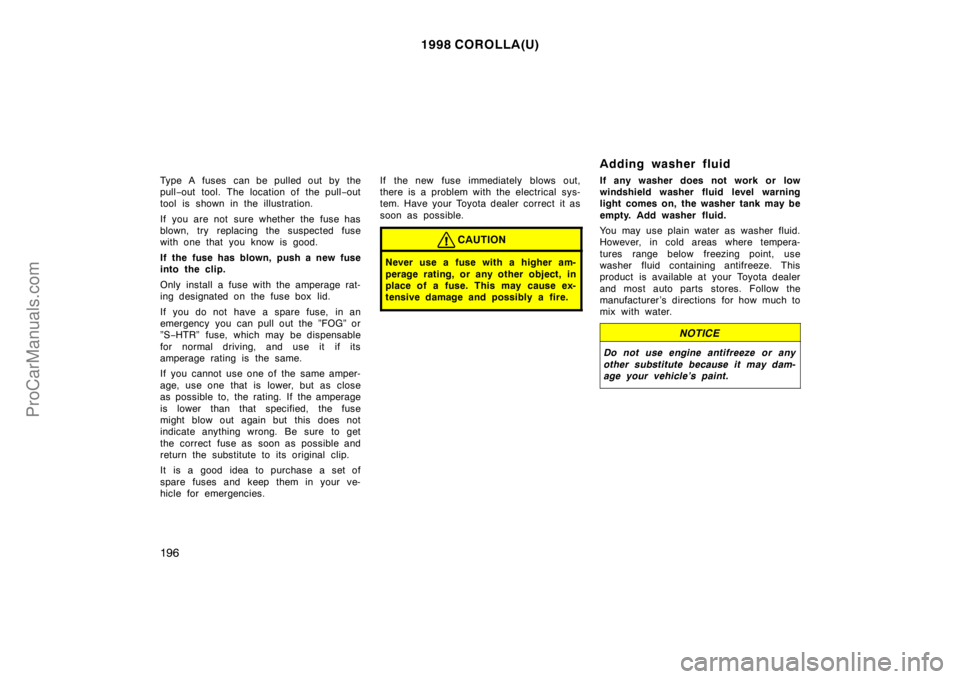
Type A fuses can be pulled out by the
pull−out tool. The location of the pull−out
tool is shown in the illustration.
If you are not sure whether the fuse has
blown, try replacing the suspected fuse
with one that you know is good.
If the fuse has blown, push a new fuse
into the clip.
Only install a fuse with the amperage rat-
ing designated on the fuse box lid.
If you do not have a spare fuse, in an
emergency you can pull out the ”FOG” or
”S−HTR” fuse, which may be dispensable
for normal driving, and use it if its
amperage rating is the same.
If you cannot use one of the same amper-
age, use one that is lower, but as close
as possible to, the rating. If the amperage
is lower than that specified, the fuse
might blow out again but this does not
indicate anything wrong. Be sure to get
the correct fuse as soon as possible and
return the substitute to its original clip.
It is a good idea to purchase a set of
spare fuses and keep them in your ve-
hicle for emergencies.If the new fuse immediately blows out,
there is a problem with the electrical sys-
tem. Have your Toyota dealer correct it as
soon as possible.
CAUTION
Never use a fuse with a higher am-
perage rating, or any other object, in
place of a fuse. This may cause ex-
tensive damage and possibly a fire.
Adding washer fluid
If any washer does not work or low
windshield washer fluid level warning
light comes on, the washer tank may be
empty. Add washer fluid.
You may use plain water as washer fluid.
However, in cold areas where tempera-
tures range below freezing point, use
washer fluid containing antifreeze. This
product is available at your Toyota dealer
and most auto parts stores. Follow the
manufacturer ’s directions for how much to
mix with water.
NOTICE
Do not use engine antifreeze or any
other substitute because it may dam-
age your vehicle’s paint.
ProCarManuals.com
Page 189 of 204

1998 COROLLA(U)
197
Replacing light bulbs—
The following illustrations show how to
gain access to the bulbs. When replacing
a bulb, make sure the ignition switch and
light switch are off. Use bulbs with the
wattage ratings given in the table.
CAUTION
Halogen bulbs have pressurized gas
inside and require special handling.
They can burst or shatter if scratched
or dropped. Hold a bulb only by its
plastic or metal case. Do not touch
the glass part of a bulb with bare
hands.
NOTICE
Only use a bulb of the listed type.
Light bulbsBulb
No.WTy p e
HeadlightsHB260/55A
Parking, front side
marker and front
turn signal lights3157NA27/8C
Rear side marker
lights1943.8C
Rear turn signal
lights315627C
Stop and tail lights315727/8C
Back−up lights92118C
License plate lights1943.8C
High mounted
stoplight—18C
Personal light—10B
Interior light—8D
Trunk light1943.8C
A: HB2 halogen bulbs
B: Single end bulbs
C: Wedge base bulbs
D: Double end bulbs
—Headlights
1. Open the hood.
RIGHT−HAND HEADLIGHT: Remove
the bolts and take out the relay
block.
Put the relay block in the appropriate
place other than on the engine.
NOTICE
Do not place the relay block on the
engine.
ProCarManuals.com
Page 197 of 204
1998 COROLLA(U)
205
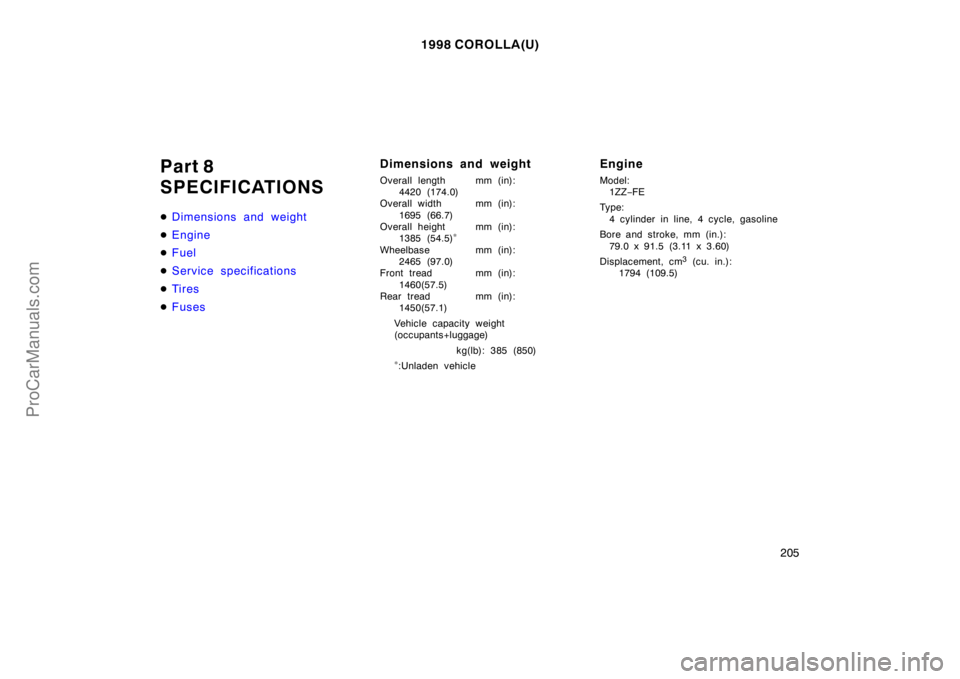
Part 8
SPECIFICATIONS
�Dimensions and weight
�Engine
�Fuel
�Service specifications
�Ti r es
�Fuses
Dimensions and weight
Overall length mm (in):
4420 (174.0)
Overall width mm (in):
1695 (66.7)
Overall height mm (in):
1385 (54.5)
∗
Wheelbase mm (in):
2465 (97.0)
Front tread mm (in):
1460(57.5)
Rear tread mm (in):
1450(57.1)
Vehicle capacity weight
(occupants+luggage)
kg(lb): 385 (850)
∗:Unladen vehicle
Engine
Model:
1ZZ−FE
Type:
4 cylinder in line, 4 cycle, gasoline
Bore and stroke, mm (in.):
79.0 x 91.5 (3.11 x 3.60)
Displacement, cm
3 (cu. in.):
1794 (109.5)
ProCarManuals.com
Page 198 of 204
1998 COROLLA(U)
206
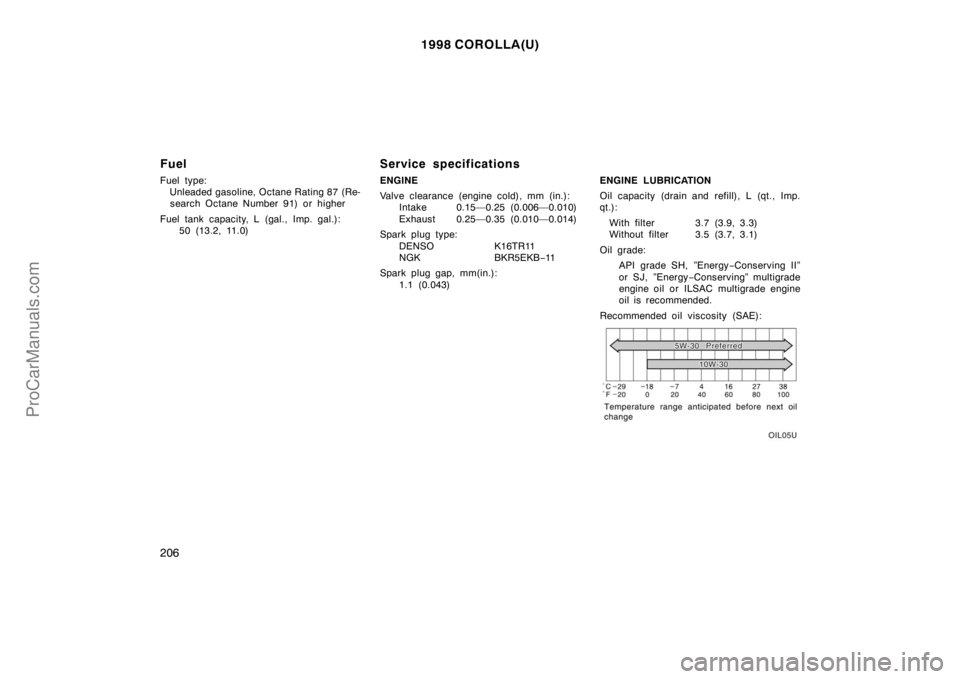
Fuel
Fuel type:
Unleaded gasoline, Octane Rating 87 (Re-
search Octane Number 91) or higher
Fuel tank capacity, L (gal., Imp. gal.):
50 (13.2, 11.0)
Service specifications
ENGINE
Valve clearance (engine cold), mm (in.):
Intake 0.15—0.25 (0.006—0.010)
Exhaust 0.25—0.35 (0.010—0.014)
Spark plug type:
DENSO K16TR11
NGK BKR5EKB−11
Spark plug gap, mm(in.):
1.1 (0.043)ENGINE LUBRICATION
Oil capacity (drain and refill), L (qt., Imp.
qt.):
With filter 3.7 (3.9, 3.3)
Without filter 3.5 (3.7, 3.1)
Oil grade:
API grade SH, ”Energy−Conserving II”
or SJ, ”Energy−Conserving” multigrade
engine oil or ILSAC multigrade engine
oil is recommended.
Recommended oil viscosity (SAE):
ProCarManuals.com
Page 199 of 204

1998 COROLLA(U)
207
COOLING SYSTEM
Total capacity, L (qt., Imp. qt.):
Manual transmission
5.8 (6.1, 5.1)
Automatic transmission
5.7 (6.0, 5.0)
Coolant type:
With ethylene−glycol antifreeze
(Do not use alcohol type.)
BATTERY
Open voltage
∗ at 20�C (68�F):
12.6−12.8 V Fully charged
12.2−12.4 V Half charged
11 . 8−12.0 V Discharged
∗: Voltage that is checked 20 minutes after
the key is removed with all the lights
turned off
Charging rates: 5 A max.
CLUTCH
Pedal freeplay, mm (in.):
5—15 (0.2—0.6)
Fluid type:
SAE J1703 or FMVSS No. 116 DOT 3MANUAL TRANSAXLE
Oil capacity, L (qt., Imp. qt.):
1.9 (2.0, 1.7)
Oil type:
Gear oil API GL−4 or GL−5
Recommended oil viscosity:
SAE 75W−90
AUTOMATIC TRANSAXLE
Automatic transmission
Fluid capacity (drain and refill),
L (qt., Imp. qt.):
Four−speed type
Up to 3.1 (3.3, 2.7)
Three−speed type
2.5 (2.6,2.2)
Fluid type:
Automatic transmission fluid D−ll or
DEXRON�III (DEXRON�II)
Differential (three−speed type only)
Fluid capacity L (qt., Imp. qt.):
1.4 (1.5, 1.2)
Fluid type:
Automatic transmission fluid D−II or
DEXRON�III (DEXRON�II)BRAKES
Minimum pedal clearance when depressed
with the pressure of 490 N (50 kgf, 110 lbf)
with the engine running, mm (in.):
Vehicles with anti−lock brake system
90 (3.5)
Vehicles without anti−lock brake system
85 (3.3)
Pedal freeplay, mm (in.):
1—6 (0.04—0.24)
Pad wear limit, mm (in.):
1.0 (0.04)
Lining wear limit, mm (in.):
1.0 (0.04)
Parking brake adjustment when pulled with
the force of 196 N (20 kgf, 44 lbf):
4—7 clicks
Fluid type:
SAE J1703 or FMVSS No. 116 DOT 3
STEERING
Wheel freeplay:
Less than 30 mm (1.2 in.)
Power steering fluid type:
Automatic transmission fluid DEXRON�II
or III
ProCarManuals.com