Page 175 of 204
1998 COROLLA(U)
183
Part 7
DO−IT−YOURSELF
MAINTENANCE—
Chapter 7−2
Engine and Chassis
�Checking the engine oil level
�Checking the engine coolant
level
�Checking brake fluid
�Checking power steering fluid
�Checking tire pressure
�Checking and replacing tires
�Rotating tires
�Installing snow tires and chains
�Replacing wheels
�Aluminum wheel precautions
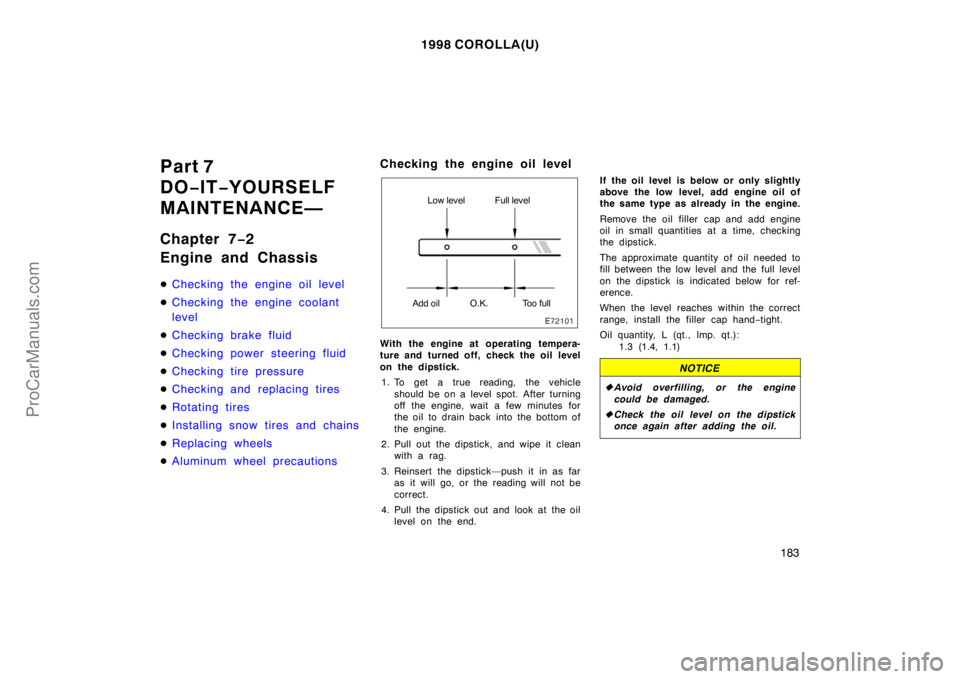
Checking the engine oil level
Low level Full level
Add oilO.K. Too full
With the engine at operating tempera-
ture and turned off, check the oil level
on the dipstick.
1. To get a true reading, the vehicle
should be on a level spot. After turning
off the engine, wait a few minutes for
the oil to drain back into the bottom of
the engine.
2. Pull out the dipstick, and wipe it clean
with a rag.
3. Reinsert the dipstick—push it in as far
as it will go, or the reading will not be
correct.
4. Pull the dipstick out and look at the oil
level on the end.If the oil level is below or only slightly
above the low level, add engine oil of
the same type as already in the engine.
Remove the oil filler cap and add engine
oil in small quantities at a time, checking
the dipstick.
The approximate quantity of oil needed to
fill between the low level and the full level
on the dipstick is indicated below for ref-
erence.
When the level reaches within the correct
range, install the filler cap hand−tight.
Oil quantity, L (qt., lmp. qt.):
1.3 (1.4, 1.1)
NOTICE
�Avoid overfilling, or the engine
could be damaged.
�Check the oil level on the dipstick
once again after adding the oil.
ProCarManuals.com
Page 179 of 204
1998 COROLLA(U)
187
Clean all dirt from outside of the reservoir
tank and look at the fluid level. If the fluid
is cold, the level should be in the ”COLD”
range. Similarly, if it is hot, the fluid level
should be in the ”HOT” range. If the level
is at the low side of either range, add
automatic transmission fluid DEXRON�
II or III to bring the level within the range.
To remove the filler cap, turn it counter-
clockwise and lift up. To reinstall it, turn
it clockwise. After replacing the filler
cap,visually check the steering box case,
vane pump and hose connections for
leaks or damage.
CAUTION
The reservoir tank may be hot so be
careful not to burn yourself.
NOTICE
Avoid overfilling, or the power steer-
ing could be damaged.
Checking tire pressure
Keep your tire pressures at the proper
level.
The recommended cold tire pressures, tire
size and the vehicle capacity weight are
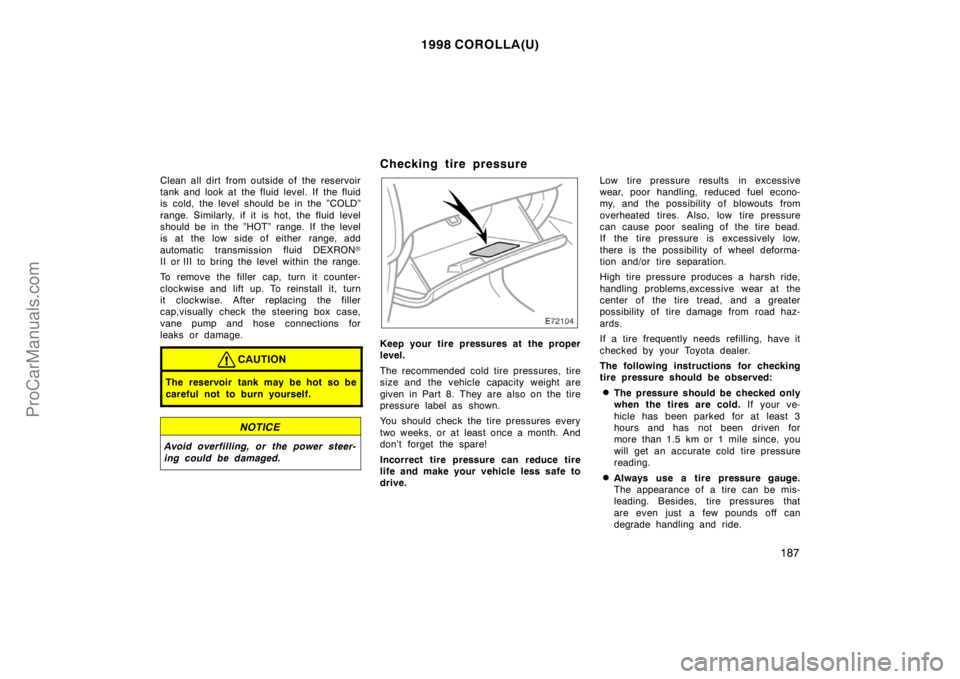
given in Part 8. They are also on the tire
pressure label as shown.
You should check the tire pressures every
two weeks, or at least once a month. And
don’t forget the spare!
Incorrect tire pressure can reduce tire
life and make your vehicle less safe to
drive.Low tire pressure results in excessive
wear, poor handling, reduced fuel econo-
my, and the possibility of blowouts from
overheated tires. Also, low tire pressure
can cause poor sealing of the tire bead.
If the tire pressure is excessively low,
there is the possibility of wheel deforma-
tion and/or tire separation.
High tire pressure produces a harsh ride,
handling problems,excessive wear at the
center of the tire tread, and a greater
possibility of tire damage from road haz-
ards.
If a tire frequently needs refilling, have it
checked by your Toyota dealer.
The following instructions for checking
tire pressure should be observed:
�The pressure should be checked only
when the tires are cold. If your ve-
hicle has been parked for at least 3
hours and has not been driven for
more than 1.5 km or 1 mile since, you
will get an accurate cold tire pressure
reading.
�Always use a tire pressure gauge.
The appearance of a tire can be mis-
leading. Besides, tire pressures that
are even just a few pounds off can
degrade handling and ride.
ProCarManuals.com
Page 199 of 204

1998 COROLLA(U)
207
COOLING SYSTEM
Total capacity, L (qt., Imp. qt.):
Manual transmission
5.8 (6.1, 5.1)
Automatic transmission
5.7 (6.0, 5.0)
Coolant type:
With ethylene−glycol antifreeze
(Do not use alcohol type.)
BATTERY
Open voltage
∗ at 20�C (68�F):
12.6−12.8 V Fully charged
12.2−12.4 V Half charged
11 . 8−12.0 V Discharged
∗: Voltage that is checked 20 minutes after
the key is removed with all the lights
turned off
Charging rates: 5 A max.
CLUTCH
Pedal freeplay, mm (in.):
5—15 (0.2—0.6)
Fluid type:
SAE J1703 or FMVSS No. 116 DOT 3MANUAL TRANSAXLE
Oil capacity, L (qt., Imp. qt.):
1.9 (2.0, 1.7)
Oil type:
Gear oil API GL−4 or GL−5
Recommended oil viscosity:
SAE 75W−90
AUTOMATIC TRANSAXLE
Automatic transmission
Fluid capacity (drain and refill),
L (qt., Imp. qt.):
Four−speed type
Up to 3.1 (3.3, 2.7)
Three−speed type
2.5 (2.6,2.2)
Fluid type:
Automatic transmission fluid D−ll or
DEXRON�III (DEXRON�II)
Differential (three−speed type only)
Fluid capacity L (qt., Imp. qt.):
1.4 (1.5, 1.2)
Fluid type:
Automatic transmission fluid D−II or
DEXRON�III (DEXRON�II)BRAKES
Minimum pedal clearance when depressed
with the pressure of 490 N (50 kgf, 110 lbf)
with the engine running, mm (in.):
Vehicles with anti−lock brake system
90 (3.5)
Vehicles without anti−lock brake system
85 (3.3)
Pedal freeplay, mm (in.):
1—6 (0.04—0.24)
Pad wear limit, mm (in.):
1.0 (0.04)
Lining wear limit, mm (in.):
1.0 (0.04)
Parking brake adjustment when pulled with
the force of 196 N (20 kgf, 44 lbf):
4—7 clicks
Fluid type:
SAE J1703 or FMVSS No. 116 DOT 3
STEERING
Wheel freeplay:
Less than 30 mm (1.2 in.)
Power steering fluid type:
Automatic transmission fluid DEXRON�II
or III
ProCarManuals.com
Page:
< prev 1-8 9-16 17-24