Page 226 of 406
Cooling System
When you decide it’s safe to lift the hood, here’s what
you’ll see:
A. Coolant Recovery Tank
B. Radiator Pressure Cap
C. Electric Cooling Engine Fans
A CAUTION: I
An electric engine cooling fan under the hood can
start up even when the engine is not running and
can injure
you. Keep hands, clothing and tools
away from any underhood electric fan.
I I
If the coolant inside the coolant recovery tank is boiling,
don’t do anything else until it cools down.
5-17
Page 227 of 406
When it is cool, remove the coolant recovery tank cap
and look at the dipstick.
The coolant level should be at
FULL COLD.
If it isn't, you may have a leak in the radiator hoses,
heater hoses, radiator, water
pump or somewhere else in
the cooling system.
A CAUTION:
Heater and radiator hoses, and other engine
parts, can be very hot. Don't touch them.
If you
do, you can be burned.
Don't run the engine
if there is a leak. If you run
the engine, it could lose all coolant. That could
cause an engine
fire, and you could be burned.
Get any leak fixed before you drive the vehicle.
I NOTICE:
I
Engine damage from running your engine
without coolant isn't covered
by your warranty.
5-18
Page 228 of 406
If there seems to be no leak, with the engine on, check to
see if the electric engine cooling fans
are running. If the
engine is overheating, both fans should be running.
If
they aren’t, your vehicle needs service.
How to Add Coolant to the Coolant
Recovery Tank
If you haven’t found a problem yet, but the coolant level
isn’t at
FULL COLD add a 50150 mixture of clean water
(preferably distilled) and DEX-COOL@ engine coolant
at the coolant recovery tank. (See “Engine Coolant” in
the Index for more information.)
a CAUTION:
-1
Adding only plain water to your cooling system
can be dangerous. Plain water,
or some other
liquid like alcohol, can boil before the proper
coolant mixture will. Your vehicle’s coolant
warning system is set for the proper coolant
mixture. With plain water or the wrong mixture,
your engine could get too hot but you wouldn’t
get the overheat warning. Your engine could
catch
fire and you or others could be burned.
Use
a 50/50 mixture of clean water and
DEX-COOL@ coolant.
NOTICE:
In cold weather, water can freeze and crack the
engine, radiator, heater core and other parts.
Use the recommended coolant and the proper
coolant mixture.
5-19
Page 261 of 406

Filling a Portable Fuel Container
Checking Things Under the Hood
A CAUTION:
Never fill a portable fuel container while it is in
your vehicle. Static electricity discharge from the
container can ignite the gasoline vapor. You can
be badly burned and your vehicle damaged
if this
occurs. To help avoid injury to you and others:
0 Dispense gasoline only into approved
containers.
0 Do not fill a container while it is inside a
vehicle, in a vehicle’s trunk, pickup bed or
on any surface other than the ground.
inside
of the fill opening before operating
the nozzle. Contact should be maintained
until the filling is complete.
0 Bring the fill nozzle in contact with the
0 Don’t smoke while pumping gasoline.
An electric fan under the hood can start up and
injure you even when the engine is not running.
Keep hands, clothing and tools away
from any
underhood electric fan.
Things that burn can get on hot engine parts and
start a fire. These include liquids like gasoline,
oil, coolant, brake fluid, windshield washer and
other fluids, and plastic or rubber.
You or others
could
be burned. Be careful not to drop or spill
things that will burn onto
a hot engine.
Page 275 of 406

Checking Transmission Fluid Cold
A cold check is made after the vehicle has been sitting
for eight
hours or more with the engine off and is used
only as a reference. Let the engine run at idle for
five
minutes if outside temperatures are 50°F (1 0°C) or
more. If it's colder than 50°F (lO°C), you may have to
idle the engine longer. Should the fluid level be low
during a cold check,
you must perform a hot check
before adding fluid. This will give
you a more accurate
reading
of the fluid level.
Checking the Fluid Hot or Cold
0 Park your vehicle on a level place. Keep the
0 With the parking brake applied, place the shift lever
0 With your foot on the brake pedal, move the shift
engine
running.
in
PARK (P).
lever through each gear range, pausing for about
three seconds in each range, Then, position the shift
lever
in PARK (P).
Let the engine run at idle for three minutes or more. ~nen,
without shutting
off the engine, follow these steps:
k 'rll
3800 V6 Engine Transmission Dipstick
Page 290 of 406
Replacing Brake System Parts
The braking system on a modem vehicle is complex.
Its many parts have to be
of top quality and work well
together
if the vehicle is to have really good braking.
Your vehicle was designed and tested with top-quality
GM brake parts. When you replace parts of your braking
system
-- for example, when your brake linings wear
down and you have to have new ones put in
-- be sure
you get new approved GM replacement parts. If you
don’t, your brakes may no longer work properly. For
example,
if someone puts in brake linings that are wrong
for your vehicle, the balance between your front and
rear brakes can change
-- for the worse. The braking
performance you’ve come
to expect can change in many
other ways if someone puts in the wrong replacement
brake parts.
Battery
Every new Pontiac has an ACDelco Freedom@ battery.
You never have to add water to one
of these. When it’s
time
for a new battery, we recommend an ACDelco
Freedom battery. Get one that has the replacement
number shown
on the original battery’s label.
Vehicle Storage
If you’re not going to drive your vehicle for 25 days
or more, remove the black, negative
(-) cable from
the battery. This will help keep your battery from
running down.
~ A CAUTION:
rn -
Batteries have acid that can burn you and gas
that can explode.
You can be badly hurt if you
aren’t careful. See “Jump Starting” in the Index
for tips on working around
a battery without
getting hurt.
Contact your dealer to learn how to prepare your vehicle
for longer storage periods.
Also, for your audio system, see “Theft-Deterrent
Feature” in the Index.
6-37
Page 309 of 406

Care of Safety Belts
T’:ep belts cle-- an-’
Cleaning the Outside of the
Windshield and
Wiper Blades
A CAUTION:
Do not bleach or dye safety belts. If you do, it
may severely weaken them. In a crash, they
might not be able
to provide adequate protection.
Clean safety belts only with mild
soap and
lukewarm water.
Cleaning Glass Surfaces
Glass should be cleaned often. GM Glass Cleaner (GM
Part No. 1050427) or a liquid household glass cleaner
will remove normal tobacco smoke and dust films on
interior glass.
Don’t use abrasive cleaners on glass, because they may
cause scratches. Avoid placing decals on
the inside rear
window, since they
may have to be scraped off later. If
abrasive cleaners are used on the inside of the rear
window,
an electric defogger element may be damaged.
Any temporary license should not be attached across the
defogger grid.
If the windshield is not clear after using the
windshield washer, or if the wiper blade chatters
when running, wax, sap or other material may be
on the blade or windshield.
Clean the outside of the windshield
with GM
Windshield Cleaner, Bon
Ami@ Powder (non-scratching
glass cleaning powder),
GM Part No. 105001 1. The
windshield
is clean if beads do not form when you
rinse it with water.
Grime from the windshield will stick to the wiper
blades and affect their performance. Clean the blade
by wiping vigorously with a cloth
soaked in
full-strength windshield washer solvent. Then
rinse the blade with water.
Check the wiper blades and clean them
as necessary;
replace blades that look worn.
6-56
Page 317 of 406
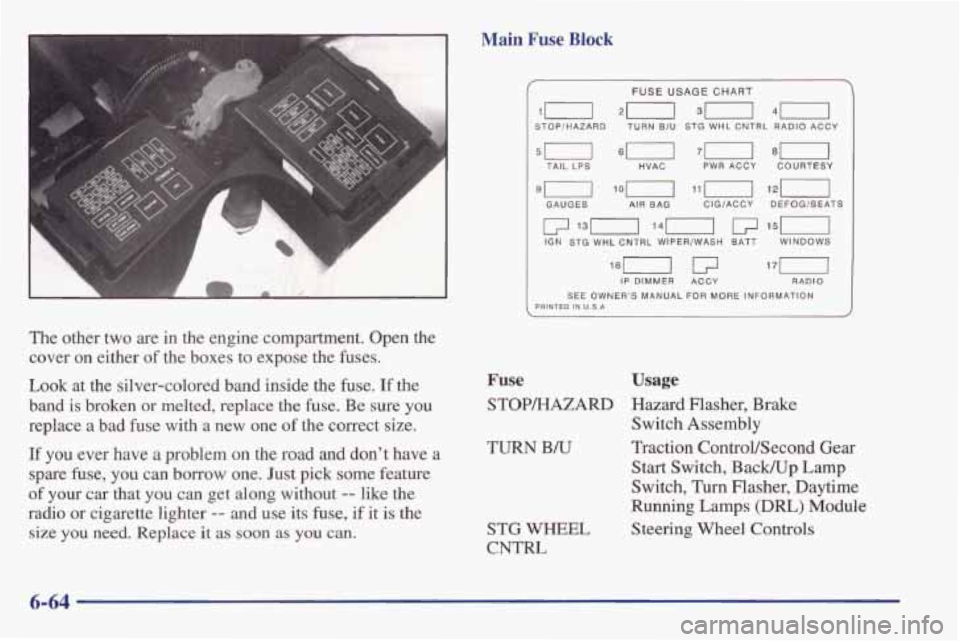
The other two are in the engine compartment. Open the
cover on either
of the boxes to expose the fuses.
Look at the silver-colored band inside the fuse. If the
band is broken or melted, replace
the fuse. Be sure you
replace a bad fuse with a new one of the correct size.
If you ever have a problem on the road and don't have a
spare fuse, you can borrow one. Just pick some feature
of your car that you
can get along without -- like the
radio or cigarette lighter
-- and use its fuse, if it is the
size
you need. Replace it as soon as you can.
Main Fuse Block
III 20 30 40
FUSE USAGE CHART
STOPIHAZARD TURN BIU STG WHL CNTRL RADIO ACCY
--
5u 4--l 7u 8U TAIL LPS HVAC PWR ACCY COURTESY
9-1 lin 121-1
GAUGES AIR BAG CIGIACCY DEFOGISEATS
IP DIMMER ACCY RADIO
SEE OWNER'S MANUAL FOR MORE INFORMATION PRINTED IN U.S.A
Fuse Usage
STOP/HAZARD Hazard Flasher, Brake
Switch Assembly
TURN B/U Traction ControVSecond Gear
Start Switch, Back/Up Lamp
Switch, Turn Flasher, Daytime
Running Lamps
(DRL) Module
Steering Wheel Controls
STG WHEEL
CNTFU
6-64

