1998 OLDSMOBILE INTRIGUE recommended oil
[x] Cancel search: recommended oilPage 125 of 340

If the CHANGE OIL light comes on and stays on after
you
start the engine, have the oil changed. The light may
indicate to change the oil sooner than suggested in your
maintenance schedule, depending on your driving patterns.
This light will come on when the system predicts that the
oil’s remaining useful life is almost up. It alerts you to
change the oil on a schedule consistent with your vehicle’s \
driving conditions. Therefore,
you should change your oil
at the intervals recommended in your maintenance
schedule or when the CHANGE
OIL light comes on,
whichever comes first. See “Engine Oil, When to Change”
and “Maintenance Schedule,” in the Index.
To reset the CHANGE
OIL light, see “Engine Oil” in
the Index.
Fuel Gr 2
0
Your fuel gage tells you
about how much fuel
you
have left when the ignition
is on. When the indicator
nears EMPTY
(E), you still
have a little fuel left,
but
you should get more soon.
Here are some things owners ask about. All these
situations are normal and do not show
a problem with
your fuel gage:
At the service station, the pump shuts off before the
gage reads
FULL (F).
It takes a little more or less fuel to fill up than the gage
indicated.
For example, the gage may have indicated
the tank was half full, but it actually took a little more
or less than half
the tank’s capacity to fill it.
The gage moves a little when you turn the corner or
speed
up.
2-65
ProCarManuals.com
Page 176 of 340

Once you are moving on the freeway, make certain you
allow a reasonable following distance. Expect to move
slightly slower at night.
When you want to leave the freeway, move to the proper
lane well in advance. If
you miss your exit, do not,
under any circumstances, stop and back up. Drive on to
the next exit.
The exit ramp can be curved, sometimes quite sharply.
The exit speed is usually posted.
Reduce your speed according to your speedometer, not
to your sense of motion. After driving for any distance
at higher speeds, you may tend to think you are going
slower than
you actually are.
Befi- ~ Leaving on a Long Trip
Make sure you’re ready. Try to be well rested. If you
must start when you’re not fresh -- such as after a day’s
work
-- don’t plan to make too many miles that first part
of the journey. Wear comfortable clothing and shoes
you
can easily drive in.
Is your vehicle ready for a long trip? If you keep it
serviced and maintained, it’s ready to go.
If it needs service, have
it done before starting out. Of course,
you’ll find experienced and able service experts in
Oldsmobile retail facilities all across
North America.
They’ll be ready and willing to help if you need it.
Here are some things
you can check before a trip:
0
0
0
0
0
0
0
Windshield Washer Fluid: Is the reservoir full? Are
all windows clean inside and outside?
Wiper Blades: Are they in good shape?
Fuel, Engine Oil, Other Fluids: Have you checked
all levels?
Lamps: Are they all working? Are the lenses clean?
Tires: They are vitally important to a safe,
trouble-free trip.
Is the tread good enough for
long-distance driving? Are the tires all inflated to
the recommended pressure?
Weather Forecasts: What’s the weather outlook
along your route? Should you delay your trip a
short time to avoid a major storm system?
Maps: Do you have up-to-date maps?
4-22
ProCarManuals.com
Page 211 of 340
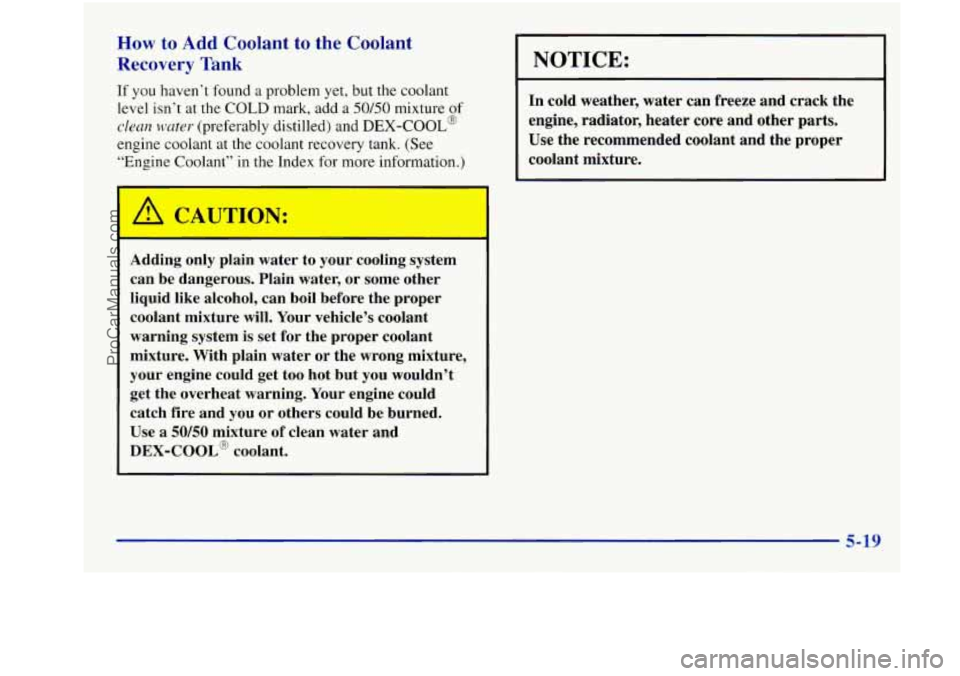
How to Add Coolant to the Coolant
Recovery Tank
If you haven’t found a problem yet, but the coolant
level isn’t at
the COLD mark, add a 50/50 mixture of
clean water (preferably distilled) and DEX-COOL@
engine coolant at the coolant recovery tank. (See
“Engine Coolant” in the
Index for more information.)
Adding only plain water to your cooling system can be dangerous. Plain water, or some other
liquid like alcohol, can boil before the proper
coolant mixture will. Your vehicle’s coolant
warning system is set for the proper coolant
mixture. With plain water or the wrong mixture,
your engine could get too hot but you wouldn’t
get the overheat warning. Your engine could
catch fire and you or others could be burned.
Use
a 50/50 mixture of clean water and
DEX-COOL@ coolant.
NOTICE:
In cold weather, water can freeze and crack the
engine, radiator, heater core and other parts.
Use the recommended coolant and the proper
coolant mixture.
5-19
ProCarManuals.com
Page 233 of 340

Fuels in Foreign Countries
If you plan on driving in another country outside the
United States or Canada, the proper fuel may be hard to
find. Never use leaded gasoline or any other fuel not
recommended in the previous text on
fuel. Costly repairs
caused by
use of improper fuel wouldn’t be covered by
your warranty.
To check on fuel availability, ask an auto club, or
contact a major oil company that does business in the
country where you’ll be driving.
You can also write us at the following address for
advice. Just tell
us where you’re going and give your
Vehicle Identification Number
(VIN).
General Motors Overseas Distribution Corporation
1908 Colonel Sam Drive
Oshawa, Ontario
L1H 8P7
Filling Your Tank
A CAUTION: I
Gasoline vapor is highly flammable. It burns
violently, and that can cause very bad injuries.
Don’t smoke if you’re near gasoline or refueling
your vehicle. Keep sparks, flames and smoking
materials away from gasoline.
6-5
ProCarManuals.com
Page 241 of 340

What Kind of Engine Oil to Use
Oils recommended for your vehicle can be identified by
looking for the “Starburst” symbol. This symbol
indicates that the oil has been certified by the American
Petroleum Institute (API).
Do not use any oil which
does
not carry this Starburst symbol.
If you change your own oil,
be sure you use oil that has
the Starburst symbol on the
front of the oil container. If
you have your oil changed
for you, be sure the
oil put
into your engine is
American Petroleum Institute certified for
gasoline engines.
You should also use the proper viscosity oil for your
vehicle, as shown in the following chart:
I RECOMMENDED SAE VISCOSITY GRADE ENGINE OILS I
FOR BEST FUEL ECONOMY AND COLD STARTING, SELECT THE LOWEST
I SAE VISCOSITY GRADE OIL FOR THE EXPECTED TEMPERATURE RANGE. I
HOT
WEATHER
/OF m T)
SAE SW-30
LOOK
FOR MIS
SYMBOL
.WJ
COLD
WEATHER
8- SAL I 1OW-30
PREFERRED above 0°F (-18°C)
DO NOT USE SAE 2OW-50 OR ANY
OTHER GRADE OIL NOT RECOMMENDED
6-13
ProCarManuals.com
Page 242 of 340

As shown in the chart, SAE low-30 is best for your
vehicle. However, you can use
SAE 5W-30 if it’s going
to be colder than
60°F (1 6°C) before your next oil
change. When it’s very cold, you should use
SAE
5W-30. These numbers on an oil container show its
viscosity, or thickness. Do not use other viscosity oils,
such as
SAE 20W-50.
I i
I NOTICE:
Use only engine oil with the American Petroleum
Institute Certified For Gasoline Engines “Starburst” symbol. Failure to use the
recommended oil can result in engine damage not
covered by your warranty.
GM Goodwrench’ oil meets all the requirements for
your vehicle.
If you are in an area where
the temperature falls below
-20°F (-29”C), consider using either an SAE 5W-30
synthetic oil or an
SAE OW-30 oil. Both will provide
easier cold starting and better protection for your engine
at extremely low temperatures.
Engine Oil Additives
Don’t add anything to your oil. Your retailer is ready to
advise if you think something should be added.
When to Change Engine Oil
Your vehicle has an Oil Life Indicator. This feature
will let you know when
to change your oil and
filter
-- usually between 3,000 miles (5 000 km) and
7,500 miles (12 500 km) since your last oil change.
Under severe conditions, the indicator may come on
before
3,000 miles (5 000 km). Never drive your vehicle
more than
7,500 miles (12 500 km) or 12 months
(whichever occurs first) without an oil change.
The system won’t detect dust in the oil.
So, if you
drive in a dusty area, be sure to change your oil every
3,000 miles
(5 000 km) or sooner. Remember to reset
the “CHANGE
OIL Light”, when the oil has been
changed. For more information, see “Engine Oil” in
the Index.
6-14
ProCarManuals.com
Page 282 of 340

Appearance Care Materials Chart
PART NUMBER I SIZE DESCRIPTION USAGE I
994954
Exterior polishing cloth
Polishing Cloth - Wax
Treated
23 in. x 25 in.
1050172 Removes tar, road oil and asphalt
Tar and Road Oil Remover
16
oz. (0.473 L)
1050173
Cleans vinyl tops, upholstery and convertible tops
Vinyl Cleaner
32
oz. (0.946 L) 1050214 Removes soil and black marks
from whitewalls
White Sidewall Tire Cleaner
16
oz. (0.473 L) 1050174 Use on chrome, stainless steel, nickel, copper and brass
Chrome Cleaner and Polish
16
oz. (0.473 L)
1050427
Cleans and lightly waxes
Wash Wax Concentrate
16
oz. (0.473 L) 1052870 Removes
dirt, grime, smoke and fingerprints
Glass Cleaner
23
oz. (0.680 L)
--
1052918**
Armor All TM Protectant
8 oz. (0.237 L) Protects leather, wood, acrylics, Plexiglas TM, plastic,
rubber and vinyl
1052925
I 16 oz. (0.473 L) I Multi-Purpose Interior Cleans carpets, seats, interior trim, door panels
I Cleaner and floor mats I
1052929 16 oz. (0.473 L)
1052930 8 oz. (0.237 L)
12377964
16 oz. (0.473 L)
Wheel Cleaner Spray on and rinse with water
Capture Dry Spot Remover Attracts, absorbs and removes soils
Armor
All TM Cleaner Cleans and shines a variety of surface types
Synthetic Chamois Shines vehicle without scratching
_____~
Silicone Tire Shine Spray on tire shine
Finish Enhancer Removes dust, fingerprints and surface contaminants
12377966 16
oz. (0.473 L) Cleaner Wax Removes light scratches and oxidation and protects finish
12377984 16
02. (0.473 L) Surface Cleaner Removes
contaminants, blemishes and swirl marks
See your General Motors Parts Department
for these products. ** Not recommended for use on instrument panel vinyl.
See “Fluids and Lubricants” in the Index.
6-54
ProCarManuals.com
Page 291 of 340

Capacities and Specifications
Please refer to “Recommended Fluids and Lubricants”
in the Index for more information.
Automatic Transaxle
3800 (Code K)
Pan Removal and Replacement ... 8 quarts (7.5 L)
After Complete Overhaul ....... 10 quarts (9.5 L)
When drainingheplacing the converter; more fluid
may be needed.
Cooling System Including Reservoir
3800 (Code K) ............. 10.2 quarts (9.63 L)
Refrigerant (R-l34a),
Air Conditioning*
............ 1.9 lbs. (0.85 kg)
Engine Crankcase
Oil and Filter Change (3800) ... 4.5 quarts (4.3 L)
Fuel Tank ................ 17.75 gallons (67.2 L)
*See “Air Conditioning Refrigerants ”later in
this section.
NOTE: All capacities are approximate. When adding,
be sure to fill to the appropriate level, as recommended
in
this manual. Recheck fluid level after filling.
3800 (Code K) Engine Specifications
Type .................................... V6
Displacement
........................ 231 CID
Compression Ratio
....................... 9.4: 1
Firing Order ...................... 1-6-5-4-3-2
Thermostat Temperature
........... 195°F (91°C)
Horsepower
............................. 195
Vehicle Dimensions
Wheelbase ................. 109 inches (270 cm)
Front Tread Width
.......... .6 1.5 inches (1 56 cm)
Rear Tread Width
........... .6 1.5 inches (156 cm)
Overall Length
............. 195.9 inches (498 cm)
Overall Width
.............. .73.8 inches (1 87 cm)
Overall Height
.............. 56.4 inches (143 cm)
6-63
ProCarManuals.com