1998 Oldsmobile Cutlass key
[x] Cancel search: keyPage 117 of 348

Anti-Lock Brake System Warning Light
Your brake system may not be working properly
if the brake system warning light is on. Driving
with the brake system warning light on can lead
to an accident. If the light is still on after you’ve pulled off the road and stopped carefully, have
the vehicle towed for service.
When the ignition is on, the brake system warning light
will also come on when you set your parking brake. The
light will stay on if your parking brake doesn’t release
fully.
If it stays on after your parking brake is fully
released, it means you have a brake problem. With the anti-lock brake
system, this light will come
on when you
turn your
ignition on or start your engine and it
will stay
on for three seconds.
That’s normal.
If the light stays on, turn the ignition to OFF. Or, if the
light comes on and the chime sounds when you’re
driving, stop as
soon as possible and turn the ignition
off. Then start the engine again to reset the system.
If
the light still stays on, or comes on again while you’re
driving, your vehicle needs service.
If the regular brake
system warning light isn’t on, you still have brakes,
but you don’t have anti-lock brakes.
If the regular
brake system warning light
is also on, you don’t have
anti-lock brakes and there’s a problem with your regular
brakes. See “Brake System Warning Light” earlier
in
this section.
The anti-lock brake system warning light should come
on briefly when you turn the ignition key to
ON. If the
light doesn’t come on then, have
it fixed so it will be
ready to warn you
if there is a problem.
2-53
Page 122 of 348

Check Oil Light
Don’t keep ariving if the oil pressure is low. If
you do, your engine can become so hot that it
catches fire. You or others could be burned.
Check your oil
as soon as possible and have your
vehicle serviced.
I NOTICE:
Damage to your engine from neglected oil
your warranty.
1 problems can be costly and is not covered by
/ OIL
This light will come on
briefly when you start
your vehicle.
If the light comes on and you hear a chime or stays on
after starting your vehicle, your engine oil level should
be checked.
Prior to checking the oil level, be sure your vehicle has
been shut
off for several minutes and is on a level
surface. Check the oil level on your dipstick and bring
it
to the proper level. See “Engine Oil” in the Index.
NOTE: A false CHECK OIL light may be generated
when parking on steep grades.
The oil level monitoring system only checks oil level
during the brief period between key on
and engine
crank.
It does not monitor engine oil level when the
engine is running. Additionally, an oil level check is
only performed if the engine has been turned
off for a
considerable period
of time allowing the oil normally in
circulation to drain back into the oil pan.
Page 149 of 348

Drunken Driving
Death and injury associated with drinking and driving is a national tragedy. It’s the number one contributor to
the highway death toll, claiming thousands of victims
every year.
Alcohol affects four things that anyone needs to drive
a vehicle:
Judgment
0 Muscular Coordination
0 Vision
Attentiveness.
Police records show that almost half of
all motor
vehcle-related deaths involve alcohol.
In most cases,
these deaths are the result
of someone who was drinking
and driving.
In recent years, over 17,000 annual motor
vehicle-related deaths have been associated with the use
of alcohol, with more than
300,000 people injured.
Many adults
-- by some estimates, nearly half the
adult population
-- choose never to drink alcohol, so
they never drive after drinking. For persons under 2 1 ,
it’s against the law in every U.S. state to drink alcohol.
There
are good medical, psychological and
developmental reasons for these laws. The
obvious way to solve
this highway safety problem
is for people never to drink alcohol and then drive. But
what if people do? How much is “too much” if the
driver plans to drive? It’s a lot less than many might
think. Although it depends on each person and situation,
here is some general information on the problem.
The Blood Alcohol Concentration
(BAC) of someone
who is drinking depends upon four things:
0 The amount of alcohol consumed
The drinker’s body weight
The amount of food that is consumed before and
during drinking
consume the alcohol.
0 The length of time it has taken the drinker to
According to the American Medical Association, a 180-lb.
(82 kg) person who drinks three 12-ounce
(355
ml) bottles of beer in an hour will end up with a
BAC
of about 0.06 percent. The person would reach the
same BAC by drinking three 4-ounce (120
ml) glasses
of wine or three mixed
drinks if each had 1-1/2 ounces
(45
ml) of a liquor like whiskey, gin or vodka.
Page 174 of 348

~~ ~ ~ ~~~~ ~ ~
~~~ ~ . ~~
-Run
your engine only as long as you must. This saves
fuel. When you run the engine, make it go a little faster
than just idle. That is, push the accelerator slightly. This
uses less fuel for the heat that you get and it keeps the
battery charged. You will need a well-charged battery to
restart the vehicle, and possibly for signaling later on
with your headlamps. Let the heater run for
a while.
' Then, shut the engine off and close the window almost
all the way to preserve the heat. Start the engine again and repeat this only when you feel really uncomfortable
from the cold. But do it as little as possible. Preserve the
fuel as long as you can. To help keep warm, you can get
' out of the vehicle and do some fairly vigorous exercises
.. every half hour or so until help comes.
Recreational Vehicle Towing
You can tow your vehicle behind another vehicle for use
at your'destination. Be sure to use the proper towing
equipment designed for recreational towing. Follow the
instructions for the towing equipment.
Towing Your Vehicle from the Front
There are two ways to tow your vehicle from the front.
To tow your vehicle with a dolly, follow these steps:
1. Put the front wheels on a dolly.
2. Put the vehicle in PARK (P).
3. Set the parking brake and then remove the key.
4. Clamp the steering wheel in a straight-ahead position
with a clamping device designed for towing.
5. Release the parking brake.
Page 175 of 348

To tow your vehicle with all four wheels on the ground,
follow these steps:
m
A
1. Position the vehicle to tow and then secure it.
2. Turn &.ignition switch to OFF.
3. Set the parking brake.
4. Remove the following fuses from the left side of the
instrument panel fuse block A) Radio, B)
Wiper,
H) Powertrain Control Module, K) Body Function
Control Module, Cluster.
This will prevent your battery
from
draining while towing. See “Instrument Panel Fuse
Block
- Left” in Section 6 for the location of these fuses.
5. Turn the ignition switch to ACC.
6. Shift your transaxle to NEUTRAL (N).
7. Release the parking brake.
Remember to replace the fuses once you reach your
destination.
To replace a fuse:
1. Set the parhg brake.
2. Remove the key from the
3. Replace the fuse. ignition switch.
I NOTICE:
Make sure that the towing speed does not exceed
65 mph (105 km/h), or your vehicle could be
badly damaged.
4-29
Page 309 of 348

At Least Twice a Year
Restraint System Check
Make sure the safety belt reminder light and all your
belts, buckles, latch plates, retractors and anchorages are
working properly. Look for any other loose or damaged
safety belt system parts.
If you see anything that might
keep a safety belt system from doing its
job, have it
repaired. Have any torn or frayed safety belts replaced.
Also look for any opened or broken air bag coverings,
and have them repaired or replaced. (The air bag system
does not need regular maintenance.)
Wiper Blade Check
Inspect wiper blades for wear or cracking. Replace blade
inserts that appear worn
or damaged or that streak or
miss areas of the windshield. Also see “Wiper Blades,
Cleaning”
in the Index.
Automatic Transaxle Inspection
Check the transaxle fluid level; add if needed. See
“Automatic Transaxle” in the Index. A fluid loss
may indicate a problem. Check the system
and repair
if needed.
At Least Once a Year
Key Lock Cylinders Service
Lubricate the key lock cylinders with the lubricant
specified in
Part D.
Body Lubrication Service
Lubricate all body door hinges and latches, including
those for the hood,
trunk lid, glove box door and console
door.
Part D tells you what to use. More frequent
lubrication may be required when exposed to a
corrosive environment.
7-27
1: I1
Page 310 of 348
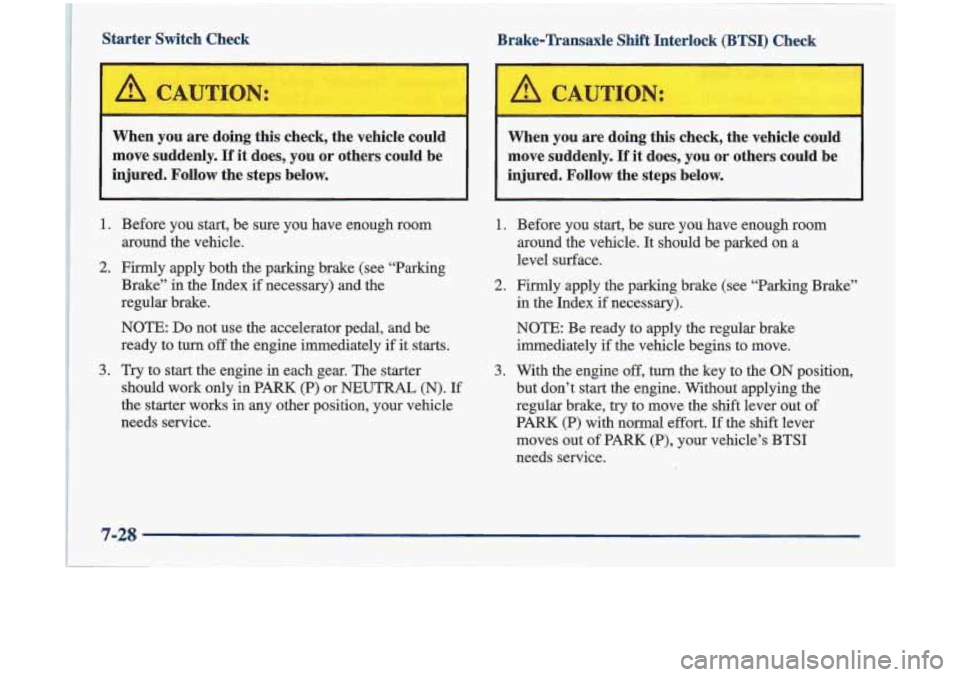
Starter Switch Check
=
Brake-Traasaxle Shift Interlock (BTSI) Check
When you are doing this check, the vehicle could
move suddenly.
If’ it does, you or others could be
---1 injured. Follow the steps below.
1.
2.
3.
Before you start, be sure you have enough room around the vehicle.
Firmly apply both the parking brake (see “Parking
Brake” in the Index if necessary) and the
regular brake.
NOTE: Do not use the accelerator pedal, and be
ready to
turn off the engine immediately if it starts.
Try to start the engine in each gear. The starter should work only in PARK (P) or NEUTRAL (N).
If
the starter works in any other position, your vehicle
needs service.
1
When you are doing this check, the vehicle could
move suddenly.
If it does, you or others could be
injured. Follow the steps below.
1. Before you start, be sure you have enough room
around the vehicle. It should be parked
on a
level surface.
2. Firmly apply the parking brake (see “Parking Brake”
in the Index if necessary).
NOTE: Be ready to apply the regular brake
immediately if the vehicle begins to move.
3. With the engine off, turn the key to the ON position,
but don’t start the engine. Without applying the
regular brake, try to move the shift lever out of
PARK (P) with normal effort. If the shift lever
moves out of PARK
(P), your vehicle’s BTSI
needs service.
7-28
Page 311 of 348

Ignition Transaxle Lock Check
While parked, and with the parking brake set, try to turn
the ignition key to OFF in each shift lever position. The
key should
turn to OFF only when the shift lever is in
PARK
(P).
On all vehicles, the key should come out only in OFF.
Parking Brake and Automatic Transaxle PARK (P)
Mechanism /*"leek
When you are doing this check, your vehicle
could begin to move. You or others could be
injured and property could be damaged. Make
sure there
is room in front of your vehicle in case
it begins to roll. Be ready to apply the regular
brake at once should the vehicle begin to move.
Park on a fairly steep hill, with the vehicle facing
downhill. Keeping your foot on the regular brake, set the
parking brake.
To check the parking brake's holding ability: With
the engine running and transaxle
in NEUTRAL (N),
slowly remove foot pressure from the regular brake
pedal.
Do this until the vehicle is held by the parking
brake only.
To check the PARK (P) mechanism's holding ability:
With the engine running, shift to
PARK (P). Then
release
all brakes.
Underbody Flushing Service
At least every spring, use plain water to flush any
corrosive materials from the underbody. Take care to
clean thoroughly any areas where mud and other debris
can collect.
7-29