Page 9 of 216
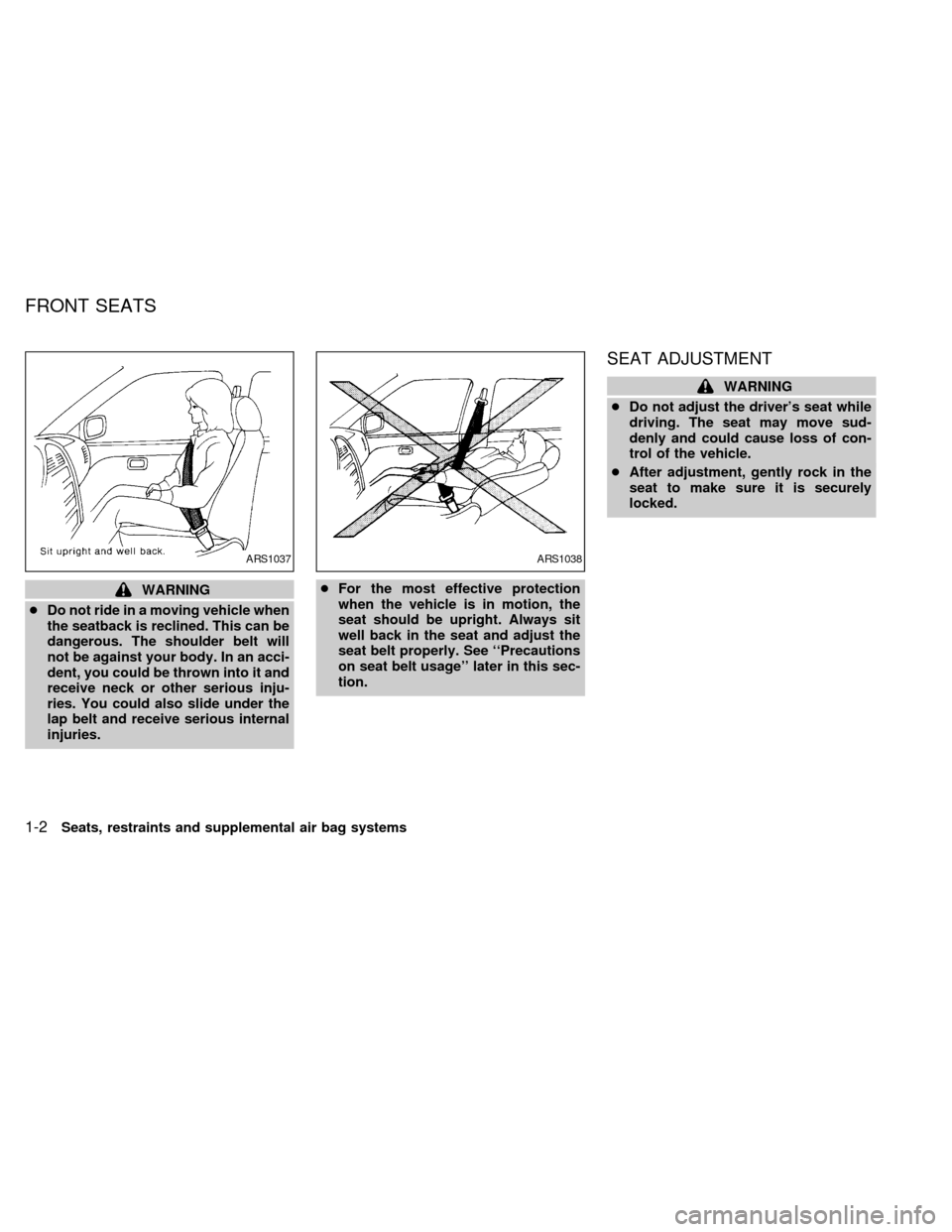
WARNING
cDo not ride in a moving vehicle when
the seatback is reclined. This can be
dangerous. The shoulder belt will
not be against your body. In an acci-
dent, you could be thrown into it and
receive neck or other serious inju-
ries. You could also slide under the
lap belt and receive serious internal
injuries.cFor the most effective protection
when the vehicle is in motion, the
seat should be upright. Always sit
well back in the seat and adjust the
seat belt properly. See ``Precautions
on seat belt usage'' later in this sec-
tion.
SEAT ADJUSTMENT
WARNING
cDo not adjust the driver's seat while
driving. The seat may move sud-
denly and could cause loss of con-
trol of the vehicle.
cAfter adjustment, gently rock in the
seat to make sure it is securely
locked.
ARS1037ARS1038
FRONT SEATS
1-2Seats, restraints and supplemental air bag systems
ZX
Page 10 of 216
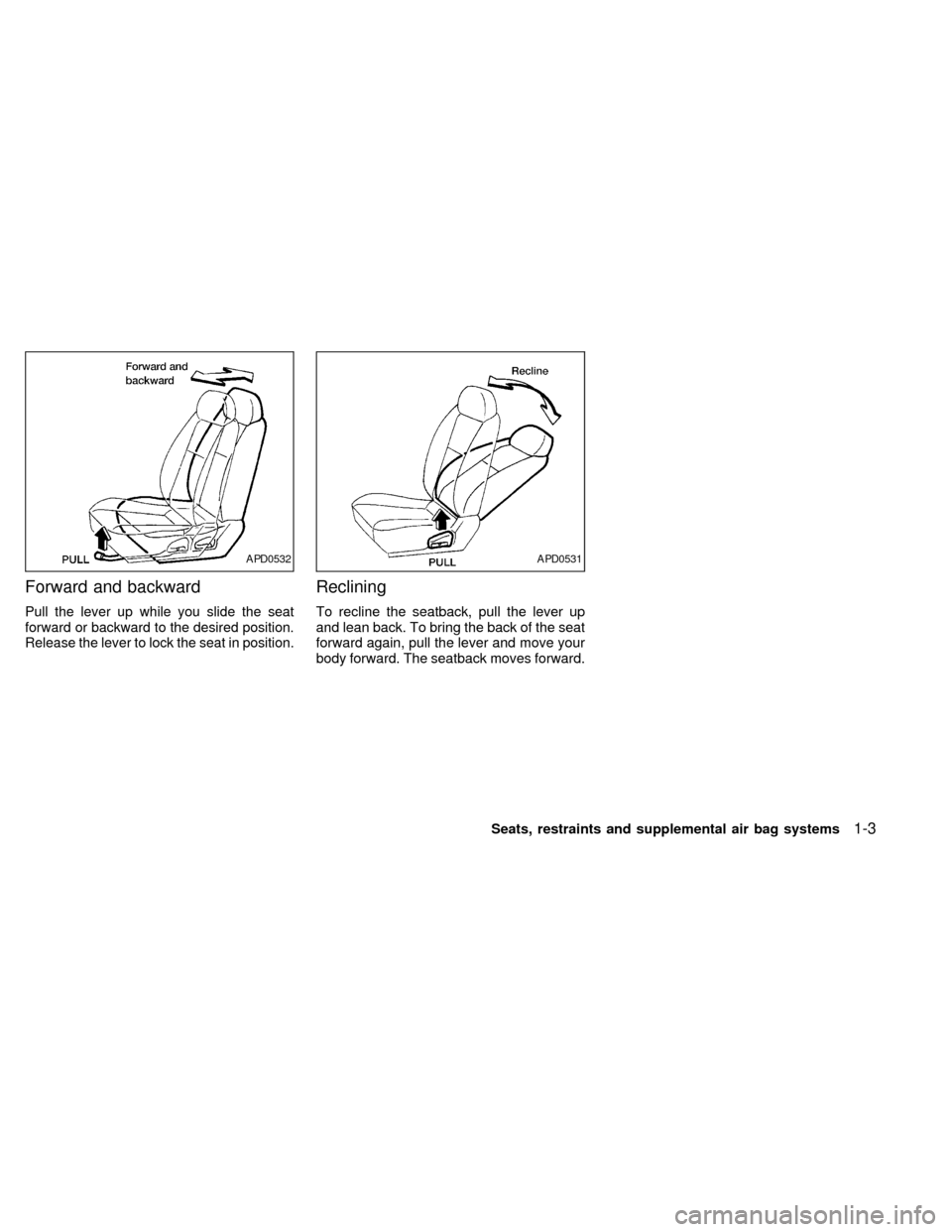
Forward and backward
Pull the lever up while you slide the seat
forward or backward to the desired position.
Release the lever to lock the seat in position.
Reclining
To recline the seatback, pull the lever up
and lean back. To bring the back of the seat
forward again, pull the lever and move your
body forward. The seatback moves forward.
APD0532APD0531
Seats, restraints and supplemental air bag systems1-3
ZX
Page 11 of 216
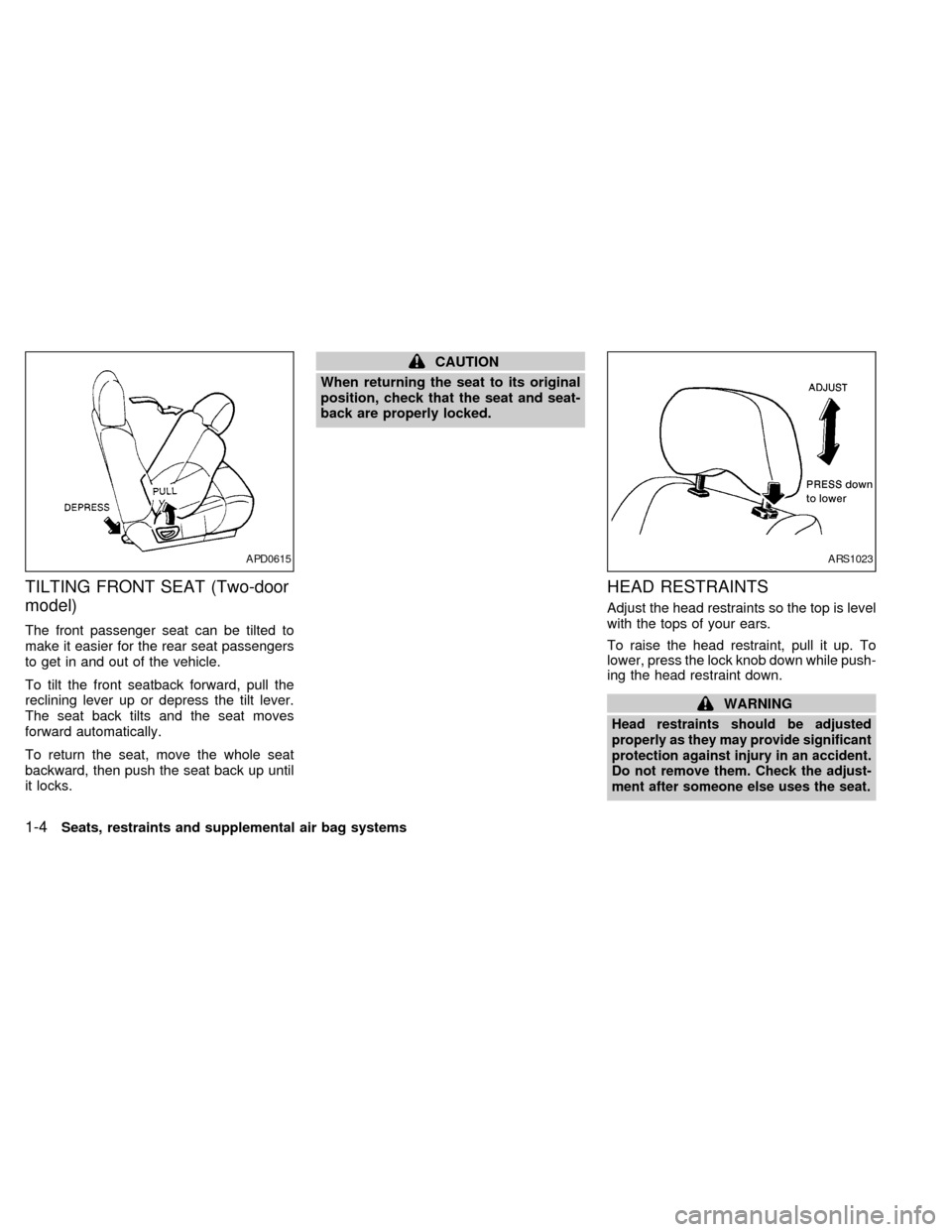
TILTING FRONT SEAT (Two-door
model)
The front passenger seat can be tilted to
make it easier for the rear seat passengers
to get in and out of the vehicle.
To tilt the front seatback forward, pull the
reclining lever up or depress the tilt lever.
The seat back tilts and the seat moves
forward automatically.
To return the seat, move the whole seat
backward, then push the seat back up until
it locks.
CAUTION
When returning the seat to its original
position, check that the seat and seat-
back are properly locked.
HEAD RESTRAINTS
Adjust the head restraints so the top is level
with the tops of your ears.
To raise the head restraint, pull it up. To
lower, press the lock knob down while push-
ing the head restraint down.
WARNING
Head restraints should be adjusted
properly as they may provide significant
protection against injury in an accident.
Do not remove them. Check the adjust-
ment after someone else uses the seat.
APD0615ARS1023
1-4Seats, restraints and supplemental air bag systems
ZX
Page 19 of 216
unit, supplemental air bag modules and all
related wiring.
When the ignition key is in the ON or START
position, the supplemental air bag warning
light illuminates for about 7 seconds and
then turns off. This means the system is
operational.
If any of the following conditions occur, the
supplemental air bag needs servicing:
1. The supplemental air bag light does not
come on and remain on for 7 seconds
and then go off as described above.
2. The supplemental air bag light flashes
intermittently or remains on.
3. The supplemental air bag light does not
come on at all.
Under these conditions, the Supplemental
Restraint System Air Bag may not operate
properly. It must be checked and repaired.
Take your vehicle to the nearest authorized
NISSAN dealer.
WARNING
If the supplemental air bag warning light
is on, it could mean that the supplemen-
tal air bag system will not operate in an
accident.
Repair and replacement procedure
The supplemental air bag system is de-
signed to inflate on a one-time-only basis.
As a reminder, unless it is damaged, the
supplemental air bag light remains illumi-
nated after inflation has occurred. Repair
and replacement of the supplemental air
bag system should be done only by an
authorized NISSAN dealer.
After a supplemental air bag inflates, the
front instrument panel assembly should be
replaced by an authorized NISSAN dealer if
damaged.
To ensure long-term functioning, the
system must be inspected 10 years after
the date of manufacture as noted on the
certification label located on the driver
side front pillar.
When maintenance work is required on the
vehicle, the supplemental air bag system
and related parts should be pointed out to
the person performing the maintenance.
The ignition key should always be in the
LOCK position when working under the
hood or inside the vehicle.
WARNING
cOnce the supplemental air bag in-
flates, the supplemental air bag
module will not function again and
must be replaced. The supplemental
air bag module cannot be repaired.
cThe supplemental air bag system
should be inspected by an autho-
rized NISSAN dealer if there is any
damage to the front end portion of
the vehicle, or replaced if the supple-
mental air bag has inflated.
cIf you need to dispose of a supple-
mental air bag or scrap the vehicle,
contact an authorized NISSAN
dealer. Correct supplemental air bag
disposal procedures are set forth in
the appropriate NISSAN Service
Manual. Incorrect disposal proce-
dures could cause personal injury.
1-12Seats, restraints and supplemental air bag systems
ZX
Page 23 of 216
THREE-POINT TYPE WITH RE-
TRACTOR
WARNING
cEvery person who drives or rides in
this vehicle should wear a seat belt
at all times.
cDo not ride in a moving vehicle when
the seatback is reclined. This can be
dangerous. The shoulder belt will
not be against your body. In an acci-
dent, you could be thrown into it and
receive neck or other serious inju-ries. You could also slide under the
lap belt and receive serious internal
injuries.
cFor the most effective protection
when the vehicle is in motion, the
seat should be upright. Always sit
well back in the seat and adjust the
seat belt properly.
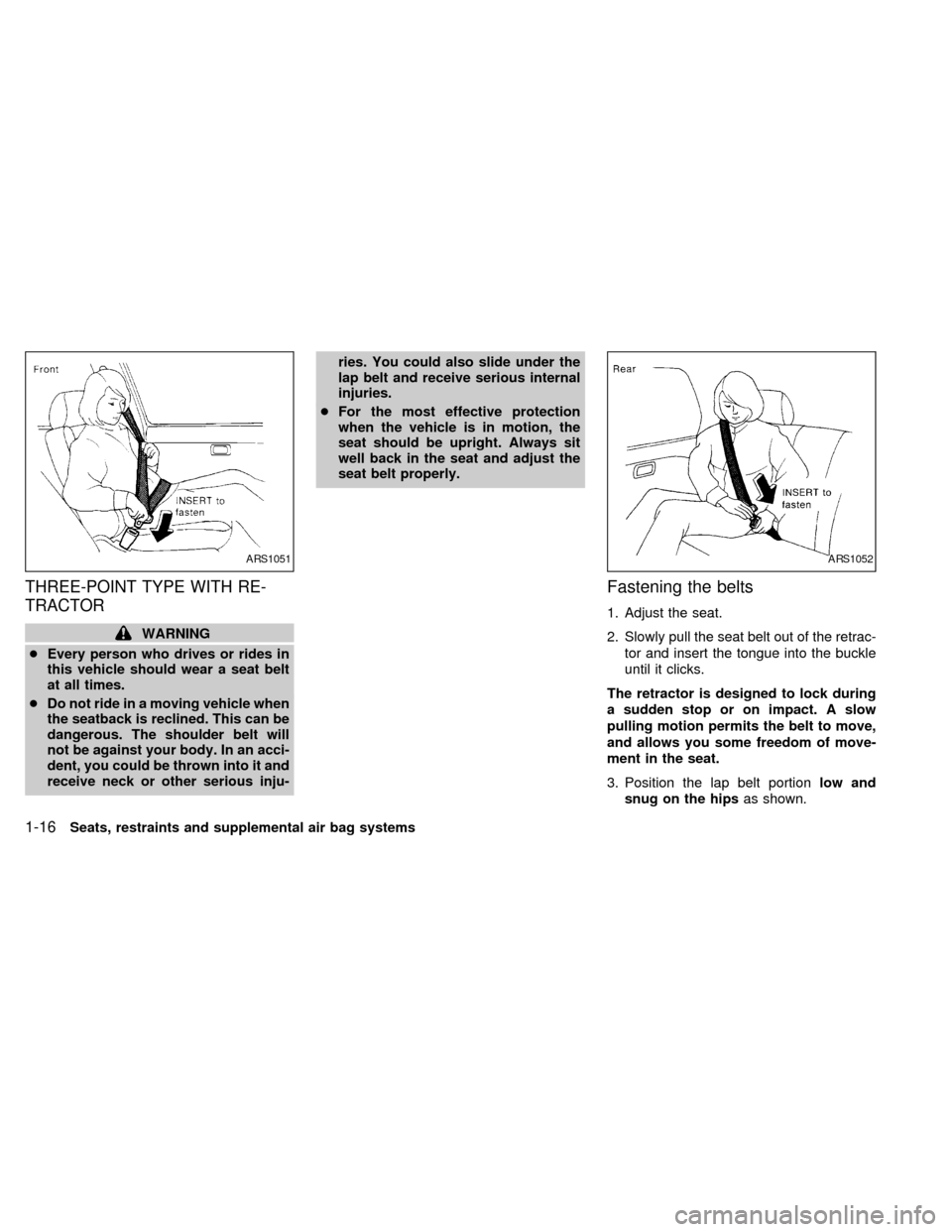
Fastening the belts
1. Adjust the seat.
2. Slowly pull the seat belt out of the retrac-
tor and insert the tongue into the buckle
until it clicks.
The retractor is designed to lock during
a sudden stop or on impact. A slow
pulling motion permits the belt to move,
and allows you some freedom of move-
ment in the seat.
3. Position the lap belt portionlow and
snug on the hipsas shown.
ARS1051ARS1052
1-16Seats, restraints and supplemental air bag systems
ZX
Page 24 of 216
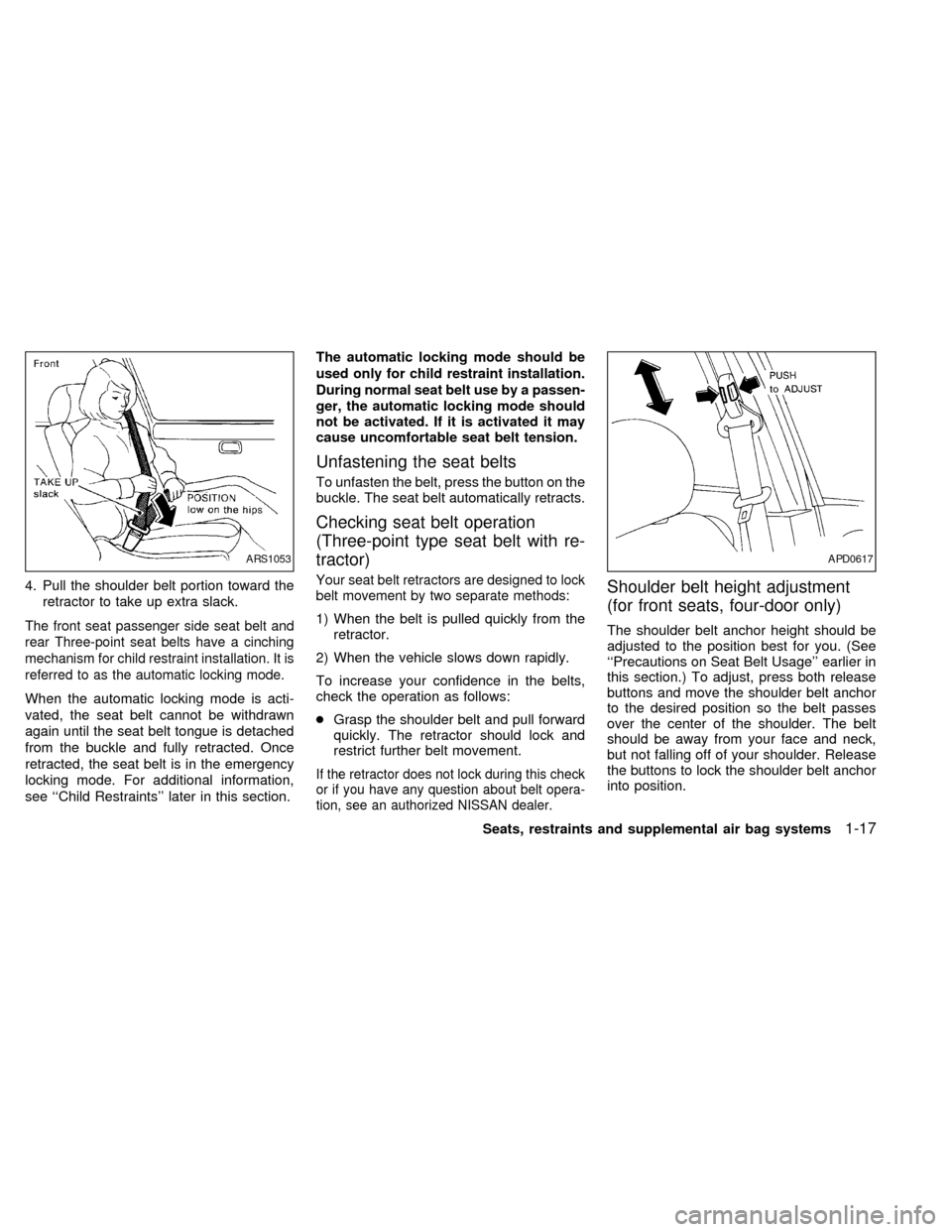
4. Pull the shoulder belt portion toward the
retractor to take up extra slack.
The front seat passenger side seat belt and
rear Three-point seat belts have a cinching
mechanism for child restraint installation. It is
referred to as the automatic locking mode.
When the automatic locking mode is acti-
vated, the seat belt cannot be withdrawn
again until the seat belt tongue is detached
from the buckle and fully retracted. Once
retracted, the seat belt is in the emergency
locking mode. For additional information,
see ``Child Restraints'' later in this section.The automatic locking mode should be
used only for child restraint installation.
During normal seat belt use by a passen-
ger, the automatic locking mode should
not be activated. If it is activated it may
cause uncomfortable seat belt tension.
Unfastening the seat belts
To unfasten the belt, press the button on the
buckle. The seat belt automatically retracts.
Checking seat belt operation
(Three-point type seat belt with re-
tractor)
Your seat belt retractors are designed to lock
belt movement by two separate methods:
1) When the belt is pulled quickly from the
retractor.
2) When the vehicle slows down rapidly.
To increase your confidence in the belts,
check the operation as follows:
cGrasp the shoulder belt and pull forward
quickly. The retractor should lock and
restrict further belt movement.
If the retractor does not lock during this check
or if you have any question about belt opera-
tion, see an authorized NISSAN dealer.
Shoulder belt height adjustment
(for front seats, four-door only)
The shoulder belt anchor height should be
adjusted to the position best for you. (See
``Precautions on Seat Belt Usage'' earlier in
this section.) To adjust, press both release
buttons and move the shoulder belt anchor
to the desired position so the belt passes
over the center of the shoulder. The belt
should be away from your face and neck,
but not falling off of your shoulder. Release
the buttons to lock the shoulder belt anchor
into position.
ARS1053APD0617
Seats, restraints and supplemental air bag systems1-17
ZX
Page 32 of 216
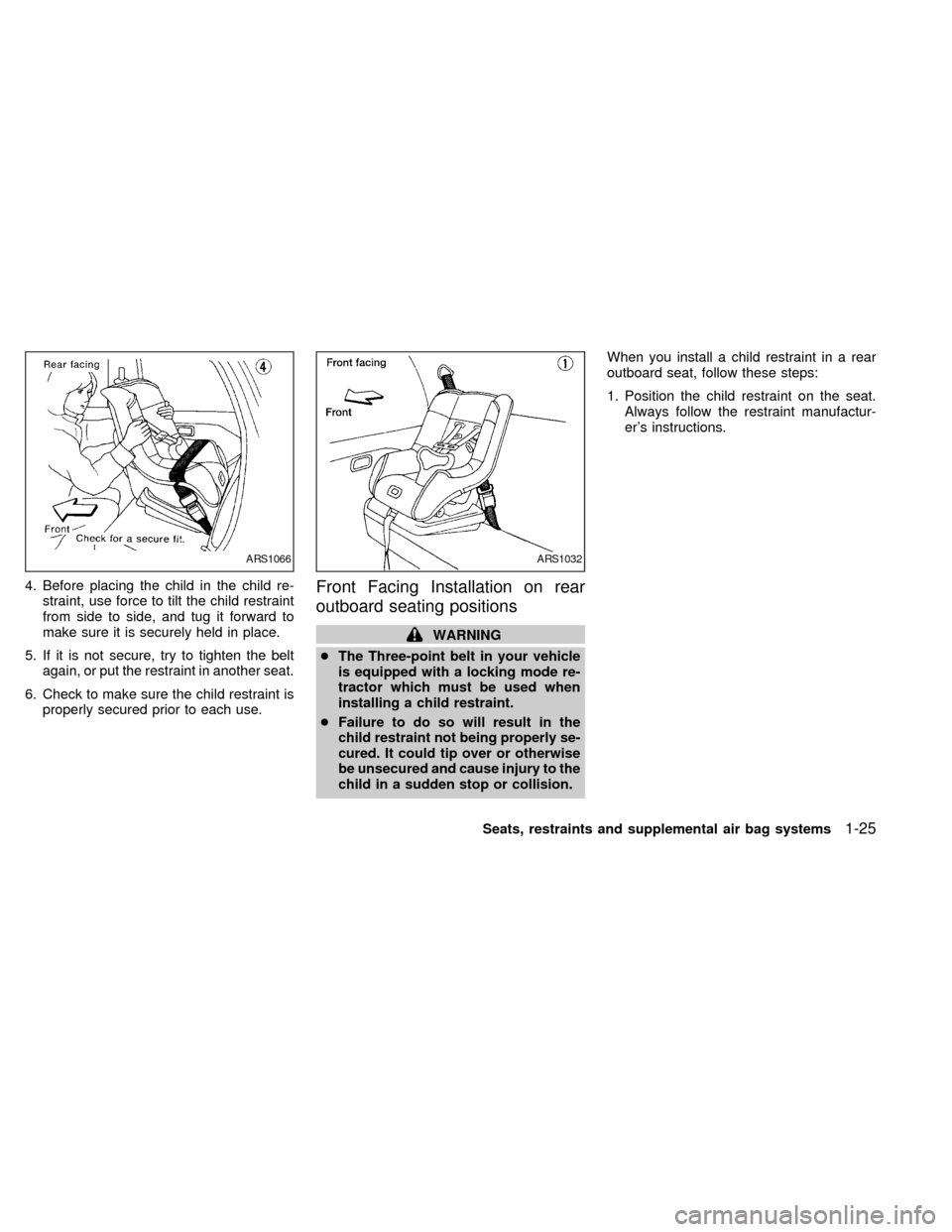
4. Before placing the child in the child re-
straint, use force to tilt the child restraint
from side to side, and tug it forward to
make sure it is securely held in place.
5. If it is not secure, try to tighten the belt
again, or put the restraint in another seat.
6. Check to make sure the child restraint is
properly secured prior to each use.Front Facing Installation on rear
outboard seating positions
WARNING
cThe Three-point belt in your vehicle
is equipped with a locking mode re-
tractor which must be used when
installing a child restraint.
cFailure to do so will result in the
child restraint not being properly se-
cured. It could tip over or otherwise
be unsecured and cause injury to the
child in a sudden stop or collision.When you install a child restraint in a rear
outboard seat, follow these steps:
1. Position the child restraint on the seat.
Always follow the restraint manufactur-
er's instructions.
ARS1066ARS1032
Seats, restraints and supplemental air bag systems1-25
ZX
Page 33 of 216
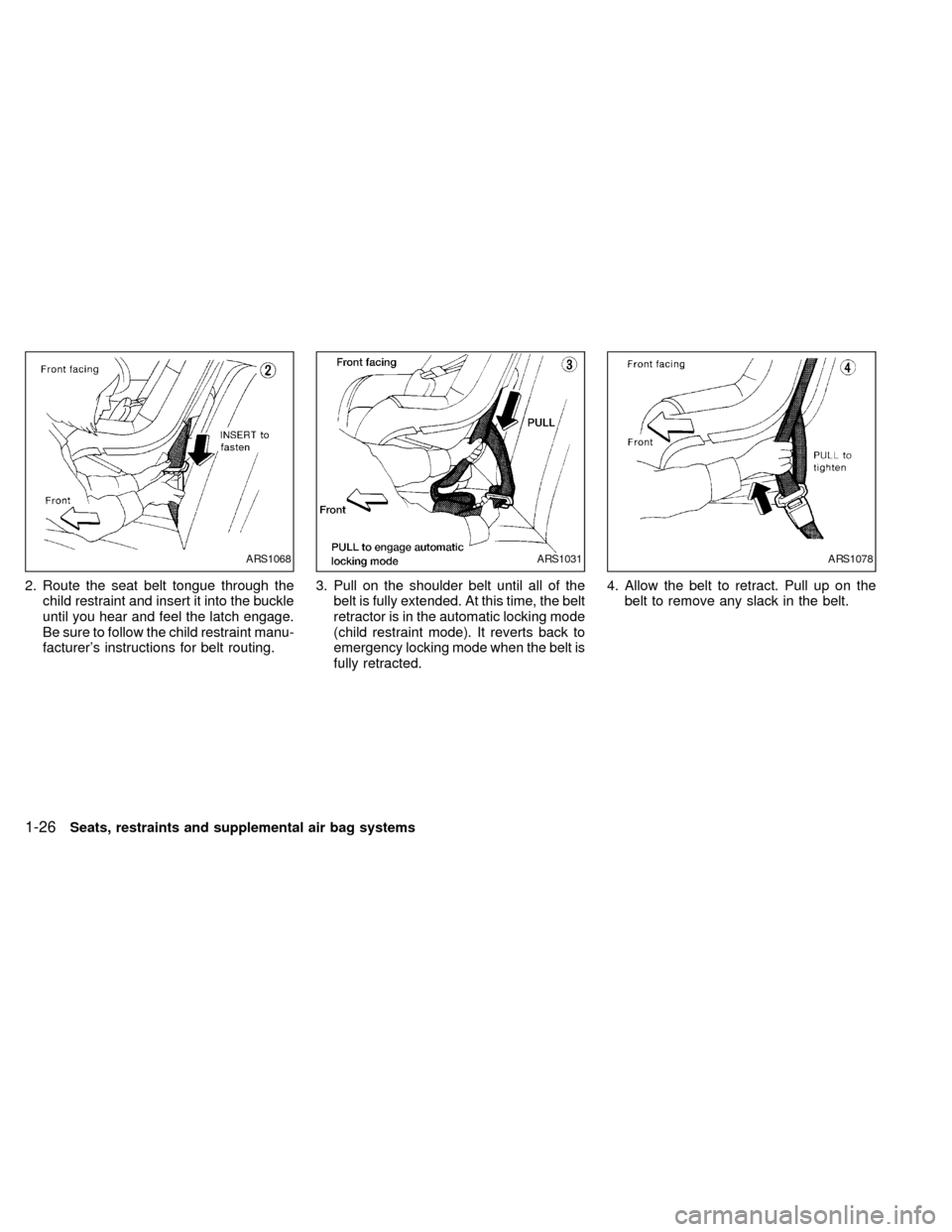
2. Route the seat belt tongue through the
child restraint and insert it into the buckle
until you hear and feel the latch engage.
Be sure to follow the child restraint manu-
facturer's instructions for belt routing.3. Pull on the shoulder belt until all of the
belt is fully extended. At this time, the belt
retractor is in the automatic locking mode
(child restraint mode). It reverts back to
emergency locking mode when the belt is
fully retracted.4. Allow the belt to retract. Pull up on the
belt to remove any slack in the belt.
ARS1068ARS1031ARS1078
1-26Seats, restraints and supplemental air bag systems
ZX