Page 197 of 216

ModelGA16DE SR20DE
Type Gasoline, 4-cycle, DOHC Gasoline, 4-cycle, DOHC
Cylinder arrangement 4-cylinder in-line 4-cylinder in-line
Bore ý Stroke in (mm) 2.992 ý 3.465 (76.0 ý 88.0) 3.386 ý 3.386 (86.0 ý 86.0)
Displacement cu in (cm
3) 97.45 (1,597) 121.92 (1,998)
Firing order1-3-4-2 1-3-4-2
Idle speed rpm
See the ``Emission Control label'' on the underside of the hood. Ignition timing degree (B.T.D.C.) at idle speed
degree/rpm
CO percentage at idle speed
[No air] %
Platinum-tipped type
(Standard for SR20DE)Conventional type
Spark plug Hot BKR4E-11 BKR5E
Standard BKR5E-11 PFR5B-11 BKR6E
Cold BKR6E-11 PFR6B-11, PFR7B-11 BKR7E
Camshaft operation Timing chain Timing chain
Spark plug gap in (mm) 0.039 to 0.043 (1.0 to 1.1) Ð 0.031 to 0.035 (0.8 to 0.9)
Generator belt size
Width ý Length in (mm)0.843 x 32.28
(21.4 x 820)
0.843 x 44.09
(21.4 x 1,120)*20.559 x 32.68
(14.2 x 830)
0.843 x 40.75
(21.4 x 1,035)*2
*1: With power steering *2: With air conditioner
The spark ignition system of this vehicle meets all requirements of the Canadian Interference-Causing Equipment Regulations.
ENGINE
10-8Technical and consumer information
ZX
Page 198 of 216

200SX SENTRA Wheel
DimensionOffset in
(mm)
Road wheel
139steel w/center
capÐ Base 13 ý 5J 1.38 (35)
139steel w/full cover Ð XE 13 ý 5J 1.38 (35)
149steel w/full cover Base, SE GXE 14 x 5.5JJ 1.47 (40)
149aluminum alloy Ð GLE 14 x 5.5JJ 1.57 (40)
159aluminum alloy SE-R SE 15 ý 6JJ 1.57 (40)
Conventional tire
size
P155/80R13 Base 13 x 5J
P175/70R13 XE 13 x 5J
P175/65R14 Base, SE GXE, GLE 14 x 5.5JJ
P195/55R15 SE-R SE 15 x 6JJ
Spare tire size
T115/70D14 Base, SE Base, XE,
GXE, GLE14ý4T
T135/70D15 SE-R SE 15 x 4T200SX SENTRA
Overall length in (mm) 171.8 (4,364) 171. (4,342)
Overall width in (mm) 66.6 (1,692) 66.6 (1,692)
Overall height in (mm) 54.2 (1,377) 54.5 (1,384)
Front tread
13-inch in (mm) 58.3 (1,481) 58.3 (1,481)
14/15-inch in (mm) 57.9 (1,471) 57.9 (1,471)
Rear tread
13-inch in (mm) 56.9 (1,445) 56.9 (1,445)
14/15-inch in (mm) 56.5 (1,435) 56.5 (1,435)
Wheelbase in (mm) 99.8 (2,535) 99.8 (2,535)
Gross vehicle weight
rating lb (kg)
See the ``F.M.V.S.S. certification
label'' on the driver's side door
pillar. Gross axle weight rating
Front lb (kg)
Rear lb (kg)
WHEEL/TIRE SIZE DIMENSIONS AND WEIGHTS
Technical and consumer information10-9
ZX
Page 199 of 216

When planning to travel in another coun-
try,you should first find out if the fuel avail-
able is suitable for your vehicle's engine.
Using fuel with too low an octane/cetane
rating may cause engine damage. All gaso-
line vehicles must be operated with un-
leaded gasoline. Therefore, avoid taking
your vehicle to areas where appropriate fuel
is not available.
When transferring the registration of
your vehicle to another country, state,
province or district,it may be necessary to
modify the vehicle to meet local laws and
regulations.
The laws and regulations for motor vehicle
emission control and safety standards vary
according to the country, state, province or
district. Therefore, vehicle specifications
may differ.
When any vehicle is to be taken into
another country, state, province or dis-
trict and registered, its modifications,
transportation, and registration are the
responsibility of the user. NISSAN is not
responsible for any inconvenience that
may result.
VEHICLE IDENTIFICATION
NUMBER (VIN) PLATE
The vehicle identification number (VIN)
plate is attached to the top of the instrument
panel on the driver's side. This number is
the identification for your vehicle and is
used in the vehicle registration.
VEHICLE IDENTIFICATION
NUMBER (Chassis number)
The chassis number is stamped as shown.
TI1050MATI1006
REGISTERING YOUR VEHICLE
IN ANOTHER COUNTRYVEHICLE IDENTIFICATION
10-10Technical and consumer information
ZX
Page 200 of 216
ENGINE SERIAL NUMBER
The engine serial number is stamped on the
engine as shown.
F.M.V.S.S. CERTIFICATION
LABEL
The Federal Motor Vehicle Safety Standard
(F.M.V.S.S.) certification label is affixed as
shown. This label contains valuable vehicle
information, such as: Gross Vehicle Weight
Ratings (GVWR), Gross Axle Weight Rating
(GAWR), month and year of manufacture,
Vehicle Identification Number, (VIN), etc.
Review it carefully.
ATI0608TI1032-AATI0606
Technical and consumer information10-11
ZX
Page 201 of 216
EMISSION CONTROL INFORMA-
TION LABEL
The emission control information label is
attached as shown.
TIRE PLACARD
The cold tire pressure is shown on the tire
placard affixed to the driver side center
pillar.
AIR CONDITIONER SPECIFICA-
TION LABEL
The air conditioner specification label is
affixed as shown.
ATI1008STI0010ATI1007
10-12Technical and consumer information
ZX
Page 202 of 216
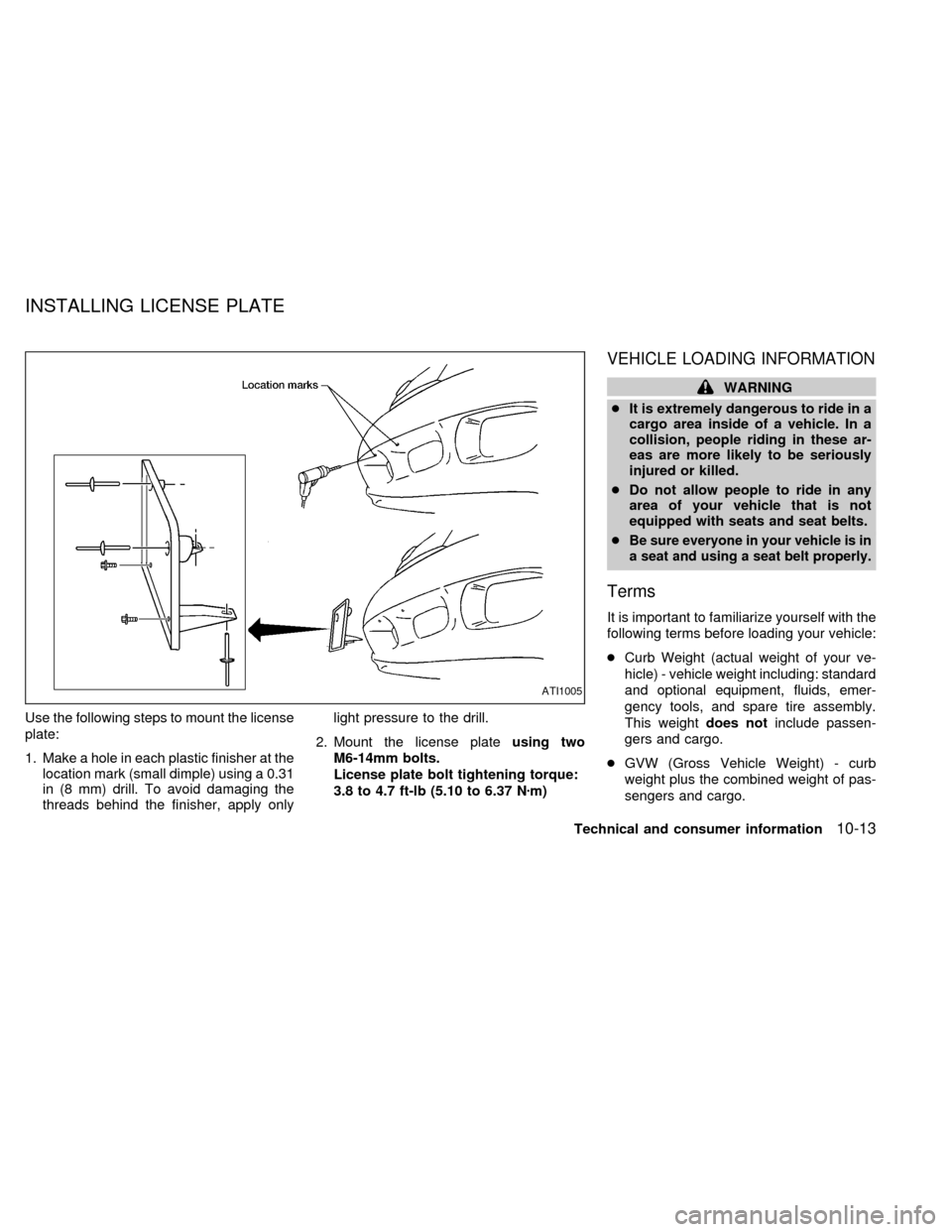
Use the following steps to mount the license
plate:
1. Make a hole in each plastic finisher at the
location mark (small dimple) using a 0.31
in (8 mm) drill. To avoid damaging the
threads behind the finisher, apply onlylight pressure to the drill.
2. Mount the license plateusing two
M6-14mm bolts.
License plate bolt tightening torque:
3.8 to 4.7 ft-lb (5.10 to 6.37 Nzm)
VEHICLE LOADING INFORMATION
WARNING
cIt is extremely dangerous to ride in a
cargo area inside of a vehicle. In a
collision, people riding in these ar-
eas are more likely to be seriously
injured or killed.
cDo not allow people to ride in any
area of your vehicle that is not
equipped with seats and seat belts.
c
Be sure everyone in your vehicle is in
a seat and using a seat belt properly.
Terms
It is important to familiarize yourself with the
following terms before loading your vehicle:
cCurb Weight (actual weight of your ve-
hicle) - vehicle weight including: standard
and optional equipment, fluids, emer-
gency tools, and spare tire assembly.
This weightdoes notinclude passen-
gers and cargo.
cGVW (Gross Vehicle Weight) - curb
weight plus the combined weight of pas-
sengers and cargo.
ATI1005
INSTALLING LICENSE PLATE
Technical and consumer information10-13
ZX
Page 203 of 216
cGVWR (Gross Vehicle Weight Rating) -
maximum total weight (load) limit speci-
fied for the vehicle.
cGAWR (Gross Axle Weight Rating) -
maximum weight (load) limit specified for
the front or rear axle.
Determining Vehicle Load Capacity
The load capacity of this vehicle is deter-
mined by weight, not by available cargo
space. For example, a luggage rack, bike
carrier, cartop carrier or similar equipment
does not increase the load carrying capacity
of your vehicle.
To determine vehicle load capacity:
Vehicle weight can be determined by using
a commercial-grade scale, found at places
such as a truck stop, gravel quarry, grain
elevator, or a scrap metal recycling facility.
1) Determine the curb weight of your ve-
hicle.
2) Compare the curb weight amount to the
GVWR specified for your vehicle to de-
termine how much more weight your
vehicle can carry.
3) After loading (cargo and passengers),re-weigh your vehicle to determine if
either GVWR or GAWR for your vehicle
is exceeded. If GVWR is exceeded, re-
move cargo as necessary. If either the
front or rear GAWR is exceeded, shift the
load or remove cargo as necessary.
Loading Tips
cThe GVW must not exceed GVWR or
GAWR as specified on the F.M.V.S.S.
Certification Label.
cDo not load the front and rear axle to the
GAWR. Doing so will exceed the GVWR.
WARNING
cProperly secure all cargo to help
prevent it from sliding or shifting. Do
not place cargo higher than the seat-
backs. In a sudden stop or collision,
unsecured cargo could cause per-
sonal injury.
cDo not load your vehicle any heavier
than the GVWR or the maximum
front and rear GAWRs. If you do,
parts on your vehicle can break, or it
can change the way your vehicle
handles. This could result in loss of
control and cause personal injury.cOverloading can shorten the life of
your vehicle. Failures caused by
overloading are not covered by your
warranty.
10-14Technical and consumer information
ZX
Page 204 of 216
Your new vehicle was designed to be used
primarily to carry passengers and cargo.
Remember that towing a trailer places ad-
ditional loads on your vehicle's engine, drive
train, steering, braking and other systems.
ANISSAN Trailer Towing Guideis avail-
able from your NISSAN dealer. This guide
includes information on trailer towing ability
and the special equipment required for
proper towing.
Maximum load limits
Maximum trailer loads
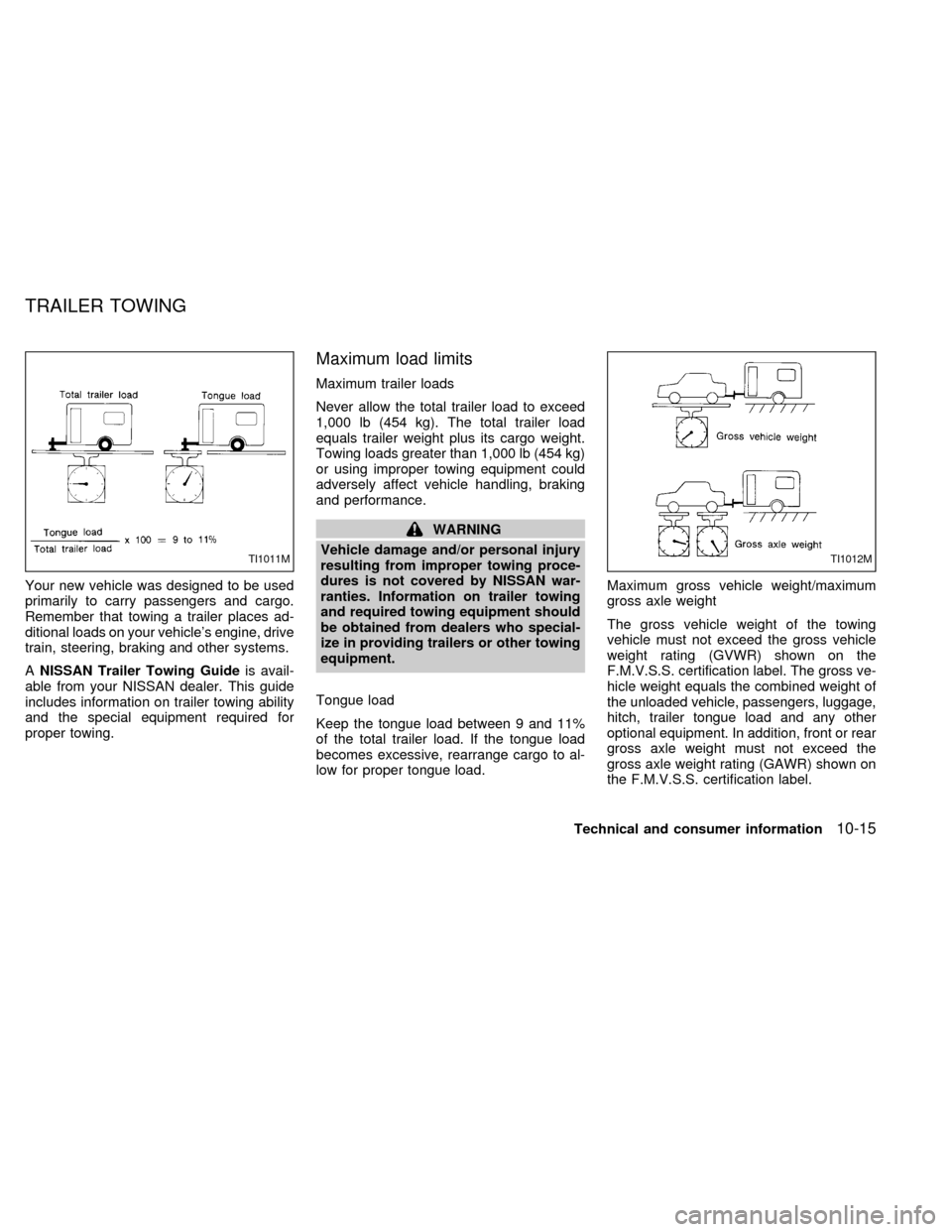
Never allow the total trailer load to exceed
1,000 lb (454 kg). The total trailer load
equals trailer weight plus its cargo weight.
Towing loads greater than 1,000 lb (454 kg)
or using improper towing equipment could
adversely affect vehicle handling, braking
and performance.
WARNING
Vehicle damage and/or personal injury
resulting from improper towing proce-
dures is not covered by NISSAN war-
ranties. Information on trailer towing
and required towing equipment should
be obtained from dealers who special-
ize in providing trailers or other towing
equipment.
Tongue load
Keep the tongue load between 9 and 11%
of the total trailer load. If the tongue load
becomes excessive, rearrange cargo to al-
low for proper tongue load.Maximum gross vehicle weight/maximum
gross axle weight
The gross vehicle weight of the towing
vehicle must not exceed the gross vehicle
weight rating (GVWR) shown on the
F.M.V.S.S. certification label. The gross ve-
hicle weight equals the combined weight of
the unloaded vehicle, passengers, luggage,
hitch, trailer tongue load and any other
optional equipment. In addition, front or rear
gross axle weight must not exceed the
gross axle weight rating (GAWR) shown on
the F.M.V.S.S. certification label.
TI1011MTI1012M
TRAILER TOWING
Technical and consumer information10-15
ZX