1998 NISSAN PATHFINDER washer fluid
[x] Cancel search: washer fluidPage 54 of 249

Engine oil pressure warning light
or
Brake warning light
Overdrive off indicator light
Charge warning light
Anti-lock brake warning light
(Except for Canada)
Turn signal/hazard indicator lights
Door open warning light
Anti-lock brake warning light
(For Canada)
High beam indicator light (Blue)
Seat belt warning light and buzzer
Automatic transmission park warning light
CRUISE indicator light
Supplemental air bag warning light
Automatic transmission oil temperature
warning light
Malfunction indicator light (MIL)
Low washer fluid warning light
(For Canada)
Tire carrier open warning light
Four-wheel drive indicator light
CHECKING BULBSTurn the ignition key to ON without starting the
engine. The following lights will come on:
,
,
or
,
,
The following lights come on briefly and then
go off:
,
or
,
If any light fails to come on, it may indicate a
burned-out bulb or an open circuit in the elec-
trical system. Have the system repaired
promptly.
WARNING LIGHTS
Engine oil pressure warning
light
This light warns of low engine oil pressure. If
the light flickers or comes on during normal
driving, pull off the road in a safe area, stop the
engineimmediatelyand call a NISSAN dealer
or other authorized repair shop.
The oil pressure warning light is not de-
signed to indicate a low oil level. Use the
dipstick to check the oil level.See ªEngine
oilº in the ª8. Do-it-yourselfº section.
Running the engine with the oil pressure
warning light on could cause serious
damage to the engine almost immedi-
ately. Turn off the engine as soon as it is
safe to do so.
WARNING/INDICATOR LIGHTS
AND BUZZERS
Instruments and controls
2-9
Z
01.1.31/R50-D
X
Page 55 of 249

Charge warning light
If the light comes on while the engine is
running, it may indicate that there is something
wrong with the charging system. Turn the
engine off and check the alternator belt. If the
belt is loose, broken, missing or if the light
remains on, see your NISSAN dealer immedi-
ately.Do not continue driving if the belt is
loose, broken or missing.
Door open warning light
This light comes on when any of the doors
and/or rear window are not closed securely
while the ignition key is ON.
Seat belt warning light and
buzzer
The light and buzzer remind you to fasten seat
belts. The light illuminates whenever the igni-
tion key is turned to ON, and will remain
illuminated until the driver's seat belt is fas-
tened. At the same time, the buzzer will sound
for about six seconds unless the driver's seat
belt is securely fastened.See ªSeat beltsº in the ª1. Seats, restraints and
supplemental air bag systemsº section for pre-
cautions on seat belt usage.
Supplemental air bag warning
light
When the ignition key is in the ON or ªSTARTº
position, the supplemental air bag light will
illuminate for about 7 seconds and then turn
off. This means the system is operational.
If any of the following conditions occur, the
supplemental air bag needs servicing and your
vehicle must be taken to your nearest autho-
rized NISSAN dealer.
1. The supplemental air bag light does not
come on and remain on for 7 seconds and
then go off as described above.
2. The supplemental air bag light flashes in-
termittently or remains on. (after 7 seconds)
3. The supplemental air bag light does not
come on at all.
Unless checked and repaired, the Supplemen-
tal Restraint System may not function properly.
For additional details on the Supplemental Air
Bag System, see Section 2.
If the supplemental air bag warning light
is on, it could mean that the supplemen-
tal air bag system will not operate in an
accident.
Low washer fluid warning
light (For Canada)
This light comes on when the washer fluid in
the washer tank is at a low level. Add washer
fluid as necessary. See ªWindow washer fluidº
in the ª8. Do-it-yourselfº section.
or
Brake warning light
This light functions for both the parking brake
and the foot brake systems.
Parking brake indicator:
The light comes on when the parking brake is
applied.
Low brake fluid warning light:
When the ignition key is in the ON position, the
light warns of a low brake fluid level. If the light
comes on while the engine is running, stop the
vehicle and perform the following:
2-10
Instruments and controls
Z
01.1.31/R50-D
X
Page 135 of 249

To lock the steering wheel, remove the key.
To unlock the steering wheel, insert the key
and turn it gently while rotating the steer-
ing wheel slightly right and left.Never remove the key while driving. If
the key is removed, the steering wheel
will lock. This may cause the driver to
lose control of the vehicle and could
result in serious vehicle damage or per-
sonal injury.KEY POSITIONSOFF (1)
The engine can be turned off without locking
the steering wheel.
ACC (Accessories) (2)
This position activates electrical accessories
such as the radio when the engine is not
running.
ON (Normal operating position) (3)
This position turns on the ignition system and
the electrical accessories.START (4)
This position activates the starter motor, start-
ing the engine.IMake sure the area around the vehicle is
clear.
ICheck fluid levels such as engine oil, cool-
ant, brake and clutch fluid, window washer
fluid as frequently as possible, at least
whenever you refuel.
ICheck to be sure that all windows and light
lenses are clean.
IVisually inspect tires for their appearance
and condition. Also check tires for proper
inflation.
ILock all doors.
IPosition seat and adjust head restraints.
IAdjust inside and outside mirrors.
IFasten seat belts and ask all passengers to
do likewise.
ICheck the operation of warning lights when
key is turned to the ON (3) position.
BEFORE STARTING THE ENGINE
5-8
Starting and driving
Z
01.1.31/R50-D
X
Page 154 of 249

TIRE EQUIPMENT1. SUMMER tires are of a tread design to
provide superior performance on dry pave-
ment. However, the performance of these
tires will be substantially reduced in snowy
and icy conditions. If you operate your
vehicle on snowy or icy roads, NISSAN
recommends the use of MUD & SNOW or
ALL SEASON tires on all four wheels.
Please consult your NISSAN dealer for the
tire type, size, speed rating and availability
information.
2. For additional traction on icy roads, studded
tires may be used. However, some Prov-
inces and States prohibit their use, so,
before installing studded tires, check local,
state and provincial laws.
Skid and traction capabilities of studded
snow tires, on wet or dry surfaces, may be
poorer than that of non-studded snow tires.
3. Tire chains may be used if desired. Make
sure they are of proper size for the tires on
your vehicle and are installed according to
the chain manufacturer's suggestions. Use
of tire chains may be prohibited according
to location. Check the local laws before
installing tire chains. When installing tire
chains, make sure they are of proper sizefor the tires on your vehicle and are in-
stalled according to the chain manufactur-
er's suggestions.Use only SAE Class S
chains.Other types may damage your
vehicle. Use chain tensioners when recom-
mended by the tire chain manufacturer to
ensure a tight fit. Loose end links of the tire
chain must be secured or removed to pre-
vent the possibility of whipping action dam-
age to the fenders or underbody. If pos-
sible, avoid fully loading your vehicle when
using tire chains. In addition, drive at a
reduced speed. Otherwise, your vehicle
may be damaged and/or vehicle handling
and performance may be adversely af-
fected.
Do not use the chains on dry roads.
SPECIAL WINTER EQUIPMENTIt is recommended that the following items be
carried in the vehicle during winter:
1. A scraper and stiff-bristled brush to remove
ice and snow from the windows and wiper
blades.
2. A sturdy, flat board to be placed under the
jack to give it firm support.
3. A shovel to dig the vehicle out of snow-
drifts.4. Extra window washer fluid to refill the res-
ervoir tank.
Starting and driving
5-27
Z
01.1.31/R50-D
X
Page 176 of 249

8 Do-it-yourselfMaintenance precautions .......................................... 8-2
Engine compartment check locations ....................... 8-3
Engine cooling system .............................................. 8-4
Engine oil .................................................................. 8-7
Automatic transmission fluid ..................................... 8-9
Power steering fluid ................................................ 8-11
Brake and clutch fluid ............................................. 8-11
Window washer fluid ............................................... 8-12
Battery ..................................................................... 8-13
Drive belts ............................................................... 8-14
Spark plugs ............................................................. 8-14
Air cleaner ............................................................... 8-16
Windshield wiper blades ......................................... 8-17
Parking brake and brake pedal ............................... 8-18
Clutch pedal ............................................................ 8-20
Fuses....................................................................... 8-20
Lights ....................................................................... 8-21
Tires and wheels ..................................................... 8-26
Clutch housing drain ................................... 8-30
Z
01.1.31/R50-D
X
Page 187 of 249
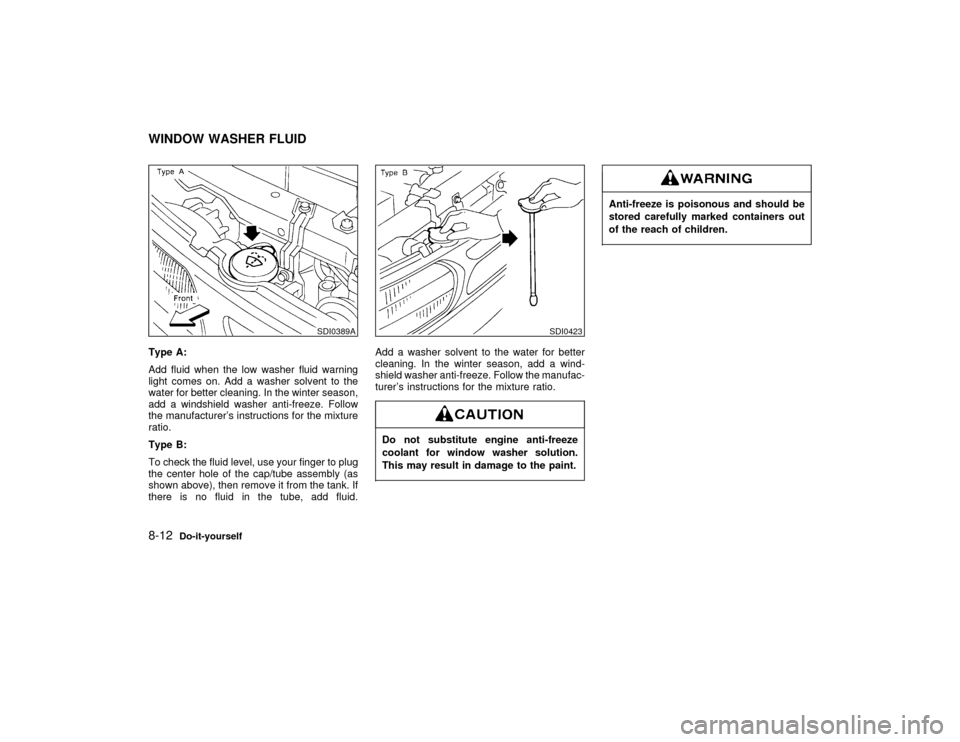
Type A:
Add fluid when the low washer fluid warning
light comes on. Add a washer solvent to the
water for better cleaning. In the winter season,
add a windshield washer anti-freeze. Follow
the manufacturer's instructions for the mixture
ratio.
Type B:
To check the fluid level, use your finger to plug
the center hole of the cap/tube assembly (as
shown above), then remove it from the tank. If
there is no fluid in the tube, add fluid.Add a washer solvent to the water for better
cleaning. In the winter season, add a wind-
shield washer anti-freeze. Follow the manufac-
turer's instructions for the mixture ratio.
Do not substitute engine anti-freeze
coolant for window washer solution.
This may result in damage to the paint.
Anti-freeze is poisonous and should be
stored carefully marked containers out
of the reach of children.
SDI0389A
SDI0423
WINDOW WASHER FLUID8-12
Do-it-yourself
Z
01.1.31/R50-D
X
Page 211 of 249

Parking brake*Check that the lever has the
proper travel and confirm that your vehicle is
held securely on a fairly steep hill with only the
parking brake applied.
Automatic transmission P position mecha-
nismOn a fairly steep hill check that your
vehicle is held securely with the selector lever
in the P position without applying any brakes.Under the hood and vehicleThe maintenance items listed here should be
checked periodically e.g. each time you check
the engine oil or refuel.
Windshield washer fluid*Check that there is
adequate fluid in the tank.
Engine coolant level*Check the coolant level
when the engine is cold.
Radiator and hosesCheck the front of the
radiator and clean off any dirt, insects, leaves,
etc., that may have accumulated. Make sure
the hoses have no cracks, deformation, rot or
loose connections.
Brake and clutch fluid levels*Make sure that
the brake and clutch fluid level is between the
MAX and MIN lines on the reservoir.
Battery*Check the fluid level in each cell. Itshould be between the MAX and MIN lines.
Engine drive belts*Make sure that no belt is
frayed, worn, cracked or oily.
Engine oil level*Check the level after parking
the vehicle on a level spot and turning off the
engine. (Be sure to wait a few minutes to allow
the oil to drain back into the sump.)
Power steering fluid level* and linesCheck
the level when the fluid is cold and the engine
is turned off. Check the lines for proper attach-
ment, leaks, cracks, etc.
Automatic transmission fluid level*Check
the level after putting the selector lever in P
(Park) with the engine idling.
Exhaust systemMake sure there are no
loose supports, cracks or holes. If the sound of
the exhaust seems unusual or there is a smell
of exhaust fumes, immediately locate the
trouble and correct it. See ªPrecautions when
starting and drivingº in the ª5. Starting and
drivingº section for exhaust gas (carbon mon-
oxide).
UnderbodyThe underbody is frequently ex-
posed to corrosive substances such as those
used on icy roads or to control dust. It is veryimportant to remove these substances, other-
wise rust will form on the floor pan, frame, fuel
lines and around the exhaust system. At the
end of winter, the underbody should be thor-
oughly flushed with plain water, being careful
to clean those areas where mud and dirt may
accumulate. For additional information, see
ªCleaning exteriorº in the ª7. Appearance and
careº section.
Fluid leaksCheck under the vehicle for fuel,
oil, water or other fluid leaks after the vehicle
has been parked for a while. Water dripping
from the air conditioner after use is normal. If
you should notice any leaks or if gasoline
fumes are evident, check for the cause and
have it corrected immediately.9-4
Maintenance
Z
01.1.31/R50-D
X
Page 243 of 249

Checking
Brake pedal ............................................... 8-18
Bulb ............................................................. 2-9
Engine coolant level .................................... 8-4
Engine oil level ............................................ 8-7
Parking brake ............................................ 8-18
Seat belt operation, Three-point ............... 1-21
Child restraint.................................................. 1-25
Installation on front seat ............................ 1-36
Installation on rear seat center ................. 1-27
Installation on rear seat outboard ............. 1-30
Precaution ................................................. 1-25
Top strap ................................................... 1-34
Child safety
Rear door lock ............................................. 3-3
Seat belt .................................................... 1-18
Chrome parts, Cleaning .................................... 7-3
Cigarette lighter and ashtray .......................... 2-22
Cleaner, Air ..................................................... 8-16
Cleaning
Exterior ........................................................ 7-2
Interior ......................................................... 7-4
Clock ............................................................... 2-33
Adjusting .................................................... 2-33
Operation ................................................... 2-34
Clutch
Fluid ........................................................... 8-11
Housing drain,
................................. 8-30
Pedal ......................................................... 8-20
Cold weather driving ....................................... 5-26
Compact disc (CD) player operation, with
cassette player type........................................ 4-23
Compass display .............................................. 2-7
Console box .................................................... 2-25Controls, Heater and manual air conditioner.... 4-3
Controls, Heater and semiautomatic air
conditioner ........................................................ 4-9
Cooling system, Engine .................................... 8-4
Corrosion protection ......................................... 7-5
Cover, Tonneau .............................................. 2-29
Cruise control.................................................. 5-16
Cup holder ...................................................... 2-24
D
Defogger switch, Rear window and outside
mirror............................................................... 2-16
Dimensions and weights, Vehicle ................. 10-11
Door .................................................................. 3-2
Door open warning light ................................. 2-10
Drinking alcohol/drugs and driving ................... 5-4
Drive belt......................................................... 8-14
Driving
Cold weather ............................................. 5-26
On snow or ice .......................................... 5-28
On-pavement and offroad ........................... 5-4
Precaution ................................................... 5-2
The vehicle .................................................. 5-9
Drugs ................................................................ 5-4
EEconomy, Fuel ................................................ 5-19
Emission control
Information label ...................................... 10-13
System warranty...................................... 10-19
Engine
Block heater .............................................. 5-28Compartment check location....................... 8-3
Coolant heater ........................................... 5-28
Coolant temperature gauge ........................ 2-4
Cooling system ............................................ 8-4
Oil ................................................................ 8-7
Oil and oil filter recommendation .............. 10-6
Overheat ...................................................... 6-9
Serial number .......................................... 10-12
Specifications ............................................ 10-9
Exhaust gas (Carbon monoxide) ...................... 5-2
Explanation of maintenance items .......... 9-2, 9-10
Exterior and interior light, Replacement ......... 8-23
F
F.M.V.S.S. certification label......................... 10-13
Fastening the seat belt
Three-point ................................................ 1-20
Two-point ................................................... 1-23
Filling, Fuel filler lid ......................................... 3-11
Filter, Air ......................................................... 8-16
Flasher switch, Hazard warning ..................... 2-19
Flat tire .............................................................. 6-2
Floor mats, Cleaning ........................................ 7-4
Fluid
Automatic transmission ............................... 8-9
Brake ......................................................... 8-11
Engine ......................................................... 8-7
Power steering .......................................... 8-11
Window washer ......................................... 8-12
Fog light switch ............................................... 2-19
Four by four clutch housing drain ................... 8-30
Four wheel drive, Using .................................. 5-20
Z
01.1.31/R50-D
X
11-2