Page 15 of 249
HEAD RESTRAINT ADJUSTMENTHead restraints should be adjusted
properly as they may provide significant
protection against injury in an accident.
Do not remove them. Check the adjust-
ment after someone else uses the seat.Adjust the head restraints so the top is level
with the top of your ears.
To raise the head restraint, just pull it up. Tolower, push the lock knob and push the head
restraint down.
ARMRESTPull the armrest forward until it is horizontal.Properly secure all cargo to help prevent
it from sliding or shifting. Do not place
cargo higher than the seatbacks. In a
sudden stop or collision, unsecured
cargo could cause personal injury.
SPA0014
SPA0351
1-8
Seats, restraints and supplemental air bag systems
Z
01.1.31/R50-D
X
Page 16 of 249

This Supplemental Restraint System section
contains important information concerning the
driver and passenger supplemental air bags.
The Supplemental Restraint System Air Bag
can help reduce impact force to the driver and
to the front passenger in certain frontal colli-
sions. The supplemental air bags are designed
tosupplementthe crash protection provided
by the driver and passenger seat belts and are
not a substitutefor them. The seat belts
should always be correctly worn and the driver
and front passenger seated a suitable distance
away from the steering wheel and instrument
panel. (See ªSeat beltsº later in this section for
instructions and precautions on seat belt us-
age.)
After turning the ignition key to the ON
position, the supplemental air bag warning
light illuminates. The supplemental air bag
warning light will turn off after about 7
seconds if the system is operational.
IThe supplemental air bags ordinarily
will not inflate in the event of a side
impact, rear impact, roll over, or
lower severity frontal collision. Al-
ways wear your seat belts to help
reduce the risk or severity of injury in
various kinds of accidents.
IThe seat belts and the supplemental
air bags are most effective when you
are sitting back and upright in the
seat. Supplemental air bags inflate
with great force. If you are unre-
strained, leaning forward, sitting
sideways or out of position in any
way, you are at greater risk of injury
or death in a crash and may also
receive serious or fatal injuries from
the supplemental air bag if you are up
against it when it inflates. Always sit
back against the seatback and as far
away as practical from the steering
SSS0096
SUPPLEMENTAL RESTRAINT
SYSTEM
Seats, restraints and supplemental air bag systems
1-9
Z
01.1.31/R50-D
X
Page 17 of 249
wheel or instrument panel. Always
use the seat belts.
IKeep hands on the outside of the
steering wheel. Placing them inside
the steering wheel rim could increase
the risk that they are injured when the
supplemental air bag inflates.
SSS0098
1-10
Seats, restraints and supplemental air bag systems
Z
01.1.31/R50-D
X
Page 18 of 249
SSS0006
SSS0007
SSS0008
Seats, restraints and supplemental air bag systems
1-11
Z
01.1.31/R50-D
X
Page 19 of 249
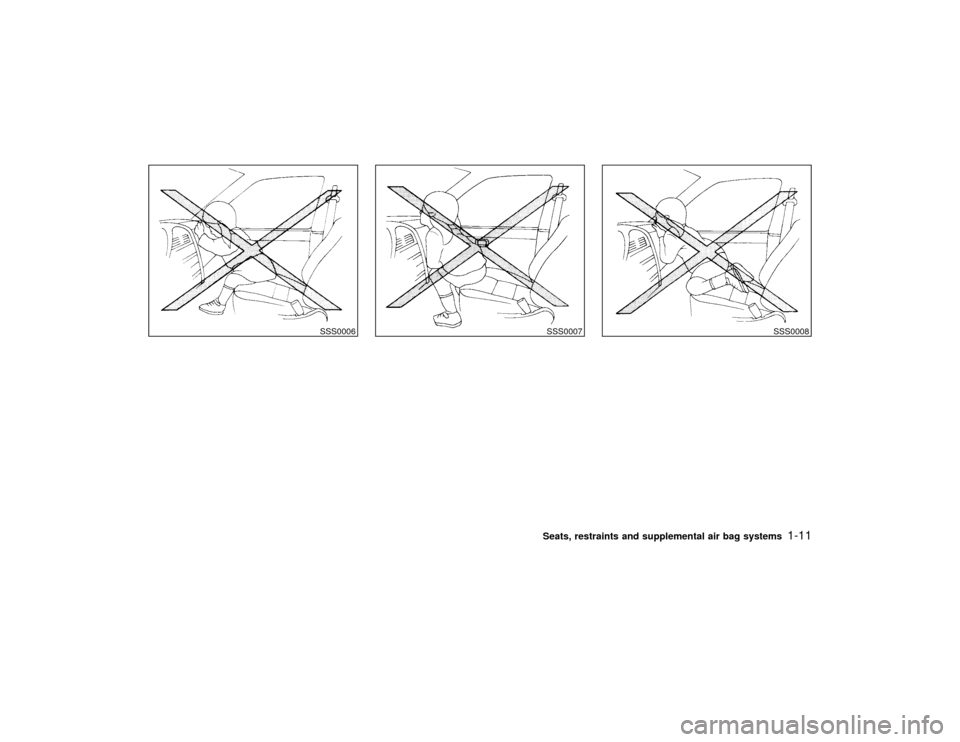
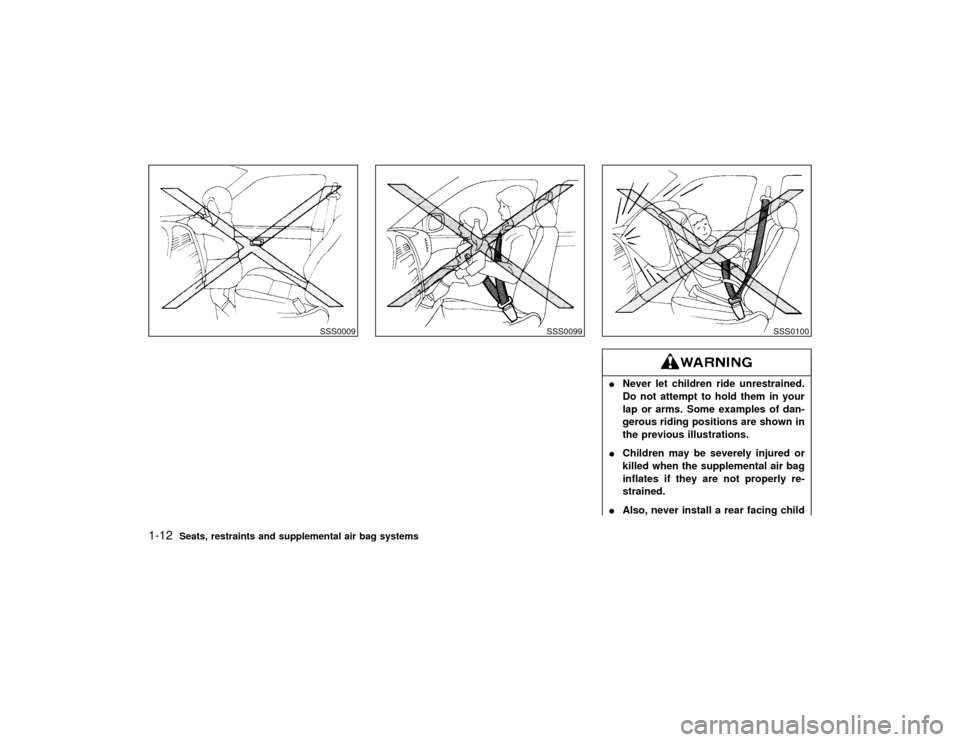
INever let children ride unrestrained.
Do not attempt to hold them in your
lap or arms. Some examples of dan-
gerous riding positions are shown in
the previous illustrations.
IChildren may be severely injured or
killed when the supplemental air bag
inflates if they are not properly re-
strained.
IAlso, never install a rear facing child
SSS0009
SSS0099
SSS0100
1-12
Seats, restraints and supplemental air bag systems
Z
01.1.31/R50-D
X
Page 20 of 249

restraint in the front seat. An inflating
supplemental air bag could seriously
injury or kill your child. See ªSeat
beltsº later in this section for infants
and small children.
Supplemental air bag systemThe driver supplemental air bag is located in
the center of the steering wheel; the front
passenger supplemental air bag is mounted in
the dashboard above the glove box. The
supplemental air bag system is designed to
inflate in higher severity frontal collisions, al-
though it may inflate if the forces in another
type of collision are similar to those of a higher
severity frontal impact. It may not inflate in
certain frontal collisions. Vehicle damage (or
lack of it) is not always an indication of proper
supplemental air bag operation.When the supplemental air bag inflates, a fairly
loud noise may be heard, followed by release
of smoke. This smoke is not harmful and does
not indicate a fire, but care should be taken not
to inhale it, as it may cause irritation and
choking. Those with a history of a breathing
condition should get fresh air promptly.
Supplemental air bags, along with the use of
seat belts, help to cushion the impact force on
the face and chest of the occupant. They can
help save lives and reduce serious injuries.
However, an inflating supplemental air bag
may cause facial abrasions or other injuries.
Supplemental air bags do not provide restraint
to the lower body.
SPA0390B
Seats, restraints and supplemental air bag systems
1-13
Z
01.1.31/R50-D
X
Page 21 of 249

The seat belts should be correctly worn and
the driver and passenger seated upright as far
as practical away from the steering wheel or
dashboard. Since the supplemental air bag
inflates quickly in order to help protect the
occupant, the force of the supplemental air
bag inflating can increase the risk of injury if
the occupant is too close to or is against the
supplemental air bag module during inflation.
The supplemental air bag will deflate quickly
after a collision.
After turning the ignition key to the ON
position, the supplemental air bag warning
light illuminates. The supplemental air bag
warning light will turn off after about 7
seconds if the system is operational.IDo not place any objects on the steer-
ing wheel pad or on the instrument
panel. Also, do not place any objects
between any occupant and the steer-
ing wheel or instrument panel. Such
objects may become dangerous pro-
jectiles and cause injury if the supple-
mental air bag inflates.
IRight after inflation, several supple-mental air bag system components
will be hot. Do not touch them; you
may severely burn yourself.
INo unauthorized changes should be
made to any components or wiring of
the supplemental air bag system.
This is to prevent accidental inflation
of the supplemental air bag or dam-
age to the supplemental air bag sys-
tem.
IDo not make unauthorized changes
to your vehicle's electrical system,
suspension system or front end
structure. This could affect proper
operation of the supplemental air bag
system.
ITampering with the supplemental air
bag system may result in serious
personal injury. Tampering includes
changes to the steering wheel and
the instrument panel assembly by
placing material over the steering
wheel pad and above the dashboard,
or by installing additional trim mate-
rial around the supplemental air bag
system.IWork around and on the supplemen-
tal air bag system should be done by
an authorized NISSAN dealer. Instal-
lation of electrical equipment should
also be done by an authorized
NISSAN dealer. The SRS wiring har-
nesses* should not be modified or
disconnected. Unauthorized electri-
cal test equipment and probing de-
vices should not be used on the
supplemental air bag system.
* The SRS wiring harnesses are cov-
ered with yellow insulation either just
before the harness connectors or
over the complete harness for easy
identification.
When selling your vehicle, we request that you
inform the buyer about the supplemental air
bag system and guide the buyer to the appro-
priate sections in this Owner's Manual.
1-14
Seats, restraints and supplemental air bag systems
Z
01.1.31/R50-D
X
Page 22 of 249
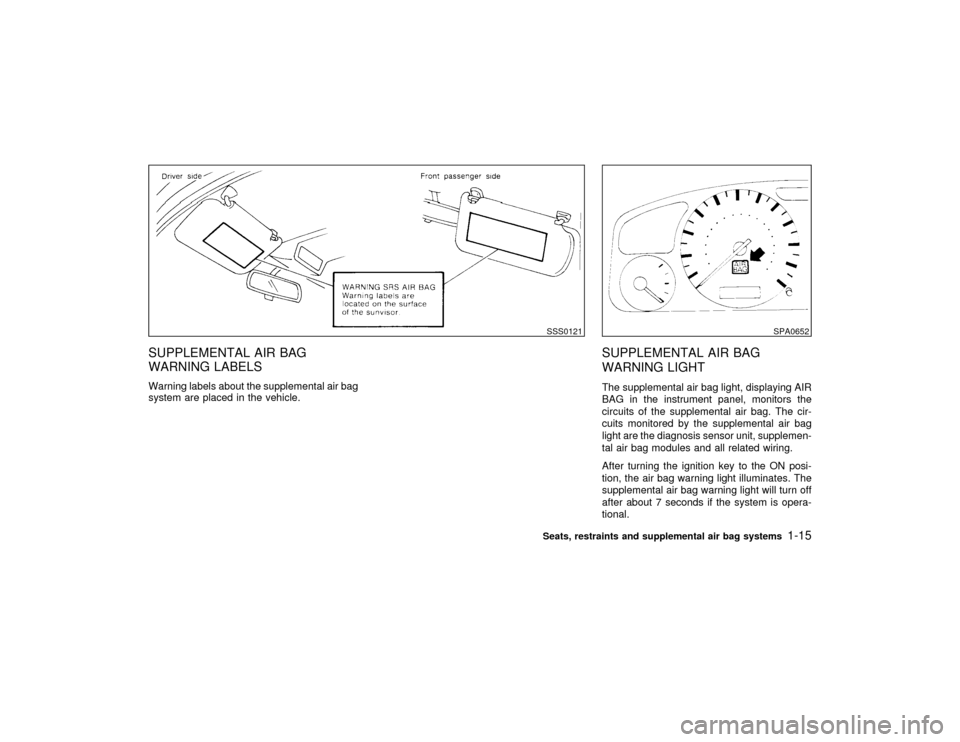
SUPPLEMENTAL AIR BAG
WARNING LABELSWarning labels about the supplemental air bag
system are placed in the vehicle.
SUPPLEMENTAL AIR BAG
WARNING LIGHTThe supplemental air bag light, displaying AIR
BAG in the instrument panel, monitors the
circuits of the supplemental air bag. The cir-
cuits monitored by the supplemental air bag
light are the diagnosis sensor unit, supplemen-
tal air bag modules and all related wiring.
After turning the ignition key to the ON posi-
tion, the air bag warning light illuminates. The
supplemental air bag warning light will turn off
after about 7 seconds if the system is opera-
tional.
SSS0121
SPA0652
Seats, restraints and supplemental air bag systems
1-15
Z
01.1.31/R50-D
X