Page 2278 of 2490
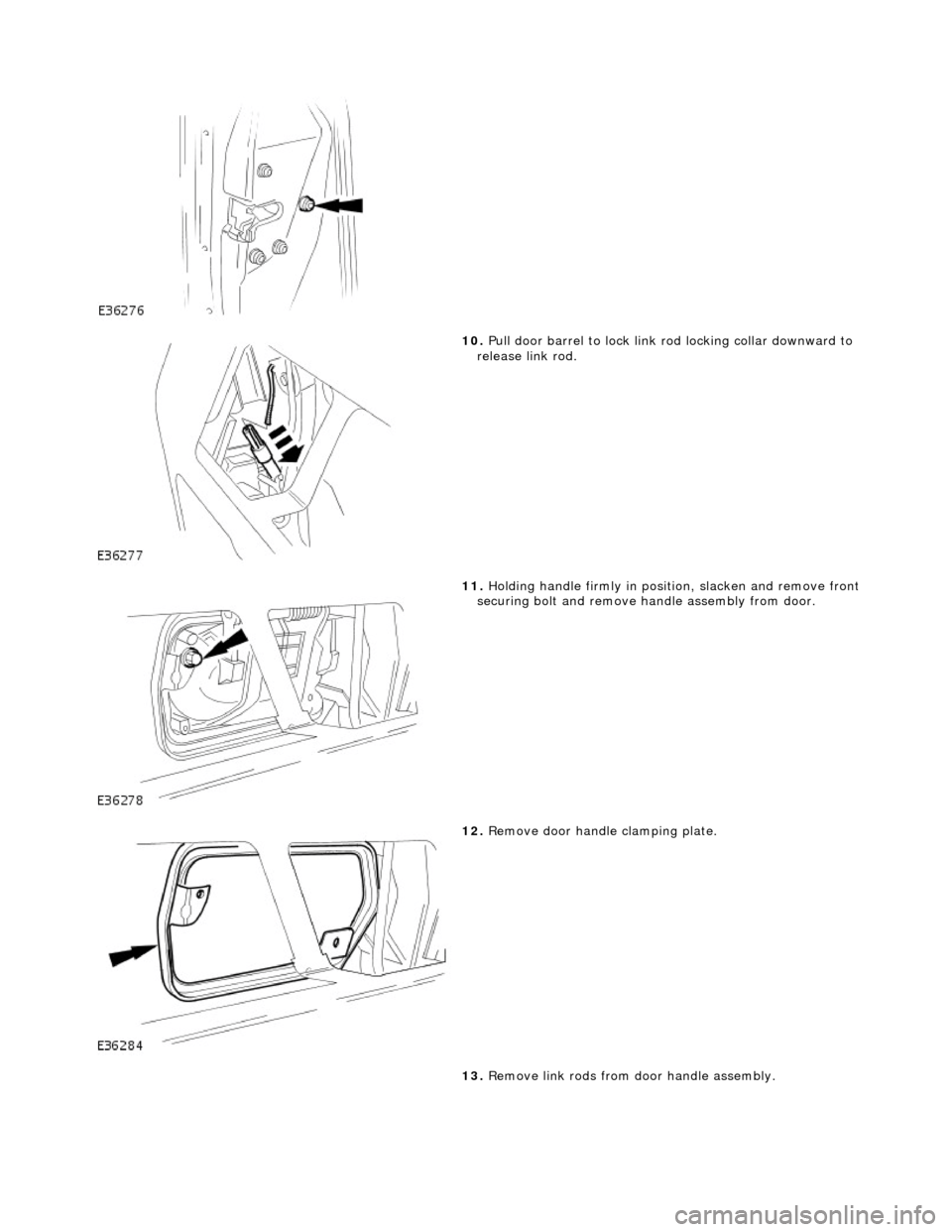
10. Pull door barrel to lock link rod locking collar downward to
release link rod.
11. Holding handle firmly in posi tion, slacken and remove front
securing bolt and remove ha ndle assembly from door.
12. Remove door handle clamping plate.
13. Remove link rods from door handle assembly.
Page 2279 of 2490
Installation
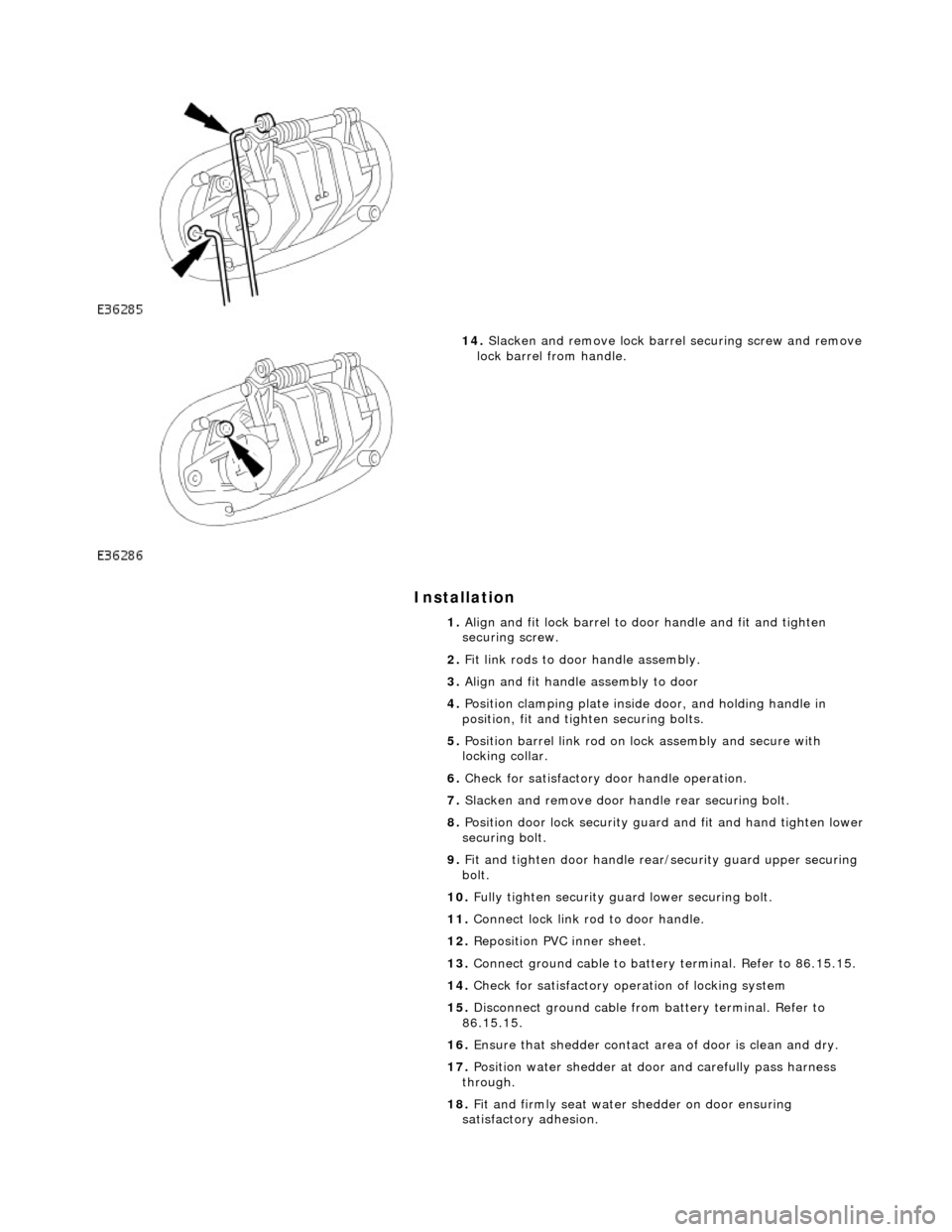
14. Slacken and remove lock barre l securing screw and remove
lock barrel from handle.
1. Align and fit lock barrel to door handle and fit and tighten
securing screw.
2. Fit link rods to door handle assembly.
3. Align and fit handle assembly to door
4. Position clamping plate inside door, and holding handle in
position, fit and tighten securing bolts.
5. Position barrel link rod on lock assembly and secure with
locking collar.
6. Check for satisfactory door handle operation.
7. Slacken and remove door handle rear securing bolt.
8. Position door lock security guard and fit and hand tighten lower
securing bolt.
9. Fit and tighten door handle rear /security guard upper securing
bolt.
10. Fully tighten security guard lower securing bolt.
11. Connect lock link rod to door handle.
12. Reposition PVC inner sheet.
13. Connect ground cable to battery terminal. Refer to 86.15.15.
14. Check for satisfactory operation of locking system
15. Disconnect ground cable from battery terminal. Refer to
86.15.15.
16. Ensure that shedder contact area of door is clean and dry.
17. Position water shedder at door and carefully pass harness
through.
18. Fit and firmly seat water shedder on door ensuring
satisfactory adhesion.
Page 2287 of 2490
Handles, Locks, Latches and Entry Systems - Luggage Compartment Lid
Latch
Removal and Installation
Removal
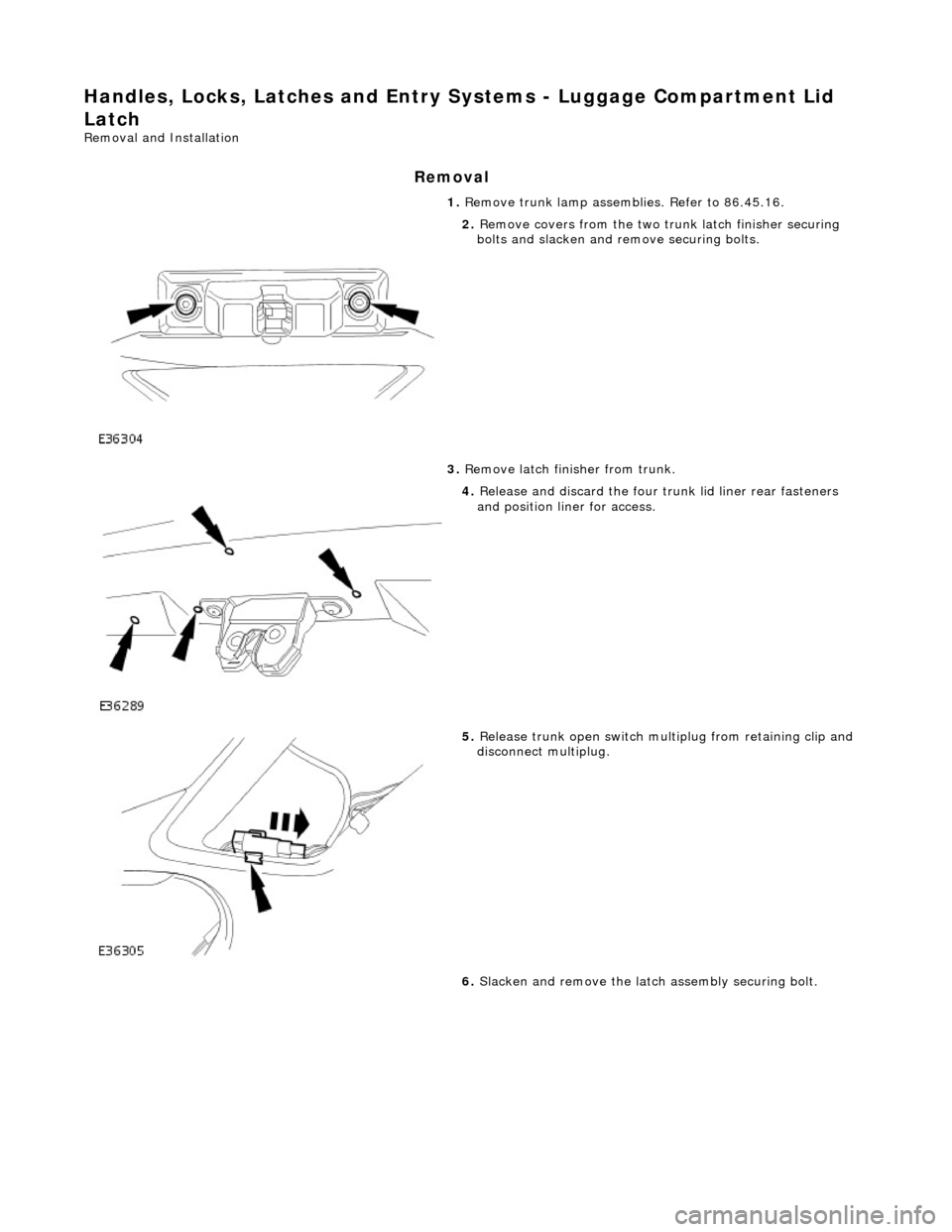
1. Remove trunk lamp assemblies. Refer to 86.45.16.
2. Remove covers from the two tr unk latch finisher securing
bolts and slacken and remove securing bolts.
3. Remove latch finisher from trunk.
4. Release and discard the four trunk lid liner rear fasteners
and position liner for access.
5. Release trunk open switch multiplug from retaining clip and
disconnect multiplug.
6. Slacken and remove the latch assembly securing bolt.
Page 2290 of 2490
Handles, Locks, Latches and Entry Systems - Luggage Compartment Lid
Latch Actuator
Removal and Installation
Removal
1. Remove battery cover and disconnect ground cable from
battery terminal. Refer to 86.15.19.
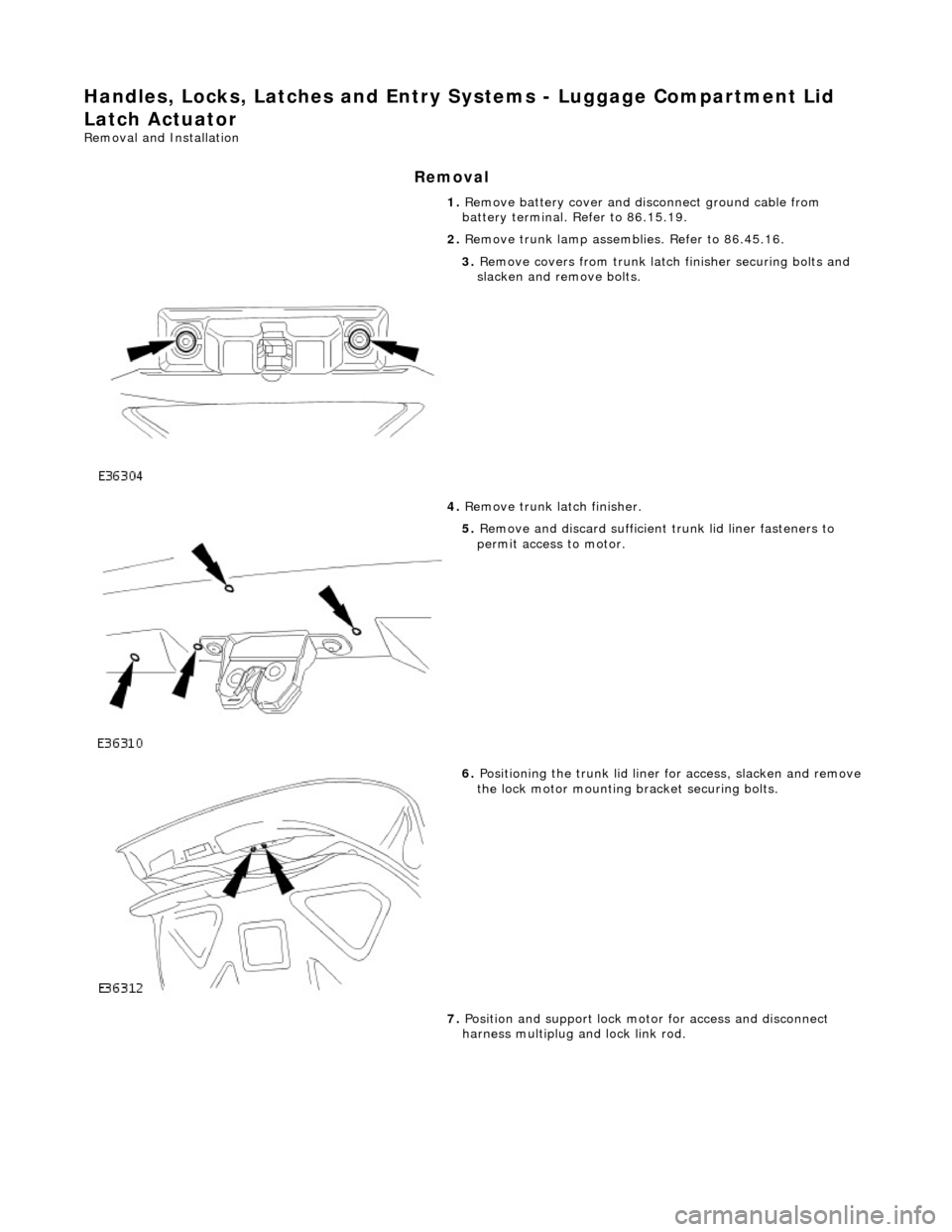
2. Remove trunk lamp assemblies. Refer to 86.45.16.
3. Remove covers from trunk latch finisher securing bolts and
slacken and remove bolts.
4. Remove trunk latch finisher.
5. Remove and discard sufficient trunk lid liner fasteners to
permit access to motor.
6. Positioning the trunk lid liner for access, slacken and remove
the lock motor mounting bracket securing bolts.
7. Position and support lock moto r for access and disconnect
harness multiplug and lock link rod.
Page 2292 of 2490
Handles, Locks, Latches and Entry Systems - Luggage Compartment Lid
Release Switch
Removal and Installation
Removal
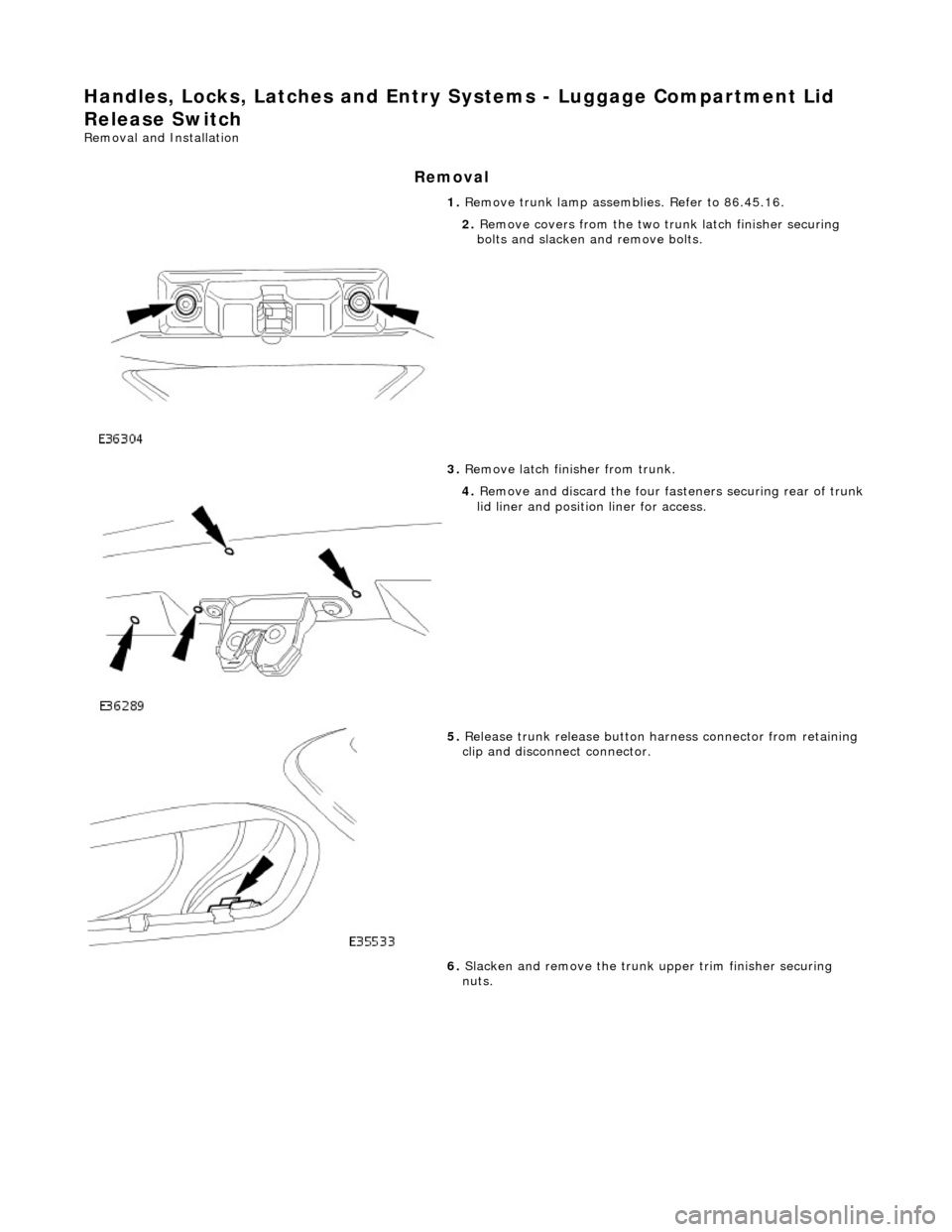
1. Remove trunk lamp assemblies. Refer to 86.45.16.
2. Remove covers from the two tr unk latch finisher securing
bolts and slacken and remove bolts.
3. Remove latch finisher from trunk.
4. Remove and discard the four fast eners securing rear of trunk lid liner and position liner for access.
5. Release trunk release button harness connector from retaining
clip and disconnect connector.
6. Slacken and remove the trunk u pper trim finisher securing
nuts.
Page 2294 of 2490
Handles, Locks, Latches and Entry Systems - Luggage Compartment Lid
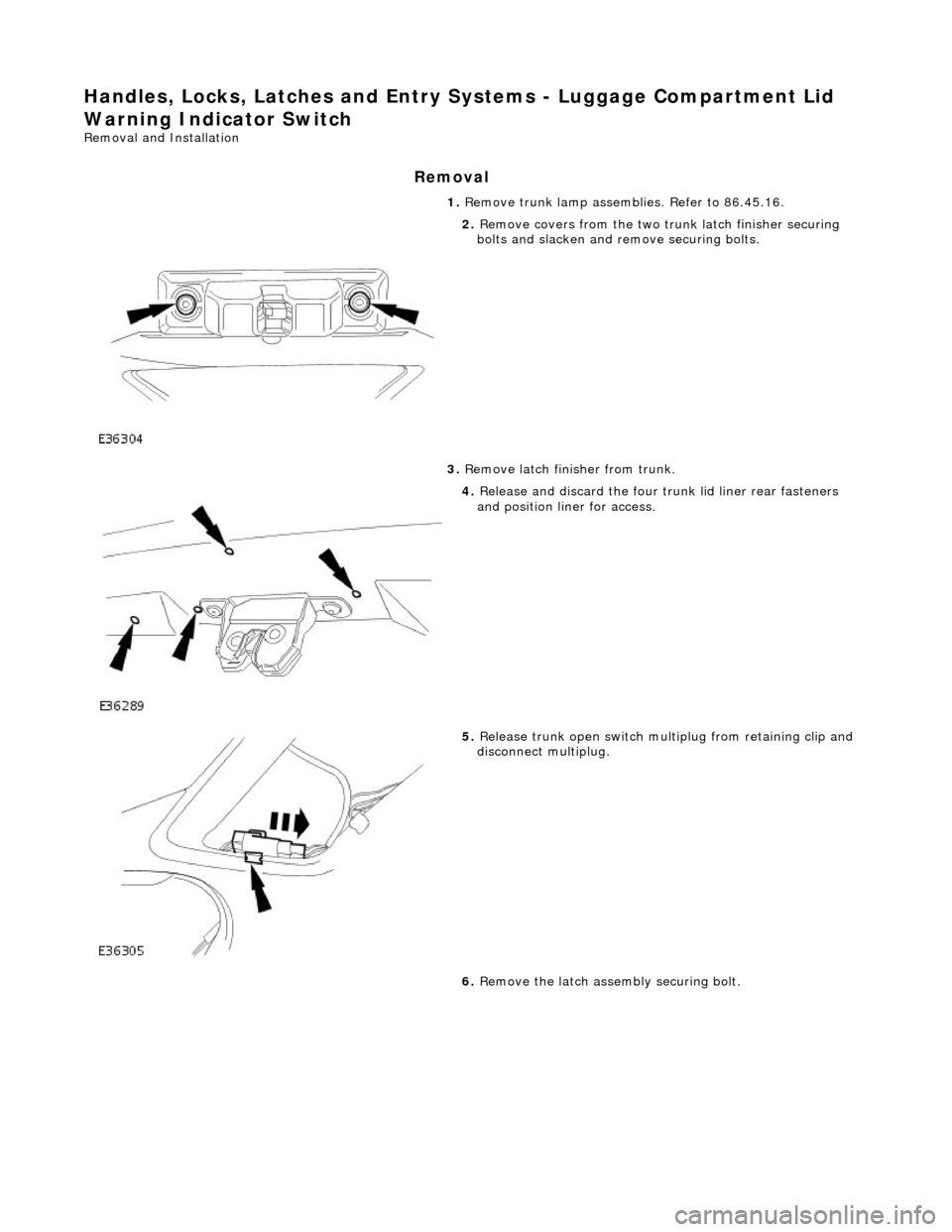
Warning Indicator Switch
Removal and Installation
Removal
1. Remove trunk lamp assemblies. Refer to 86.45.16.
2. Remove covers from the two tr unk latch finisher securing
bolts and slacken and remove securing bolts.
3. Remove latch finisher from trunk.
4. Release and discard the four trunk lid liner rear fasteners
and position liner for access.
5. Release trunk open switch multiplug from retaining clip and
disconnect multiplug.
6. Remove the latch assembly securing bolt.
Page 2307 of 2490
cooling duct.
The windshield washer is operated by pressing the button at the end of the wiper control stalk switch. Pressing and
releasing the button operates the washer for 1 to 1.4 seconds and the wiper completes three sweeps. An optional drip wipe
function adds a further sweep of the wiper after a 4 second delay, to clear residual fluid from the windshield. If the button is
held depressed, the washer and wiper will operate continuous ly for up to 20 seconds. When the button is released, the
wiper will again complete three further sweeps.
Headlamp Powerwash
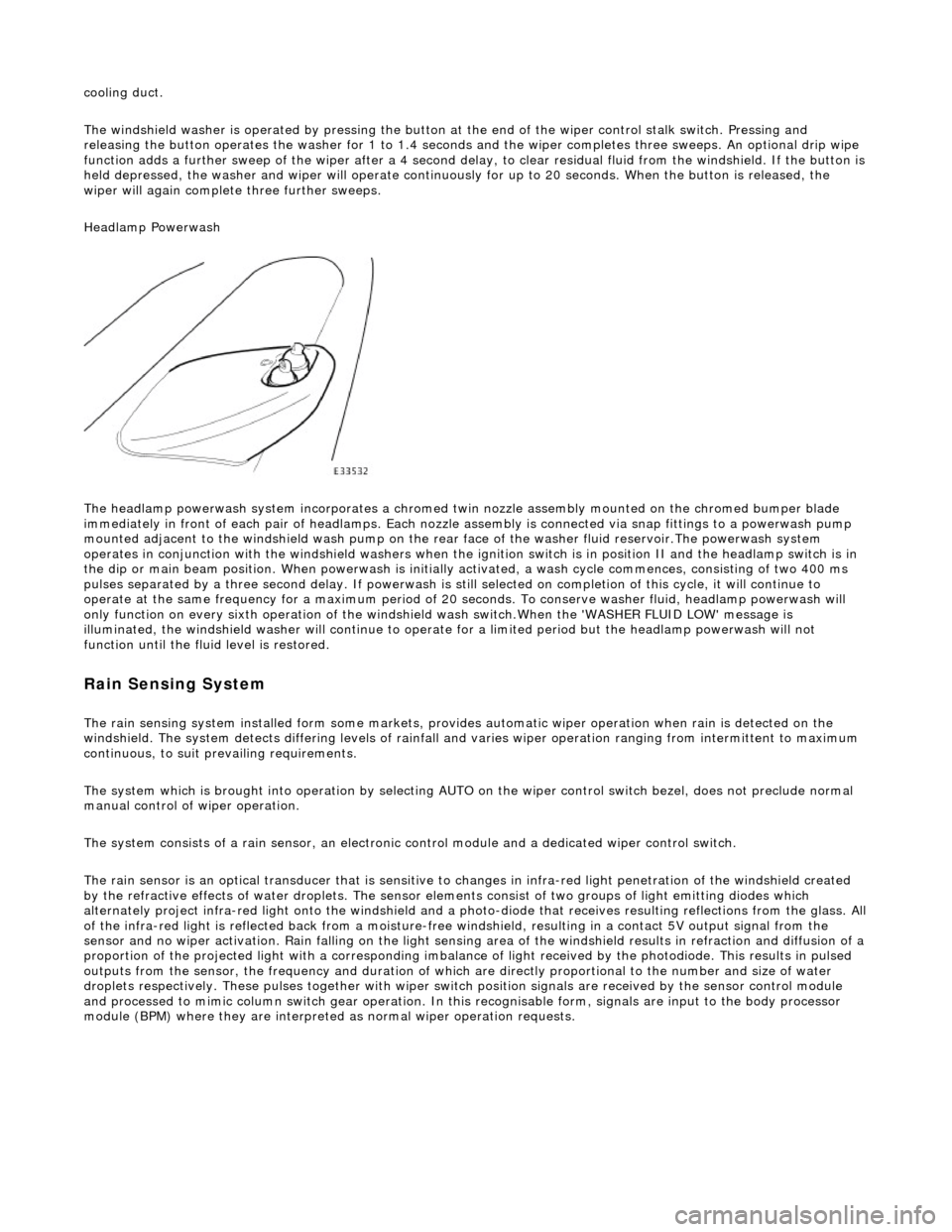
The headlamp powerwash system incorporates a chromed twin nozzle assembly mounted on the chromed bumper blade
immediately in front of each pair of he adlamps. Each nozzle assembly is connected via snap fittings to a powerwash pump
mounted adjacent to the windshield wash pump on the rear face of the washer fluid reservoir.The powerwash system
operates in conjunction with the windshield washers when the ignition switch is in position II and the headlamp switch is in
the dip or main beam position. When powerwash is initially activated, a wash cycle commences, consisting of two 400 ms
pulses separated by a three second delay. If powerwash is still selected on completion of this cycle, it will continue to
operate at the same frequency for a maximum period of 20 se conds. To conserve washer fluid, headlamp powerwash will
only function on every sixth operation of the windshie ld wash switch.When the 'WASHER FLUID LOW' message is
illuminated, the windshield washer will continue to operat e for a limited period but the headlamp powerwash will not
function until the fluid level is restored.
Rain Sensing System
The rain sensing system installed form so me markets, provides automatic wiper operation when rain is detected on the
windshield. The system detects differing le vels of rainfall and varies wiper operation ranging from intermittent to maximum
continuous, to suit prevailing requirements.
The system which is brought into operation by selecting AUTO on the wiper control switch bezel, does not preclude normal
manual control of wiper operation.
The system consists of a rain sensor, an electronic control module and a dedicated wiper control switch.
The rain sensor is an optical transducer that is sensitive to changes in infra-red light penetration of the windshield created
by the refractive effects of water drople ts. The sensor elements consist of two groups of light emitting diodes which
alternately project infra-red light onto th e windshield and a photo-diode that receiv es resulting reflections from the glass. A ll
of the infra-red light is reflected back from a moisture-free windshield, resulting in a contact 5V output signal from the
sensor and no wiper activation. Rain falling on the light sensing area of the wi ndshield results in refraction and diffusion of a
proportion of the projected light with a corresponding imbalance of light received by the photodiode. This results in pulsed
outputs from the sensor, the frequency and duration of which are directly proportional to the number and size of water
droplets respectively. These pulses together with wiper switch position signals are received by the sensor control module
and processed to mimic column switch gear operation. In this recognisable form, signals are input to the body processor
module (BPM) where they are interprete d as normal wiper operation requests.
Page 2310 of 2490
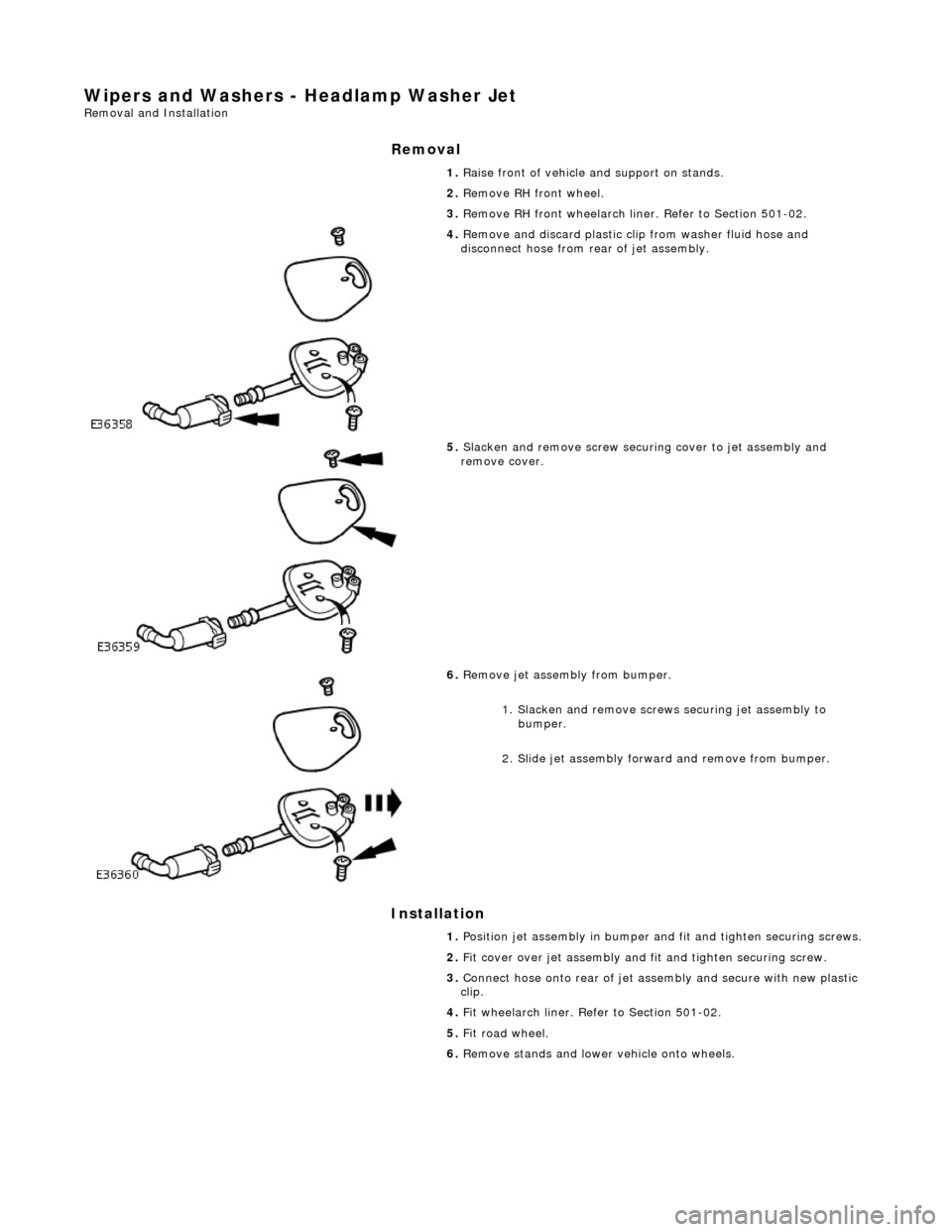
Wipers and Washers - Headlamp Washer Jet Removal and Installation
Removal
Installation
1.
Raise front of vehicle and support on stands.
2. Remove RH front wheel.
3. Remove RH front wheelarch liner. Refer to Section 501-02.
4. Remove and discard plastic clip from washer fluid hose and
disconnect hose from rear of jet assembly.
5. Slacken and remove screw securing cover to jet assembly and
remove cover.
6. Remove jet assembly from bumper.
1. Slacken and remove screws securing jet assembly to bumper.
2. Slide jet assembly forward and remove from bumper.
1. Position jet assembly in bumper an d fit and tighten securing screws.
2. Fit cover over jet assembly and fit and tighten securing screw.
3. Connect hose onto rear of jet asse mbly and secure with new plastic
clip.
4. Fit wheelarch liner. Refer to Section 501-02.
5. Fit road wheel.
6. Remove stands and lower vehicle onto wheels.