1998 ISUZU TROOPER ECO mode
[x] Cancel search: ECO modePage 217 of 3573

AIR CONDITIONING 1BÐ91
6. Heating Start Timing Control
When the automatic heater/air conditioner is
started, heating is turned on under following
conditions.
·The detected temperature of thermo unit is
136¡F or less.
·The temperature setting signal and the total
signal by each sensor meet the condition of
heating.
When the detected temperature by the coolant
temperature sensor is 136¡F or less the blower
fan motor is set to work at low speed and the
"DEF" mode is selected.
When the detected temperature by the coolant
temperature sensor is 77¡F or more, the blow
mode changes automatic control. And the
blower fan speed is controlled to be lineally up
from "LO" to "MAX HI".7. Cooling Start Timing Control
When the automatic heater/air conditioner is
started, cooling is turned on under following
conditions.
·The in car sensor is 86¡F or more.
·The temperature setting signal and the signals
from each sensor meet the specified condition.
The blower fan speed is set to "LO" for
maximum 7 seconds when cooling start
conditions meet, and then, is controlled to be
lineally up to "MAX HI" by 5.32%/S.
Ignition swich
"ON"
Time
Blower voltage to turn
on the cooling
7 SEC maximum3 SEC
100%
(MAX HI)
33.5%
(LO)5.32%/S
C06RY00001
33.5%
(LO)
2.63%/S
Mode
DEF
Auto
Mode
100%
(MAX HI)
Ignition
switch "ON"
Thermo Unit 58¡C(Gasoline)
52¡C(Diesel) Time
840RY00009
Page 222 of 3573
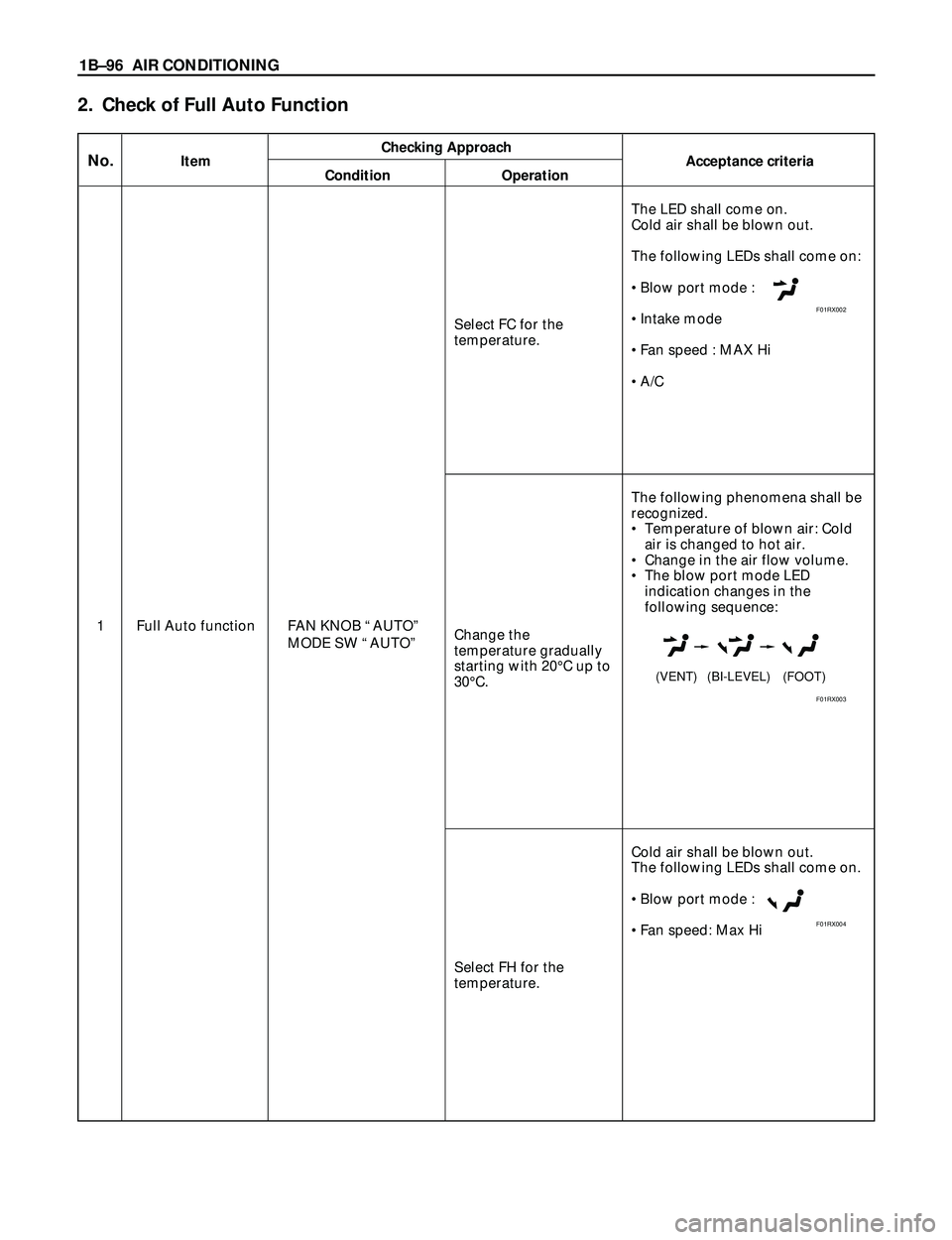
1BÐ96 AIR CONDITIONING
Checking ApproachNo.ItemAcceptance criteria
Condition Operation
Change the
temperature gradually
starting with 20¡C up to
30¡C.The following phenomena shall be
recognized.
¥ Temperature of blown air: Cold
air is changed to hot air.
¥ Change in the air flow volume.
¥ The blow port mode LED
indication changes in the
following sequence:
Select FH for the
temperature.Cold air shall be blown out.
The following LEDs shall come on.
¥ Blow port mode :
¥ Fan speed: Max Hi Select FC for the
temperature.The LED shall come on.
Cold air shall be blown out.
The following LEDs shall come on:
¥ Blow port mode :
¥ Intake mode
¥ Fan speed : MAX Hi
¥ A/C
1 Full Auto function FAN KNOB ÒAUTOÓ
MODE SW ÒAUTOÓ
2. Check of Full Auto Function
(VENT) (FOOT)(BI-LEVEL)
F01RX003 F01RX002
F01RX004
Page 223 of 3573

AIR CONDITIONING 1BÐ97
TROUBLESHOOTING WITH SELF-DIAGNOSIS FUNCTION
1. Overview of Self-Diagnosis Function
The self-diagnosis is implemented in 3 steps for each target. For detail of check procedure contained in
each step, refer to the relevant section of "Check Procedure by Failed Location" listed in the Self-
Diagnosis Operation Procedure.
For turning on the self-diagnosis function and switching of the check step, refer to the flow chart given
below. You can reset the self-diagnosis function by turning the ignition switch off or turning the DEF
switch on for 3 seconds.
2. Self-Diagnosis Operation Procedure
While holding both the Auto switch and the DEF switch on the
automatic heater/air conditioner panel, turn the IG off and then
on.
Does the A/C LED flash every 0.5 second interval?
Press the A/C switch once.
(The past trouble
diagnosing function will
be turned on.)
Does the A/C LED flashes every 0.5 seconds?
Does each output equipment functions normally according to
operation of the temperature setting lever?
Press the DEF switch for 3
seconds consecutively or turn on
and off the IG.
Failure on the
output equipment
or the harness.
Preparations
(1) Set the IG to the OFF mode.
(2) Apply 60W bulb light to the sun sensor.
(3) Set the temperature setting lever on the automatic heater/air
conditioner panel to the center position (25C).
(4) Set the fan switch on the same panel to the Auto position.
End of the self-diagnosis.(The current trouble diagnosing function will be turned on
approximately in 10 seconds.)
YESNO
YESNO
NO
YES
Refer to *1.
Refer to *2.
Page 224 of 3573
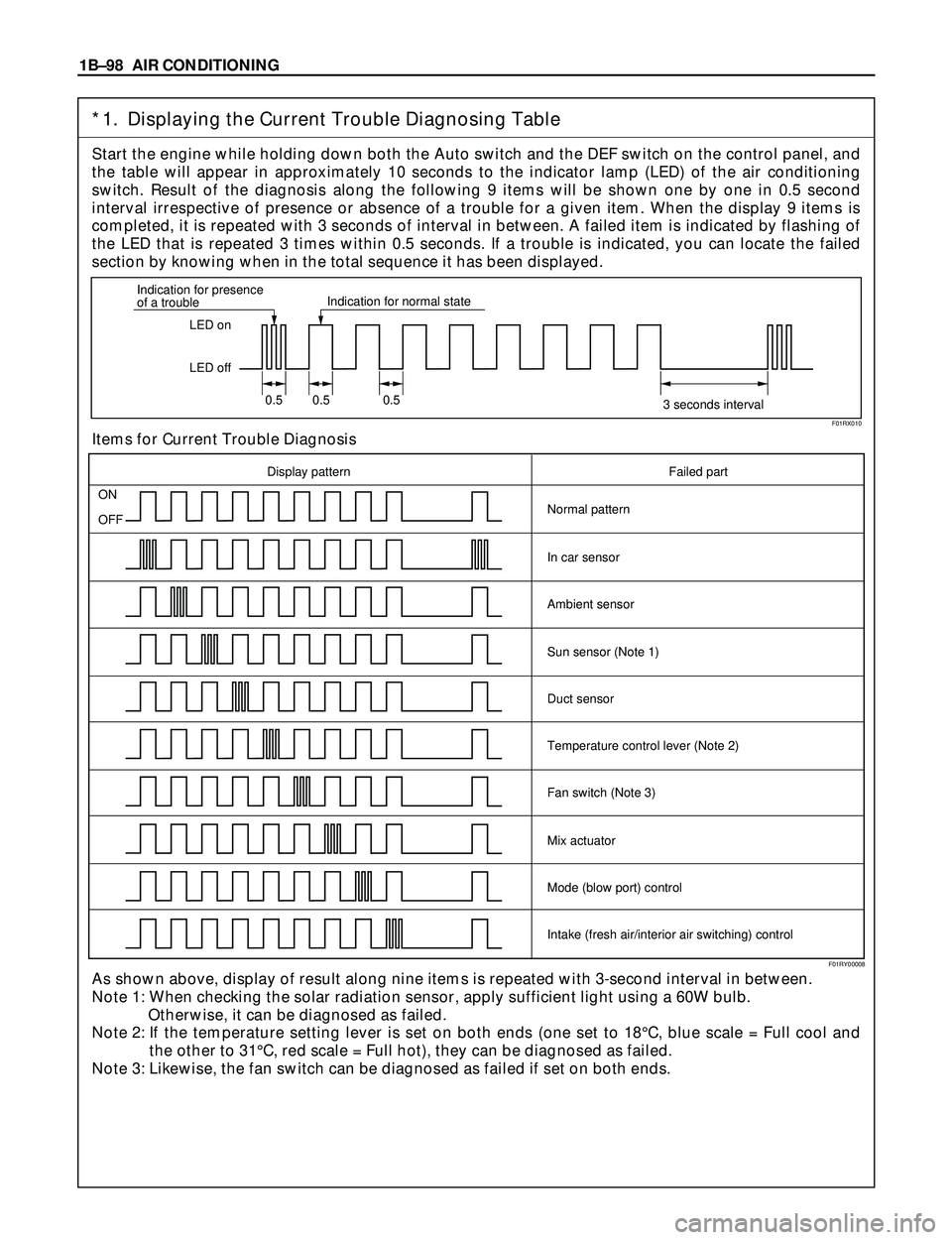
1BÐ98 AIR CONDITIONING
*1. Displaying the Current Trouble Diagnosing Table
Start the engine while holding down both the Auto switch and the DEF switch on the control panel, and
the table will appear in approximately 10 seconds to the indicator lamp (LED) of the air conditioning
switch. Result of the diagnosis along the following 9 items will be shown one by one in 0.5 second
interval irrespective of presence or absence of a trouble for a given item. When the display 9 items is
completed, it is repeated with 3 seconds of interval in between. A failed item is indicated by flashing of
the LED that is repeated 3 times within 0.5 seconds. If a trouble is indicated, you can locate the failed
section by knowing when in the total sequence it has been displayed.
Items for Current Trouble Diagnosis
As shown above, display of result along nine items is repeated with 3-second interval in between.
Note 1: When checking the solar radiation sensor, apply sufficient light using a 60W bulb.
Otherwise, it can be diagnosed as failed.
Note 2: If the temperature setting lever is set on both ends (one set to 18¡C, blue scale = Full cool and
the other to 31¡C, red scale = Full hot), they can be diagnosed as failed.
Note 3: Likewise, the fan switch can be diagnosed as failed if set on both ends.
LED on
LED off Indication for presence
of a troubleIndication for normal state
0.5 0.5 0.5
3 seconds interval
ON
OFF
Display pattern Failed part
Normal pattern
In car sensor
Ambient sensor
Sun sensor (Note 1)
Duct sensor
Temperature control lever (Note 2)
Fan switch (Note 3)
Mix actuator
Mode (blow port) control
Intake (fresh air/interior air switching) control
F01RX010
F01RY00008
Page 225 of 3573

AIR CONDITIONING 1BÐ99
*2. Displaying the Past Trouble Diagnosing Table
The past trouble diagnosis displays only the items on which trouble has recurred 16 times in the past.
If you press the air conditioning switch once while the current trouble diagnosis is taking place, display
of the past trouble diagnosis will appear on the indicator lamp (LED) of the air conditioning switch.
Results of the diagnosis along the following five items are displayed one by one in 0.5 second interval
irrespective of presence or absence of a trouble. A failed item is indicated by flashing of the LED that is
repeated 3 times within 0.5 seconds. You can locate the failed section by counting in what sequence it
has been displayed.
Items for Past Trouble Diagnosis
LED on
LED off Indication for presence of a trouble Indication for normal state
0.5 0.5 0.5
3 second interval
Display pattern
ON
OFFNormal pattern
In car sensor
Ambient sensor
Sun sensor
Duct sensor
Mix actuatorFailed part
F01RX011
F01RY00007
*3. Check of Output Equipment
FAN
MIX
MODE
DOOR
INTAKE
DOOR
SET UP
TEMPERATURE
100
(%)
33.5
F/H
VENT
B/L
FOOT
D/F
DEF
REC
MIX
FRE
F/C 20 21 22 23 24 25 26 27 28 29 30 F/H (%)
F/C
F01RY00001
Page 259 of 3573
COMPRESSOR OVERHAUL 1D Ð 3
solvent, and dried with dry air. Use only lint free
cloths to wipe parts.
The operations described below are based on
bench overhaul with compressor removed from the
car, except as noted. They have been prepared in
order of accessibility of the components. When the
compressor is removed from the car for servicing,
the oil remaining in the compressor should be
discarded and new refrigerant oil added to the
compressor.
Magnetic clutch assembly repair procedures require
that the system be discharged of refrigerant. (Refer
to Section 1B for ÒREFRIGERANT RECOVERYÓ.)
Compressor malfunction will appear in one of four
ways: noise, seizure, leakage or low discharge
pressure. Resonant compressor noises are not
cause for alarm; however, irregular noise or rattles
may indicate broken parts or excessive clearances
due to wear. To check seizure, de-energize the
magnetic clutch and check to see if the drive plate
can be rotated. If rotation is impossible, the
compressor is seized. Low discharge pressure may
be due to a faulty internal seal of the compressor,
or a restriction in the compressor. Low discharge
pressure may also be due to an insufficient
refrigerant charge or a restriction elsewhere in the
system. These possibilities should be checked prior
to servicing the compressor. If the compressor is
inoperative, but is not seized, check to see if current
is being supplied to the magnetic clutch coil
terminals.
The compressor has vanes built into a rotor which
is mounted on a shaft.
When the shaft rotates, the vanes built into the
cylinder block assembly are opened by centrifugal
force.
This changes the volume of the space formed by
the rotor and cylinder, resulting in the intake and
compression of the refrigerant gas. The discharge
valve and the valve stopper, which protects the
discharge valve, are built into the cylinder block
assembly. There is no suction valve but a shaft seal
is installed between the shaft and head; a trigger
valve, which applies back pressure to the vanes, is
installed in the cylinder block and a refrigerant gas
temperature sensor is installed in the front head.
The specified quantity of compressor oil is
contained in the compressor to lubricate the various
parts using the refrigerant gas discharge pressure.
6VD1 engine is equipped with an invariable
capacity five-vane rotary compressor (DKV-14D
Type).
The compressor sucks and compresses refrigerant
by the rotation of the vane installed to the shaft,
and always discharges a fixed amount of refrigerant
independent of the load of refrigerant.The thermo sensor is installed to the front head of
the compressor to protect it by stopping its
operation when the refrigerant gas is insufficient or
when the temperature get abnormally high.
·OFF ..... 160 ±5¡C (320.0 ±9.0¡F)
·ON ..... 135 ±5¡C (275.0 ±9.0¡F)
4JG2 Engine are provided with a swash plate type
compressor (DKS-15CH Type)
Swash plate compressors have a swash (slanted)
plate mounted on the shaft. When the shaft turns,
the rotation of the swash plate is converted to
reciprocating piston motion which sucks in and
compresses the refrigerant gas.
Shaft seal (Lip type) is installed between the valve
plate and shaft & cylinder head to prevent
refrigerant gas leaks. A specified amount of
compressor oil is contained in the oil pan.
This oil is supplied to the cylinders, bearings, etc.,
by an oil pump which is connected to the swash
plate shaft.
With some compressors the differential between
the intake pressure and discharge pressure
generated while the compressor is operating is
used for lubrication instead of an oil pump.
Three pistons are arranged at 120g intervals around
the center of the swash plate shaft. These pistons
are connected to the ends of the swash plate
through shoe disks and balls.
The rotation of the swash plate causes
reciprocating movement of the piston inside the
cylinders, with each piston operating as two
cylinders. Because of that, the compressor operates
as though it has 6 cylinders.
The specified amount of the compressors oil is
150cc (4.2 Imp fl oz).
Also, compressor oil to be used varies according to
the compressor model. Be sure to avoid mixing two
or more different types of oil.
If the wrong oil is used, lubrication will be poor and
the compressor will seize or malfunction.
Page 314 of 3573
BLEEDING THE POWER
STEERING SYSTEM
When a power steering pump or gear has been
installed, or an oil line has been disconnected, the
air that has entered the system must be bled out
before the vehicle is operated. If air is allowed to
remain in the power steering fluid system, noisy
and unsatisfactory operation of the system may
result.
BLEEDING PROCEDURE
When bleeding the system, and any time fluid is
added to the power steering system, be sure to use
only power steering fluid as specified in
“MAINTENANCE AND LUBRICATION” in section
0B.
1. Fill the pump fluid reservoir to the proper
level and let the fluid settle for at least two
minutes.
2. Start the engine and let it run for a few
seconds.
Do not turn the steering wheel. Then turn the
engine off.
3. Add fluid if necessary.
4. Repeat the above procedure until the fluid
level remains constant after running the
engine.
5. Raise the front end of the vehicle so that the
wheels are off the ground.
6. Start the engine. Slowly turn the steering
wheel right and left, lightly contacting the
wheel stops.
7. Add power steering fluid if necessary.
8. Bring down the vehicle, set the steering wheel
at the straight forward position after turning it
to its full steer positions 2 or 3 times, and stop
the engine.
9. Stop the engine. Check the fluid level and
refill as required.
10. If the fluid is extremely foamy, allow the
vehicle to stand a few minutes and repeat the
above procedure.
INSPECT
•Belt for tightness.
•Pulley for looseness or damage. The pulley
should not wobble with the engine running.
•Make sure that hose and pipes are properly
fitted.
•Fluid level and fill to the proper level.
FLUSHING THE POWER
STEERING SYSTEM
1. Raise the front end of the vehicle off the
ground until the wheels are free to turn.
2. Remove the fluid return line at the reservoir
inlet connector and plug the connector.
Position the line toward a large container to
catch the draining fluid.
3. While running the engine at idle, fill the
reservoir with new power steering fluid. Turn
the steering wheel in both directions. Do not
contact wheel stops or hold the wheel in a
corner, or fluid will stop and the pump will be
in pressure relief mode. A sudden overflow
from the reservoir may develop if the wheel is
held at a stop.
4. While refilling the reservoir, check the
draining fluid for contamination. If foreign
material is still evident, replace all lines,
disassemble and clean or replace the power
steering system components. Do not re-use
any drained power steering fluid.
5. Install all the lines and hoses. Fill the system
with new power steering fluid and bleed the
system as described in “Bleeding The Power
Steering System”. Operate the engine for
about 15 minutes. 2A – 12 POWER STEERING
ON-VEHICLE SERVICE
Page 362 of 3573

2A – 60 SUPPLEMENTAL RESTRAINT SYSTEM STEERING WHEEL & COLUMN
COMBINATION SWITCH REPLACEMENT
32
1
74 5 6
Removal Steps
1. Front console assembly
2. Lower cluster assembly
3. Steering lower cover
4. Inflator module
5. Steering wheel
6. Steering column cover
7. Combination switch and
SRS coil assembly
Installation Steps
7. Combination switch and
SRS coil assembly
6. Steering column cover
5. Steering wheel
4. Inflator module
3. Steering lower cover
2. Lower cluster assembly
1. Front console assembly
431RT001
These steps are based on the LHD model.
REMOVAL
Preparation:
1) Turn the steering wheel so that the vehicle's wheels
are pointing straight ahead.
2) Turn the ignition switch to "LOCK".
3) Disconnect the battery ground cable, and wait at least
5 minutes.
4) Disconnect the yellow 2way SRS connector located
under the steering column.
CAUTION:
The wheels of the vehicle must be straight ahead and the
steering column in the "LOCK" position before
disconnecting the steering wheel. Failure to do so will
cause the coil assembly to become uncentered which will
cause damage to the coil assembly.