1998 HONDA PRELUDE weight
[x] Cancel search: weightPage 8 of 278

Your Vehicle's Safety Features
Airbags
Your vehicle has a Supplemental
Restraint System (SRS) with frontal
airbags to help protect the driver and
a front seat passenger. This system also includesan indicator light on the
instrument panel to alert you to a
possible problem with the system. Following are the most important
things you need to know about your
airbags.
Airbags do not replace seat belts.
They supplement seat belts byproviding extra protection for the
heads and chests of front seat
occupants.
Airbags offer no protection in side
impacts, rear impacts, rollovers,
or minor or moderate collisions.
Airbags are designed to deploy
only during a severe frontal
collision (such as a 25 mph [40
km/h] crash into a parked car of similar size and weight). Airbags can pose serious hazards.
To do their job, airbags must
inflate with tremendous force and
speed. So while airbags save lives,
they can cause serious injuries to adults and larger children who are
not wearing seat belts, are not wearing them properly, are sitting
too close to the airbag, or are notsitting in a proper position. Infants
and small children are at an even
greater risk of injury or death.
What you should do: Always wear
your seat belt properly and sit upright and as far back as possible
from the steering wheel or
dashboard.
Driver and Passenger Safety
SRS
ProCarManuals.comMain Menu Table of Contents s t
Page 28 of 278
Protecting Children
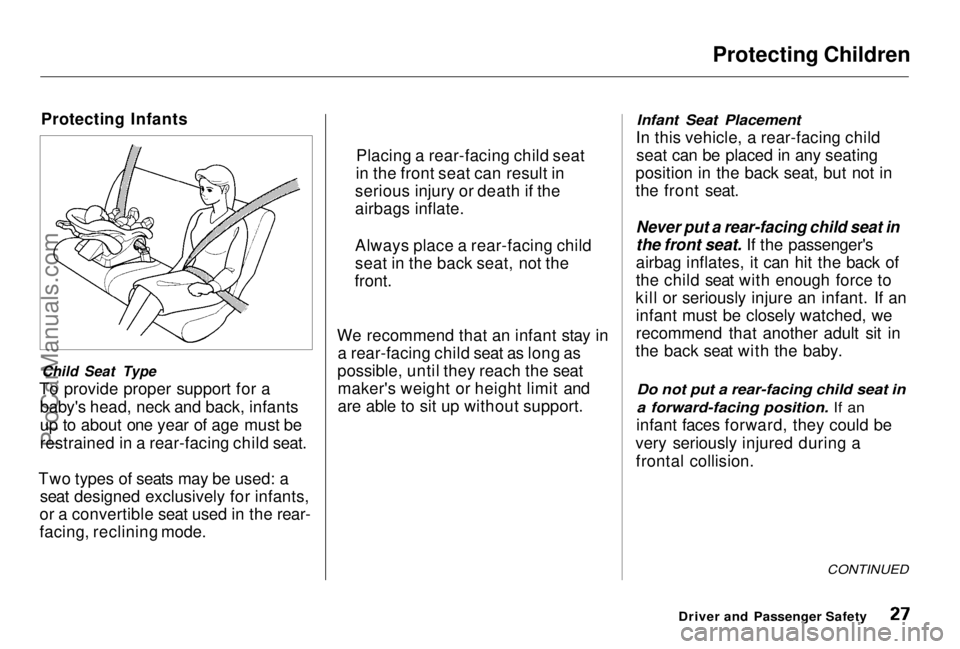
Protecting Infants
Child Seat Type
To provide proper support for a baby's head, neck and back, infants
up to about one year of age must be
restrained in a rear-facing child seat.
Two types of seats may be used: a seat designed exclusively for infants,
or a convertible seat used in the rear-
facing, reclining mode. We recommend that an infant stay in
a rear-facing child seat as long as
possible, until they reach the seat maker's weight or height limit and
are able to sit up without support.
Infant Seat Placement
In this vehicle, a rear-facing child seat can be placed in any seating
position in the back seat, but not in
the front seat.
Never put a rear-facing child seat in
the front seat. If the passenger's
airbag inflates, it can hit the back of
the child seat with enough force to
kill or seriously injure an infant. If an infant must be closely watched, we
recommend that another adult sit in
the back seat with the baby.
Do not put a rear-facing child seat in
a forward-facing position. If an
infant faces forward, they could be
very seriously injured during a frontal collision.
CONTINUED
Driver and Passenger Safety
Placing a rear-facing child seat
in the front seat can result in
serious injury or death if the
airbags inflate.
Always place a rear-facing child
seat in the back seat, not the
front.ProCarManuals.comMain Menu Table of Contents s t
Page 30 of 278

Protecting Children
4. After confirming that the belt is locked, grab the shoulder part of
the belt near the buckle and pull
up to remove any slack from the
lap part of the belt. Remember, if
the lap part of the belt is not tight,
the child seat will not be secure.
To remove slack, it may help to put weight on the child seat, or
push on the back of the seat while
pulling up on the belt. 5. Push and pull the child seat
forward and from side to side to
verify that it is secure enough to stay upright during normal driving
maneuvers. If the child seat is not
secure, unlatch the belt, allow it to
retract fully, then repeat these
steps.
To deactivate the locking
mechanism in order to remove achild seat, unlatch the buckle,
unroute the seat belt, and let the belt
fully retract.
CONTINUED
Driver and Passenger SafetyProCarManuals.comMain Menu Table of Contents s t
Page 32 of 278

Protecting Children
Protecting Small Children
Child Seat Type
A child who can sit up without support, and who fits within the child
seat maker's weight and height
limits, should be restrained in a
forward-facing, upright child seat. Of the different seats available, we
recommend those that have a five-
point harness system as shown.
We also recommend that a small child stay in the child seat as long as
possible, until they reach the weightor height limit for the seat. Child Seat Placement
In this vehicle, the best place to
install a forward-facing child seat is
in one of the seating positions in the
back seat.
Placing a forward-facing child seat in
the front seat of a vehicle equipped
with a passenger airbag can be
hazardous. If the vehicle seat is too
far forward, or the child's head is thrown forward during a collision, an
inflating passenger's airbag canstrike the child with enough force to
cause very serious or fatal injuries. If
a small child must be closely
watched, we recommend that another adult sit in the back seat
with the child.
CONTINUED
Driver and Passenger SafetyProCarManuals.comMain Menu Table of Contents s t
Page 34 of 278

Protecting Children
2. To activate the lockable retractor, slowly pull the shoulder part of the
belt all the way out until it stops, then let the belt feed back into the
retractor (you might hear a
clicking noise as the belt retracts).
3. After the belt has retracted, tug on it. If the belt is locked, you will not
be able to pull it out. If you can pull the belt out, it is not locked and
you will need to repeat these steps.
4. After confirming that the belt is
locked, grab the shoulder part of
the belt near the buckle and pullup to remove any slack from the
lap part of the belt. Remember, if
the lap part of the belt is not tight,
the child seat will not be secure. It
may help to put weight on the
child seat, or push on the back of
the seat while pulling up on the
belt. 5. Push and pull the child seat
forward and from side to side to
verify that it is secure enough to stay upright during normal driving
maneuvers. If the child seat is not secure, unlatch the belt, allow it to
retract fully, then repeat these
steps.
CONTINUED
Driver and Passenger SafetyProCarManuals.comMain Menu Table of Contents s t
Page 36 of 278

Protecting Children
Protecting Larger Children
When a child reaches the recommended weight or height limit
for a forward-facing child seat, the child should sit in one of the backseats and wear a lap/shoulder belt.
If a child is too short for the shoulder
part of the belt to properly fit, we recommend that the child use a
booster seat until they are tallenough to use the seat belt without a
booster.
The following pages give instructions on how to check properseat belt fit, what kind of booster
seat to use if one is needed, and
important precautions for children
who must sit in the front seat.
Checking Seat Belt Fit
To determine whether a lap/
shoulder belt properly fits a child,
first have the child put on the seat belt, following the instructions on
page 14. Then check how the belt
fits.
CONTINUED
Driver and Passenger Safety
Allowing a larger child to sit
improperly in the front seat can
result in injury or death if the
airbags inflate.
If a larger child must sit in front,
they should move the seat as
far back as possible and wear their seat belt properly.ProCarManuals.comMain Menu Table of Contents s t
Page 74 of 278

Keys and Locks
Lockout Prevention
If you forget and leave the key in the
ignition switch, Lockout Prevention
will not allow you to lock the driver's door. With the driver's door open
and the key in the ignition, both
master door lock switches are
disabled.
However, if the driver's door is not open, the master door lock switches
are not disabled. Pushing the switch
down on the open passenger's door
will lock both doors. If you try to lock an open driver'sdoor by pushing in the lock tab, the
tabs on both doors pop out. Pushing
in the lock tab on the passenger's door only locks that door.
Trunk
You can open the trunk in two ways:
Pull the trunk release handle to
the left of the driver's seat. Use the master key to open the
trunk lock. The valet key does not
work in this lock.
To close the trunk, press down on
the trunk lid.
See page 129 for cargo loading and
weight limit information. Keep the
trunk lid closed at all times while
driving to avoid damaging the lid,
and to prevent exhaust gas from
getting into the interior. See Carbon
Monoxide Hazard on page 47.
Instruments and Controls
CONTINUED
TRUNK RELEASE
HANDLE MASTER KEYProCarManuals.comMain Menu Table of Contents s t
Page 125 of 278

Fuel Economy
The condition of your vehicle and your driving habits are the two most important things that affect the fuel
mileage you get.
Vehicle Condition Always maintain your vehicle accord- ing to the maintenance schedule.
This will keep it in top operating condition.
An important part of that mainte- nance is the Owner MaintenanceChecks (see page 171). For
example, an underinflated tire
causes more "rolling resistance,"
which uses fuel. It also wears out
faster, so check the tire pressure at
least monthly.
In winter, the build-up of snow on
your vehicle's underside adds weight and rolling resistance. Frequent
cleaning helps your fuel mileage and
reduces the chance of corrosion. Driving Habits
You can improve fuel economy by driving moderately. Rapid acceler-
ation, abrupt cornering, and hard
braking use more fuel.
Always drive in the highest gear that allows the engine to run and acceler-
ate smoothly.
Depending on traffic conditions, try
to maintain a constant speed. Every
time you slow down and speed up,
your vehicle uses extra fuel. Use the cruise control, when appropriate, to
increase fuel economy. A cold engine uses more fuel than a
warm engine. It is not necessary to "warm-up" a cold engine by letting it
idle for a long time. You can drive
away in about a minute, no matter
how cold it is outside. The engine
will warm up faster, and you get better fuel economy. To cut down on
the number of "cold starts," try tocombine several short trips into one.
The air conditioning puts an extra load on the engine which makes ituse more fuel. Turn off the A/C to
cut down on air conditioning use.
Use the flow-through ventilation
when the outside air temperature ismoderate.
Before DrivingProCarManuals.comMain Menu Table of Contents s t