Page 31 of 278

Protecting Children
Infant Seat Installation Tips
For proper protection, an infant must
ride in a reclined, or semi-reclined
position. To determine the proper reclining angle, check with the baby's
doctor or follow the seat maker's
recommendations.
To achieve the desired reclining angle, it may help to put a rolled up
towel under the toe of the child seat,
as shown above. When properly installed, a rear-
facing child seat may prevent the
driver or a front-seat passenger from
moving their seat as far back as
recommended (see page 11). Or it
may prevent the seat-back from
locking in the desired position (see
page 12).
In either case, we recommend that
you place the child seat directly behind the front passenger seat,move the front seat as far forward as
needed, and leave it unoccupied. You may also wish to get a smaller child
seat that allows you to safely carry a
front passenger.
Additional Precautions for Infants
Never hold a baby on your lap. If
you are not wearing a seat belt in a crash, you could be thrown
forward into the dashboard and crush the child.
If you are wearing a seat belt, the
baby can be torn from your arms. For example, if the vehicle crashes
into a parked vehicle at 30 mph (48 km/h), a 20 Ibs (9 kg) baby
will become a 600 Ibs (275 kg)
force, and you will not be able to hold it. Never put a seat belt over yourself
and a baby. During a crash, the
belt could press deep into the child and cause very serious injuries.
Driver and Passenger SafetyProCarManuals.comMain Menu Table of Contents s t
Page 35 of 278
Protecting Children
To deactivate the locking mechanism in order to remove a
child seat, unlatch the buckle,
unroute the seat belt, and let the belt
fully retract.
Additional Precautions for Small
Children
Never hold a small child on your
lap. If you are not wearing a seat
belt in a crash, you could be
thrown forward into the dashboard and crush the child.
If you are wearing a seat belt, the
child can be torn from your arms
during a crash. For example, if the
vehicle crashes into a parked
vehicle at 30 mph (48 km/h), a 30 Ibs (14 kg) child will become a
900 Ibs (410 kg) force, and you will
not be able to hold it.
Never put a seat belt over yourself
and a child. During a crash, the
belt could press deep into the child
and cause very serious injuries.
Driver and Passenger SafetyProCarManuals.comMain Menu Table of Contents s t
Page 44 of 278

Additional Information About Your SRS
SRS Components
Your Supplemental Restraint System (SRS) includes:
Two frontal airbags. The driver'sairbag is stored in the center of
the steering wheel; the front
passenger's airbag is stored in the dashboard. Both are marked
"SRS".
Sensors that can detect a severe
frontal collision. A sophisticated electronic system
that continually monitors thesensors, control unit, the airbag
activators, and all related wiring
when the ignition is ON (II). An indicator light on the
instrument panel to alert you to a
possible problem with the system (see page 45). Emergency backup power in case
your vehicle's electrical system is disconnected in a crash. How Your Airbags Work
If you ever have a severe frontal
collision, the sensors will detect
rapid deceleration and signal the
control unit to instantly inflate the
airbags.
During a crash, your seat belt helps
restrain your lower body and torso.
Your airbag provides a cushion to help restrain and protect your headand chest.
Driver and Passenger Safety
CONTINUEDProCarManuals.comMain Menu Table of Contents s t
Page 62 of 278
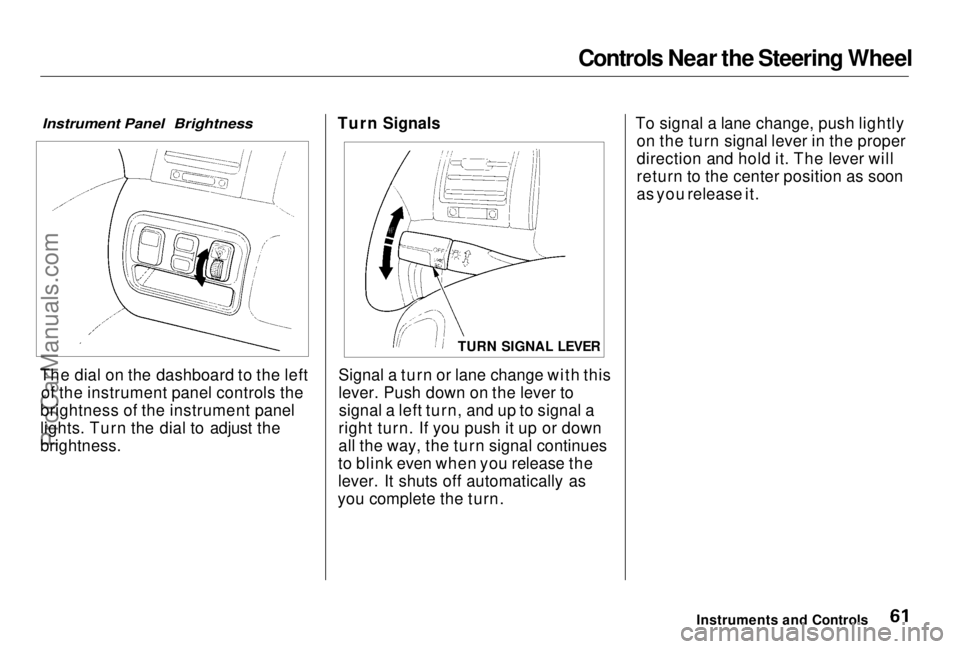
Controls Near the Steering Wheel
Instrument Panel Brightness
The dial on the dashboard to the left of the instrument panel controls the
brightness of the instrument panel
lights. Turn the dial to adjust the
brightness. Turn Signals
Signal a turn or lane change with this
lever. Push down on the lever tosignal a left turn, and up to signal a
right turn. If you push it up or down
all the way, the turn signal continues
to blink even when you release the
lever. It shuts off automatically as
you complete the turn. To signal a lane change, push lightly
on the turn signal lever in the proper
direction and hold it. The lever will
return to the center position as soon
as you release it.
Instruments and Controls
TURN SIGNAL LEVERProCarManuals.comMain Menu Table of Contents s t
Page 83 of 278
Moonroof
Use the switch on the dashboard to
open and close the moonroof. The
ignition must be ON (II). Push and hold the switch to open the
moonroof. Release the switch when
the moonroof reaches the desired
position. To close the moonroof, press and hold the switch. The moonroof has a key-off delay.
You can still open and close the
moonroof for up to ten minutes after
you turn off the ignition. The key-off delay cancels as soon as you open
either door. You must then turn the
ignition ON (II) for the moonroof to
operate.
If you try to open the moonroof in
below-freezing temperatures, or whenit is covered with snow or ice, you can
damage the moonroof panel or motor.
Instruments and Controls MOONROOF SWITCH
NOTICE
Closing the moonroof on
someone's hands or fingers can
cause serious injury.
Make sure passengers are
clear of the moonroof before
closing it.ProCarManuals.comMain Menu Table of Contents s t
Page 94 of 278
Heating and Cooling
Mode Buttons Use the MODE buttons to select the
vents the air flows from. Some air
will flow from the dashboard corner
vents in all modes. Air flows from the center
and corner vents in the dashboard. Air flow is divided between
the vents in the dashboard and the
floor vents. Air flows from the floor
vents.
Air flow is divided between
the floor vents and the defroster
vents at the base of the windshield. Air flows from the defroster
vents at the base of the windshield. When you select the system
automatically switches to Fresh Air
mode and turns on the A/C.
Comfort and Convenience FeaturesProCarManuals.comMain Menu Table of Contents s t
Page 95 of 278
Heating and Cooling
Vent Controls
You can adjust the direction of the
air coming from the dashboard vents
by moving the tab in the center of
each vent up-and-down and side-to-
side.
The vents in the corners of the
dashboard can be opened and closed
with the dials underneath them. How to Use the System
This section covers how to set up the system controls for ventilation,
heating, cooling, dehumidifying, and defrosting.
The engine must be running for the heater and air conditioning to
generate hot and cold air. The heater
uses engine coolant to warm the air.If the engine is cold, it will be several
minutes before you feel warm air
coming from the system.
The air conditioning does not rely on engine temperature.
Comfort and Convenience Features
CENTER VENT
SIDE VENTProCarManuals.comMain Menu Table of Contents s t
Page 122 of 278
Service Station Procedures
Opening the Hood
1. Shift to Park or Neutral and set the parking brake. Pull the hood
release handle located under the
lower left corner of the dashboard.
The hood will pop up slightly. 2. Standing in front of the vehicle,
put your fingers under the frontedge of the hood to the right of
center. Slide your hand to the left
until you feel the hood latch
handle. Push this handle to the left
until it releases the hood. Lift the
hood.
3. Pull the support rod out of its clip
and insert the end into the hole on
the left side of the hood.
To close the hood, lift it up slightly to remove the support rod from the
hole. Put the support rod back into its holding clip. Lower the hood to
about a foot (30 cm) above the
fender, then let it drop.
After closing the hood, make sure it is securely latched.
Before Driving HOOD RELEASE HANDLE
LATCHCLIP SUPPORT RODProCarManuals.comMain Menu Table of Contents s t