1998 HONDA CIVIC COUPE parking brake
[x] Cancel search: parking brakePage 207 of 251
Changing a Flat Tire
If you have a flat tire while driving, stop in a safe place to change it.
Stopping in traffic or on the shoulder
of a busy road is dangerous. Drive
slowly along the shoulder until you
get to an exit or an area to stop that is far away from the traffic lanes.
1. Park the vehicle on firm, levelground away from traffic. Turn on
the hazard warning lights and turn
the ignition switch to LOCK (0).
2. Put the transmission in Park (automatic) or Reverse (manual).
Apply the parking brake. Have all of the passengers get out of the
vehicle while you change the tire. 3. Open the trunk. Raise the trunk
floor by lifting up on the back edge.
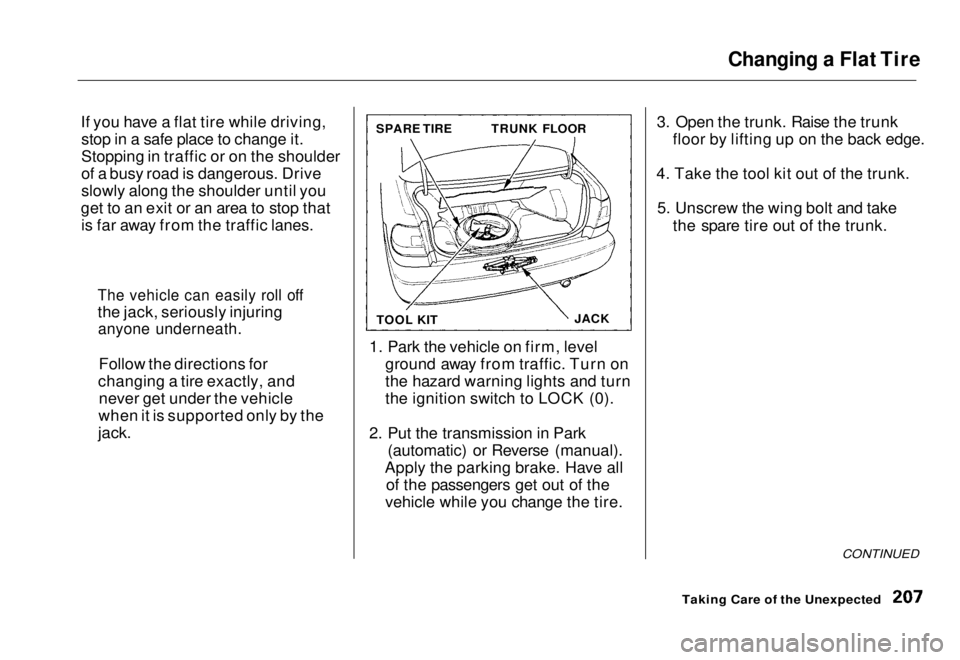
4. Take the tool kit out of the trunk. 5. Unscrew the wing bolt and take the spare tire out of the trunk.
CONTINUED
Taking Care of the Unexpected
The vehicle can easily roll off
the jack, seriously injuring
anyone underneath.
Follow the directions for
changing a tire exactly, and never get under the vehicle
when it is supported only by the
jack.
SPARE TIRE
TRUNK FLOOR
TOOL KIT JACKMain Menu Table of Contents s t
Page 213 of 251
If Your Engine Won't Start, Jump Starting
The Starter Operates Normally In this case, the starter motor'sspeed sounds normal, or even faster
than normal, when you turn the ignition switch to START (III), but
the engine does not run.
Are you using the proper startingprocedure? Refer to Starting the
Engine on page 121.
Do you have fuel? Turn the
ignition switch to ON (II) for a
minute and watch the fuel gauge.
The low fuel level warning light may not be working, so you were
not reminded to fill the tank.
There may be an electrical problem, such as no power to the
fuel pump. Check all the fuses (see page 223).
If you find nothing wrong, you will
need a qualified technician to find
the problem. See Emergency Towing on page 227. Jump Starting
If your vehicle's battery has rundown, you may be able to start the
engine by using a booster battery.
Although this seems like a simple procedure, you should take several
precautions.
You cannot start a Honda with anautomatic transmission by pushing
or pulling it. To jump start your vehicle, follow
these directions closely:
1. Open the hood and check the physical condition of the battery(see page 150). In very cold
weather, check the condition of the electrolyte. If it seems slushyor like ice, do not try jump starting
until it thaws.
If a battery sits in extreme cold, the
electrolyte inside can freeze.
Attempting to jump start with a frozen
battery can cause it to rupture.
2. Turn off all the electrical acces- sories: heater, A/C, stereo system,
lights, etc.
Put the transmission in Neutral or
Park and set the parking brake.
CONTINUED
Taking Care of the Unexpected
A battery can explode if you do
not follow the correct procedure,
seriously injuring anyone nearby.
Keep all sparks, open flames,
and smoking materials away
from the battery.
NOTICEMain Menu Table of Contents s t
Page 215 of 251
If Your Engine Overheats
The pointer of your vehicle's temperature gauge should stay in
the midrange under most conditions.It may go higher if you are driving up
a long steep hill on a very hot day. If
it climbs to the red mark, you should
determine the reason.
Driving with the temperature gauge-
pointer at the red mark can cause serious damage to your engine. Your vehicle can overheat for several
reasons, such as lack of coolant or a
mechanical problem. The only
indication may be the temperature
gauge climbing to or above the red
mark. Or you may see steam or
spray coming from under the hood.
In either case, you should take
immediate action.
1. Safely pull to the side of the road.
Put the transmission in Neutral or
Park and set the parking brake.
Turn off the heating and cooling system and all other accessories.
Turn on the hazard warning
indicators.
2. If you see steam and/or spray coming from under the hood, turnoff the engine.
3. If you do not see steam or spray, leave the engine running and
watch the temperature gauge. If
the high heat is due to overloading (climbing a long, steep hill on a
hot day with the A/C running, for
example), the engine should start
to cool down almost immediately. If it does, wait until the tempera-
ture gauge comes down to the mid-
point then continue driving.
CONTINUED
Taking Care of the Unexpected
NOTICE
Steam and spray from an
overheated engine can
seriously scald you.Do not open the hood if steam
is coming out.Main Menu Table of Contents s t
Page 220 of 251
Brake System Indicator
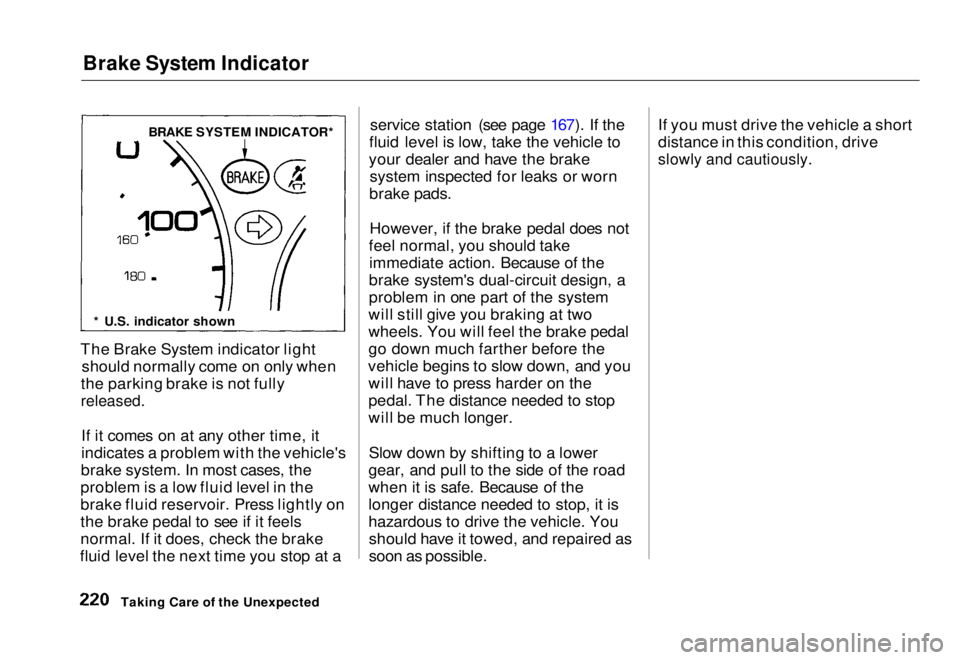
The Brake System indicator light should normally come on only when
the parking brake is not fully
released.
If it comes on at any other time, it
indicates a problem with the vehicle's
brake system. In most cases, the
problem is a low fluid level in the
brake fluid reservoir. Press lightly on
the brake pedal to see if it feels
normal. If it does, check the brake
fluid level the next time you stop at a service station (see page 167). If the
fluid level is low, take the vehicle to
your dealer and have the brake system inspected for leaks or worn
brake pads.
However, if the brake pedal does not
feel normal, you should take immediate action. Because of the
brake system's dual-circuit design, a
problem in one part of the system
will still give you braking at two
wheels. You will feel the brake pedal
go down much farther before the
vehicle begins to slow down, and you will have to press harder on the
pedal. The distance needed to stop
will be much longer.
Slow down by shifting to a lower
gear, and pull to the side of the road
when it is safe. Because of the
longer distance needed to stop, it is
hazardous to drive the vehicle. You should have it towed, and repaired as
soon as possible. If you must drive the vehicle a short
distance in this condition, drive
slowly and cautiously.
Taking Care of the Unexpected BRAKE SYSTEM INDICATOR*
* U.S. indicator shownMain Menu Table of Contents s t
Page 227 of 251
Emergency Towing
If your vehicle needs to be towed,
call a professional towing service or,
if you belong to one, an organization
that provides roadside assistance.
Never tow your vehicle behind another vehicle with just a rope or
chain. It is very dangerous.
There are three popular types of
professional towing equipment.Flat-bed Equipment - The operatorloads your vehicle on the back of a
truck. This is the best way to transport your Honda.
Wheel-Lift Equipment - The tow
truck uses two pivoting arms that go under the tires (front or rear) and lift
them off the ground. The other two
tires remain on the ground.This is an acceptable way to tow
your Honda.
Sling-type Equipment - The tow
truck uses metal cables with hookson the ends. These hooks go around parts of the frame or suspension and
the cables lift that end of the vehicle off the ground. Your vehicle's
suspension and body can be seriously
damaged. This method of towing is
unacceptable.
If your Honda cannot be transported
by flat-bed, it should be towed by
wheel-lift equipment with the front
wheels off the ground. If, due to damage, your vehicle must be towed
with the front wheels on the ground, do the following.
5-speed Manual Transmission
Release the parking brake.Shift the transmission to Neutral.
Automatic Transmission Release the parking brake.Start the engine.
Shift to D4, then to N.
Turn off the engine.
Improper towing preparation will
damage the transmission. Follow
the above procedure exactly. If you
cannot shift the transmission or
start the engine (automatic
transmission), your vehicle must be
transported with the front wheels
off the ground.
With the front wheels on the
ground, it is best to tow the vehicle
no farther than 50 miles (80 km), and keep the speed below 35 mph
(55 km/h).
If you decide to tow your vehicle
with all four wheels on the ground,
make sure you use a properly-
designed and attached tow bar.
Prepare the vehicle for towing as
described above, and leave theignition switch in Accessory (I) so
the steering wheel does not lock.
Make sure the radio and any items
Taking Care of the Unexpected
NOTICEMain Menu Table of Contents s t
Page 248 of 251
Index
Before Driving............................... 107
Belts, Seat........................................... 6
Beverage Holder.............................. 82
Body Repair.................................... 200
Brakes
Anti-lock System (ABS)............ 135Break-in, New Linings .............. 108
Fluid............................................ 166Light, Burned-out...................... 192
Parking..........................................80
System Indicator.......................... 53
Wear Indicators......................... 134
Brakes, ABS Operation.................................... 134
System Indicator..................
53, 13 7
Braking System............................. .
134
Break-in, New Car......................... 108
Brightness Control, Instruments... 60
Brights, Headlights......................... 59
Bulb Replacement Back-up Lights........................... 193
Brake Lights............................... 192
Front Parking Lights................. 191
Front Side Marker Lights......... 191
Headlights.................................. 189
High-mount Brake Light.......... 194 Interior Light.............................. 195
License Plate Lights.................. 194
Rear Side Marker Lights.......... 193
Specifications............................. 234
Trunk Light................................ 196
Turn Signal Lights..................... 191
Bulbs, Halogen............................... 185
Cables, Jump Starting With.......... 213
Capacities Chart............................. 233 Carbon Monoxide Hazard.............. 47
Carrying Cargo.............................. 116
Cassette Player
Care............................................. 102
Operation.................................... 100
CAUTION, Explanation of............... ii
CD Changer.................................... 103
CD Player........................................ 103
Certification Label......................... 230
Chains............................................. 185
Change Oil
How to......................................... 157
When to....................................... 146
Changing a Flat Tire..................... 207 Changing Engine Coolant............. 161
Charging System Indicator .... 53,
218
Checking
Automatic Transmissio
n
Fluid........................................ 164
Battery Condition...................... 173
Brake Fluid................................. 167
Clutch Fluid................................ 167
Drive Belts.................................. 178
Engine Coolant........................... 112
Engine Oil..............................
111
Fuses........................................... 22 2
Manua
l Transmission Fluid..... 166
Power Steering Fluid................. 168
Checklist, Before Driving............. 120
Cleaner, Air.................................... 169
Cleaning Exterior....................................... 200
Interior........................................ 202
Seat Belts.................................... 202
Vinyl............................................202
Windows..................................... 203
Clock, Setting the............................ 99
Clutch Fluid.................................... 167
CO in the Exhaust......................... 240
Cold Weather, Starting in............. 121Main Menu s t
Page 251 of 251
Index
Head Restraints............................... 75
Heating and Cooling........................ 86 High Altitude, Starting at.............. 121
High-Low Beam Switch .................. 59
High-mount Brake Light............... 194
Hood, Opening the ........................ 110
Horn................................................... 58
Hot Coolant, Warning about........ 159
Hydraulic Clutch............................ 167
Hydroplaning.................................. 139
Identification Number, Vehicle.... 230
If Your Car Has to be Towed....... 227
Ignition
Keys............................................... 67
Switch............................................ 67
Timing Contro l
System............. 241
Important Safety Precautions .......... 4
Indicator Lights, Instrument
Panel..............................................51
Infant Restraint................................ 27
Inflation, Proper Tire .................... 179 High Speed Driving................... 236
Normal Driving.......................... 179
Inside Mirror.................................... 79
Inspection, Tire.............................. 181
Instrument Panel............................. 50
Instrument Panel Brightness......... 60
Interior Cleaning............................ 202
Interior Light.................................... 84
Introduction......................................... i
Jacking up the Car......................... 208
Jack, Tire........................................ 207
Jump Starting................................. 213
Keys................................................... 67
Label, Certification........................ 230
Lane Change, Signaling.................. 60
Lap Belt............................................. 41
Lap/Shoulder Belts......................... 40
Leaking of Exhaust into Car.......... 47 Lights
Bulb Replacement..................... 189
Indicator........................................ 51 Parking.......................................... 59
Turn Signal................................... 60
LOCK (Ignition Key Position)....... 68
Locks
Anti-theft Steering Column........ 68Fuel Fill Door............................. 109
Power Door.................................. 69
Trunk............................................ 73
Low Coolant Level......................... 112
Low Fuel Indicator .......................... 54
Lower Gear, Downshifting to a.... 122
Low Oil Pressure Indicator.... 53,
217
Lubricant Specification s
Chart.... 233
Luggage.......................................... 116
Maintenance................................... 141
Owner Maintenance Checks.... 153
Record.................................. 151-152
Required Indicator....................... 57
CONTINUEDMain Menu s t