Page 166 of 251
Transmission Fluid
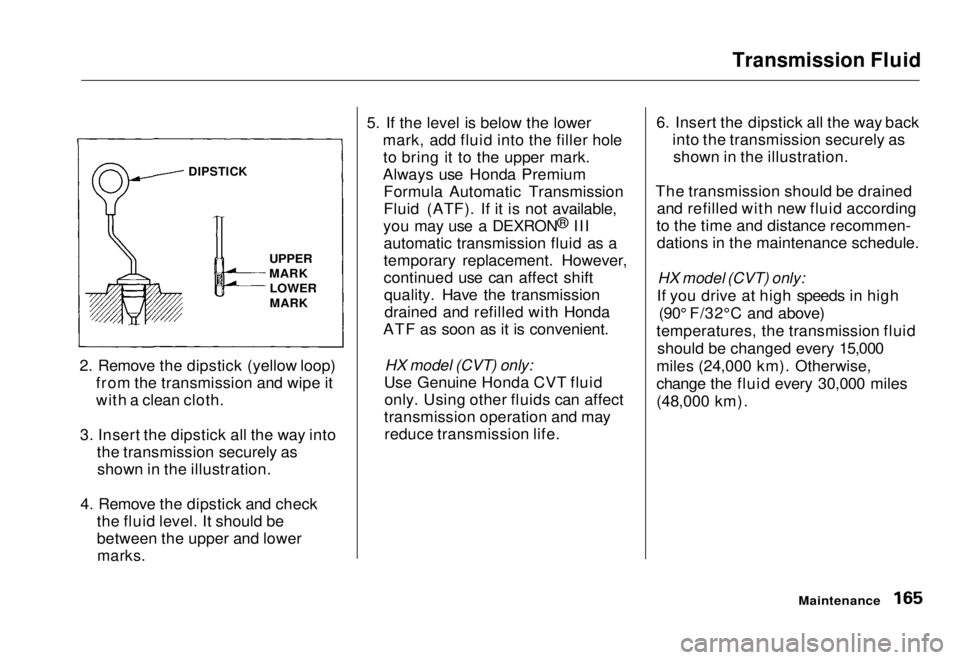
2. Remove the dipstick (yellow loop) from the transmission and wipe it
with a clean cloth.
3. Insert the dipstick all the way into the transmission securely asshown in the illustration.
4. Remove the dipstick and check the fluid level. It should be
between the upper and lower
marks.
5. If the level is below the lower
mark, add fluid into the filler holeto bring it to the upper mark.
Always use Honda Premium Formula Automatic Transmission
Fluid (ATF). If it is not available,
you may use a DEXRON ®
III
automatic transmission fluid as a
temporary replacement. However,
continued use can affect shift quality. Have the transmissiondrained and refilled with Honda
ATF as soon as it is convenient.
HX model (CVT) only:
Use Genuine Honda CVT fluid only. Using other fluids can affect
transmission operation and may reduce transmission life. 6. Insert the dipstick all the way back
into the transmission securely asshown in the illustration.
The transmission should be drained and refilled with new fluid according
to the time and distance recommen- dations in the maintenance schedule.
HX model (CVT) only:
If you drive at high speeds in high (90° F/32°C and above)
temperatures, the transmission fluid should be changed every 15,000
miles (24,000 km). Otherwise,
change the fluid every 30,000 miles
(48,000 km).
Maintenance
DIPSTICK
UPPER
MARK
LOWER
MARKMain Menu Table of Contents s t
Page 167 of 251
Transmission Fluid, Brake and Clutch Fluid
5-speed Manual Transmission
Check the fluid level with the
transmission at normal operating
temperature and the vehicle sitting
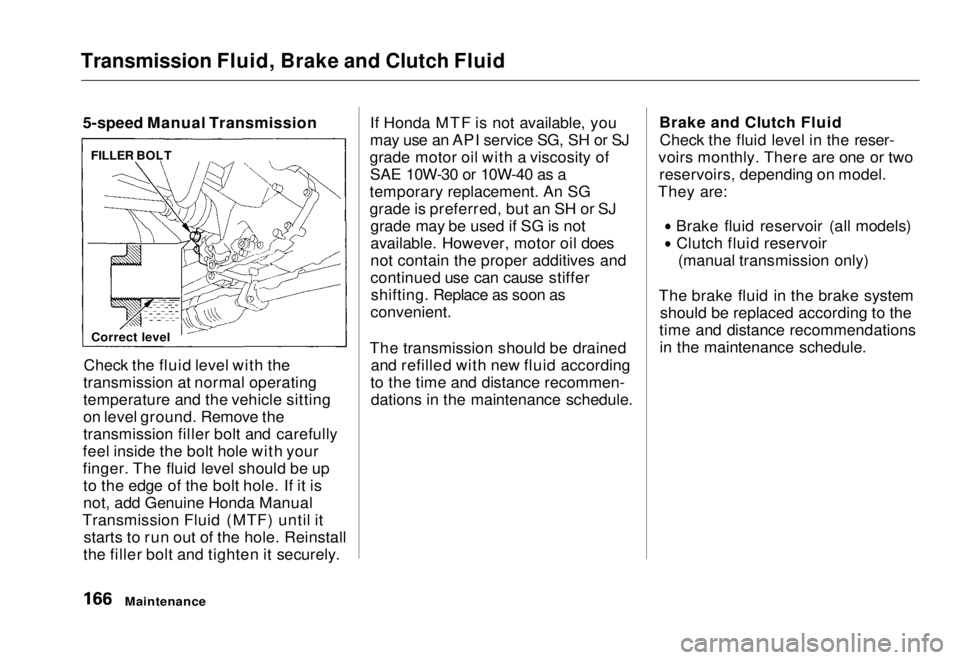
on level ground. Remove the
transmission filler bolt and carefully
feel inside the bolt hole with your
finger. The fluid level should be up to the edge of the bolt hole. If it is
not, add Genuine Honda Manual
Transmission Fluid (MTF) until it starts to run out of the hole. Reinstall
the filler bolt and tighten it securely. If Honda MTF is not available, you
may use an API service SG, SH or SJ
grade motor oil with a viscosity of SAE 10W-30 or 10W-40 as a
temporary replacement. An SG
grade is preferred, but an SH or SJ grade may be used if SG is not
available. However, motor oil does
not contain the proper additives and
continued use can cause stiffershifting. Replace as soon as
convenient.
The transmission should be drained and refilled with new fluid according
to the time and distance recommen- dations in the maintenance schedule. Brake and Clutch Fluid
Check the fluid level in the reser-
voirs monthly. There are one or two reservoirs, depending on model.
They are:
Brake fluid reservoir (all models)Clutch fluid reservoir (manual transmission only)
The brake fluid in the brake system should be replaced according to the
time and distance recommendations in the maintenance schedule.
Maintenance
FILLER BOLT
Correct levelMain Menu Table of Contents s t
Page 170 of 251
Air Cleaner Element
The air cleaner element should be replaced according to the time anddistance recommendations in the
maintenance schedule.
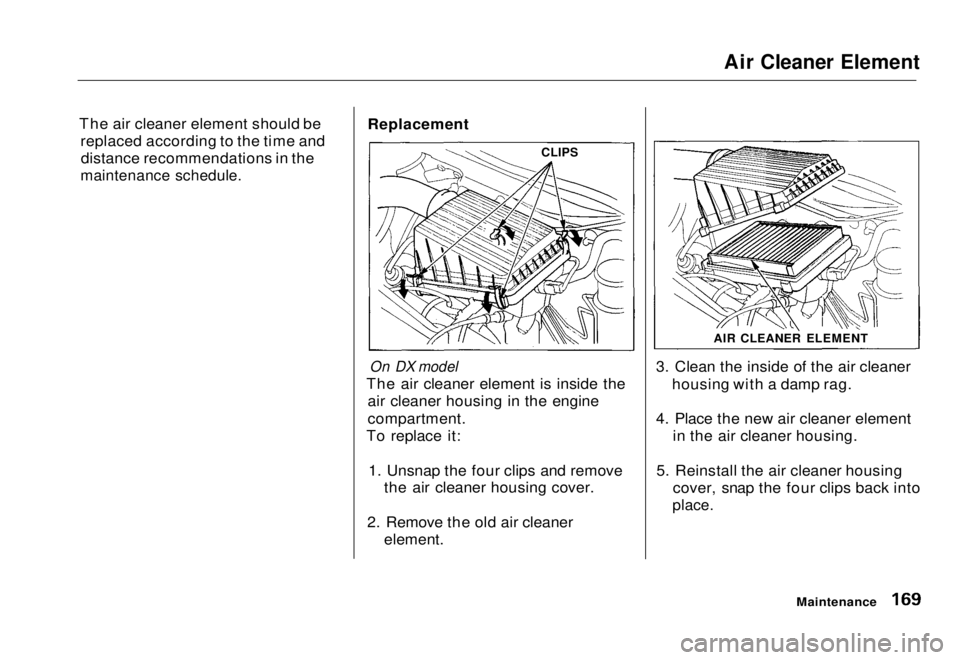
Replacement
On DX model
The air cleaner element is inside the air cleaner housing in the engine
compartment.
To replace it:
1. Unsnap the four clips and remove the air cleaner housing cover.
2. Remove the old air cleaner element. 3. Clean the inside of the air cleaner
housing with a damp rag.
4. Place the new air cleaner element in the air cleaner housing.
5. Reinstall the air cleaner housing cover, snap the four clips back into
place.
Maintenance
CLIPS
AIR CLEANER ELEMENTMain Menu Table of Contents s t
Page 219 of 251
Malfunction Indicator Lamp
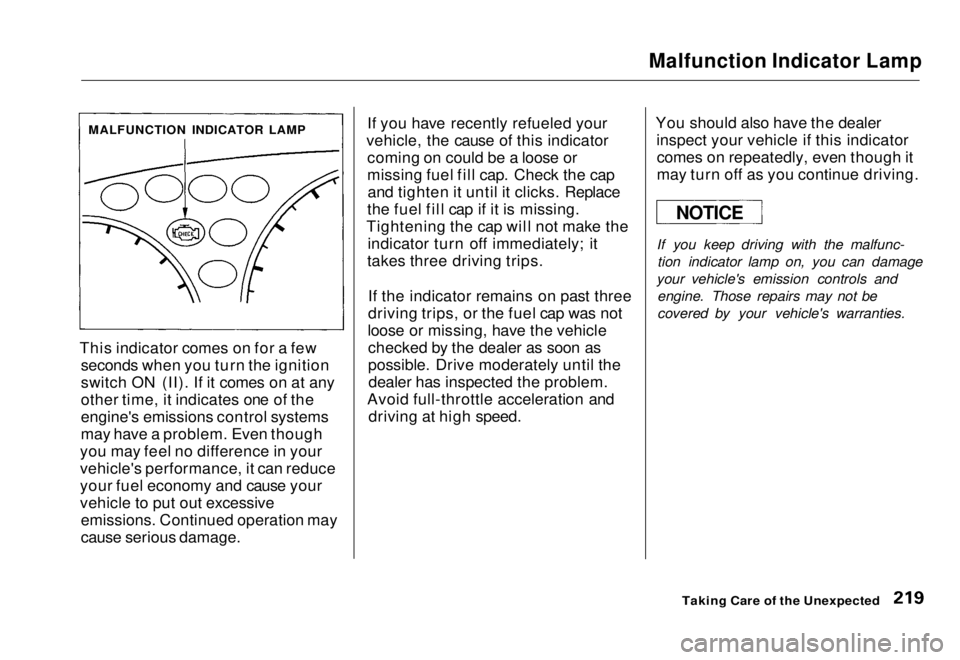
This indicator comes on for a few seconds when you turn the ignition
switch ON (II). If it comes on at any
other time, it indicates one of the
engine's emissions control systems
may have a problem. Even though
you may feel no difference in your
vehicle's performance, it can reduce
your fuel economy and cause your
vehicle to put out excessive emissions. Continued operation may
cause serious damage. If you have recently refueled your
vehicle, the cause of this indicator coming on could be a loose or
missing fuel fill cap. Check the capand tighten it until it clicks. Replace
the fuel fill cap if it is missing.
Tightening the cap will not make the indicator turn off immediately; it
takes three driving trips.
If the indicator remains on past three
driving trips, or the fuel cap was not
loose or missing, have the vehicle checked by the dealer as soon as
possible. Drive moderately until thedealer has inspected the problem.
Avoid full-throttle acceleration and driving at high speed. You should also have the dealer
inspect your vehicle if this indicatorcomes on repeatedly, even though it
may turn off as you continue driving.
If you keep driving with the malfunc- tion indicator lamp on, you can damage
your vehicle's emission controls and engine. Those repairs may not be
covered by your vehicle's warranties.
Taking Care of the Unexpected
MALFUNCTION INDICATOR LAMP
NOTICEMain Menu Table of Contents s t
Page 246 of 251
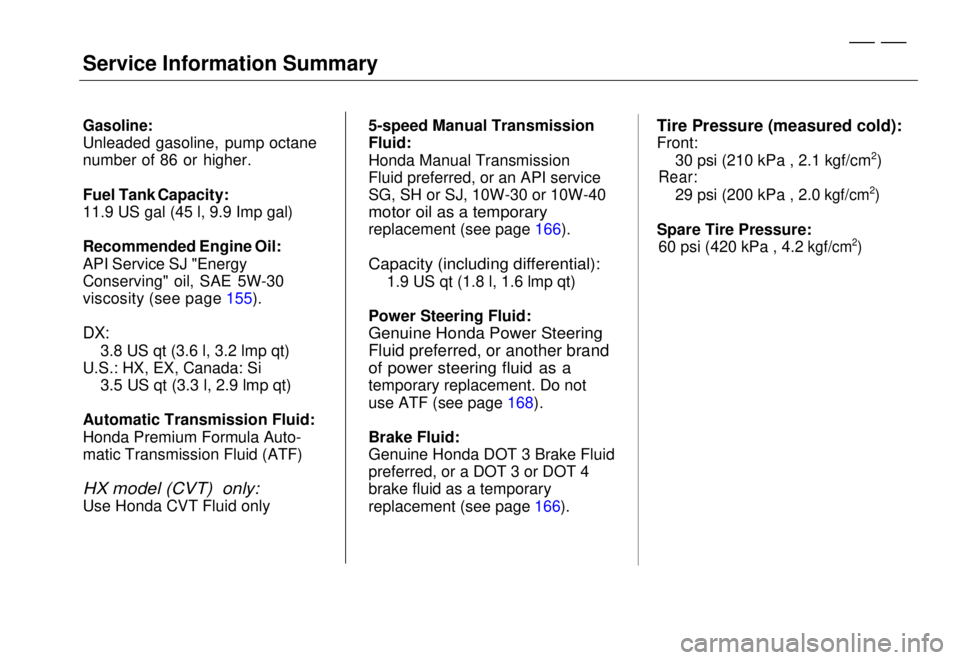
Gasoline:
Unleaded gasoline, pump octane
number of 86 or higher.
Fuel Tank Capacity:
11.9 US gal (45 l, 9.9 Imp gal)
Recommended Engine Oil:
API Service SJ "Energy
Conserving" oil, SAE 5W-30
viscosity (see page 155).
DX:
3.8 US qt (3.6 l, 3.2 lmp qt)
U.S.: HX, EX, Canada: Si
3.5 US qt (3.3 l, 2.9 lmp qt)
Automatic Transmission Fluid:
Honda Premium
Formula Auto-
matic Transmission Fluid (ATF)
HX model (CVT)
only:
Use Honda CVT Fluid only 5-speed Manual Transmission
Fluid:
Honda Manual Transmission
Fluid preferred, or an API service
SG, SH or SJ,
10W-30 or 10W-40
motor oil as a temporary
replacement (see page 166).
Capacity (including differential):
1.9 US qt (1.8 l, 1.6 lmp qt)
Power Steering Fluid:
Genuine Honda Power Steering
Fluid preferred, or another brand
of power steering fluid as a
temporary replacement. Do not
use ATF (see page 168).
Brake
Fluid:
Genuine Honda DOT 3 Brake Fluid
preferred, or a DOT 3 or DOT 4
brake fluid as a temporary
replacement (see page
166).
Tire Pressure (measured cold):
Front:
30 psi (210 kPa , 2.1 kgf/cm2)
Rear:
29 psi (200 kPa , 2.0
kgf/cm2
)
Spare Tire Pressure:
60 psi (420 kPa , 4.2
kgf/cm 2
)
Service
Information SummaryMain Menu s t
Page:
< prev 1-8 9-16 17-24