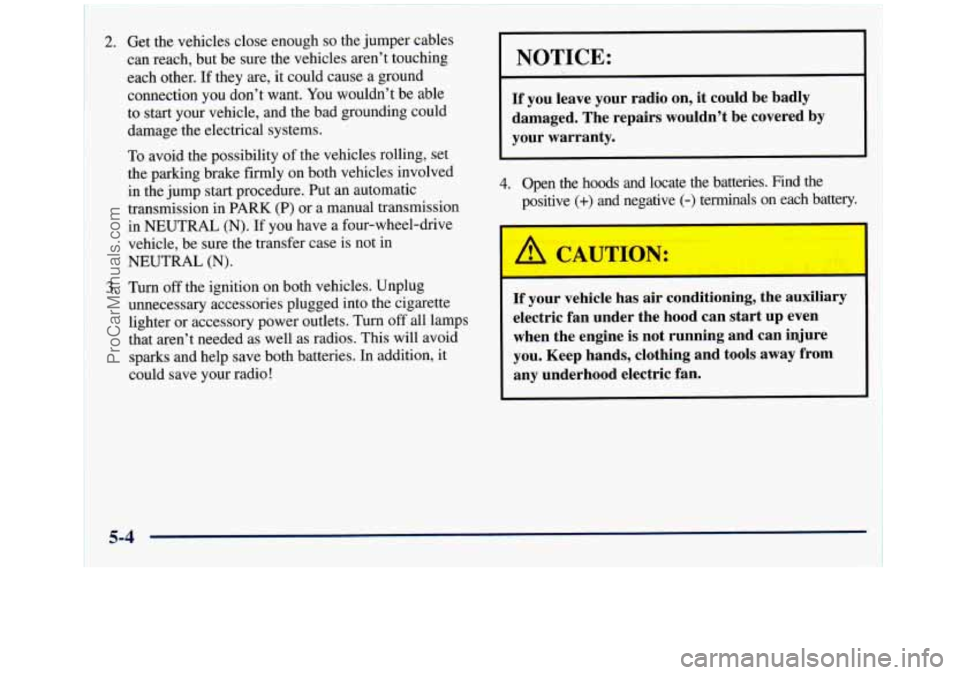
2. Get the vehicles close enough so the jumper cables
can reach, but be sure the vehicles aren’t touching
each other. If they are, it could cause a ground
connection
you don’t want. You wouldn’t be able
to start your vehicle, and the bad grounding could
damage the electrical systems.
To avoid the possibility
of the vehicles rolling, set
the parking brake firmly on both vehicles involved
in the jump start procedure. Put an automatic
transmission in
PARK (P) or a manual transmission
in NEUTRAL (N).
If you have a four-wheel-drive
vehicle, be sure the transfer case is not in
NEUTRAL
(N).
3. Turn off the ignition on both vehicles. Unplug
unnecessary accessories plugged into the cigarette
lighter or accessory power outlets. Turn
off all lamps
that aren’t needed as well as radios. This will avoid
sparks and help save both batteries. In addition, it
could save your radio!
I NOTICE:
If you leave your radio on, it could be badly
damaged. The repairs wouldn’t be covered by
your warranty.
4. Open the hoods and locate the batteries. Find the
positive
(+) and negative (-) terminals on each battery.
If your vehicle has air conditioning, the auxiliary
electric fan under the hood can start up even
when the engine is not running and can injure
you. Keep hands, clothing and tools
away from
any underhood electric fan.
5-4
t
ProCarManuals.com
Headlamps Fuses and Circuit Breakers
The headlamp wiring is protected by an internal circuit
breaker. An electrical overload will cause
the lamps
to go on and off, or
in some cases to remain off. If
this happens, have your headlamp wiring checked
right away.
Windshield Wipers
The windshield wiper motor is protected by a circuit
breaker and
a fuse. If the motor overheats due to heavy
snow, etc., the wiper will stop
until the motor cools. If
the overload is caused by some electrical problem and
not snow, etc., be sure to get it fixed.
Power Windows and Other Power Options
Circuit breakers protect the power windows and other
power accessories. When the current load is too heavy,
the circuit breaker opens and closes, protecting the
circuit
until the problem is fixed or goes away. The wiring circuits
in your vehicle are protected from
short circuits by
a combination of fuses, circuit breakers
and fusible thermal links.
This greatly reduces the
chance
of fires caused by electrical problems.
Look at the silver-colored band inside the fuse. If the
band is broken or melted, replace the fuse. Be sure you
replace
a bad fuse with a new one of the identical size
and rating.
If you ever have
a problem on the road and don’t have a
spare fuse, you can “borrow” one that has the same
amperage. Just pick some feature
of your vehicle that
you can get along without
-- like the radio or cigarette
lighter
-- and use its fuse, if it is the correct amperage.
Replace
it as soon as you can.
6-7 1
ProCarManuals.com
FuseKircuit Breaker
3
4
Usage
Courtesy Lamps, Cargo Lamp,
Glove Box Lamp, Dome/Reading
Lamps, Vanity Mirrors,
Power Mirrors
Instrument Cluster, DRL Relay,
Lamp Switch, Keyless Entry,
Low Coolant Module, Illuminated Entry Module,
DRAC (Diesel Engine)
Not Used
Cruise Control
Auxiliary Power Outlet
Crank
License Lamp, Parking Lamps,
Taillamps,
Roof Marker Lamps,
Tailgate Lamps, Front
Sidemarkers, Fog Lamp Relay,
Door Switch Illumination,
Fender Lamps, Headlamp Switch Illumination
FuseKircuit
Breaker
10
11
12
13
14
15
I6
17
18
19
Usage
Air Bag System
Wiper Motor, Washer Pump
A/C,
A/C Blower,
High Blower Relay
Power
Amp, Cigarette Lighter,
Door Lock Relay,
Power Lumbar Seat
4WD Indicator, Cluster, Comfort
Controls, Instrument Switches,
Radio Illumination,
Chime Module
DRL Relay,
Fog Lamp Relay
Front and Rear Turn Signals,
Back-up Lamps, BTSl Solenoid
Radio (Ignition)
4WAL/VCM, ABS. Cruise Control
Radio (Batterv)
6-73
ProCarManuals.com
Pregnancy. Use of Safety Belts .................... 1-22
Problems on the Road ............................ 5- 1
Protecting Exterior Bright Metal Parts ............... 6-67
PTO
......................................... 4-61
Publications. Service and Owner
.............. 8- 1 I . 8- I2
Radiator
..................................... 5-20
Radiator Pressure Cap
........................... 6-32
Radio Reception
................................ 3-23
Radios
........................................ 3-7
Rain. Driving
In ................................ 4-28
Rear
Reading
Lamps
................................ 2-44
Axle
.................................. 6-26.7-47
Outside Seat Position
..................... 1-34. 1-38
Safety Belt Comfort Guides ..................... 1-40
Seat Passengers
.............................. 1-34
Towing
..................................... 5-12
Window Defogger ............................. 3-6
RearSeat
.................................. 1-7.1-8
Rearview Mirror
................................ 2-45
Electrochromic Day/Night
...................... 2-46
Inside Day/Night
............................. 2-45
Reclining Seatbacks
.............................. 1-4
Recommended Fluids and Lubricants
............... 7-46
Recovery
Hooks ................................ 5-37
Recovery Tank, Coolant
.......................... 5- 15
Recreational Vehicle Towin?
...................... 4-4 1
Refrigerants, Air Conditionlng .................... 6-79 Replacement
Bulbs
................................. 6.39. 6.76
Wheel
...................................... 6-59
Parts
....................................... 6-78
Replacing Safety Belts ........................... 1-70
Reporting Safety Defects ......................... 8-10
Restraints Checking
................................... 1-70
Child
....................................... 1-45
Head
........................................ 1-5
Replacing Parts After
a Crash ................... 1-70
System Check ................................ 7-41
Right Front Passenger Position
.................... 1-23
Roadside Assistance .............................. 8-5
Roadside Assistance. Canadian
..................... 8-7
Rocking Your Vehicle ........................... 5-37
Roof Marker Lamp Bulb Replacement
.............. 6-47
Rotation
. Tires ............................ 6-53. 6-54
Safety Bell Extender ............................ 1-70
Safety Belts .................................... 1-9
Adults ...................................... 1-14
Care
....................................... 6-64
Children .................................... 1-42
Driver Position
............................... 1-14
Extender
.................................... 1-70
Incorrect Usage
.................... 1 . 17. 1.68. 1-69
Center
Passenger Position
...................... 1-32
How to Wear Properly ......................... 1-14
9-8
ProCarManuals.com