Page 264 of 386

Checking Transmission Fluid Hot
Get the vehicle warmed up by driving about 15 miles
(24 km) when outside temperatures are above 50°F
(10°C). If it's colder than 50°F (lO"C), drive the
vehicle in THIRD (3) until the engine temperature gage
moves and
then remains steady for 10 minutes. Then
follow the hot check procedures.
Checking Transmission Fluid Cold
A cold check is made after the vehicle has been sitting
for eight hours or more with
the engine off and is used
only as
a reference. Let the engine run at idle for five
minutes
if outside temperatures are 50°F (10°C) or
more.
If it's colder than 50°F (lO"C), you may have to
idle the engine longer. Should the fluid level be low
during a cold check, you
1nust perform a hot check
before adding fluid. This will give you a more accurate
reading of the fluid level.
Checking the Fluid Hot or Cold
Park your vehicle on a level place. Keep the
engine running.
With the parking brake applied, place the shift lever
in PARK (P).
With your foot on the brake pedal, move the shift
lever through each gear range, pausing for about
three seconds in each range. Then, position the shift
lever
in PARK (P).
Let the engine run at idle for three minutes or more.
Then, without shutting
off the engine, follow these steps:
1. The transmission
dipstick has a red
handle and
is located at
the rear of the engine
compartment.
Flip the
handle up and then pull
out the dipstick and
wipe
it with a clean rag
or paper towel.
6- 17
ProCarManuals.com
Page 274 of 386

Brakes
Brake Fluid
have your brake system fixed, since a leak means that
sooner or later your brakes won't work well, or won't
work at all.
So, it isn't a good idea to "top off' your brake fluid.
Adding brake fluid won't correct
a leak. If you add fluid
when your linings are worn, then you'll have too much
fluid when you get new brake linings. You should add
(or remove) brake fluid,
as necessary, only when work
is done
on the brake hydraulic system.
Your brake master cylinder reservoir is here.
It is filled
with DOT-3 brake fluid.
There are
only two reasons why the brake fluid level in
the reservoir might go down. The first is that the brake
fluid goes down
to an acceptable level during normal
brake lining wear. When new linings are
put in, the fluid
level goes back up. The other reason
is that fluid is
leaking out
of the brake system. If it is, you should
If you have too much brake fluid, it can spill
on the engine. The fluid will burn
if' the engine
is hot enough.
You or others could be burned,
and your vehicle could be damaged. Add brake
fluid only when work is done on the brake
hydraulic system.
Refer to the Maintenance Schedule to determine when to
check your brake fluid. See "Periodic Maintenance
Inspections"
in the Index.
6-27
ProCarManuals.com
Page 275 of 386
Checking Brake Fluid What to Add
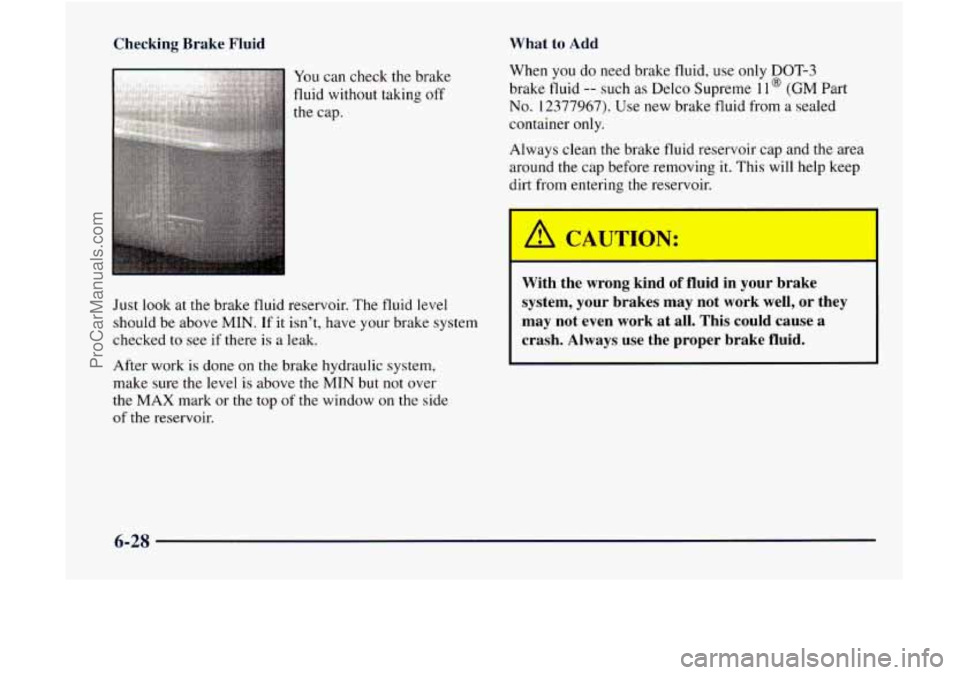
You can check the brake
fluid without taking off
the cap.
Just look at the brake fluid reservoir. The fluid level
should be above
MIN. If it isn’t, have your brake system
checked to see if there is a leak.
After work is done
on the brake hydraulic system,
make sure
the level is above the MTN but not over
the
MAX mark or the top of the window on the side
of the reservoir. When
you do need brake fluid, use only
DOT-3
brake fluid -- such as Delco Supreme 11 @ (GM Part
No.
12377967). Use new brake fluid from a sealed
container only.
Always clean the brake fluid reservoir cap and the
area
around the cap before removing it. This will help keep
dirt from entering the reservoir.
A CAUTION:
With the wrong kind of fluid in your brake
system, your brakes may not work well, or they
may not even work at
all. This could cause a
crash. Always use the proper brake fluid.
6-28
ProCarManuals.com
Page 276 of 386

NOTICE:
0 Using the wrong fluid can badly damage
brake system parts. For example, just
a few
drops of mineral-based oil, such as engine
oil, in your brake system can damage brake
system parts
so badly that they’ll have to be
replaced. Don’t let someone put in the
wrong kind of fluid.
If you spill brake fluid on your vehicle’s
painted surfaces, the paint finish can be
damaged. Be careful not to spill brake fluid
on your vehicle.
If you do, wash it off
immediately. See “Appearance Care” in
the Index.
Brake Wear
Your vehicle has four-wheel disc brakes.
Disc brake pads have built-in wear indicators that
make a high-pitched warning sound when the brake
pads are worn and new pads are needed. The sound
may come and
go or be heard all the time your vehicle
is moving (except when you are pushim on the brake
pedal firmly).
A CAU‘
The brake wear warning sound means that soon
your brakes won’t work well. That could lead to
an accident. When you hear the brake wear
warning sound, have your vehicle serviced.
NOTICE:
Continuing to drive with worn-out brake pads
could result
in costly brake repair.
6-29
ProCarManuals.com
Page 277 of 386

Some driving conditions or climates may cause a brake
squeal when the brakes are first applied or lightly
applied. This does not mean something is wrong with
your brakes.
Properly torqued wheel nuts are necessary to help
prevent brake pulsation. When tires are rotated, inspect
brake pads for wear and evenly torque
wheel nuts in the
proper sequence to
GM specifications.
Brake linings should always be replaced as complete
axle sets.
See “Brake System Inspection” in Section
7 of this manual
under Part
C “Periodic Maintenance Inspections.”
Brakc Jedal Travel
See your dealer if the brake pedal does not return to
normal height, or if there is a rapid increase in pedal
travel. This could be a sign of brake trouble.
Brake Adjustment
Every time you make a brake stop, your disc brakes
adjust for wear.
Replacing Brake System Parts
The braking system on a modern vehicle is complex.
Its many parts have to be
of top quality and work well
together
if the vehicle is to have really good braking.
Your vehicle was designed and tested with top-quality
GM brake parts. When you replace parts of your braking
system
-- for example, when your brake linings wear
down and
you have to have new ones put in -- be sure
you get new approved GM replacement parts.
If you
don’t, your brakes may
no longer work properly. For
example,
if someone puts in brake linings that are wrong
for your vehicle, the balance between your front and
rear brakes can change
-- for the worse. The braking
performance you’ve come to expect can change in many
other ways if someone puts
in the wrong replacement
brake parts.
Battery
Every new vehicle has an ACDelco Freedom@ battery.
You never have to add water to one of these. When it’s
time for a new battery, we recommend an ACDelco
Freedom battery. Get one that has the replacement
number shown on the original battery’s label.
6-30
ProCarManuals.com
Page 291 of 386

NOTICE:
The wrong wheel can also cause problems with
bearing life, brake cooling, speedometer or
odometer calibration, headlamp aim, bumper
height, vehicle ground clearance and tire
clearance to the body and chassis.
See “Changing a Flat Tire” in the Index for
more information.
Used Replacement Wheels
I
Putting a used wheel on your vehicle is
dangerous. You can’t know how it’s been used or
how far it’s been driven. It could fail suddenly
and cause an accident.
If you have to replace a
wheel, use a new GM original equipment wheel.
Tire Chains
NOTICE:
Don’t use tire chains. They can damage your
vehicle because there’s not enough clearance.
Use another type of traction device only if its
manufacturer recommends it for use on your
vehicle and tire size combination and road
conditions. Follow that manufacturer’s
instructions.
To help avoid damage to your
vehicle, drive slowly, readjust
or remove the
device
if it’s contacting your vehicle, and don’t
spin your wheels.
If you do find traction devices that will fit, install
them on the rear tires.
6-44
ProCarManuals.com
Page 304 of 386
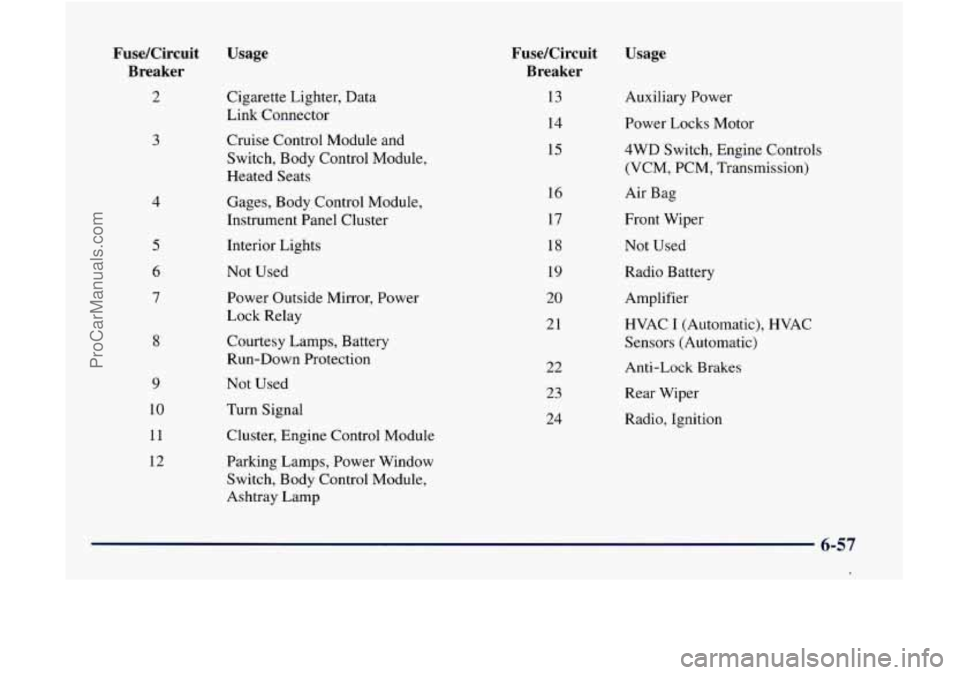
FuseKircuit Usage
Breaker
2
3
4
8
9
10
11
12 Cigarette
Lighter, Data
Link Connector
Cruise Control Module and
Switch, Body Control Module,
Heated Seats
Gages, Body Control Module,
Instrument Panel Cluster
Interior Lights
Not Used
Power Outside Mirror, Power
Lock Relay
Courtesy Lamps, Battery
Run-Down Protection
Not Used
Turn Signal
Cluster, Engine Control Module
Parking Lamps, Power Window
Switch, Body Control Module,
Ashtray Lamp
FuseKircuit
Breaker
13
14
15
16
17
18
19
20
21
22
23
24
Usage
Auxiliary Power
Power Locks Motor
4WD Switch, Engine Controls (VCM, PCM, Transmission)
Air Bag
Front Wiper
Not Used
Radio Battery
Amplifier
HVAC
I (Automatic), HVAC
Sensors (Automatic)
Anti-Lock Brakes
Rear Wiper
Radio, Ignition
6-57
ProCarManuals.com
Page 306 of 386

Name
RT TRN
RR PRK
TRL PRK
LT HDLP
RT HDLP
LT HI
RT HI
FR PRK
INT BAT
ENG
I
ECM B
ABS
ECM
1
HORN
BTS
I
BIU LP
IGN E
AIC
RAP
OXYSEN
Usage
Right Turn Signal Rear
Right Rear Parking Lamps
Trailer Park Lamps Left Headlamp
Right Headlamp
Left High Beam
Right High Beam
Front Parking Lamps
I/P Fuse Block Feed
Engine SensorsISolenoids, MAP,
CAM. PURGE, VENT
Engine Control Module, Fuel Pump,
Module, Oil Pressure
Anti-Lock Brake System
Engine Control Module Injectors Horn
Brake-Transmission Shift Interlock
Back-up
Lalllps
Engine
Air Conditioning
Retained Accessory Power
Oxygen Sensor
Name
IGN B
DRL
FOG LP
IGN
A
STUD #2
PARKLP
LR PRK
IGN C
HTDSEAT ATC
RRDFOG
HVAC
TRCHMSL
RR W/W
CRANK
LD LEV
HI BEAM
HAZLP
VECHMSL
HTDMIR
STOPLP
TBC
Usage
Column Feed, IGN 2, 3,4
Daytime Running Lamps
Fog Lamps
Starting and Charging IGN
I
Accessory Feeds, Electric Brake
Parking La~nps
Left Rear Parking Lamps Starter Solenoid, Fuel Pump. PRNDL
Heated Seat
Electronic Transfer Case
Rear Defogger
HVAC System
Trailer Center High Mount Stop Light
Rear Window Wiper
Clutch Switch, NSBU Switch
Electronic Load Leveling
HID Headlamps Hazard Lamps
Vehicle Center High
Mount Stop Lamp
Heated Mirror
Stoplamps
Truck Body Computer
6-59
1
ProCarManuals.com