Page 213 of 386
I’ :---d Warning Flashers
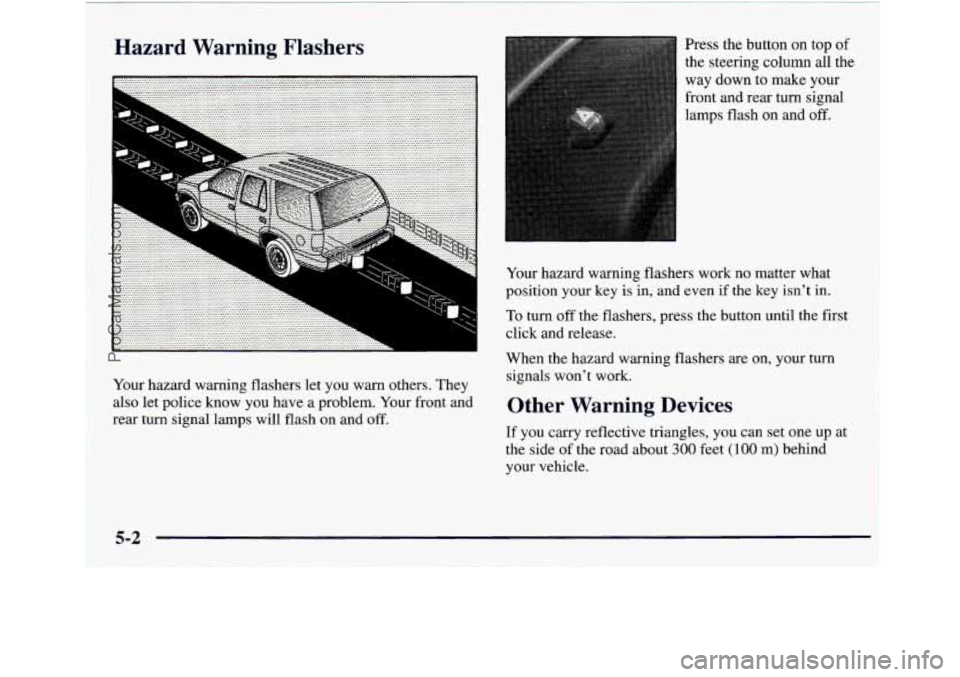
Your hazard warning flashers let you warn others. They
also let police know you have a problem. Your front and
rear turn signal lamps will flash
on and off. Press the button
on top of
the steering
column all the
way down to make your
front and rear turn signal
lamps flash on and
off.
Your hazard warning flashers work no matter what
position your key
is in, and even if the key isn’t in.
To turn
off the flashers, press the button until the first
click and release.
When the hazard warning flashers
are on, your turn
signals won’t work.
Other Warning Devices
If you carry reflective triangles, you can set one up at
the side of the road about
300 feet (100 m) behind
your vehicle.
5-2
ProCarManuals.com
Page 219 of 386
JTION:
A vehicle can fall from a car carrier if it isn’t
adequately secured. This can cause
a collision,
serious personal injury and vehicle damage. The
vehicle should be tightly secured with chains or
steel cables before it is transported.
Don’t use substitutes (ropes, leather straps,
canvas webbing, etc.) that can be cut by sharp
edges underneath the towed vehicle. Always use
T-hooks inserted in the T-hook slots. Never use
J-hooks. They will damage drivetrain and
suspension components.
When your vehicle is being towed, have the ignition key
turned
to the OFF position. The steering wheel should
be clamped
in a straight-ahead position with a clamping
device designed for towing service.
Do not use the
vehicle’s steering column lock for this. The transmission
should be in NEUTRAL
(N) and the transfer case
should be
in 2HI. The parking brake should be released.
If your vehicle has no electrical power, the electrical
solenoid lock
must be overridden to shift from
PARK (P) to NEUTRAL (N). Follow these steps:
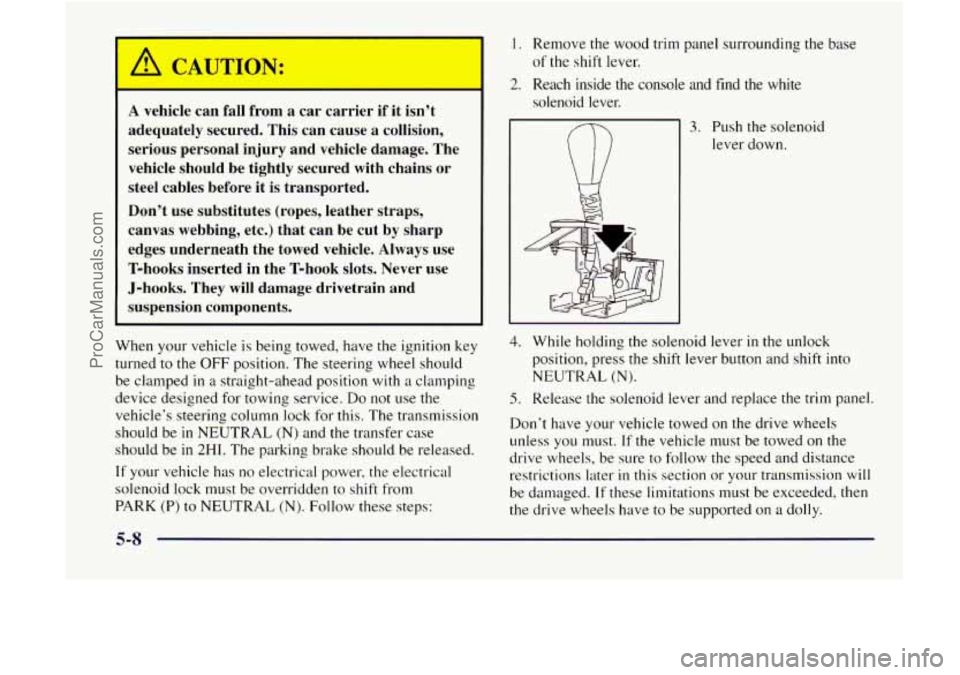
1 I Remove the wood trim panel surrounding the base
2. Reach inside the console and find the white of the shift lever.
solenoid lever.
(ii
3. Push the solenoid
lever down.
4. While holding the solenoid lever in the unlock
position, press the shift lever button and shift into
NEUTRAL
(N).
5. Release the solenoid lever and replace the trim panel.
Don’t have your vehicle towed on the drive wheels
unless
you must. If the vehicle must be towed on the
drive wheels, be sure to follow the speed and distance
restrictions later
in this section or your transmission will
be damaged. If these limitations must be exceeded, then
the drive wheels have to be supported
on a dolly.
5-8
ProCarManuals.com
Page 231 of 386

Engine Fan Noise
This vehicle has a clutched engine cooling fan. When the
clutch is engaged, the fan spins faster to provide more air
to cool the engine. In most everyday driving conditions,
the clutch is
not engaged. This improves fuel economy and
reduces
fan noise. Under heavy vehicle loading, trailer
towing and/or high outside temperatures, the fan speed
increases when the clutch engages.
So you may hear an
increase in fan noise. This is normal and should not be
mistaken
as the transmission slipping or making extra
shifts. It is merely the cooling system functioning properly.
The fan will slow down when additional cooling is not
required and the clutch disengages.
You may
also hear this fan noise when you start the
engine. It will go away
as the fan clutch disengages.
If a Tire Goes Flat
It’s unusual for a tire to “blow out” while you’re driving,
especially if you maintain your tires properly.
If air goes
out of
a tire, it’s much more likely to leak out slowly.
But
if you should ever have a “blowout,” here are a few
tips about what to expect and what to do:
If
a front tire fails, the flat tire will create a drag that
pulls the vehicle toward that side.
Take your foot off the
accelerator pedal and grip
the steering wheel firmly.
Steer to maintain lane position, and then gently brake to
a stop well out of the traffic lane.
A rear blowout, particularly on a curve, acts much like a
skid and may require the same correction you’d use in a
skid. In any rear blowout, remove your foot from the
accelerator pedal. Get the vehicle under control by
steering the
way you want the vehicle to go. It may be
very bumpy and noisy, but you can
still steer. Gently
brake to
a stop -- well off the road if possible.
If a tire goes flat, the next part shows how to use your
iacking equipment to change
a flat tire safely. u Y a. c
5-20
ProCarManuals.com
Page 244 of 386
Rocking Your Vehicle To Get It Out
First, turn your steering wheel left and right. That will
clear
the area around your front wheels. Shift the transfer
case into
4HI. Then shift back and forth between
REVERSE
(R) and a forward gear, spinning the wheels as
little as possible. Release the accelerator pedal while you shift, and press lightly
on the accelerator pedal when the
transmission is in gear.
If that doesn’t get you out after a
few tries,
you may need to be towed out. Or, you can use
your recovery
hooks. If you do need to be towed out, see
“Towing Your Vehicle”
in the Index.
Using the Recovery Hooks
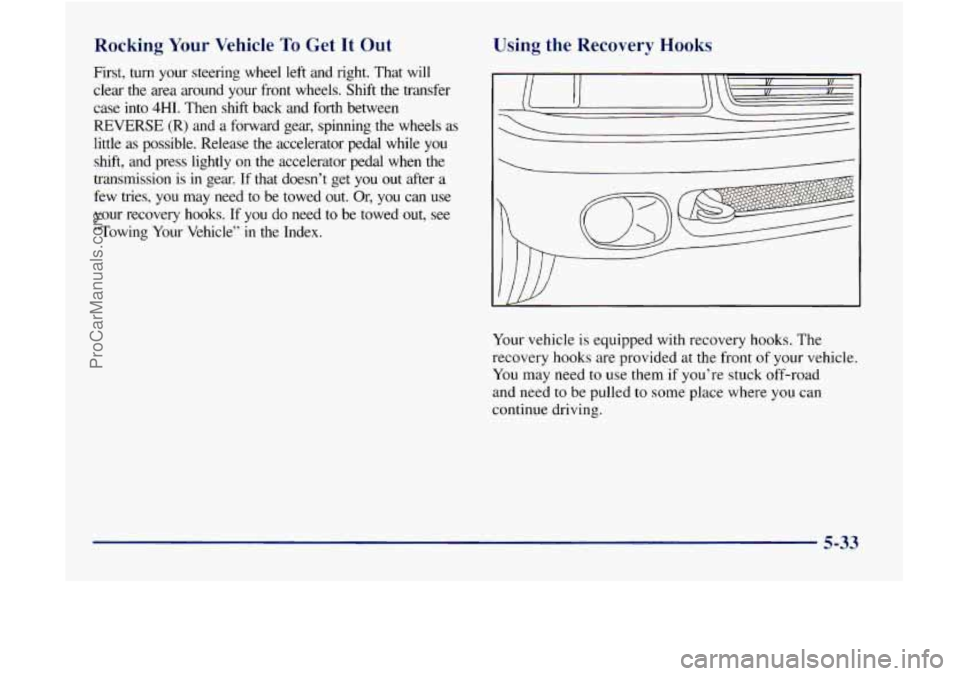
Your vehicle is equipped with recovery hooks. The
recovery hooks are provided at the front
of your vehicle.
You may need
to use them if you’re stuck off-road
and need
to be pulled to some place where you can
continue driving.
5-33
ProCarManuals.com
Page 248 of 386

Section 6 Service and Appearance Care
Here you will find information about the care of your vehicle. This section begins with service and fuel information,
and then
it shows how to check important fluid and lubricant levels. There is also technical information about your
vehicle, and a part devoted
to its appearance care.
6-2
6-3
6-5
6-5
6-7
6-8
6-
10
6-14
6- 15
6-19
6-20
6-2
1
6- 24
6-25
6-25
6-26
6-
2’7
Service
Fuel
Fuels in Foreign Countries
Filling Your Tank
Filling a Portable
Fuel Container
Checking Things Under the Hood
Engine Oil
Air Cleaner
Automatic Transmission Fluid
Rear Axle
Four- Wheel Drive
Engine Coolant
Radiator Pressure Cap
Thermostat
Power Steering Fluid
Windshield Washer Fluid
Brakes Battery
Bulb Replacement
Windshield Wiper Blade Replacement
Tires
Appearance Care
Cleaning the Inside
of Your Vehicle
Care of Safety Belts
Cleaning the Outside of Your Vehicle
Appearance Care Materials Chart
Vehicle Identification Number (VIN)
Service Parts Identification Label
Electrical System
Replacement Bulbs
Capacities and Specifications
Air Conditioning Refrigerants
6-30
6-3
1
6-34
6-36
6-45
6-46
6-48
6-50
6-53
6-54
6-54
6-54
6- 60
6- 60
6-62
6-1
ProCarManuals.com
Page 256 of 386
When you lift the hood, you’ll see these items:
C
A. Battery
B. Coolant Recovery Tank
C. Engine
Oil Dipstick
D. Engine
Oil Fill
E. Transmission Dipstick
E Power Steering Reservoir
G. Brake Master Cylinder
H. Air Cleaner
I. Fuse Block
J. Windshield Washer Fluid
6-9
ProCarManuals.com
Page 261 of 386

Remote Oil Filter
The access door for the remote oil filter is in the steering
linkage shield assembly located under the radiator
support. Twist the screw to unlock or lock the door.
If
you open the door, make sure it is securely closed when
you are finished.
What to Do with Used Oil
Did you know that used engine oil contains certain
elements
that may be unhealthy for your skin and could
even cause cancer? Don’t let used oil stay on your skin
for very long. Clean your skin and nails with soap and
water, or
a good hand cleaner. Wash or properly throw
away clothing or rags containing used engine oil. (See
the manufacturer’s warnings about the use and disposal
of oil products.)
Used oil can be a real threat to the environment. If you
change your own oil, be sure to drain all free-flowing oil
from the filter before disposal. Don’t ever dispose of oil
by putting
it in the trash, pouring it on the ground, into
sewers, or into streams or bodies
of water. Instead,
recycle it by taking it to
a place that collects used oil. If
you have a problem properly disposing of your used oil,
ask your dealer, a service station or a local recycling
center for help.
To remove the air cleaner, remove the wing nuts that
hold the cover on. Remove the cover and lift
out the
air filter.
Insert
a new air filter, then replace the air cleaner cover.
Tighten the wing nuts
to hold the cover in place.
6-14
ProCarManuals.com
Page 272 of 386

Thermostat
Engine coolant temperature is controlled by a thermostat
in the engine coolant system. The thermostat stops the
flow
of coolant through the radiator until the coolant
reaches a preset temperature.
Power Steering Fluid
When to Check Power Steering Fluid
It is not necessary to regularly check power steering
fluid unless you suspect there is
a leak in the system or
you hear an unusual noise.
A fluid loss in this system
could indicate a problem. Have the system inspected
and repaired.
How To Check Power Steering Fluid
When the engine compartment is cool, wipe the cap and
the top
of the reservoir clean, then unscrew the cap and
wipe the dipstick with a clean rag. Replace the cap and
completely tighten it. Then remove the cap again and
look at the fluid level on the dipstick.
The level should be between the
ADD and FULL marks.
If necessary, add only enough fluid to bring the level up
to the proper range.
What to Use
To determine what kind of fluid to use, see
“Recommended Fluids and Lubricants” in the Index.
Always use the proper fluid. Failure to use the proper
fluid can cause leaks and damage hoses and seals.
6-25
ProCarManuals.com