Page 267 of 386
Four-wheel Drive
Transfer Case
When to Check Lubricant
Refer to the Maintenance Schedule to determine how
often
to check the lubricant. See “Periodic Maintenance
Inspections” in
the Index.
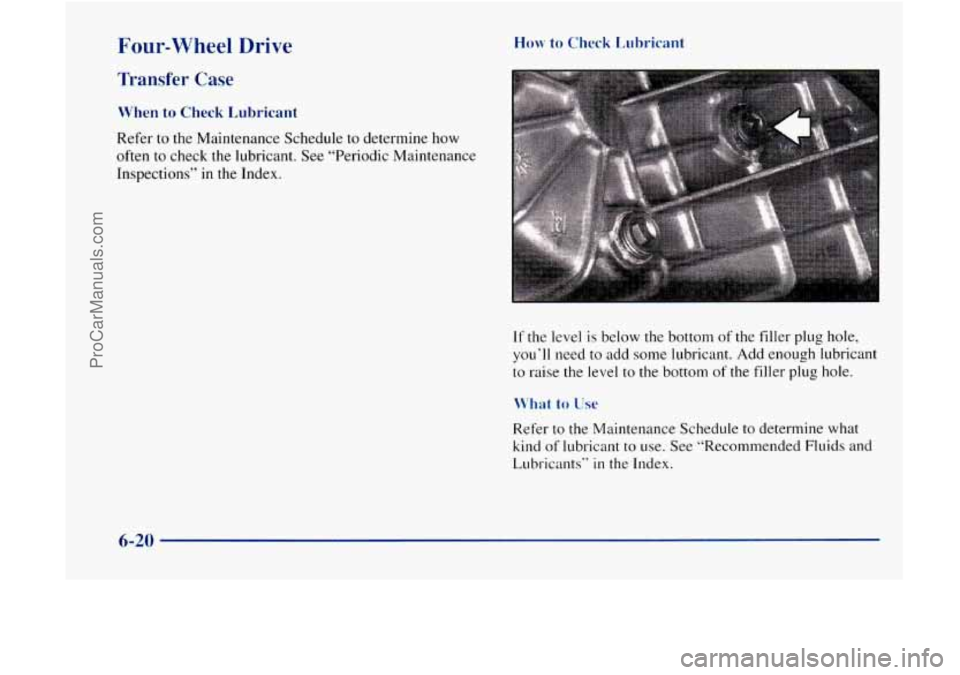
How to Check Lubricant
If the level is below the bottom of the filler plug hole,
you’ll need to add some lubricant. Add enough lubricant
to raise
the level to the bottom of the filler plug hole.
Refer to the Maintenance Schedule to determine what
kind
of lubricant to use. See “Recommended Fluids and
Lubricants” in the Index.
6-20
ProCarManuals.com
Page 276 of 386

NOTICE:
0 Using the wrong fluid can badly damage
brake system parts. For example, just
a few
drops of mineral-based oil, such as engine
oil, in your brake system can damage brake
system parts
so badly that they’ll have to be
replaced. Don’t let someone put in the
wrong kind of fluid.
If you spill brake fluid on your vehicle’s
painted surfaces, the paint finish can be
damaged. Be careful not to spill brake fluid
on your vehicle.
If you do, wash it off
immediately. See “Appearance Care” in
the Index.
Brake Wear
Your vehicle has four-wheel disc brakes.
Disc brake pads have built-in wear indicators that
make a high-pitched warning sound when the brake
pads are worn and new pads are needed. The sound
may come and
go or be heard all the time your vehicle
is moving (except when you are pushim on the brake
pedal firmly).
A CAU‘
The brake wear warning sound means that soon
your brakes won’t work well. That could lead to
an accident. When you hear the brake wear
warning sound, have your vehicle serviced.
NOTICE:
Continuing to drive with worn-out brake pads
could result
in costly brake repair.
6-29
ProCarManuals.com
Page 315 of 386

Part A: Scheduled Maintenance
Services
Using Your Maintenance Schedule
We at General Motors want to help you keep your
vehicle in good working condition. But we don’t
know
exactly how you’ll drive it. You may drive very short
distances
only a few times a week. Or you may drive
long distances all the time in very hot, dusty weather.
You may use
your vehicle in making deliveries. Or
you may drive
it to work, to do errands or in many
other ways.
Because
of all the different ways people use their
vehicles, maintenance needs vary. You may even need
more frequent checks and replacements than you’ll find
in the schedules in this section. So please read this
section and
note how you drive. If you have any
questions
on how to keep your vehicle in good
condition, see your dealer.
This part tells you the maintenance services you should
have done and
when you should schedule them. If you
go to your dealer for your service needs, you’ll know
that GM-trained and supported service people will
perform the work using genuine GM parts. The proper fluids and lubricants to use are listed in
Part D. Make sure whoever services your vehicle uses
these. All parts should be replaced and all necessary
repairs done before you or anyone else drives the vehicle.
These schedules are for vehicles that:
0 carry passengers and cargo within recommended
limits. You will find these limits on your vehicle’s
Certificationflire label. See “Loading Your Vehicle”
in the Index.
0 are driven on reasonable road surfaces within legal
driving limits.
are driven off-road in the recommended manner. See
“Off-Road Driving With Your Four-Wheel-Drive
Vehicle”
in the Index.
0 use the recommended fuel. See “Fuel” in the Index.
Selecting the Right Schedule
First you’ll need to decide which of the two schedules is
right for your vehicle. Here’s how to decide which
schedule to follow:
7-4
ProCarManuals.com
Page 355 of 386

Throttle System Inspection
Inspect the throttle system for interference or binding,
and for damaged or missing parts. Replace parts as
needed. Replace any components that have high effort
or excessive wear.
Do not lubricate accelerator and
cruise control cables.
Drive Axle Service
Check readfront axle fluid level and add as needed.
Check constant velocity joints and axle seals for leaking.
Transfer Case (Four-wheel Drive)
Inspection
Every 12 months or at oil change intervals, check front
axle and transfer case and add lubricant when necessary.
Check vent hose at transfer case for kinks and proper
installation. More frequent lubrication may be required
on off-road
use.
Brake System Inspection
Inspect the complete system. Inspect brake lines and
hoses for proper hook-up, binding, leaks, cracks,
chafing, etc. Inspect disc brake pads for wear and rotors
for surface condition. Inspect other brake parts,
including calipers, parking brake, etc. Check parking
brake adjustment. You may need to have your brakes
inspected more often if your driving habits or conditions
result in frequent braking.
7-44
ProCarManuals.com
Page 377 of 386

Engine (Continued) .............................. 6-9
Exhaust
..................................... 2-24
FanNoise
................................... 5-20
Identification
................................ 6-54
OilLevelCheck
.............................. 7-39
Overheating
................................. 5-11
Specifications
................................ 6-60
Engine Compartment Fuse Block
.................. 6-58
Engineoil
.................................... 6-10
Adding
..................................... 6-11
Additives
................................... 6-13
Checking
................................... 6-11
Kindtouse
................................. 6-12
Pressure Gage
................................ 2-69
Used
....................................... 6-14
When to Change
.............................. 6- I3
Exhaust, Engine
................................ 2-24
Exit Lighting
.................................. 2-39
Express-Down Window
.......................... 2-29
Fabric Cleaning
............................... 6-46
Filling
a Portable Fuel Container .................... 6-7
FillingYourTank
................................ 6-5
Fi 1 ter
Air
........................................ 6-14
Remote Oil .................................. 6- 14
Finish Care .................................... 6-5 1
Finish Damage ................................. 6-52
Running While
Parked
......................... 2-25
Starting
..................................... 2-15
Engine Coolant
................................. 6-2 1
FirstGear ..................................... 2-20
Flashers. Hazard Warning
......................... 5-2
Flat Tire. Changing
............................. 5-21
Fluids and Lubricants
............................ 7-4.5
FogLampSwitch ............................... 2-38
Foreign Countries. Fuel ........................... 6-5
Four-wheel Drive
......................... 2-26. 6-20
French Language Manual 11
FrontAxle .................................... 6-21
Front Reading Lamps
....................... 2.39. 2.43
Front Storage Area .............................. 2-45
FrontTowing
................................... 5-9
Filling a Portable Container
...................... 6-7
Filling Your Tank
.............................. 6-5
Foreign Countries .............................. 6-5
Engine Compartment
.......................... 6-58
Instrument Panel
............................. 6-56
Fuses and Circuit Breakers
....................... 6-55
Gages
.. ...........................
Front Turn Signal Lamp Bulb Replacement .......... 6-33
Fuel
.......................................... 6-3
Cage
....................................... 2-72
Fuse Block
Engine Coolant Temperature
.................... 2-66
Fuel
....................................... 2-72
Engine Oil Pressure ........................... 2-69
GasCap
....................................... 6-5
Gate A-jar Light ................................ 2-71
GAWR
....................................... 4-40
Gear
Positions ................................. 2-18
9-4
ProCarManuals.com