1998 FORD MUSTANG belt
[x] Cancel search: beltPage 82 of 192

10. Try to pull the belt out of the retractor to make
sure the retractor is in the automatic locking mode
(you should not be able to pull more belt out). If the
retractor is not locked, unbuckle the belt and repeat
steps two through nine.
Check to make sure the child seat is properly
secured before each use.
Attaching safety seats with tether straps
Some manufacturers make safety seats that include
a tether strap that goes over the back of the vehicle
seat and attaches to an anchoring point. Other
manufacturers offer the tether strap as an accessory.
Contact the manufacturer of your child safety seat
for information about ordering a tether strap.
Tether anchorage hardware
Attachment holes (at each rear seating position)
have been provided in your vehicle to attach anchor
hardware, if required. Tether anchorage hardware
kits (part number 613D74) including instructions,
may be obtained at no charge from any Ford or
Lincoln-Mercury dealer. All vehicles built for sale in
Canada include a tether anchor hardware kit.
Be sure to follow the child safety seat
manufacturer's instructions.
Tighten the anchor according to
specifications. Otherwise, the safety seat
may not be properly secured and the child may be
injured in a sudden stop or collision.
Seating and safety restraints
82
Page 84 of 192

Important safety precautions
A computer system controls the engine's idle
revolutions per minute (RPM). When the engine
starts, the idle RPM runs faster to warm the engine.
If the engine idle speed does not slow down
automatically, have the vehicle checked. Do not
allow the vehicle to idle for more than ten minutes
at high engine RPM.
Before starting the vehicle:
1. Make sure all vehicle occupants have buckled
their safety belts. For more information on safety
belts and their proper usage, refer to theSeating
and safety restraintschapter.
2. Make sure the headlamps and vehicle accessories
are off.
If starting a vehicle with an automatic transmission:
²Make sure the
parking brake is set.
²Make sure the gearshift is in P (Park).
If starting a vehicle with a manual transmission:
²Make sure the parking brake is set.
²Push the clutch
pedal to the floor.
Starting
84
Page 85 of 192

3. Turn the key to 4
(ON) without turning
the key to 5 (START).
Make sure the corresponding lights illuminate briefly.
If a light fails to illuminate, have the vehicle
serviced.
²If the driver's safety belt is fastened, the
light
may not illuminate.
1
2
34
5
P! BRAKE
L
0
00000 00
C
E
FH
LH
10 203020 406080100
120
140
160
180
405060 70
80
90
100
11 0
1204
5
6
7 3
2
1
H
THEFT
RPMX1000
FUEL DOORSELECT/RESET
LOW
FUELO/D
OFF AIR
BAGSERVICE
ENGINE
SOON
MPH km/h
ABS
.
P! BRAKE
L
0
00000 00
C
E
FH
LH
102040608020 40608010 012 0 14 0
160
180
200
220
240
100
120
140
305070 90
110
13 0
1504
5
6
7
8 3
2
1
H
THEFT
RPMX1000
FUEL DOORSELECT/RESET
LOW
FUELO/D
OFF AIR
BAGSERVICE
ENGINE
SOON
MPH km/h
ABS
.
Starting
85
Page 122 of 192
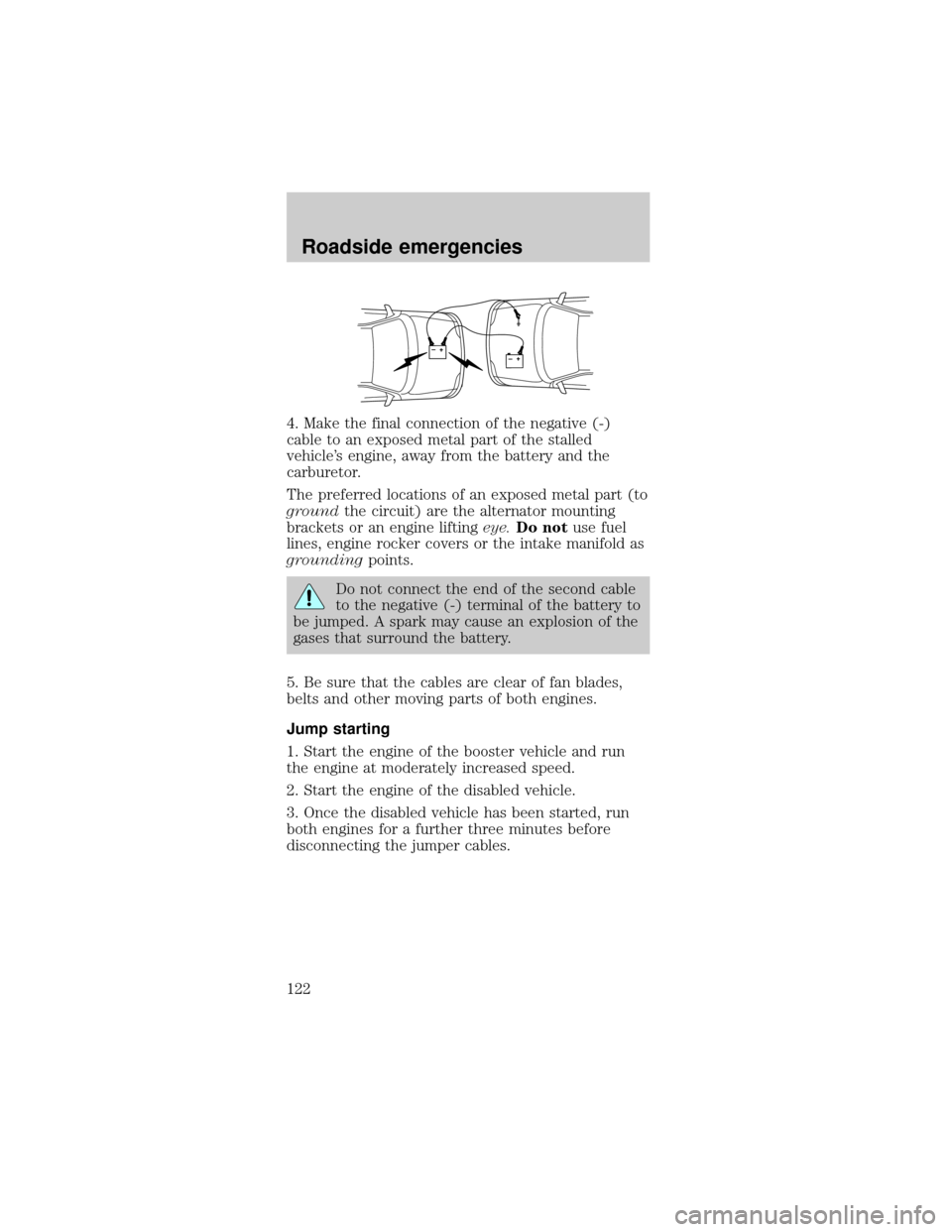
4. Make the final connection of the negative (-)
cable to an exposed metal part of the stalled
vehicle's engine, away from the battery and the
carburetor.
The preferred locations of an exposed metal part (to
groundthe circuit) are the alternator mounting
brackets or an engine liftingeye.Do notuse fuel
lines, engine rocker covers or the intake manifold as
groundingpoints.
Do not connect the end of the second cable
to the negative (-) terminal of the battery to
be jumped. A spark may cause an explosion of the
gases that surround the battery.
5. Be sure that the cables are clear of fan blades,
belts and other moving parts of both engines.
Jump starting
1. Start the engine of the booster vehicle and run
the engine at moderately increased speed.
2. Start the engine of the disabled vehicle.
3. Once the disabled vehicle has been started, run
both engines for a further three minutes before
disconnecting the jumper cables.
+–+–
Roadside emergencies
122
Page 125 of 192

It is recommended that your vehicle be towed with a
wheel lift or flatbed equipment.
However, on Mustang and Mustang GT models, a
slingbelt with T-hooks can also be used.
Do not tow Cobra or Convertible models with a
slingbelt. Ford Motor Company has not approved a
slingbelt towing procedure for these vehicles.
If your vehicle is to be towed from the rear using
wheel lift equipment or a slingbelt, the front wheels
must be placed on a dolly to prevent damage to the
front fascia (bumper).
A towing manual is available from Ford Motor
Company for all authorized tow truck operators.
Have your tow truck driver refer to this manual for
proper hook-up and towing procedures for your
vehicle.
Roadside emergencies
125
Page 176 of 192

Do not use household cleaning products,
alcohol solutions, solvents or cleaners intended
for rubber, vinyl or plastics.
Cleaning and maintaining the safety belts
Clean the safety belts with a mild soap solution
recommended for cleaning upholstery or carpets. Do
not bleach or dye the belts, because these actions
may weaken the belt webbing.
Check the safety belt system periodically to make
sure there are no nicks, wear or cuts. If your vehicle
has been involved in an accident, refer to theSafety
belt maintenancesection in theSeating and safety
restraintschapter.
Inside windows
Use glass cleaner for the inside windows if they
become fogged.
Convertible top and padded molding care
To avoid damage to the vinyl top and moldings, use
only an approved Ford cleaner, or equivalent. Do not
use stiff bristle brushes or abrasive materials or
cleaners.
Hot waxes applied by commercial car washes can
affect the cleanability of vinyl material.
Using high water pressure or wand-type car washes
against the convertible top and windows may cause
water leaks and possible seal damage.
Underbody
Flush the complete underside of vehicle frequently.
Keep body drain holes unplugged. Inspect for road
damage.
Maintenance and care
176
Page 187 of 192

Fuel
choosing
the right fuel ......... 156
comparisons with EPA
fuel economy
estimates ............... 163
detergent in fuel ... 158
filling your vehicle
with fuel ......... 154,155
gauge ....................... 12
quality .................... 157
running
out of fuel ............. 158
safety information
relating to automotive
fuels ....................... 154
Fuses ................. 109,110
Gas mileage (see
Fuel economy) ........ 159
160,161,162
Gauges ....................... 12
engine coolant
temperature gauge . 13
engine oil pressure
gauge ....................... 15
Hazard flashers ....... 108
Head restraints ......... 63
Headlamps
aiming ............. 170,171
bulb
specifications ........ 170
high beam ............ 7,44
warning chime ........ 11
Heating ...................... 18
heating and air
conditioning
system ................ 18,20
Hood ........................ 128
Ignition ..................... 182
Inspection/maintenance
(I/M) testing ............ 164
Instrument panel ........ 6cleaning ................. 175
Keys
key in ignition
chime ....................... 11
positions of the
ignition .................... 45
removing from the
ignition .................. 101
Lamps
daytime
running light ........... 16
fog lamps ................. 52
headlamps ............... 16
headlamps, flash to
pass .......................... 44
instrument panel,
dimming ................... 17
interior
lamps ......... 49,169,170
replacing bulbs ..... 165
166,167,168,169
Lane change indicator
(see Turn signal) ...... 43
Lights, warning and
indicator
air bag ........................ 7
anti-lock brakes
(ABS) ...................... 10
anti-theft ................... 7
brake ........................ 10
charging system ........ 7
check coolant .......... 11
low fuel ...................... 9
overdrive off .............. 9
safety belt ................. 7
service engine soon .. 8
turn signal indicator . 6
Lumbar support,
seats ...................... 65,66
Manual transmission
reverse ................... 100
Index
187
Page 188 of 192

Mirrors
side view mirrors
(power) ................... 51
Motorcraft parts ...... 158
Octane rating .......... 157
Odometer ................... 14
Panic alarm feature,
remote entry system 57
Parking brake ............ 90
Power distribution box
(see Fuses) ............. 113
Power door locks ...... 51
Power steering .......... 92
fluid, checking and
adding .................... 140
Radio ................ 21,22,23
24,25,26,27,28,29,30
31,32,33,34,35,36,37
38,39,40,41,42,43
Relays ...................... 109
Remote entry
system .............. 56,60,61
illuminated entry .... 58
locking/unlocking
doors ................... 56,57
replacement/additional
transmitters ............. 58
replacing
the batteries ............ 59
Safety belts (see
Safety restraints) ...... 11
Safety restraints
cleaning the safety
belts .................. 71,176
extension assembly 70
for children ........ 76,77
warning light and
chime .................. 11,70
Seat belts (see Safety
restraints) ........ 66,68,69
Seats .......................... 63
child safety seats .... 78cleaning ................. 175
Seats-easy access/
easyout feature ......... 65
Servicing your
vehicle ............... 126,127
Spark plugs,
specifications ........... 177
Special notice .............. 3
Specification chart,
lubricants ................. 180
Speed control ............ 46
Speedometer ............. 13
Starting your
vehicle .............. 83,84,86
jump starting ........ 120
121,122,123
Steering wheel
tilting ....................... 45
Tachometer ............... 14
Tires ........... 149,150,151
changing ......... 115,116
checking
the pressure .......... 151
replacing ................ 152
rotating .................. 151
snow tires
and chains ............. 153
tire grades ............. 150
treadwear .............. 150
Towing
wrecker .................. 124
Traction control ........ 91
active light .............. 10
Traction-lok
rear axle .................. 101
Transmission ........... 142
automatic
operation ................. 93
fluid, checking and
adding
(automatic) ........... 142
143,144
Index
188