Page 88 of 219
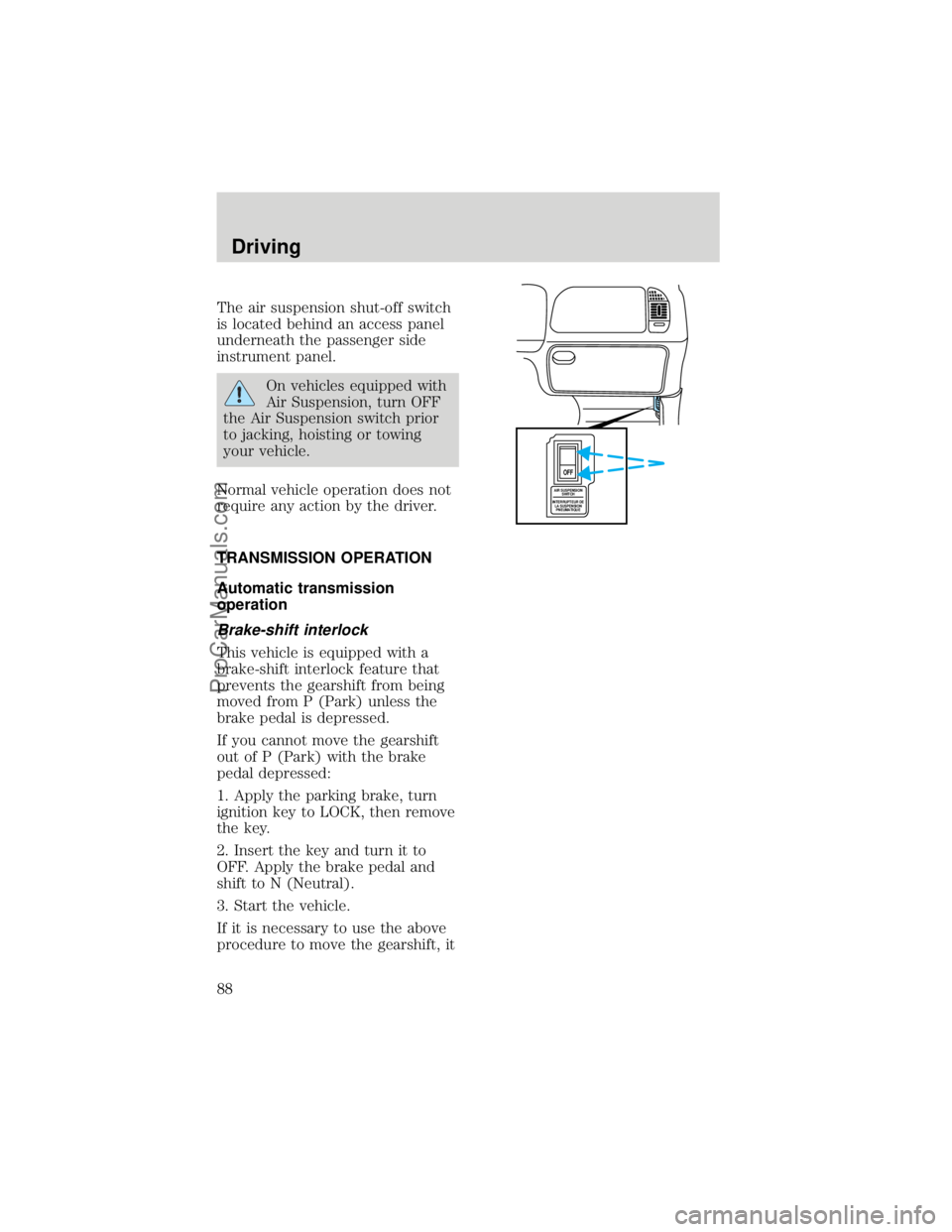
The air suspension shut-off switch
is located behind an access panel
underneath the passenger side
instrument panel.
On vehicles equipped with
Air Suspension, turn OFF
the Air Suspension switch prior
to jacking, hoisting or towing
your vehicle.
Normal vehicle operation does not
require any action by the driver.
TRANSMISSION OPERATION
Automatic transmission
operation
Brake-shift interlock
This vehicle is equipped with a
brake-shift interlock feature that
prevents the gearshift from being
moved from P (Park) unless the
brake pedal is depressed.
If you cannot move the gearshift
out of P (Park) with the brake
pedal depressed:
1. Apply the parking brake, turn
ignition key to LOCK, then remove
the key.
2. Insert the key and turn it to
OFF. Apply the brake pedal and
shift to N (Neutral).
3. Start the vehicle.
If it is necessary to use the above
procedure to move the gearshift, it
AIR SUSPENSION
SWITCH
INTERRUPTEUR DE
LA SUSPENSION
PNEUMATIQUE
OFF
Driving
88
ProCarManuals.com
Page 89 of 219
is possible that a fuse has blown
and the vehicle's brakelamps may
not be operating properly. Refer to
Fuses and relaysin theRoadside
emergencieschapter.
Do not drive your vehicle
until you verify that the
brakelamps are working.
If your vehicle gets stuck in mud
or snow it may be rocked out by
shifting from forward and reverse
gears in a steady pattern. Press
lightly on the accelerator in each
gear.
Do not rock the vehicle for
more than a few minutes. The
transmission and tires may be
damaged or the engine may
overheat.
Always set the parking
brake fully and make sure
the gearshift is latched in P
(Park). Turn off the ignition
whenever you leave your vehicle.
Driving with a 4±speed
automatic transmission
Understanding gearshift
positions
Pull the gearshift lever towards
you and downward to move the
automatic gearshift.
Driving
89
ProCarManuals.com
Page 91 of 219
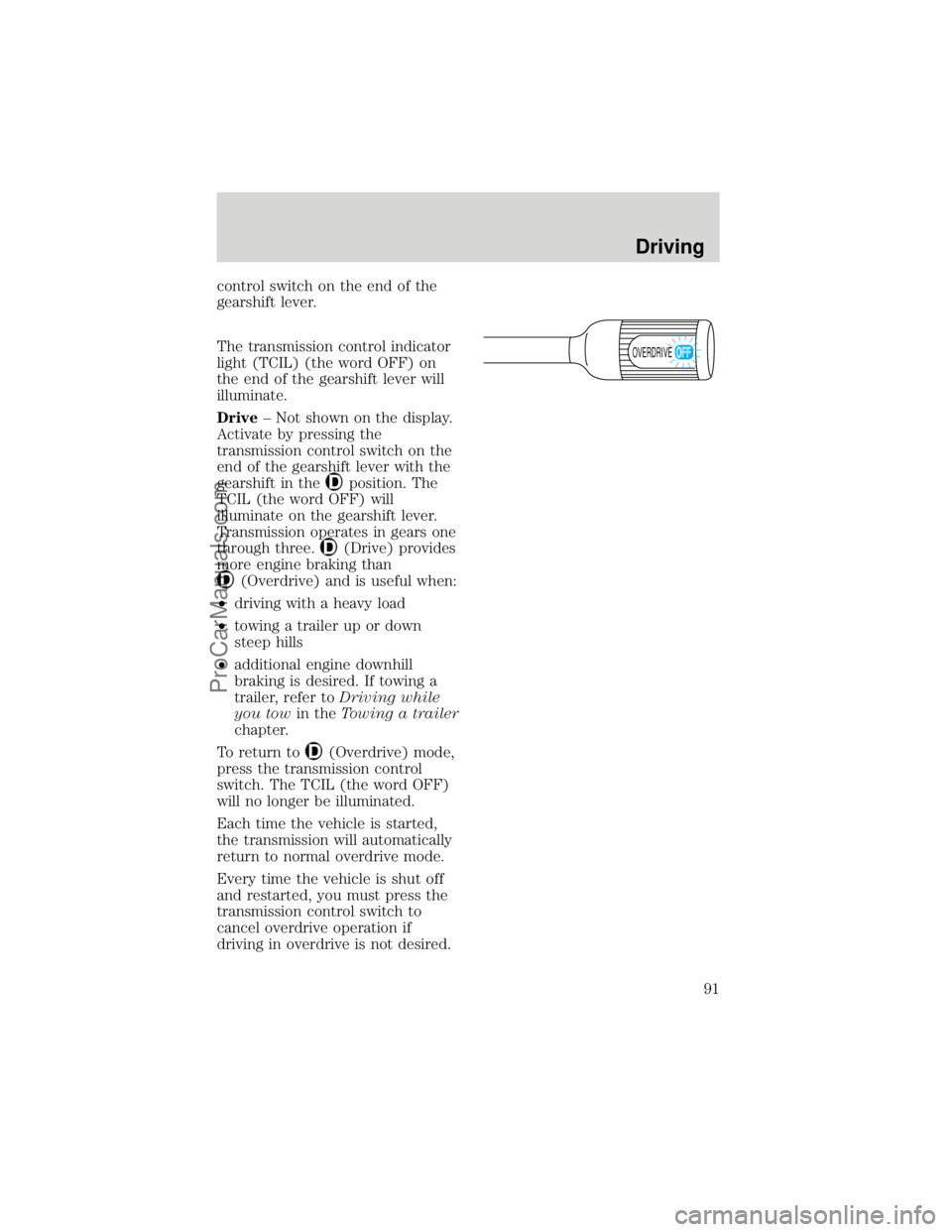
control switch on the end of the
gearshift lever.
The transmission control indicator
light (TCIL) (the word OFF) on
the end of the gearshift lever will
illuminate.
Drive± Not shown on the display.
Activate by pressing the
transmission control switch on the
end of the gearshift lever with the
gearshift in the
position. The
TCIL (the word OFF) will
illuminate on the gearshift lever.
Transmission operates in gears one
through three.
(Drive) provides
more engine braking than
(Overdrive) and is useful when:
²driving with a heavy load
²towing a trailer up or down
steep hills
²additional engine downhill
braking is desired. If towing a
trailer, refer toDriving while
you towin theTowing a trailer
chapter.
To return to
(Overdrive) mode,
press the transmission control
switch. The TCIL (the word OFF)
will no longer be illuminated.
Each time the vehicle is started,
the transmission will automatically
return to normal overdrive mode.
Every time the vehicle is shut off
and restarted, you must press the
transmission control switch to
cancel overdrive operation if
driving in overdrive is not desired.
OVERDRIVE
Driving
91
ProCarManuals.com
Page 98 of 219
Removing key from ignition
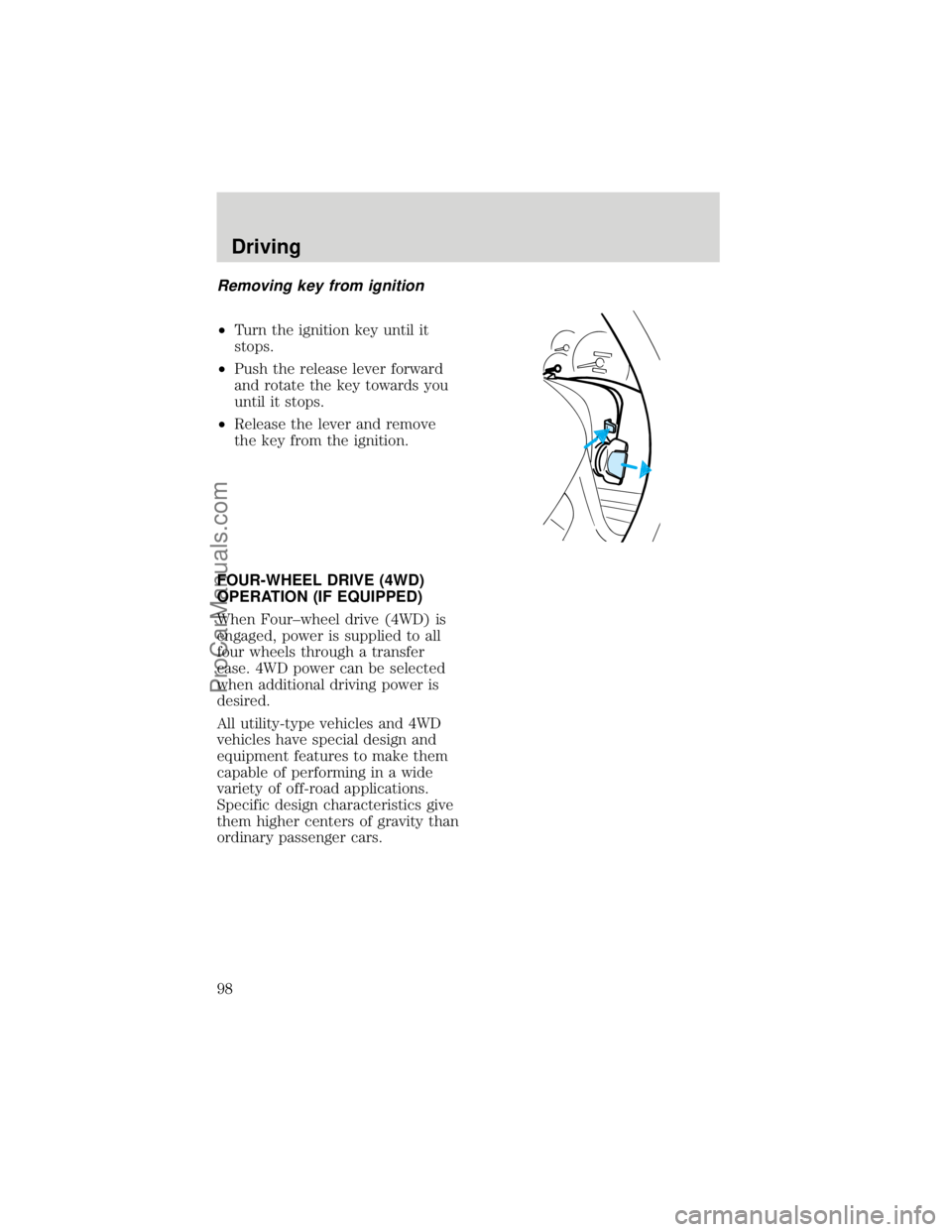
²Turn the ignition key until it
stops.
²Push the release lever forward
and rotate the key towards you
until it stops.
²Release the lever and remove
the key from the ignition.
FOUR-WHEEL DRIVE (4WD)
OPERATION (IF EQUIPPED)
When Four±wheel drive (4WD) is
engaged, power is supplied to all
four wheels through a transfer
case. 4WD power can be selected
when additional driving power is
desired.
All utility-type vehicles and 4WD
vehicles have special design and
equipment features to make them
capable of performing in a wide
variety of off-road applications.
Specific design characteristics give
them higher centers of gravity than
ordinary passenger cars.
Driving
98
ProCarManuals.com
Page 102 of 219
transmission and puts the
vehicle in neutral regardless of
transmission gearshift lever
position. The vehicle can move
forward or backwards. Make
sure the parking brake is
applied and the vehicle is never
left unattended with the
transfer case in neutral.
This position should only be used
when towing the vehicle. Refer to
Wrecker towingin theRoadside
emergencieschapter.
Do not leave the vehicle
unattended with the
transfer case in the N (Neutral)
position. Always set the parking
brake fully and turn off the
ignition when leaving the vehicle.
Using the electronic shift 4WD
system (if equipped)
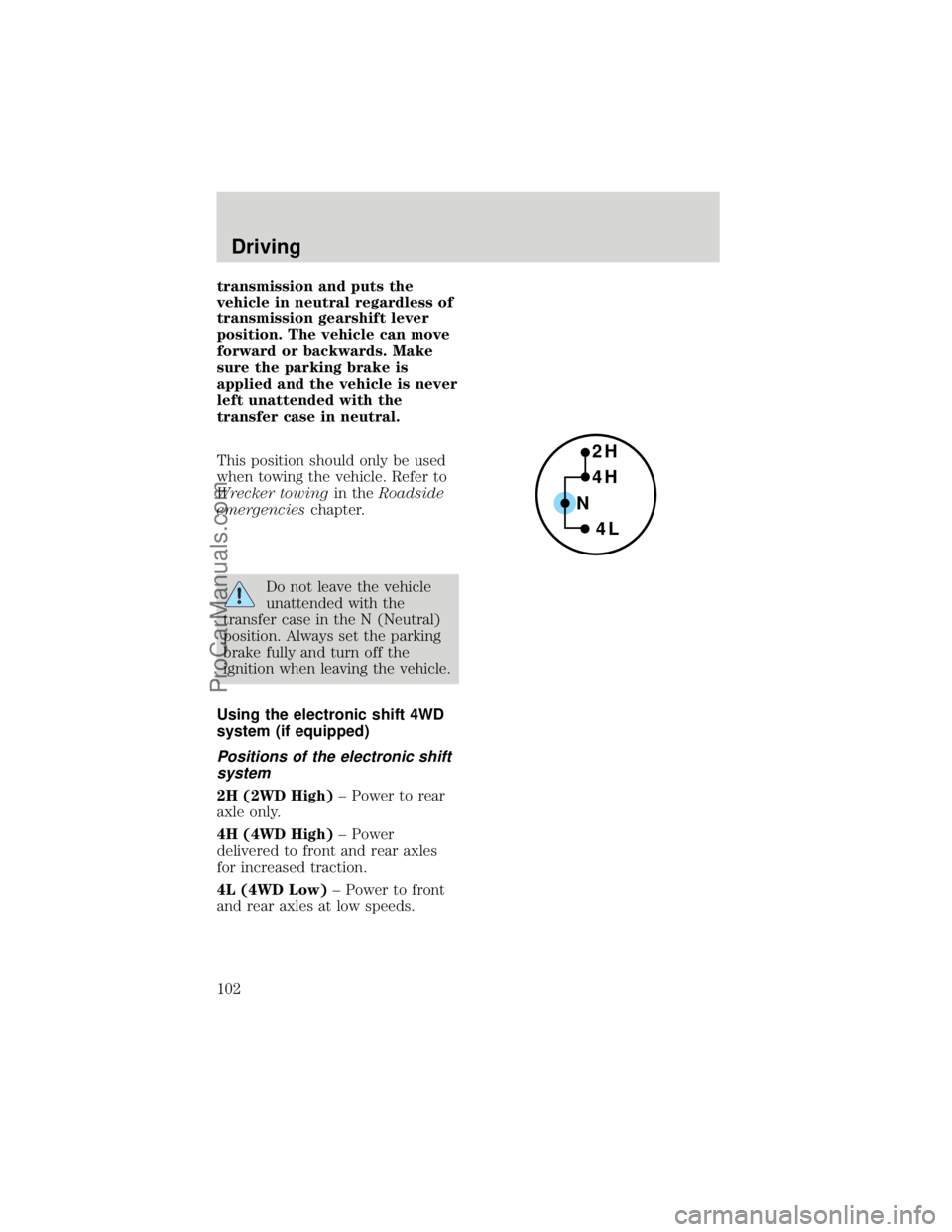
Positions of the electronic shift
system
2H (2WD High)± Power to rear
axle only.
4H (4WD High)± Power
delivered to front and rear axles
for increased traction.
4L (4WD Low)± Power to front
and rear axles at low speeds.
2H
4H
4L N
Driving
102
ProCarManuals.com
Page 109 of 219

vehicle and is listed on the
Safety Compliance Label on the
driver's door pillar.
²GAWR (Gross Axle Weight
Rating): Carrying capacity for
each axle system. The GAWR is
specific to each vehicle and is
listed on the Safety Compliance
Label on the driver's door pillar.
²GCWR (Gross Combined
Weight Rating): Maximum
combined weight of towing
vehicle (including passengers
and cargo) and the trailer. The
GCWR indicates the maximum
loaded weight that the vehicle is
allowed to tow.
²Maximum Trailer Weight
Rating: Maximum weight of a
trailer the vehicle is permitted
to tow. The maximum trailer
weight rating equals the vehicle
curb weight for each
engine/transmission
combination, any required
option weight for trailer towing
and the weight of the driver
from the GCWR for the towing
vehicle.
²Maximum Trailer Weight:
maximum weight of a trailer the
loaded vehicle (including
passengers and cargo) is
permitted to tow. It is
determined by subtracting the
weight of the loaded trailer
towing vehicle from the GCWR
for the towing vehicle.
²Trailer Weight Range:
Specified weight range that the
Driving
109
ProCarManuals.com
Page 110 of 219
trailer must fall within that
ranges from zero to the
maximum trailer weight rating.
Remember to figure in the tongue
load of your loaded trailer when
figuring the total weight.
Do not exceed the GVWR
or the GAWR specified on
the Safety Compliance
Certification Label.
Do not use replacement tires with
lower weight capacities than the
originals because they may lower
the vehicle's GVWR and GAWR
limitations. Replacement tires with
a higher weight limit than the
originals do not increase the
GVWR and GAWR limitations.
Calculating the load your
vehicle can carry/tow
1. Use the Safety Compliance
Certification Label to find the axle
code number and engine type for
your vehicle.
2. Use the appropriate maximum
gross combined weight rating
(GCWR) chart to find the
maximum GCWR for your type
engine and rear axle ratio.
3. Weigh your vehicle as you
customarily operate the vehicle
without cargo. To obtain correct
weights, try taking your vehicle to
a shipping company or an
inspection station for trucks.
4. Subtract your loaded vehicle
weight from the maximum GCWR
Driving
110
ProCarManuals.com
Page 111 of 219
on the following charts. This is the
maximum trailer weight your
vehicle can tow and must fall
below the maximum shown under
maximum trailer weight on the
chart.
DRIVING THROUGH WATER
Do not drive quickly through
standing water, especially if the
depth is unknown. Traction or
brake capability may be limited
and if the ignition system gets wet,
your engine may stall. Water may
also enter your engine's air intake
and severely damage your engine.
If driving through deep or standing
water is unavoidable, proceed very
slowly. Never drive through water
that is higher than the bottom of
the hubs (truck)/wheel rims (car).
Once through the water, always try
the brakes. Wet brakes do not stop
the vehicle as effectively as dry
brakes. Drying can be improved by
moving your vehicle slowly while
applying light pressure on the
brake pedal.
Driving
111
ProCarManuals.com