1998 FORD F150 brakes
[x] Cancel search: brakesPage 111 of 219

on the following charts. This is the
maximum trailer weight your
vehicle can tow and must fall
below the maximum shown under
maximum trailer weight on the
chart.
DRIVING THROUGH WATER
Do not drive quickly through
standing water, especially if the
depth is unknown. Traction or
brake capability may be limited
and if the ignition system gets wet,
your engine may stall. Water may
also enter your engine's air intake
and severely damage your engine.
If driving through deep or standing
water is unavoidable, proceed very
slowly. Never drive through water
that is higher than the bottom of
the hubs (truck)/wheel rims (car).
Once through the water, always try
the brakes. Wet brakes do not stop
the vehicle as effectively as dry
brakes. Drying can be improved by
moving your vehicle slowly while
applying light pressure on the
brake pedal.
Driving
111
Page 112 of 219
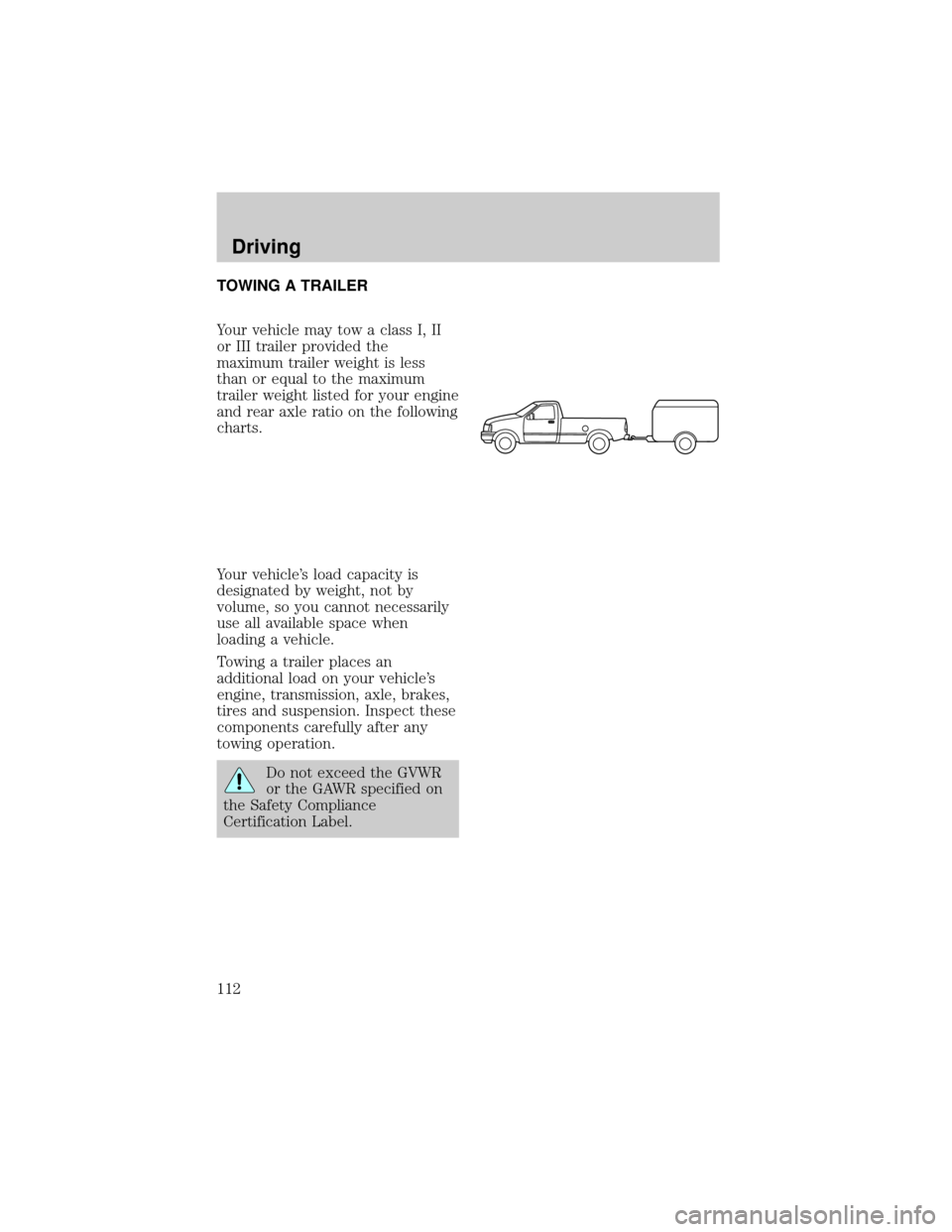
TOWING A TRAILER
Your vehicle may tow a class I, II
or III trailer provided the
maximum trailer weight is less
than or equal to the maximum
trailer weight listed for your engine
and rear axle ratio on the following
charts.
Your vehicle's load capacity is
designated by weight, not by
volume, so you cannot necessarily
use all available space when
loading a vehicle.
Towing a trailer places an
additional load on your vehicle's
engine, transmission, axle, brakes,
tires and suspension. Inspect these
components carefully after any
towing operation.
Do not exceed the GVWR
or the GAWR specified on
the Safety Compliance
Certification Label.
Driving
112
Page 119 of 219
3. Measure the height of a
reference point on the front and
rear bumpers at the center of the
vehicle.
4. Attach the trailer to the vehicle
and adjust the hitch equalizers so
that the front bumper height is
within 0±13 mm (0.5 in) of the
reference point. After proper
adjustment, the rear bumper
should be no higher than in Step 3.
5. Turn the air suspension (if
equipped) control to ON.
Adjusting an equalizing
hitch so the rear bumper
of the vehicle is lower or higher
than it was unloaded will defeat
the function of the load
equalizing hitch and may cause
unpredictable handling.
Safety chains
Always connect the trailer's safety
chains to the vehicle. To connect
the trailer's safety chains, cross the
chains under the trailer tongue and
allow slack for turning corners.
If you use a rental trailer, follow
the instructions that the rental
agency gives to you.
Trailer brakes
Electric brakes and manual,
automatic or surge-type brakes are
safe if installed properly and
adjusted to the manufacturer's
specifications. The trailer brakes
Driving
119
Page 162 of 219
BRAKE FLUID
Checking and adding brake
fluid
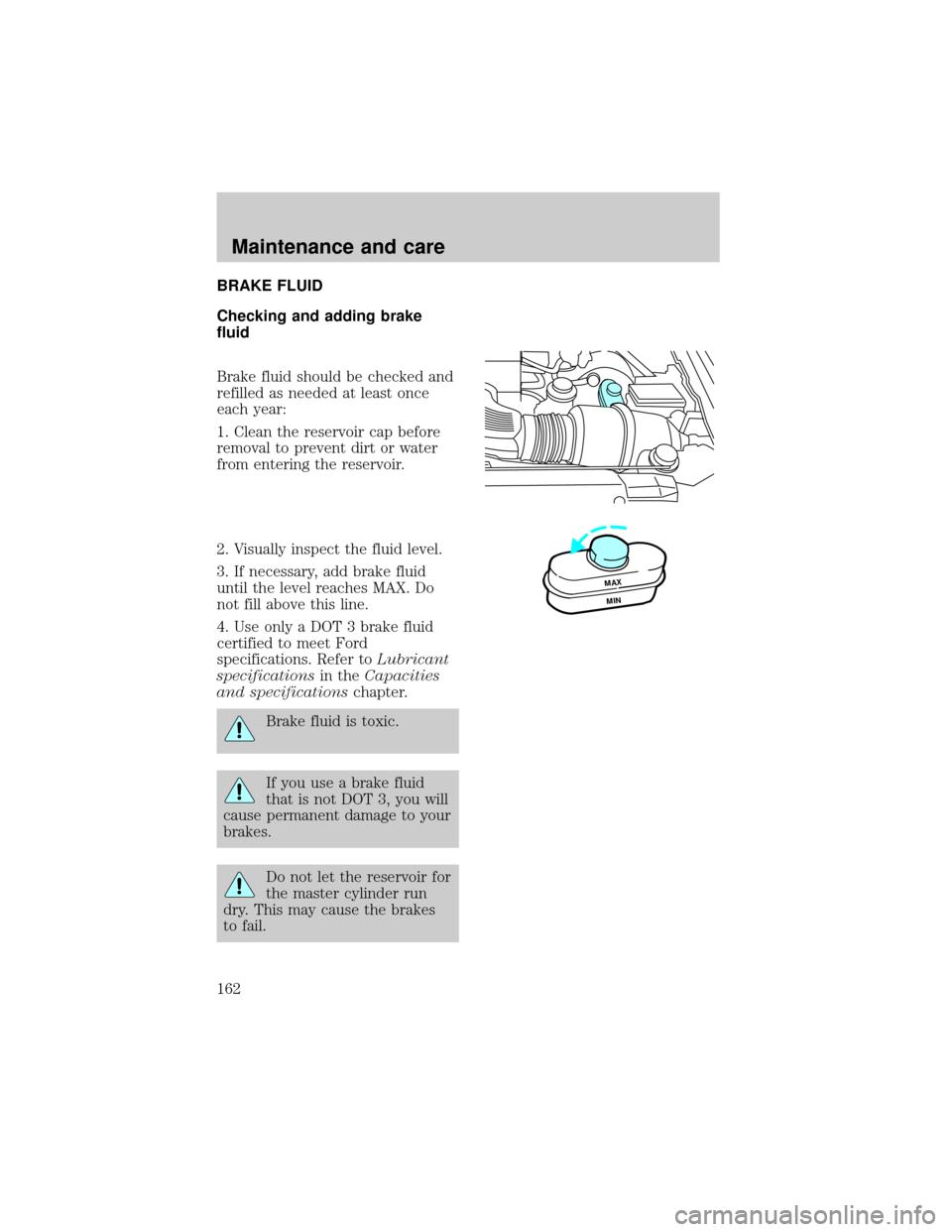
Brake fluid should be checked and
refilled as needed at least once
each year:
1. Clean the reservoir cap before
removal to prevent dirt or water
from entering the reservoir.
2. Visually inspect the fluid level.
3. If necessary, add brake fluid
until the level reaches MAX. Do
not fill above this line.
4. Use only a DOT 3 brake fluid
certified to meet Ford
specifications. Refer toLubricant
specificationsin theCapacities
and specificationschapter.
Brake fluid is toxic.
If you use a brake fluid
that is not DOT 3, you will
cause permanent damage to your
brakes.
Do not let the reservoir for
the master cylinder run
dry. This may cause the brakes
to fail.
MAX
MIN
Maintenance and care
162
Page 199 of 219

antennas, before entering a car
wash.
After washing, apply the brakes
several times to dry them.
Waxing your vehicle
Wax when water stops beading on
the surface. This could be every
three or four months, depending
on operating conditions.
Use only carnauba or
synthetic-based waxes. Remove
any bugs and tar before waxing
vehicle. Use cleaning fluid or
alcohol with a clean cloth to
remove. Use tar remover to
remove any tar spots.
Repairing paint chips
Minor scratches or paint damage
from road debris may be repaired
with touch-up , paint repair foil or
aerosol paint spray from the Ford
accessory line. Observe the
application instructions on the
products.
Remove particles such as bird
droppings, tree sap, insect
remains, tar spots, road salt and
industrial fallout immediately.
Cleaning the wheels
Wash with the same detergent as
the body of your vehicle. Do not
use acid-based wheel cleaners,
steel wool, fuel or strong
detergents. Never use abrasives
that will damage the finish of
special wheel surfaces. Use a tar
remover to remove grease and tar.
Maintenance and care
199
Page 216 of 219

Air bag supplemental restraint
system ..........................................60
and child safety seats ..............61
description ................................60
disposal ......................................64
indicator light ...........................63
passenger air bag ...........62,65,66
Air conditioning
manual heating and air
conditioning system .......22,23,26
Air suspension
description ................................87
warning light .............................11
Ambulance packages ....................3
Anti-lock brake system (ABS)
description ................................84
Anti-theft system ........................40
Battery .......................................175
voltage gauge ............................16
Brake fluid
checking and adding ..............162
Brakes ..........................................83
anti-lock .....................................83
anti-lock brake system (ABS)
warning light .............................84
fluid, checking and adding ....162
Brake-shift interlock ...................88
Break-in period .............................2
Bulbs, replacing ........................192
headlamps ...............................193
specifications ..........................197
Changing a tire .........................141
Child safety seats ........................70
Chime
headlamps on ............................12
Cleaning your vehicle ...............198
engine compartment ..............200
fabric ........................................201
instrument panel ....................201
plastic parts ............................201
safety belts ..............................202
tail lamps .................................201washing ....................................198
waxing .....................................199
wheels ......................................199
Clutch
fluid ..........................................163
Controls .......................................19
Daytime running light system ...17
Driving under special
conditions ..................................105
high water ...............................105
slippery roads ..................106,107
Emission control system ..........189
Engine ........................................210
check engine temperature
warning, message
center ...............................155,156
service points ..........................155
Engine block heater ...................80
Engine coolant
checking and adding .......164,165
disposal ....................................166
refill capacities ........................167
Engine oil ...........................156,160
changing oil and oil filter .......161
checking and
adding ........................156,158,160
Exhaust fumes ............................81
Fail safe cooling ........................168
Foglamps ............................196,197
Four-Wheel Drive vehicles .........98
control trac ........................19,102
indicator light ...........................99
lever operated electric shift ....99
Fuel
calculating fuel economy .......188
improving fuel economy ........130
octane rating ...........................187
quality ......................................187
safety information relating to
automotive fuels .....................184
Fuel gauge ...................................13
Fuel pump shut-off switch .......131
Index
216
Page 217 of 219

Fuse panels
instrument panel ....................133
power distribution box ...........138
Fuses ...................................132,133
Gauges, Mechanical ....................13
engine coolant temperature
gauge .........................................14
Hazard flashers .........................131
Headlamps
autolamp system .......................18
flashing ......................................35
high beam .................................35
turning on and off ....................17
Heating ........................................20
High beams
indicator light ...........................10
Hood
release lever ............................154
Ignition
positions of the ignition ...........27
removing the key ......................98
Instrument panel
lighting up panel and
interior .......................................18
Jump-starting your
vehicle .................................147,149
attaching cables ......................148
disconnecting cables ..............149
Keyless entry system
autolock .....................................44
Keys
key in ignition chime ...............12
Lamps
interior lamps ...........................36
map lamps .................................36
parking lamps .........................195
Lights, warning and indicator
air bag ..........................................8
anti-lock brakes (ABS) ..............9
anti-theft ...................................10
brake ............................................9
charging system ........................10check engine ............................6,7
door ajar ....................................11
engine oil pressure ...................10
four-wheel drive ........................11
fuel reset ................................6,12
safety belt ...................................9
turn signal indicator ...................9
Load limits
trailer towing ..........................110
Lubricant specifications ....205,208
Manual transmission ...................92
shift speeds .....................94,96,97
Mirrors
side view mirrors (power) .......38
Odometer .....................................15
Off road driving, 4-wheel drive 104
Overdrive ................................35,36
Panic alarm feature, remote
entry system ................................43
Parking brake ..............................85
Parts (see Motorcraft parts) ....205
Power door locks ........................38
Power steering
fluid, checking and adding ....169
Recreational towing, all wheels
on the ground ...........................123
Relays ........................................132
Remote entry system .................42
illuminated entry ......................47
locking/unlocking doors ...........43
replacement/additional
transmitters ...............................46
replacing the batteries .............45
Reporting safety defects ..........215
Safety restraints
automatic locking mode
(retractor) .......................54,55,56
extension assembly ..................57
for children ...............................68
lap and shoulder belts ........53,54
maintenance ..............................58
proper use .................................51
Index
217