Page 87 of 219
normal driving and should not be
noticeable to the driver.
To avoid injury, never run
the engine with one wheel
off the ground, such as when
changing a tire.
AIR SUSPENSION SYSTEM (IF
EQUIPPED)
The air suspension system is
designed to improve ride, handling
and general vehicle performance
for static, on and off-road driving
conditions.
²The load leveling feature of the
air suspension automatically
keeps the vehicle at a constant
level if a load is added or
removed from the vehicle.
²The height adjustment feature
automatically controls the
vehicle height over a range of
approximately 5 cm (2 inches)
based on vehicle speed, ignition
position and selection of two or
four-wheel drive modes.
Driving
87
Page 122 of 219

(automatic transmissions) or 1
(First) (manual transmissions)
and increase idle speed. This
aids engine cooling and air
conditioner efficiency.
²Vehicles with trailers should not
be parked on a grade. If you
must park on a grade, place
wheel chocks under the trailer's
wheels.
Launching or retrieving a boat
When backing down a ramp during
boat launching or retrieval,
²Do not allow the static water
level to rise above the bottom
edge of the rear bumper and
²Do not allow waves to break
higher than 15 cm (six inches)
above the bottom edge of the
rear bumper.
Exceeding these limits may allow
water to enter critical vehicle
components, adversely affecting
driveability, emissions and
reliability.
If the rear axle is submerged in
water, the rear axle lubricant
should be checked and changed, if
necessary. The rear axle is filled
with a synthetic lubricant and does
not normally require a lubricant
change for the life of the vehicle.
Rear axle lubricant quantities
should not need to be checked
unless a leak is suspected.
Driving
122
Page 168 of 219
Leave a 50/50 mixture of engine
coolant and water in your vehicle
year-round in non-extreme
climates.
What you should know about
fail-safe cooling (if equipped)
If the engine coolant supply is
depleted, this feature allows the
vehicle to be driven temporarily
before incremental component
damage is incurred. The ªfail safeº
distance depends on ambient
temperatures, vehicle load and
terrain.
How fail-safe cooling works
If the engine overheats, the engine
will automatically switch from
eight to alternating four cylinder
operation. Each disabled cylinder
acts as an air pump and cools the
engine.
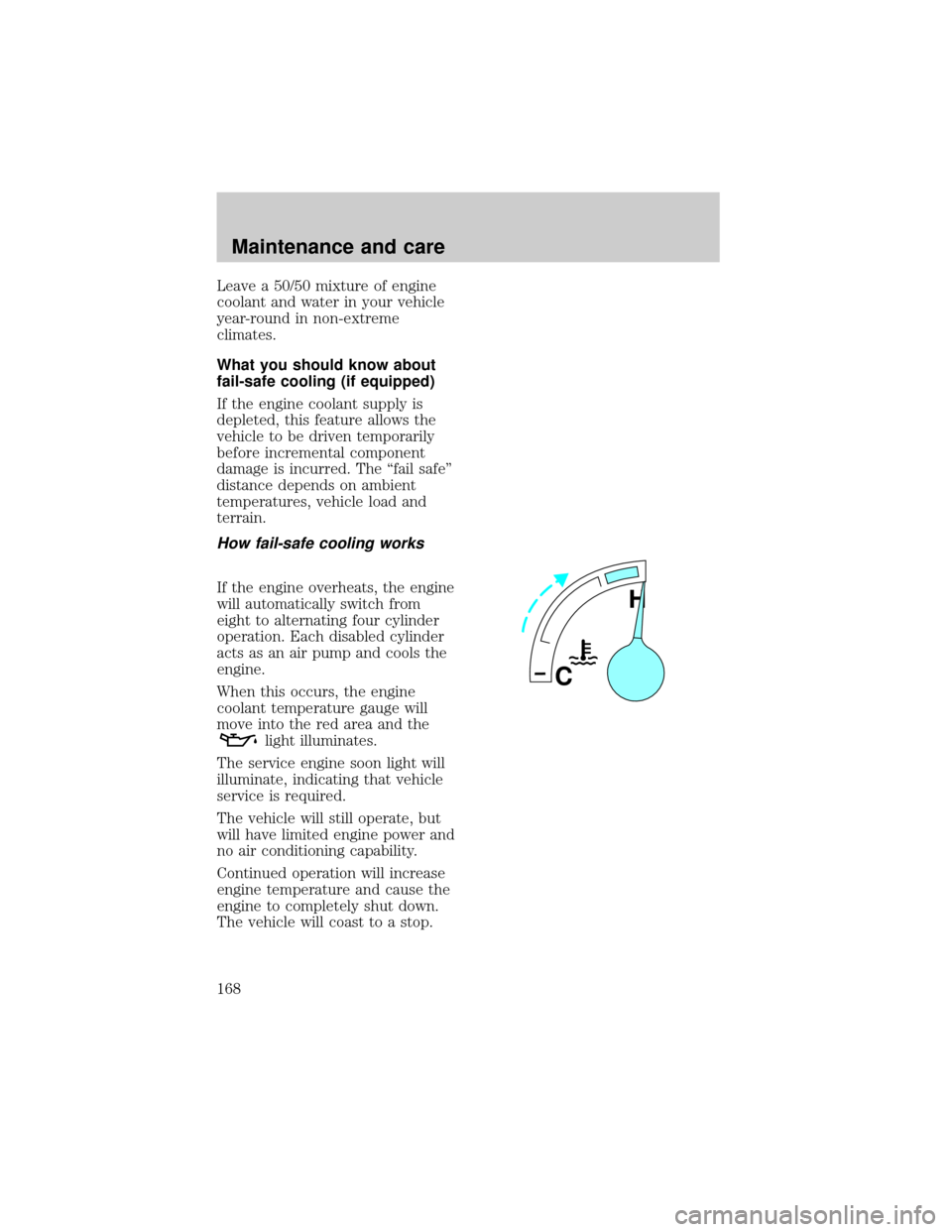
When this occurs, the engine
coolant temperature gauge will
move into the red area and the
light illuminates.
The service engine soon light will
illuminate, indicating that vehicle
service is required.
The vehicle will still operate, but
will have limited engine power and
no air conditioning capability.
Continued operation will increase
engine temperature and cause the
engine to completely shut down.
The vehicle will coast to a stop.
H
C
Maintenance and care
168
Page 187 of 219
control devices and systems may
be adversely affected.
Repair of damage caused by using
a fuel that your vehicle was not
designed for may not be covered
by your warranty.
Octane recommendations
Your vehicle is designed to use
regular unleaded with an (R+M)/2
octane rating of 87. We do not
recommend gasolines labeled as
ªregularº in high altitude areas that
are sold with octane ratings of 86
or even less.
Do not be concerned if your
vehicle sometimes knocks lightly.
However, if it knocks heavily under
most driving conditions on fuel
with the recommended octane, see
your dealer or a qualified service
technician to prevent any engine
damage.
Fuel quality
If you are experiencing starting,
rough idle or hesitation problems
try a different brand of fuel. If the
condition persists, see your dealer
or a qualified service technician.
The American Automobile
Manufacturers Association (AAMA)
issued a gasoline specification to
provide information on high quality
fuels that optimize the
performance of your vehicle. We
recommend the use of gasolines
that meet the AAMA specification
if they are available.
87
Maintenance and care
187
Page 199 of 219

antennas, before entering a car
wash.
After washing, apply the brakes
several times to dry them.
Waxing your vehicle
Wax when water stops beading on
the surface. This could be every
three or four months, depending
on operating conditions.
Use only carnauba or
synthetic-based waxes. Remove
any bugs and tar before waxing
vehicle. Use cleaning fluid or
alcohol with a clean cloth to
remove. Use tar remover to
remove any tar spots.
Repairing paint chips
Minor scratches or paint damage
from road debris may be repaired
with touch-up , paint repair foil or
aerosol paint spray from the Ford
accessory line. Observe the
application instructions on the
products.
Remove particles such as bird
droppings, tree sap, insect
remains, tar spots, road salt and
industrial fallout immediately.
Cleaning the wheels
Wash with the same detergent as
the body of your vehicle. Do not
use acid-based wheel cleaners,
steel wool, fuel or strong
detergents. Never use abrasives
that will damage the finish of
special wheel surfaces. Use a tar
remover to remove grease and tar.
Maintenance and care
199
Page 216 of 219

Air bag supplemental restraint
system ..........................................60
and child safety seats ..............61
description ................................60
disposal ......................................64
indicator light ...........................63
passenger air bag ...........62,65,66
Air conditioning
manual heating and air
conditioning system .......22,23,26
Air suspension
description ................................87
warning light .............................11
Ambulance packages ....................3
Anti-lock brake system (ABS)
description ................................84
Anti-theft system ........................40
Battery .......................................175
voltage gauge ............................16
Brake fluid
checking and adding ..............162
Brakes ..........................................83
anti-lock .....................................83
anti-lock brake system (ABS)
warning light .............................84
fluid, checking and adding ....162
Brake-shift interlock ...................88
Break-in period .............................2
Bulbs, replacing ........................192
headlamps ...............................193
specifications ..........................197
Changing a tire .........................141
Child safety seats ........................70
Chime
headlamps on ............................12
Cleaning your vehicle ...............198
engine compartment ..............200
fabric ........................................201
instrument panel ....................201
plastic parts ............................201
safety belts ..............................202
tail lamps .................................201washing ....................................198
waxing .....................................199
wheels ......................................199
Clutch
fluid ..........................................163
Controls .......................................19
Daytime running light system ...17
Driving under special
conditions ..................................105
high water ...............................105
slippery roads ..................106,107
Emission control system ..........189
Engine ........................................210
check engine temperature
warning, message
center ...............................155,156
service points ..........................155
Engine block heater ...................80
Engine coolant
checking and adding .......164,165
disposal ....................................166
refill capacities ........................167
Engine oil ...........................156,160
changing oil and oil filter .......161
checking and
adding ........................156,158,160
Exhaust fumes ............................81
Fail safe cooling ........................168
Foglamps ............................196,197
Four-Wheel Drive vehicles .........98
control trac ........................19,102
indicator light ...........................99
lever operated electric shift ....99
Fuel
calculating fuel economy .......188
improving fuel economy ........130
octane rating ...........................187
quality ......................................187
safety information relating to
automotive fuels .....................184
Fuel gauge ...................................13
Fuel pump shut-off switch .......131
Index
216