Page 144 of 210
CHANGING THE TIRES
If you get a flat tire while driving, do not apply the brake heavily.
Instead, gradually decrease your speed. Hold the steering wheel firmly
and slowly move to a safe place on the side of the road.
Spare tire information
Your vehicle is equipped with a spare tire that may be used as a spare or
a regular tire. The spare tire is not equipped with wheel trim. The wheel
trim from the original wheel/tire may be used on the spare.
If your vehicle is equipped with 4WD or AWD, a spare tire of a
different size than the road tires should not be used. Such a tire
could result in damage to driveline components and make the
vehicle difficult to control.
Location of the spare tire and tools
The spare tire and tools for your vehicle are stowed in the following
locations:
Tool Location
Spare tire Under the vehicle, just in front of the rear
bumper
Jack, lug nut wrench Left rear quarter panel behind interior trim
Jack handle Behind rear seats, under carpet
Removing the spare tire
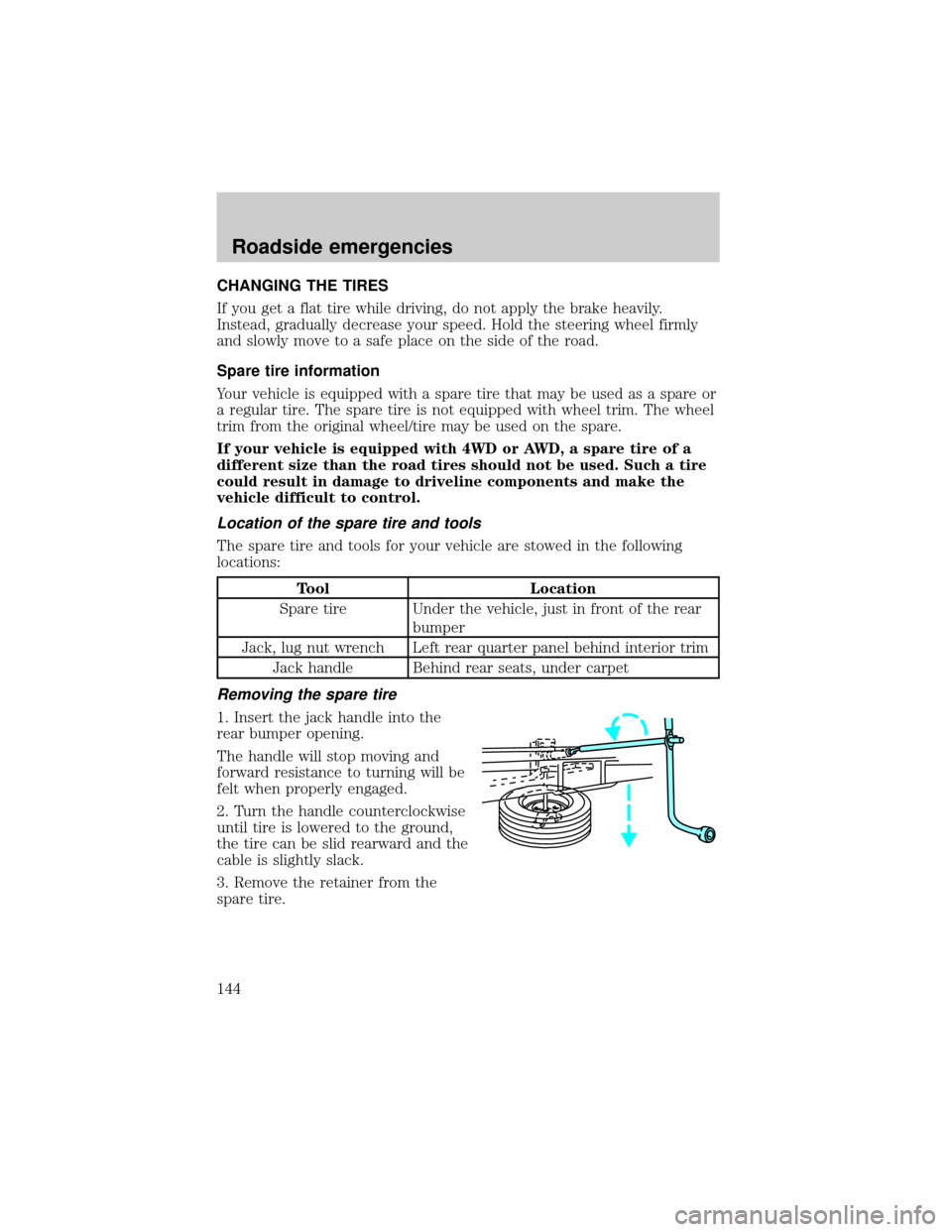
1. Insert the jack handle into the
rear bumper opening.
The handle will stop moving and
forward resistance to turning will be
felt when properly engaged.
2. Turn the handle counterclockwise
until tire is lowered to the ground,
the tire can be slid rearward and the
cable is slightly slack.
3. Remove the retainer from the
spare tire.
Roadside emergencies
144
Page 157 of 210
3. Turn off the engine and remove the key.
4. Block the wheels to prevent the vehicle from moving unexpectedly.
Working with the engine on
²Automatic transmission:
1. Set the parking brake and
ensure the gearshift is securely latched in P (Park).
2. Block the wheels to prevent the vehicle from moving unexpectedly.
Do not start your engine with the air cleaner removed and do
not remove it while the engine is running.
²Manual transmission:
1. Set the parking brake,
depress the clutch and place the gearshift in N (Neutral).
2. Block the wheels to prevent the vehicle from moving unexpectedly.
Do not start your engine with the air cleaner removed and do
not remove it while the engine is running.
OPENING THE HOOD
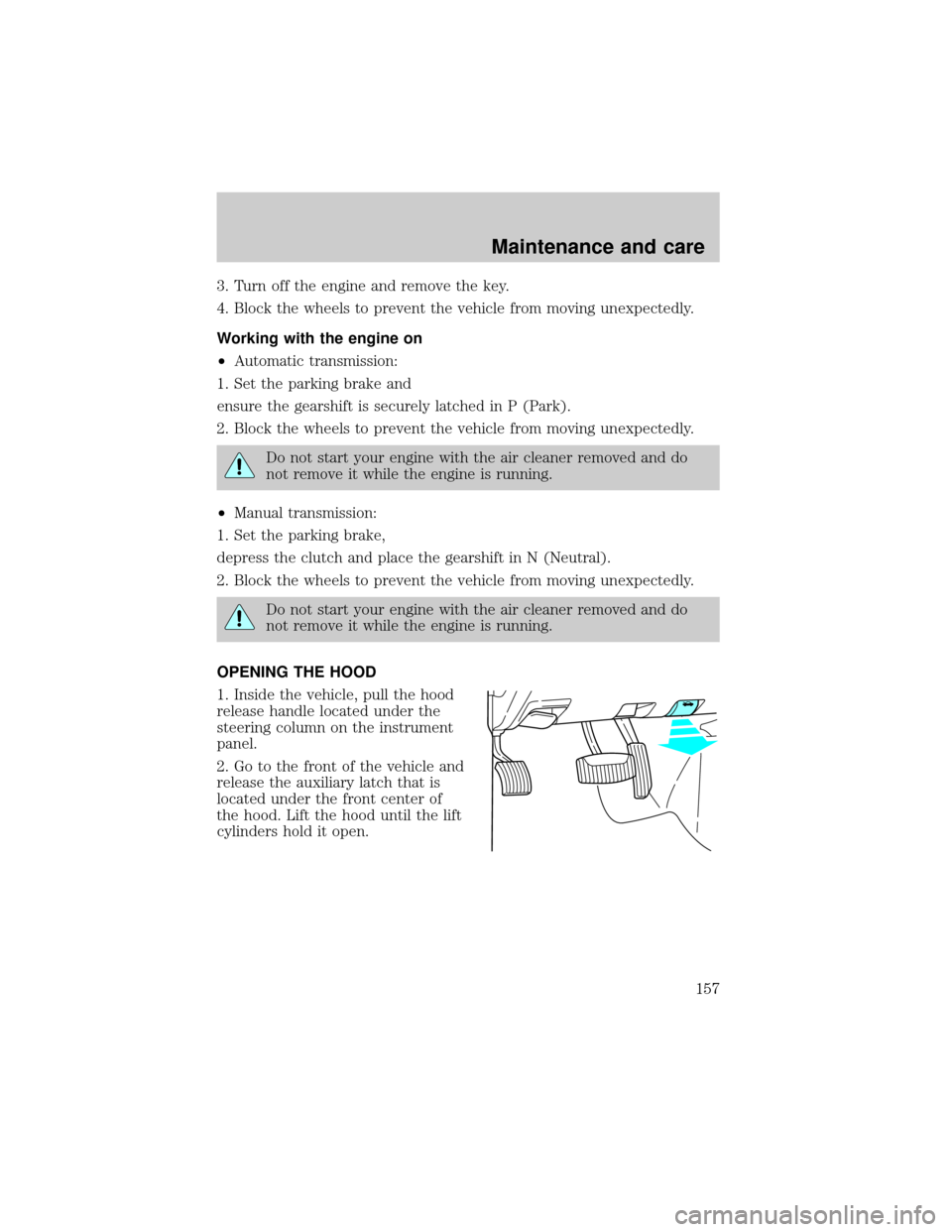
1. Inside the vehicle, pull the hood
release handle located under the
steering column on the instrument
panel.
2. Go to the front of the vehicle and
release the auxiliary latch that is
located under the front center of
the hood. Lift the hood until the lift
cylinders hold it open.
Maintenance and care
157
Page 158 of 210
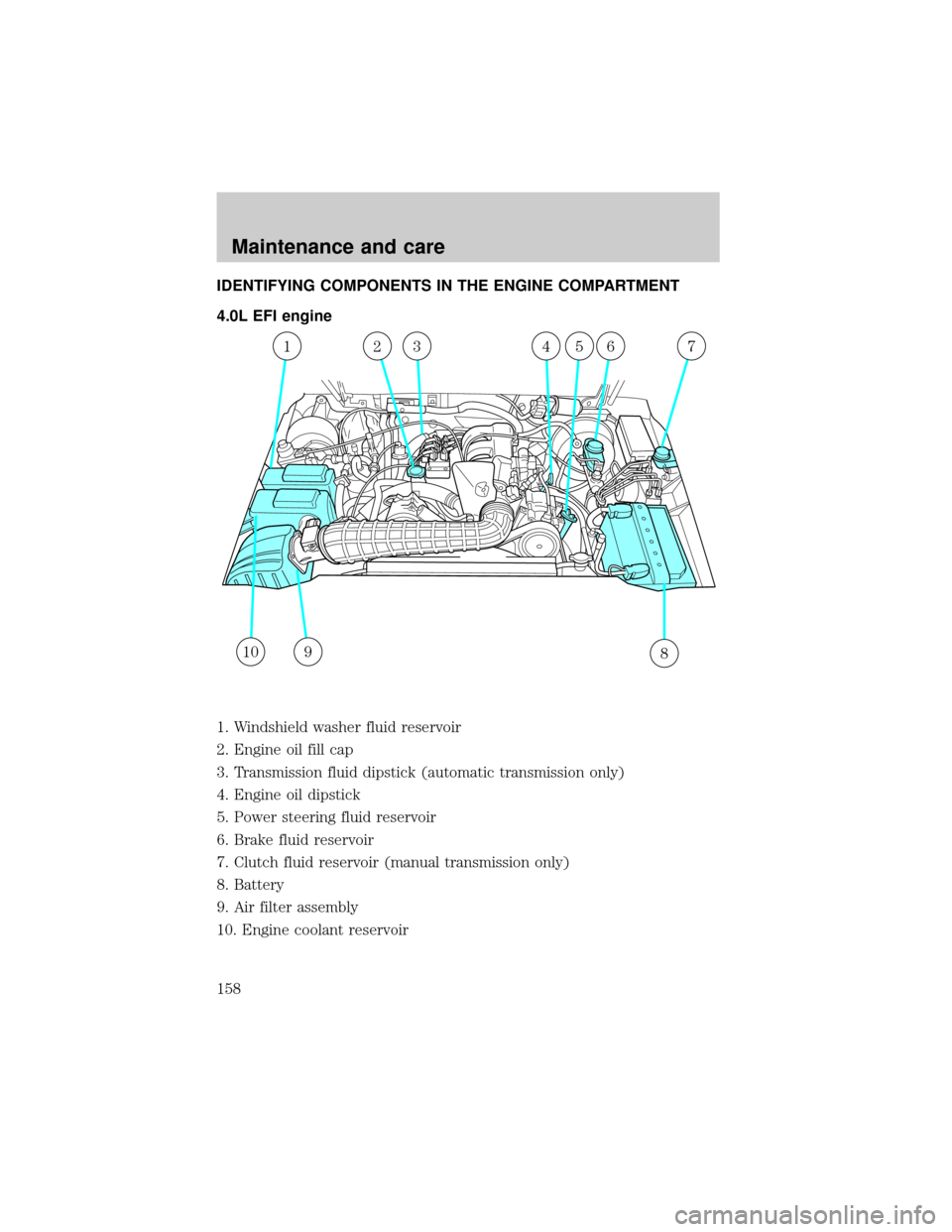
IDENTIFYING COMPONENTS IN THE ENGINE COMPARTMENT
4.0L EFI engine
1. Windshield washer fluid reservoir
2. Engine oil fill cap
3. Transmission fluid dipstick (automatic transmission only)
4. Engine oil dipstick
5. Power steering fluid reservoir
6. Brake fluid reservoir
7. Clutch fluid reservoir (manual transmission only)
8. Battery
9. Air filter assembly
10. Engine coolant reservoir
10
1235674
89
Maintenance and care
158
Page 159 of 210
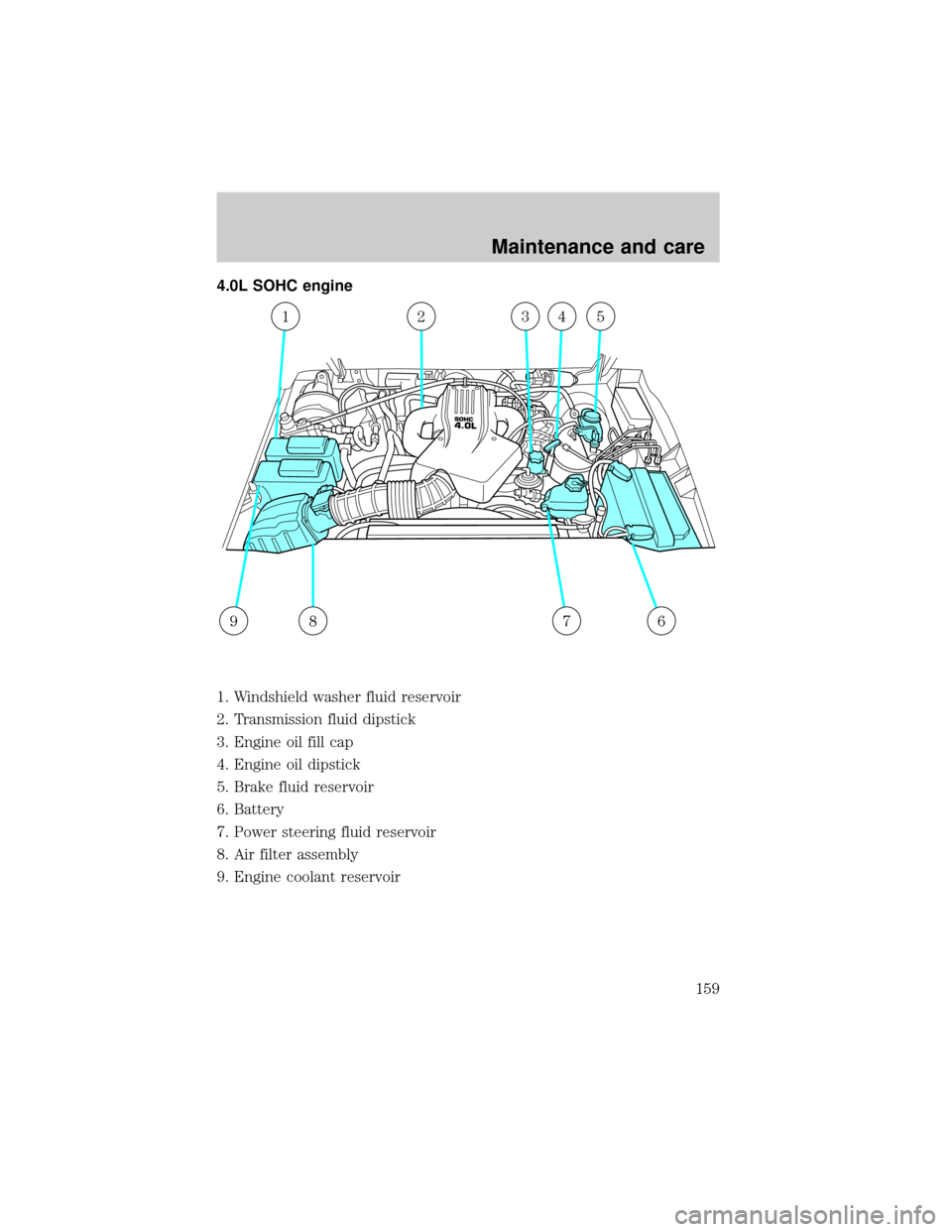
4.0L SOHC engine
1. Windshield washer fluid reservoir
2. Transmission fluid dipstick
3. Engine oil fill cap
4. Engine oil dipstick
5. Brake fluid reservoir
6. Battery
7. Power steering fluid reservoir
8. Air filter assembly
9. Engine coolant reservoir
9
13425
867
Maintenance and care
159
Page 160 of 210
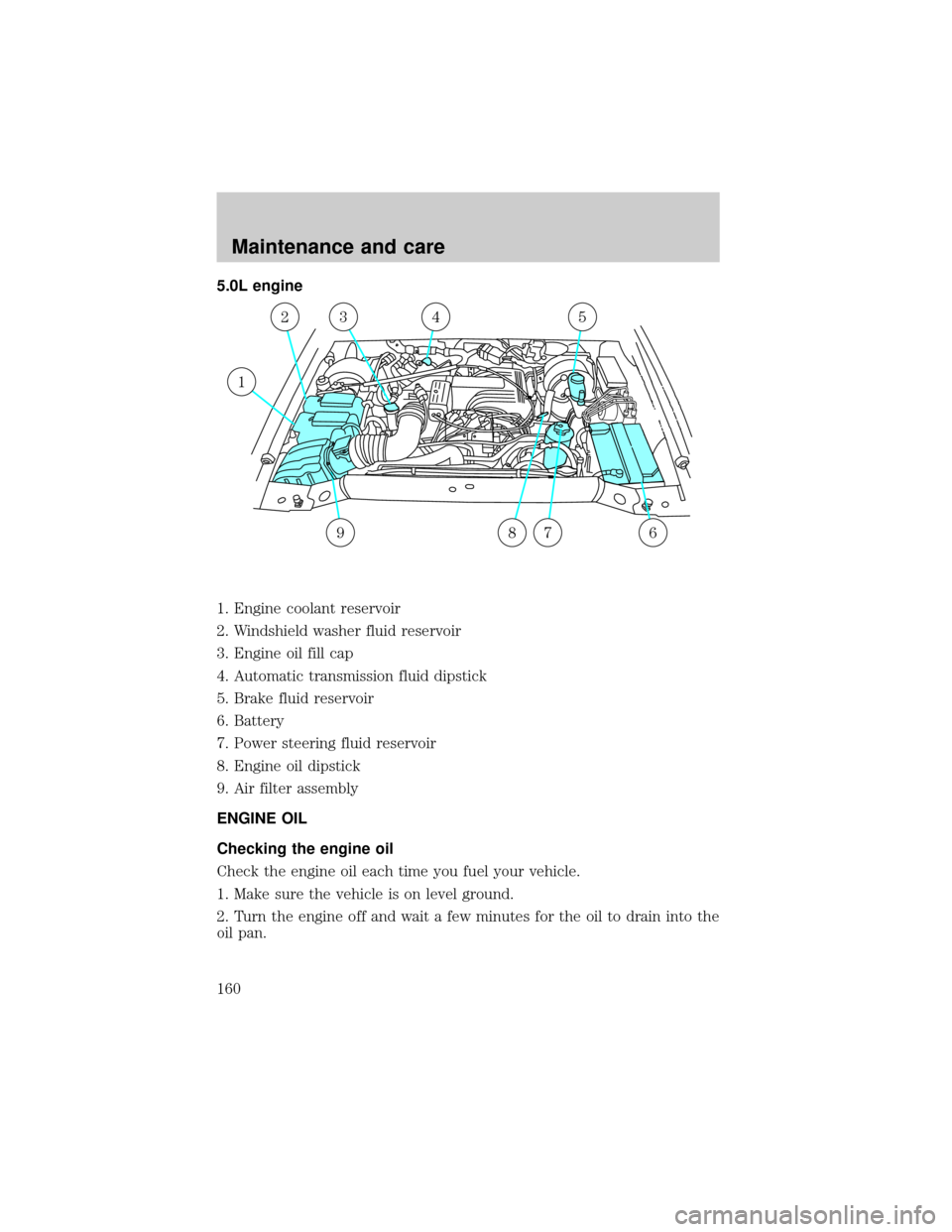
5.0L engine
1. Engine coolant reservoir
2. Windshield washer fluid reservoir
3. Engine oil fill cap
4. Automatic transmission fluid dipstick
5. Brake fluid reservoir
6. Battery
7. Power steering fluid reservoir
8. Engine oil dipstick
9. Air filter assembly
ENGINE OIL
Checking the engine oil
Check the engine oil each time you fuel your vehicle.
1. Make sure the vehicle is on level ground.
2. Turn the engine off and wait a few minutes for the oil to drain into the
oil pan.
1
23
6
54
879
Maintenance and care
160
Page 169 of 210
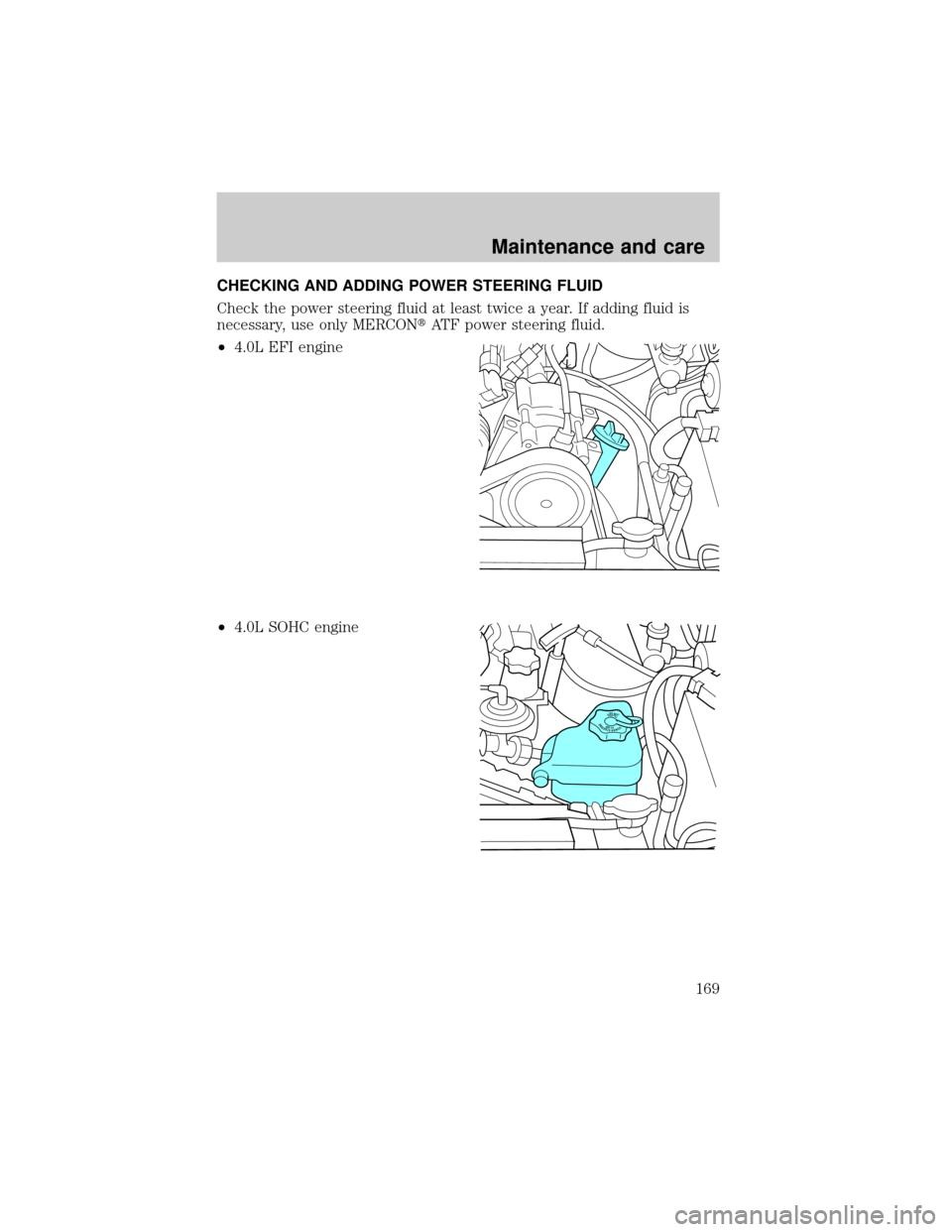
CHECKING AND ADDING POWER STEERING FLUID
Check the power steering fluid at least twice a year. If adding fluid is
necessary, use only MERCONtATF power steering fluid.
²4.0L EFI engine
²4.0L SOHC engine
DONOTOVERFILLPOWERSTEERINGFLUID
Maintenance and care
169
Page 170 of 210

²5.0L engine
1. Start the engine and let it run until it reaches normal operating
temperature (the engine coolant temperature gauge will be near the
center of the NORMAL band).
2. While the engine idles, turn the steering wheel left and right several
times.
3. Turn the engine off.
4. Check the fluid level in the reservoir.
5.If your vehicle is equipped with a 4.0L EFI engine,the fluid level
should be in the FULL HOT range. Do not add fluid if the level is in this
range.
6.If your vehicle is equipped with a 4.0L SOHC engine or a 5.0L
engine,the fluid level should be between the MIN and MAX lines. Do
not add fluid if the level is in this range.
7. If the fluid is low, add fluid in small amounts, continuously checking
the level until it reaches the correct operating range. Be sure to put the
cap back on the reservoir.
TRANSMISSION FLUID
Checking and adding automatic transmission fluid
Follow the scheduled service intervals outlined in the ``Service Guide''.
Before adding any fluid, make sure the correct type is used. The type of
fluid used is normally indicated on the dipstick and/or dipstick handle
and also in theLubricant specificationssection in theCapacities and
specificationschapter.
Maintenance and care
170
Page 198 of 210
REFILL CAPACITIES
Fluid Ford Part Name Application Capacity
Engine oil
(including
filter
change)Motorcraft 5W30
Super Premium
Motor OilAll engines
4.7L (5.0
quarts)
Brake fluid Ford High
Performance DOT
3 Brake FluidAll
Fill to line in
reservoir
Power
steering
fluidMotorcraft
MERCONtAT FAll Fill to line on
reservoir or
dipstick
Transmission
fluidMotorcraft
MERCONtAT F5-speed manual
2.6L (5.6 pints)
Motorcraft
MERCONtVATF4R70W Automatic
(5.0L engines
only)13.1L (13.9
quarts)
5R55E Automatic
with 4.0L EFI
engine (4x2)9.0L (9.5
quarts)
5R55E Automatic
with 4.0L SOHC
engine (4x2)9.25L (9.75
quarts)
5R55E Automatic
with 4.0L EFI
engine (4x4)9.3L (9.8
quarts)
5R55E Automatic
with 4.0L SOHC
engine (4x4)9.55L (10.0
quarts)
Transfer
caseMotorcraft
MERCONtAT F4WD 1.4L (1.5
quarts)
AWD 1.25L (1.3
quarts)
Engine
coolantFord Premium
Cooling System
Fluid4.0L engine 7.4L (7.8
quarts)
5.0L engine 12.1L (12.8
quarts)
Capacities and specifications
198