Page 158 of 191

technician to prevent any engine
damage.
Fuel quality
If you are experiencing starting,
rough idle or hesitation problems
try a different brand of fuel. If the
condition persists, see your dealer
or a qualified service technician.
The American Automobile
Manufacturers Association (AAMA)
issued a gasoline specification to
provide information on high quality
fuels that optimize the
performance of your vehicle. We
recommend the use of gasolines
that meet the AAMA specification
if they are available.
It should not be necessary to add
any aftermarket products to your
fuel tank if you continue to use a
high-quality fuel.
Cleaner air
Ford approves the use of gasolines
to improve air quality, including
reformulated gasolines that contain
oxygenates up to 10% ethanol or
15% MTBE.
Do not use gasolines containing
methanol, which can damage
critical fuel system components.
Damage resulting from the use of
methanol may not be covered by
your warranty.
Running out of fuel
Avoid running out fuel because this
situation may have an adverse
Maintenance and care
158
Page 159 of 191
affect on modern powertrain
components.
You may need to crank the engine
several times before the system
starts to pump fuel from the tank
to the engine. If you run out of
fuel, your Service Engine Soon
light may come on. For more
information on the Service Engine
Soon light, refer to the
Instrumentationchapter.
Calculating fuel economy
To accurately calculate your
vehicle's fuel economy:
1. Fill the tank completely and
record the initial odometer
reading.
2. Each time you fill the tank,
record the amount of fuel added
(in liters or gallons).
3. After at least three to five fuel
tank fill-ups, fill the fuel tank and
record the current mileage
reading.
4. Use one of the following
equations to calculate fuel
economy.
Liters used x 1004Total
kilometers traveled
Total miles traveled4Total
gallons used
Keep a record for at least one
month. This will provide an
accurate estimate of the vehicle's
fuel economy.
Maintenance and care
159
Page 161 of 191
Do not park, idle, or drive
your vehicle in dry grass
or other dry ground cover. The
emission system heats up the
engine compartment and exhaust
system, which can start a fire.
Watch for fluid leaks, strange
odors, smoke, loss of oil pressure,
the charging system warning light,
the ªService Engine Soonº light or
the temperature warning light.
These events could indicate that
the emission control system is not
working properly.
If you smell exhaust fumes
of any kind inside your
vehicle, have the dealer inspect
and fix your vehicle immediately.
Do not drive if you smell exhaust
fumes. These fumes are harmful
and could kill you.
Do not make any unauthorized
changes to your vehicle or engine.
By law, vehicle owners and anyone
who manufactures, repairs,
services, sells, leases, trades
vehicles, or supervises a fleet of
vehicles are not permitted to
intentionally remove an emission
control device or prevent it from
working. Information about your
vehicle's emission system is on the
Vehicle Emission Control
Information Decal located on or
near the engine. This decal
identifies engine displacement and
gives some tune up specifications.
Maintenance and care
161
Page 162 of 191

Please consult your ªWarranty
Guideº for complete emission
warranty information.
Readiness for
inspection/maintenance (I/M)
testing
In some localities, it may be a legal
requirement to pass an I/M test of
the on-board diagnostic (OBD-II)
system. If your ªcheck
engine/service engine soonº light is
on, reference the applicable light
description in theWarning Lights
and Chimessection of your
owners guide. Your vehicle may
not pass the I/M test with the
ªcheck engine/service engine soonº
light on.
If the vehicle's powertrain system
or its battery has just been
serviced, the OBD-II system is
reset to a ªnot ready for I/M testº
condition. To ready the OBD-II
system for I/M testing, a minimum
of 30 minutes of city and highway
driving is necessary as described
below:
²First, at least 10 minutes of
driving on an expressway or
highway.
²Next, at least 20 minutes driving
in stop and go, city type traffic
with at least four idle periods.
Allow the vehicle to sit for at least
eight hours without starting the
engine. Then, start the engine and
complete the above driving cycle.
The engine must warm up to its
normal operating temperature.
Maintenance and care
162
Page 163 of 191
Once started, do not turn off the
engine until the above driving
cycle is complete.
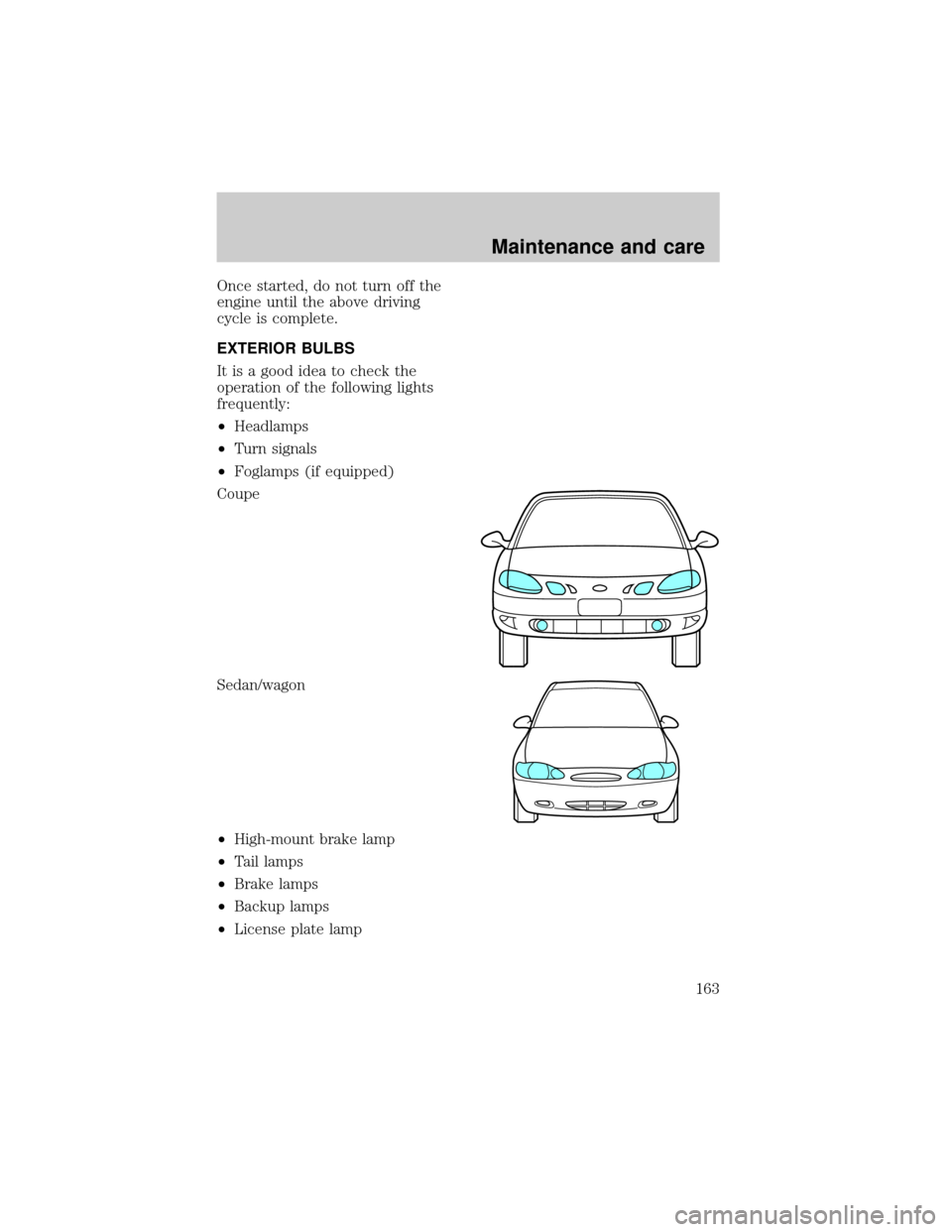
EXTERIOR BULBS
It is a good idea to check the
operation of the following lights
frequently:
²Headlamps
²Turn signals
²Foglamps (if equipped)
Coupe
Sedan/wagon
²High-mount brake lamp
²Tail lamps
²Brake lamps
²Backup lamps
²License plate lamp
Maintenance and care
163
Page 176 of 191

Use only carnauba or
synthetic-based waxes. Remove
any bugs and tar before waxing
vehicle. Use cleaning fluid or
alcohol with a clean cloth to
remove. Use tar remover to
remove any tar spots.
Repairing paint chips
Minor scratches or paint damage
from road debris may be repaired
with touch-up, paint repair foil or
aerosol paint spray from the Ford
accessory line. Observe the
application instructions on the
products.
Remove particles such as bird
droppings, tree sap, insect
remains, tar spots, road salt and
industrial fallout immediately.
Cleaning the wheels
Wash with the same detergent as
the body of your vehicle. Do not
use acid-based wheel cleaners,
steel wool, fuel or strong
detergents. Never use abrasives
that will damage the finish of
special wheel surfaces. Use a tar
remover to remove grease and tar.
Cleaning the engine
Engines are more efficient when
they are clean because grease and
dirt buildup keep the engine
warmer than normal. When
washing:
²Take care when using a power
washer to clean the engine. The
Maintenance and care
176
Page 177 of 191
high pressure fluid could
penetrate the sealed parts and
cause damage.
²Do not spray with cold water to
avoid cracking the engine block
or other engine components.
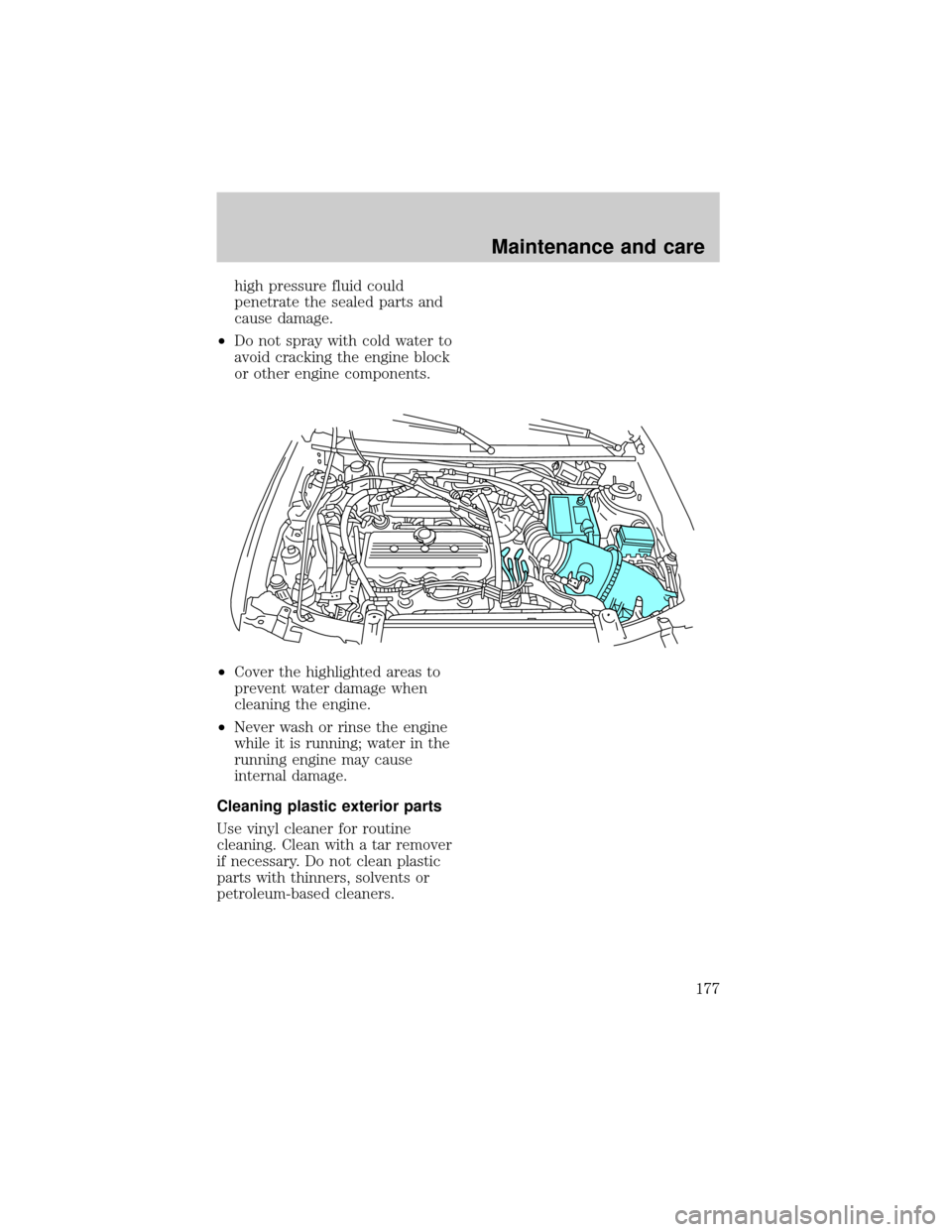
²Cover the highlighted areas to
prevent water damage when
cleaning the engine.
²Never wash or rinse the engine
while it is running; water in the
running engine may cause
internal damage.
Cleaning plastic exterior parts
Use vinyl cleaner for routine
cleaning. Clean with a tar remover
if necessary. Do not clean plastic
parts with thinners, solvents or
petroleum-based cleaners.
Maintenance and care
177
Page 180 of 191

MOTORCRAFT PART NUMBERS
Component 2.0L SOHC engine 2.0L DOHC Zetec
engine
Air filter FA-1643 FA-1643
Fuel filter FG-862 FG-862
Battery BX-58C BXT-58
Oil filter FL-400-A FL-2005
PCV Valve EV-229 EV-224
Spark plugs* AGSF-34EE** AZFS-22FE***
* Refer to Vehicle Emissions Control Information (VECI) decal for
spark plug gap information.
**Replacement double platinum spark plug9EE9will replace9E9and
9EG9and9P9will replace9P9and9PG9suffixed plugs. Refer to the
Engine Data chart for spark plug gap specifications.
*** If a spark plug is removed for inspection, it must be reinstalled in
the same cylinder. Cylinders No. 1 and 2 have a ªFEº suffix. Cylinders
No. 3 and 4 have a F suffix. If a spark plug needs to be replaced, use
only spark plugs with the same service part number suffix letter ªFEº
as shown on the engine decal.
REFILL CAPACITIES
FluidFord Part
NameApplication Capacity
Brake fluid Ford High
Performance
DOT 3 Brake
FluidAll Fill to line in
reservoir
Engine coolant Ford Premium
Cooling System
FluidAutomatic
transaxles6.0L
(6.3 quarts)
Manual
transaxles5.0L
(5.3 quarts)
Capacities and specifications
180