Page 149 of 191
make replacing the wipers easy,
turn the ignition to ACC, then turn
the wipers on. When the wipers
reach the vertical position, turn
the ignition to LOCK.
To replace the wiper blades:
1. Pull the wiper arm away from
the windshield and lock into the
service position.
2. Turn the blade at an angle from
the wiper arm. Push the lock pin
with a screwdriver to release the
blade and pull the wiper blade
down toward the windshield to
remove it from the arm.
3. Attach the new wiper to the
wiper arm and press it into place
until a click is heard.
INFORMATION ABOUT TIRE
QUALITY GRADES
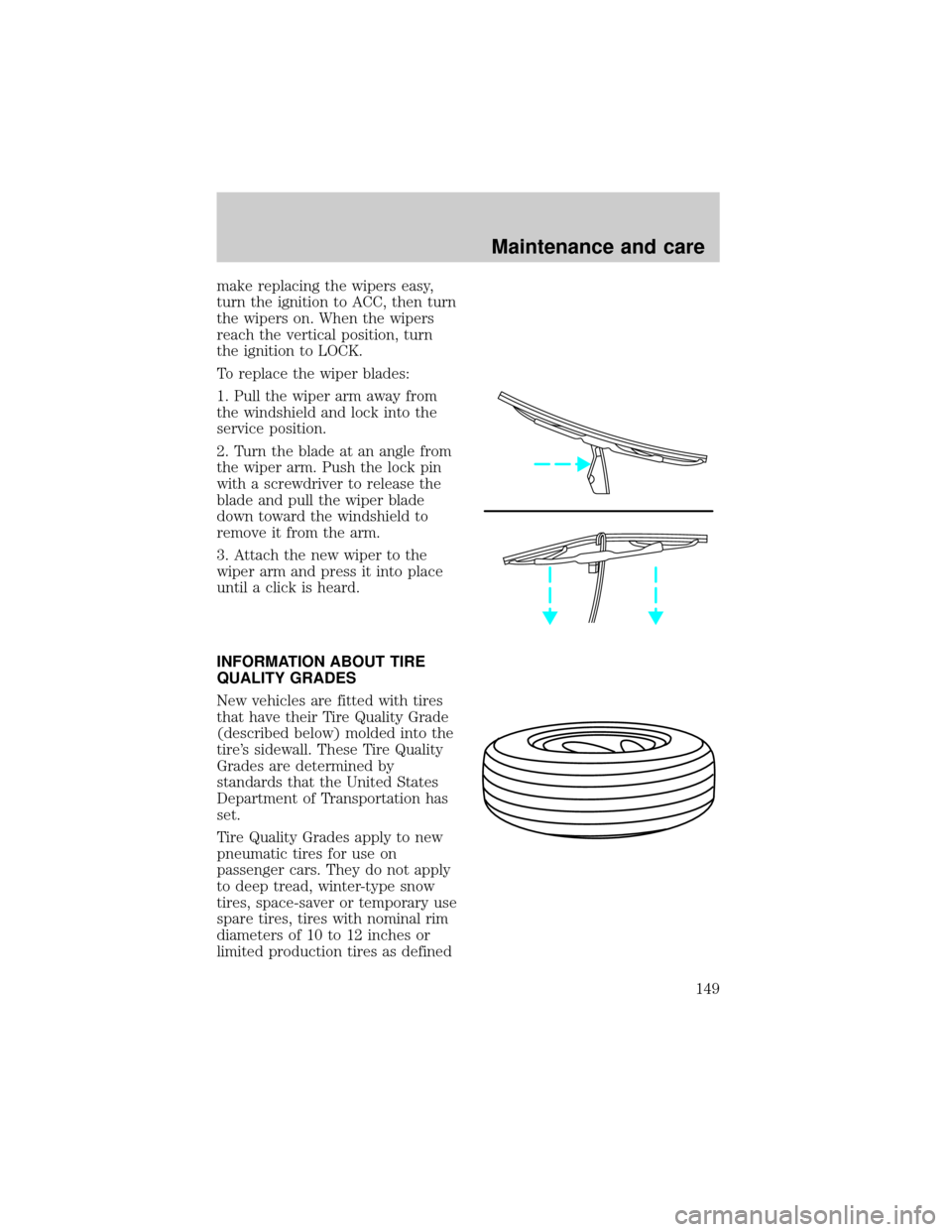
New vehicles are fitted with tires
that have their Tire Quality Grade
(described below) molded into the
tire's sidewall. These Tire Quality
Grades are determined by
standards that the United States
Department of Transportation has
set.
Tire Quality Grades apply to new
pneumatic tires for use on
passenger cars. They do not apply
to deep tread, winter-type snow
tires, space-saver or temporary use
spare tires, tires with nominal rim
diameters of 10 to 12 inches or
limited production tires as defined
Maintenance and care
149
Page 166 of 191
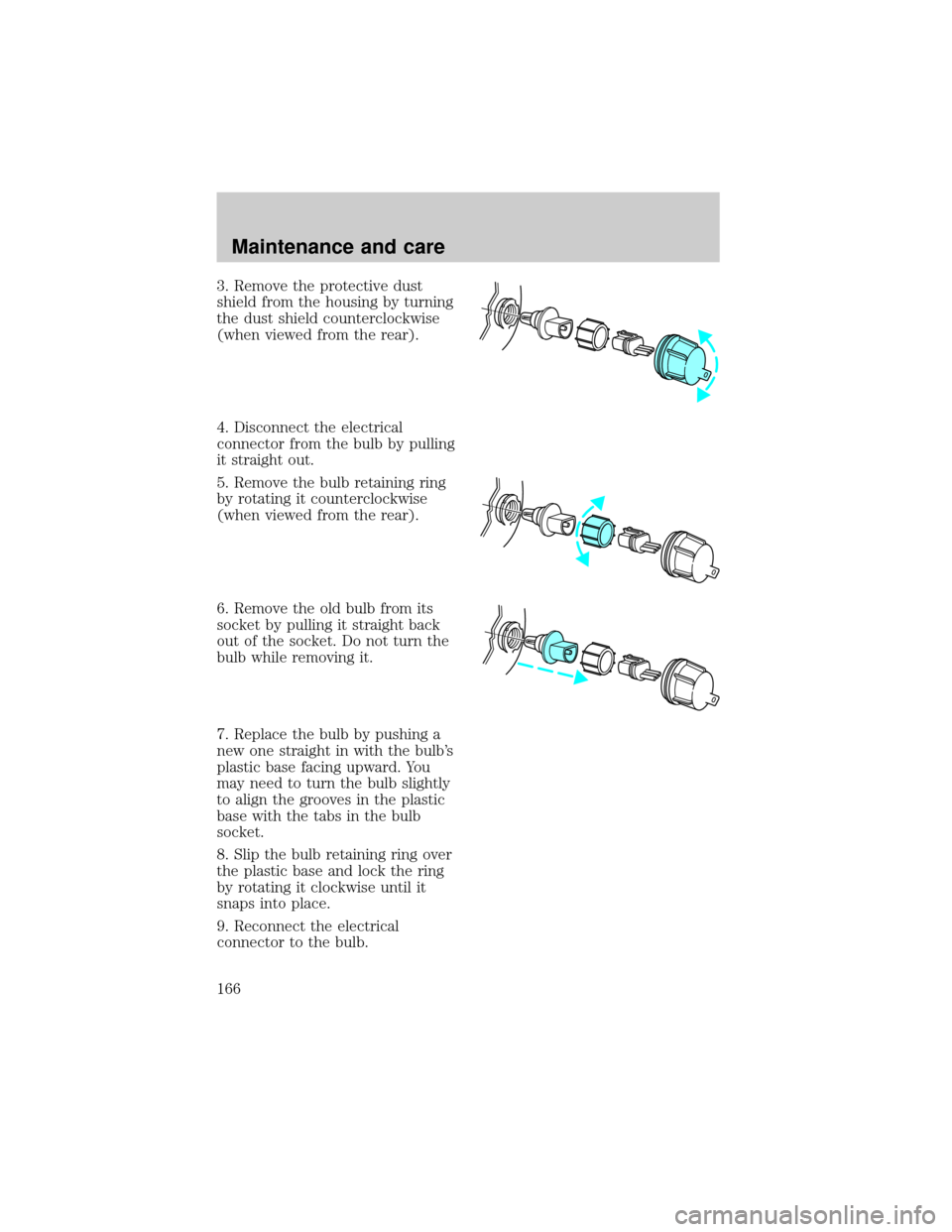
3. Remove the protective dust
shield from the housing by turning
the dust shield counterclockwise
(when viewed from the rear).
4. Disconnect the electrical
connector from the bulb by pulling
it straight out.
5. Remove the bulb retaining ring
by rotating it counterclockwise
(when viewed from the rear).
6. Remove the old bulb from its
socket by pulling it straight back
out of the socket. Do not turn the
bulb while removing it.
7. Replace the bulb by pushing a
new one straight in with the bulb's
plastic base facing upward. You
may need to turn the bulb slightly
to align the grooves in the plastic
base with the tabs in the bulb
socket.
8. Slip the bulb retaining ring over
the plastic base and lock the ring
by rotating it clockwise until it
snaps into place.
9. Reconnect the electrical
connector to the bulb.
Maintenance and care
166
Page 167 of 191
10. Replace the protective dust
shield and lock the shield by
rotating it clockwise until it locks
into position.
11. Reconnect the headlamp wiring
socket to the in-line connector.
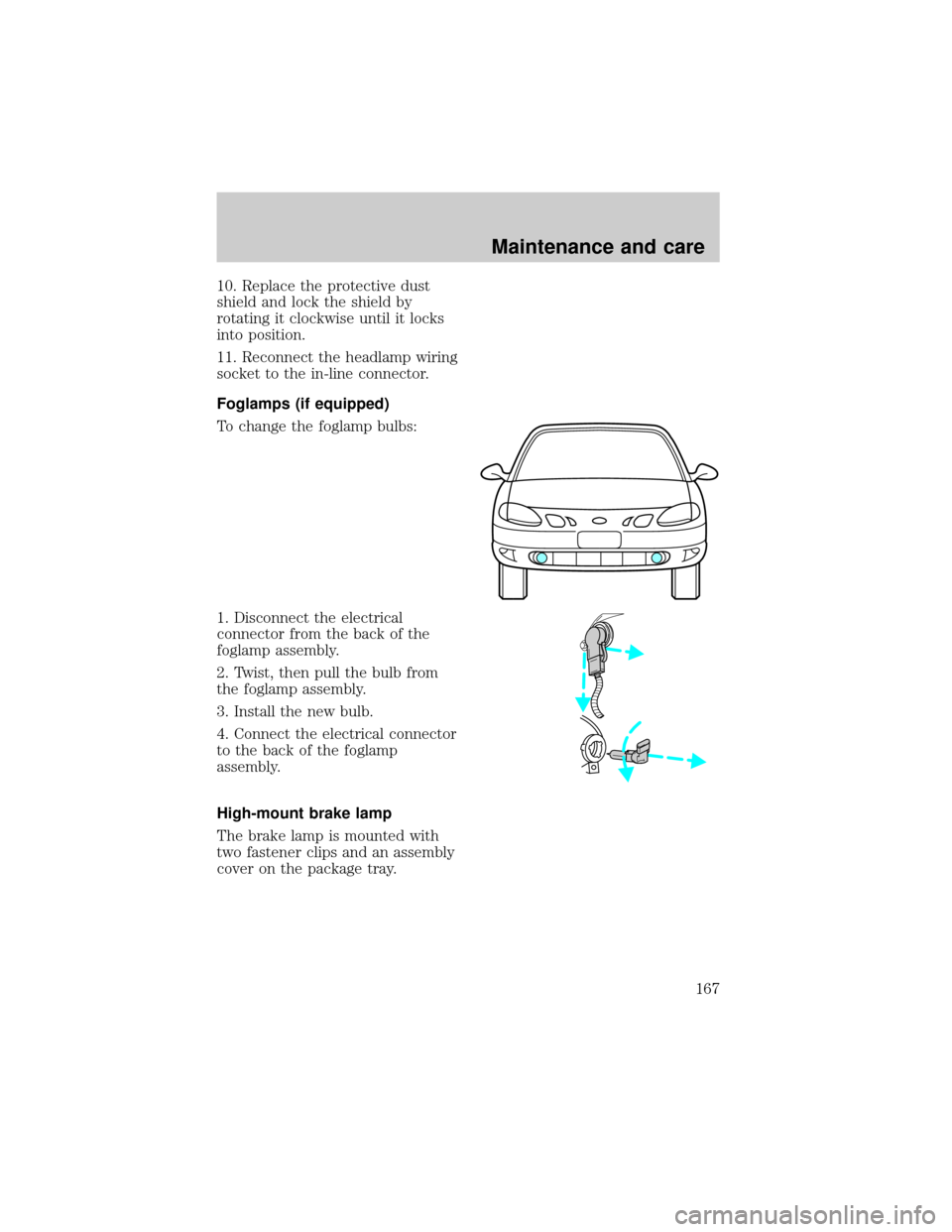
Foglamps (if equipped)
To change the foglamp bulbs:
1. Disconnect the electrical
connector from the back of the
foglamp assembly.
2. Twist, then pull the bulb from
the foglamp assembly.
3. Install the new bulb.
4. Connect the electrical connector
to the back of the foglamp
assembly.
High-mount brake lamp
The brake lamp is mounted with
two fastener clips and an assembly
cover on the package tray.
Maintenance and care
167
Page 170 of 191
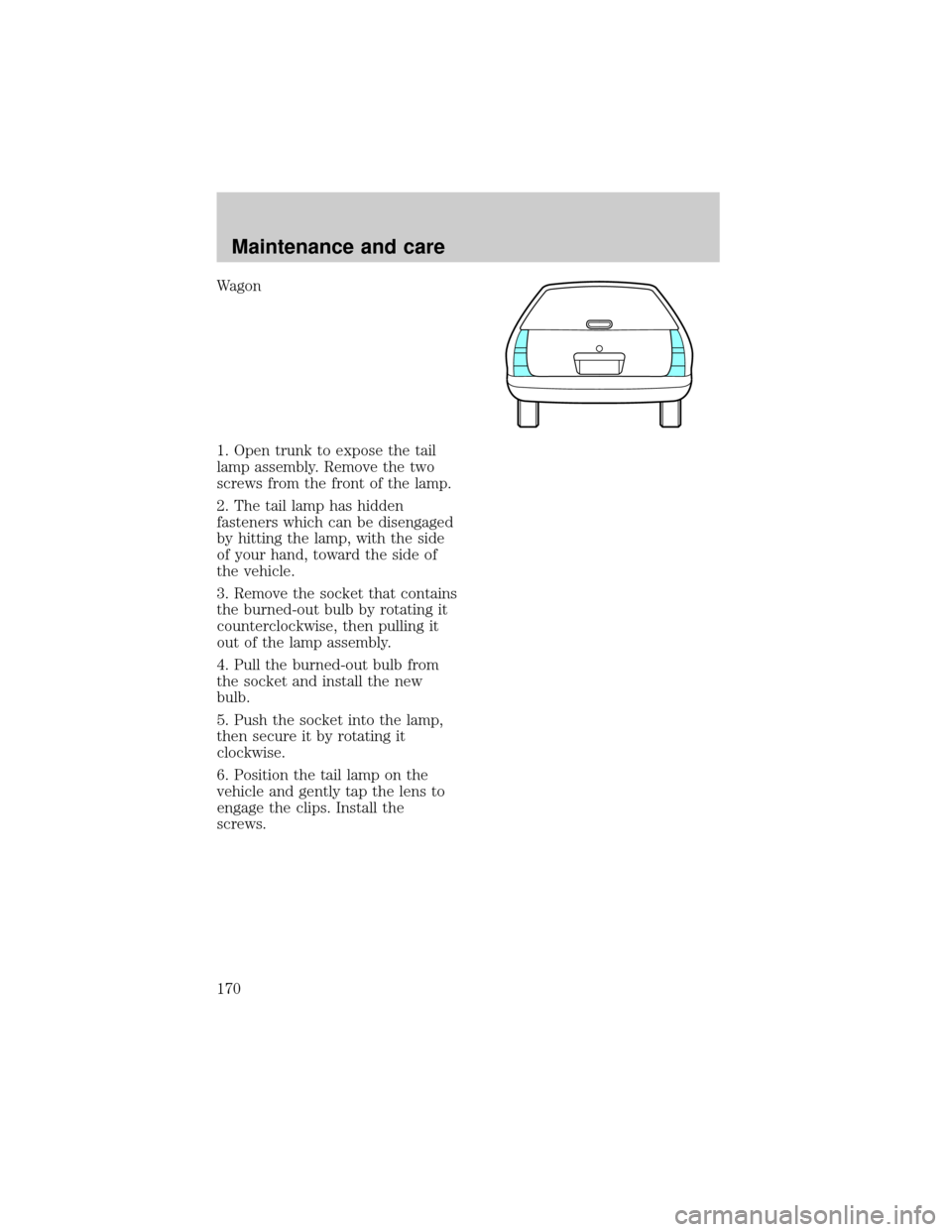
Wagon
1. Open trunk to expose the tail
lamp assembly. Remove the two
screws from the front of the lamp.
2. The tail lamp has hidden
fasteners which can be disengaged
by hitting the lamp, with the side
of your hand, toward the side of
the vehicle.
3. Remove the socket that contains
the burned-out bulb by rotating it
counterclockwise, then pulling it
out of the lamp assembly.
4. Pull the burned-out bulb from
the socket and install the new
bulb.
5. Push the socket into the lamp,
then secure it by rotating it
clockwise.
6. Position the tail lamp on the
vehicle and gently tap the lens to
engage the clips. Install the
screws.
Maintenance and care
170
Page 174 of 191
headlamp refer to the directional
change (left or right) of the
horizontal aim.
3.Usea4mmwrench or socket to
turn the horizontal adjusting screw
until the forward edge of the
knurled portion of the screw is
aligned with the ª0º reference
mark (as shown) on the plastic
slider when viewed directly from
above.
Vertical aim adjustment
1. Park the vehicle on a level
surface.
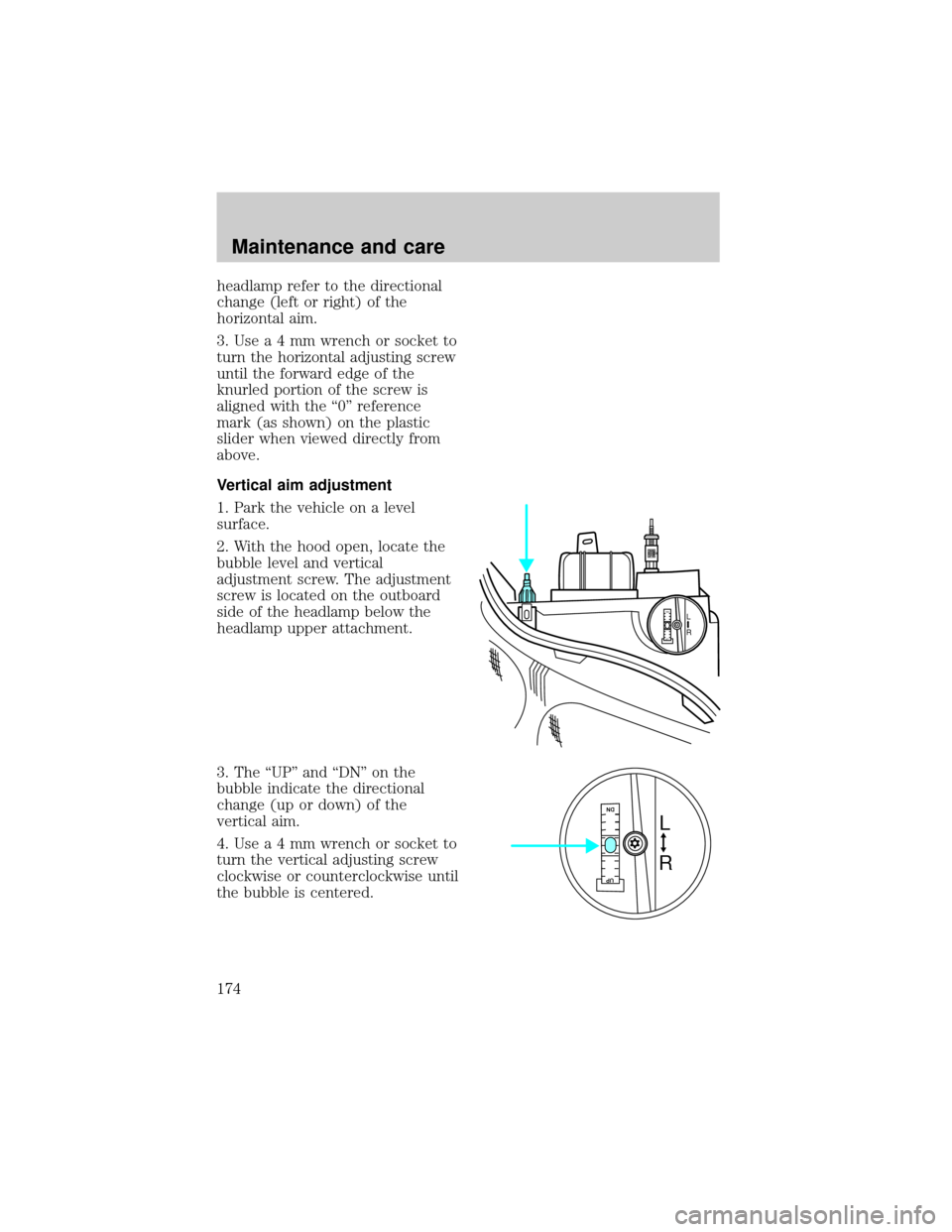
2. With the hood open, locate the
bubble level and vertical
adjustment screw. The adjustment
screw is located on the outboard
side of the headlamp below the
headlamp upper attachment.
3. The ªUPº and ªDNº on the
bubble indicate the directional
change (up or down) of the
vertical aim.
4.Usea4mmwrench or socket to
turn the vertical adjusting screw
clockwise or counterclockwise until
the bubble is centered.
L
R
UP
DN
L
R
DNUP
Maintenance and care
174
Page 177 of 191
high pressure fluid could
penetrate the sealed parts and
cause damage.
²Do not spray with cold water to
avoid cracking the engine block
or other engine components.
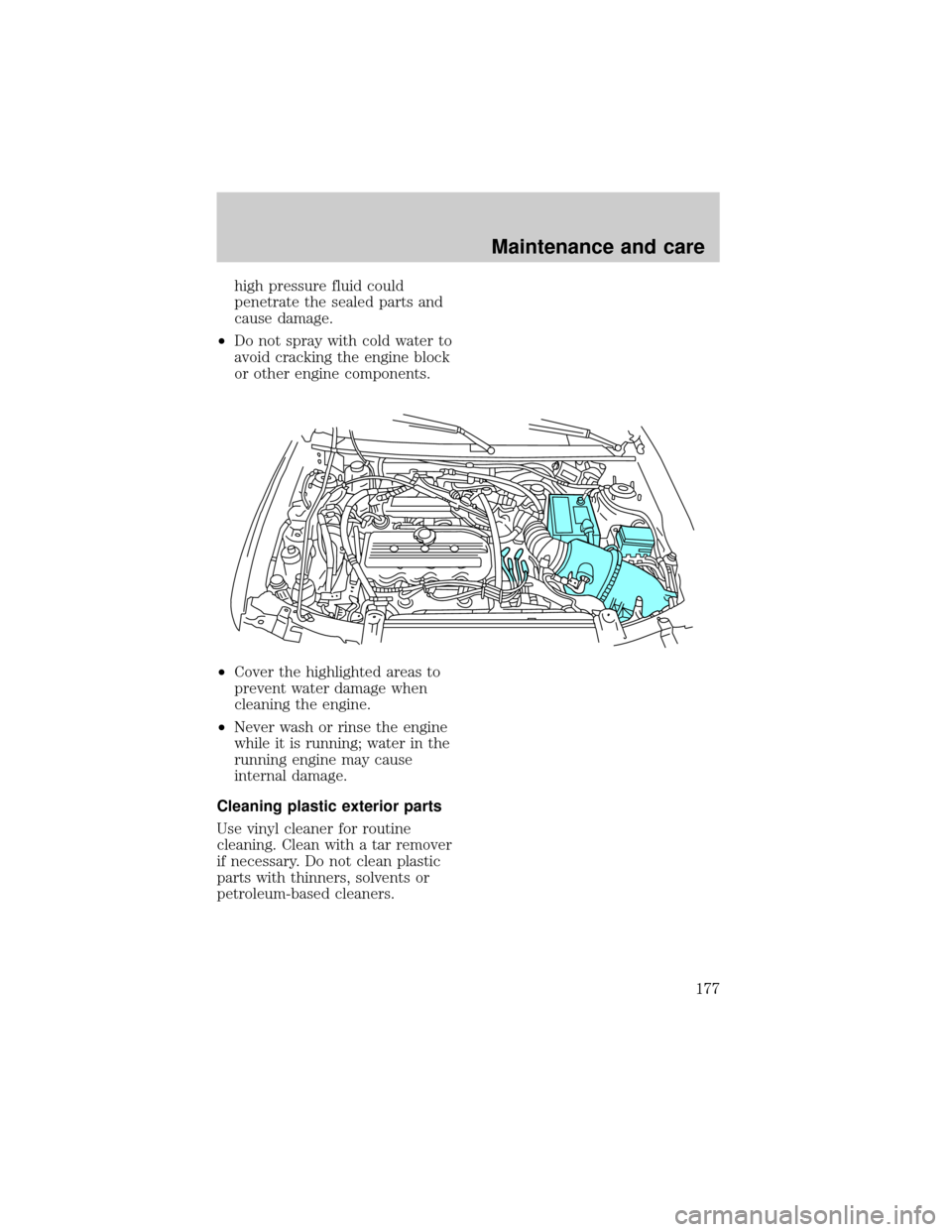
²Cover the highlighted areas to
prevent water damage when
cleaning the engine.
²Never wash or rinse the engine
while it is running; water in the
running engine may cause
internal damage.
Cleaning plastic exterior parts
Use vinyl cleaner for routine
cleaning. Clean with a tar remover
if necessary. Do not clean plastic
parts with thinners, solvents or
petroleum-based cleaners.
Maintenance and care
177
Page 182 of 191
FluidFord Part
Name or
EquivalentFord Part
NumberFord
Specification
Lock cylinder Penetrating
lubricantE8AZ-19A501-B N/A
Automatic
transmissionMotorcraft
MERCONtAT FXT-2-QDX MERCONt
Manual
transmissionMotorcraft
MERCONtAT FXT-2-QDX MERCONt
Engine oil Motorcraft 5W30
Super Premium
Motor OilXO-5W30-QSP WSS-M2C153-G
and API
Certification
Mark
Constant
velocity jointsCV Joint Grease
(High Temp.)E43Z-19590-A ESP-M1C207-A
Engine coolant Ford Premium
Cooling System
FluidE2FZ-19549-AA ESE-M97B44-A
Power steering
reservoirMotorcraft
MERCONtAT FXT-2-QDX MERCONt
ENGINE DATA
Engine 2.0L-2V engine 2.0L-4V Zetec engine
Cubic inches 121 121
Horsepower 110 @ 5000 rpm 130 @ 5750 rpm
Torque 125 lb. ft. @
3750 rpm127 lb-ft. @ 4250 rpm
Required fuel grade 87 octane 87 octane
Firing order 1-3-4-2 1-3-4-2
Spark plug gap 1.3-1.4 mm
(0.052-.056 inch)1.22-1.32 mm
(0.048-.052 inch)
Ignition system DIS DIS
Capacities and specifications
182
Page 186 of 191

IDENTIFYING YOUR VEHICLE
Safety compliance label
The National Highway Traffic
Safety Administration Regulations
require that a Safety Compliance
Certification Label be affixed to a
vehicle and prescribe where the
Safety Compliance Certification
Label may be located. The Safety
Compliance Certification Label is
located on the front door latch
pillar on the driver's side.
Vehicle identification number
The vehicle identification number
is attached to a metal tag and is
located on the driver side
instrument panel.
Engine number
The engine number (the last eight
numbers of the vehicle
identification number) is stamped
on the engine block, transmission,
frame and transfer case (if so
equipped).
MFD. BY FORD MOTOR CO. IN U.S.A.
EXT PNT: XXXXXX XXXXXX RC: XX DSO: XXXX F0000
BAR INT TR TP/PS R AXLE TR SPR T0000
X XX XXX X XX X XXXX
UTC
ÑFOHT-15294A10-GA
MAXIMUM LOAD=OCCUPANTS + LUGGAGE=XXXKG/XXXXLB
OCCUPANTS: X TOTAL X FR X 2ND X RR OCCUPANTS LUGGAGE
XX XXXKG/XXXXLB
TIRE: XXXX/XXXXX XXX X XXXKG/XXXXLB
PRESSURE (FR) XXX kPa/33 PSI COLD
PRESSURE (RR) XXX kPa/33 PSI COLD
TRAILER TOWING - SEE OWNER GUIDE
DATE: XXXXX GVWR:XXXXX LB/ XXXXX KG
VIN: XXXXXXXXXXXXXXXXX TYPE: XXXXXXXXXXXXXXX FGAWR: XXXXXX/XXXXXXX RGAWR: XXXXXXX/XXXXXXX
THIS VEHICLE CONFORMS TO ALL APPLICABLE FEDERAL
MOTOR VEHICLE SAFETY STANDARDS IN EFFECT ON THE
DATE OF MANUFACTURE SHOWN ABOVE.
XXXXXXXXXXXXXXXXX
AIR BAG
Capacities and specifications
186