Page 65 of 191
the child closer to the center of
the vehicle may help provide a
good shoulder belt fit.
If the shoulder belt cannot be
properly positioned:
²move the child to one of the
seats with a lap belt only (if
equipped)
OR
²if the child is the proper size,
restrain the child in a safety
seat.
Do not leave children,
unreliable adults, or pets
unattended in your vehicle.
To improve the fit of lap and
shoulder belts on children who
have outgrown child safety seats,
Ford recommends use of a
belt-positioning booster seat that is
labelled as conforming to all
Federal motor vehicle safety
standards. Belt-positioning booster
seats raise the child and provide a
shorter, firmer seating cushion that
encourages safer seating posture
and better fit of lap and shoulder
belts on the child. A
belt-positioning booster should be
used if the shoulder belt rests in
front of the child's face or neck, or
if the lap belt does not fit snugly
on both thighs, or if the thighs are
too short to let the child sit all the
way back on the seat cushion
when the lower legs hang over the
edge of the seat cushion. You may
wish to discuss the special needs
Seating and safety restraints
65
Page 66 of 191
of your child with your
pediatrician.
SAFETY SEATS FOR CHILDREN
Child and infant or child safety
seats
Use a safety seat that is
recommended for the size and
weight of the child. Carefully
follow all of the manufacturer's
instructions with the safety seat
you put in your vehicle. If you do
not install and use the safety seat
properly, the child may be injured
in a sudden stop or collision.
When installing a child safety seat:
²Use the correct safety belt
buckle for that seating position.
²Make sure the tongue is
securely fastened in the buckle.
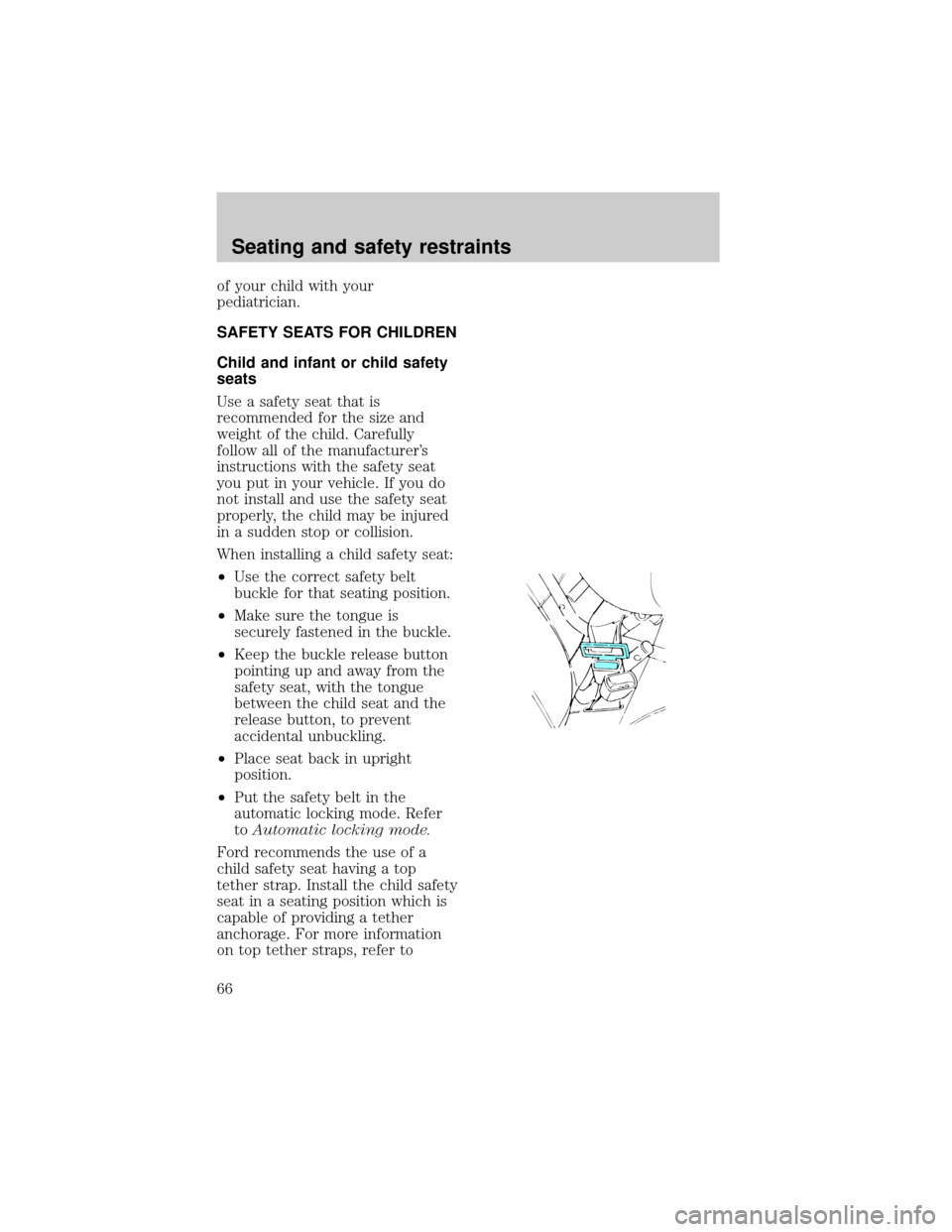
²Keep the buckle release button
pointing up and away from the
safety seat, with the tongue
between the child seat and the
release button, to prevent
accidental unbuckling.
²Place seat back in upright
position.
²Put the safety belt in the
automatic locking mode. Refer
toAutomatic locking mode.
Ford recommends the use of a
child safety seat having a top
tether strap. Install the child safety
seat in a seating position which is
capable of providing a tether
anchorage. For more information
on top tether straps, refer to
Seating and safety restraints
66
Page 67 of 191
Attaching safety seats with tether
straps.
Carefully follow all of the
manufacturer's instructions
included with the safety seat you
put in your vehicle. If you do not
install and use the safety seat
properly, the child may be
injured in a sudden stop or
collision.
Installing child safety seats in
combination lap and shoulder
belt seating positions
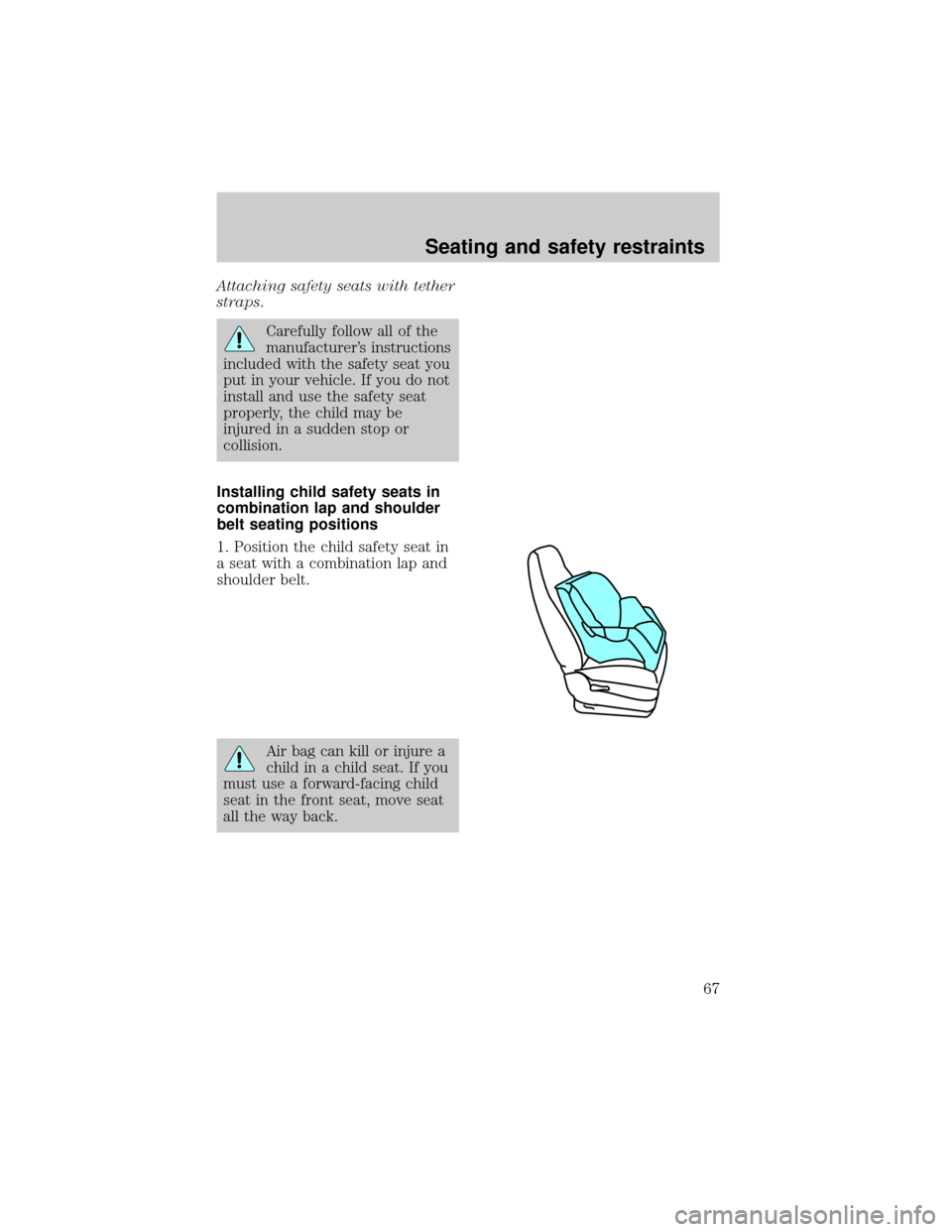
1. Position the child safety seat in
a seat with a combination lap and
shoulder belt.
Air bag can kill or injure a
child in a child seat. If you
must use a forward-facing child
seat in the front seat, move seat
all the way back.
Seating and safety restraints
67
Page 70 of 191
able to pull more belt out). If the
retractor is not locked, unbuckle
the belt and repeat steps two
through nine.
Check to make sure the child seat
is properly secured before each
use.
Attaching safety seats with
tether straps
Some manufacturers make safety
seats that include a tether strap
that goes over the back of the
vehicle seat and attaches to an
anchoring point. Other
manufacturers offer the tether
strap as an accessory. Contact the
manufacturer of your child safety
seat for information about ordering
a tether strap.
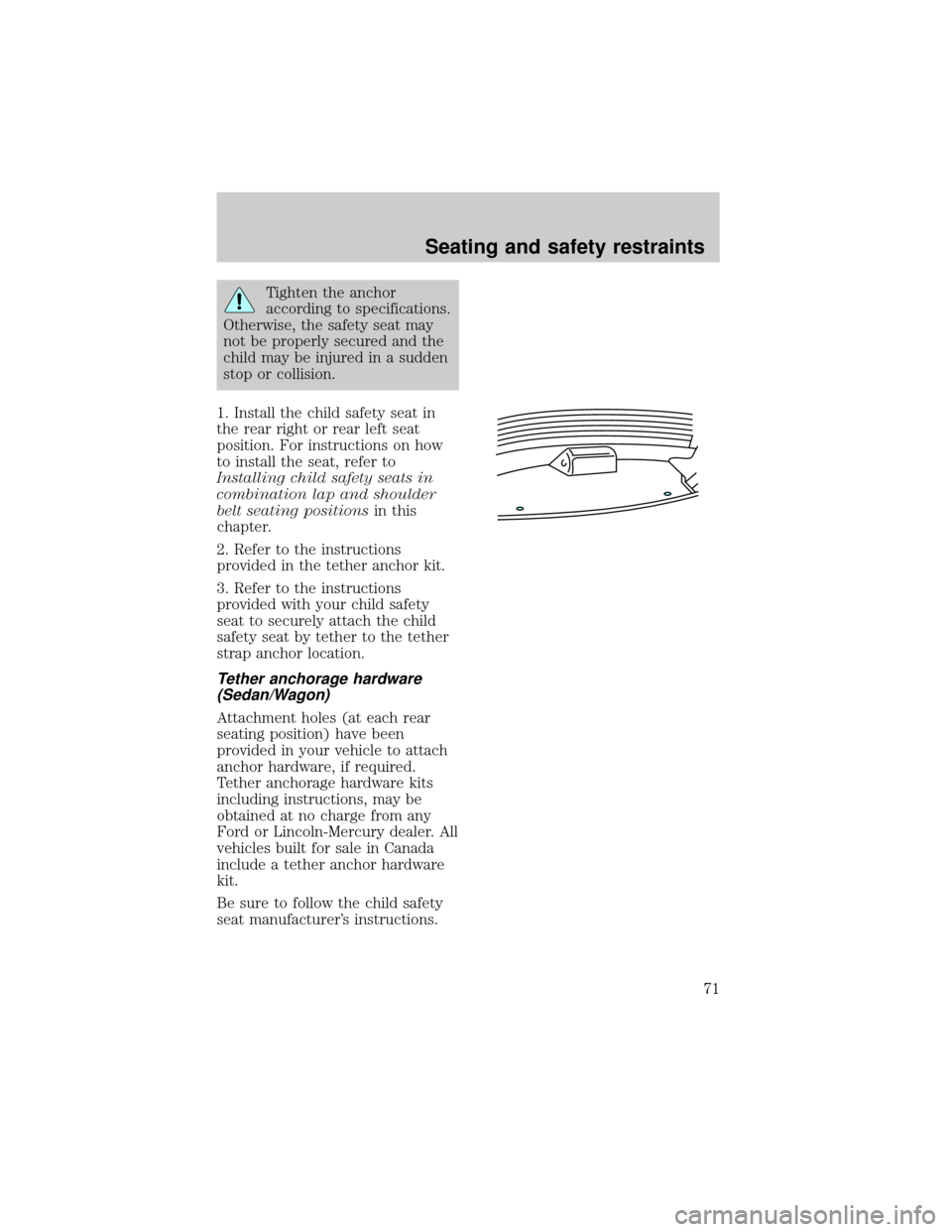
Tether anchorage hardware
(Coupe)
Attachment holes (at each rear
outboard seating position) have
been provided in your vehicle to
attach anchor hardware, if
required. Tether anchorage
hardware kits (part number
613D74) including instructions,
may be obtained at no charge from
any Ford or Lincoln-Mercury
dealer. All vehicles built for sale in
Canada include a tether anchor
hardware kit.
Be sure to follow the child safety
seat manufacturer's instructions.
Seating and safety restraints
70
Page 71 of 191
Tighten the anchor
according to specifications.
Otherwise, the safety seat may
not be properly secured and the
child may be injured in a sudden
stop or collision.
1. Install the child safety seat in
the rear right or rear left seat
position. For instructions on how
to install the seat, refer to
Installing child safety seats in
combination lap and shoulder
belt seating positionsin this
chapter.
2. Refer to the instructions
provided in the tether anchor kit.
3. Refer to the instructions
provided with your child safety
seat to securely attach the child
safety seat by tether to the tether
strap anchor location.
Tether anchorage hardware
(Sedan/Wagon)
Attachment holes (at each rear
seating position) have been
provided in your vehicle to attach
anchor hardware, if required.
Tether anchorage hardware kits
including instructions, may be
obtained at no charge from any
Ford or Lincoln-Mercury dealer. All
vehicles built for sale in Canada
include a tether anchor hardware
kit.
Be sure to follow the child safety
seat manufacturer's instructions.
Seating and safety restraints
71
Page 72 of 191
Tighten the anchor
according to specifications.
Otherwise, the safety seat may
not be properly secured and the
child may be injured in a sudden
stop or collision.
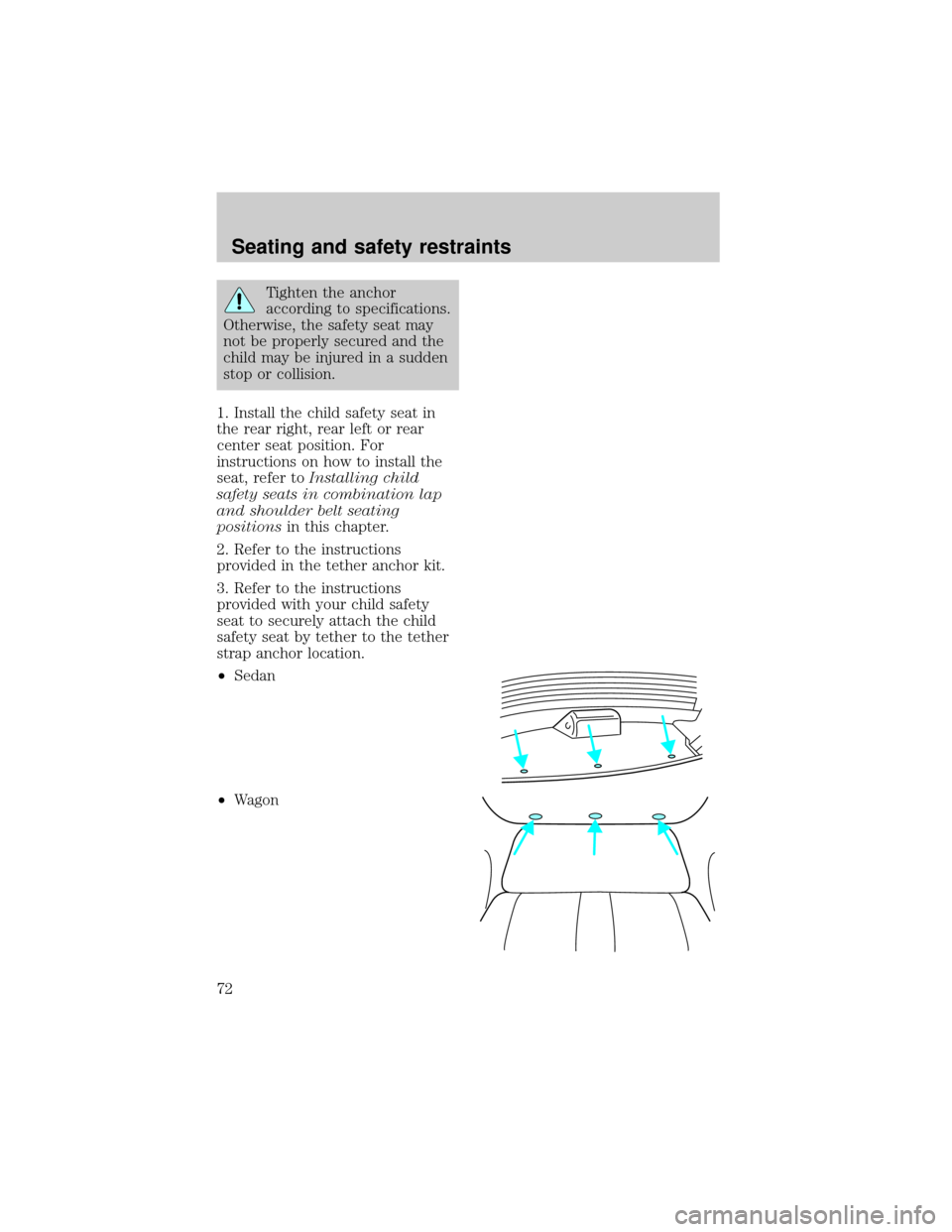
1. Install the child safety seat in
the rear right, rear left or rear
center seat position. For
instructions on how to install the
seat, refer toInstalling child
safety seats in combination lap
and shoulder belt seating
positionsin this chapter.
2. Refer to the instructions
provided in the tether anchor kit.
3. Refer to the instructions
provided with your child safety
seat to securely attach the child
safety seat by tether to the tether
strap anchor location.
²Sedan
²Wagon
Seating and safety restraints
72
Page 73 of 191
BUILT-IN CHILD SEATS
Built-in child safety seat
(if equipped)
The rear seat may include a
built-in child seat. This child seat
conforms to all Federal and local
motor vehicle safety standards.
Read the labels located on the
child seat cushion and shoulder
belt for information on the built-in
child seat.
Use the built-in child seatonlyif
the child is at least 9 months old,
weighs 9±27 kg (20±60 lb) and the
child's shoulders (top) are below
the shoulder harness slots in the
built-in child seat.
Children not meeting these
requirements should be secured in
an approved aftermarket seat.
Refer toChildren and infant or
child safety seatsin this chapter.
Built-in child seat retractors
The belts on built-in child seats
are equipped with a retractor that
locks when both tongues are
latched into the crotch safety belt
buckle. The retractor will
automatically snug the belts
around the child. If the belts do
not remain snug, take the vehicle
to the dealer for child seat repair.
The belts will not snug during a
collision.
Seating and safety restraints
73
Page 79 of 191
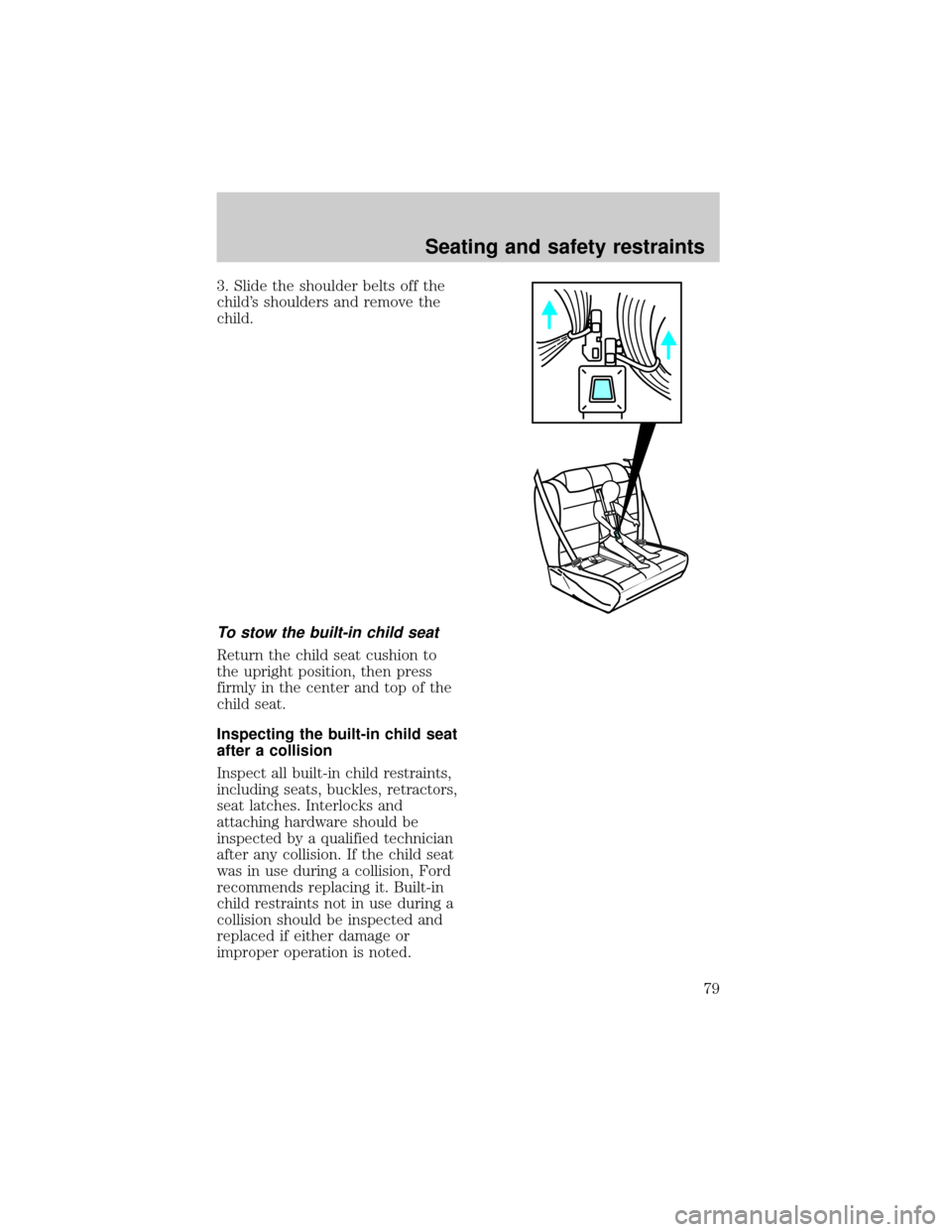
3. Slide the shoulder belts off the
child's shoulders and remove the
child.
To stow the built-in child seat
Return the child seat cushion to
the upright position, then press
firmly in the center and top of the
child seat.
Inspecting the built-in child seat
after a collision
Inspect all built-in child restraints,
including seats, buckles, retractors,
seat latches. Interlocks and
attaching hardware should be
inspected by a qualified technician
after any collision. If the child seat
was in use during a collision, Ford
recommends replacing it. Built-in
child restraints not in use during a
collision should be inspected and
replaced if either damage or
improper operation is noted.
Seating and safety restraints
79