1998 FORD CROWN VICTORIA brake fluid
[x] Cancel search: brake fluidPage 111 of 160

IDENTIFYING COMPONENTS IN THE ENGINE COMPARTMENT
4.6L SOHC V8 engine
1. Brake fluid reservoir
2. Engine oil dipstick
3. Engine oil filler cap
4. Windshield washer fluid reservoir
5. Air filter assembly
6. Power steering fluid reservoir
7. Engine coolant reservoir
8. Battery
9. Automatic transmission fluid dipstick
912
3
6578
4
Maintenance and care
111
Page 114 of 160
Do not use supplemental engine oil additives, oil treatments or engine
treatments. They are unnecessary and could, under certain conditions,
lead to engine damage which is not covered by your warranty.
Change your engine oil and filter according to the appropriate schedule
listed in the ªService Guideº.
Ford production and aftermarket (Motorcraft) oil filters are designed for
added engine protection and long life. If a replacement oil filter is used
that does not meet Ford material and design specifications, startup
engine noises or knock may be experienced.
It is recommended you use the appropriate Motorcraft oil filter (or
another brand meeting Ford specifications) for your engine application.
Changing the engine oil and filter
Change your engine oil and filter according to the appropriate schedule
listed in the ªService Guideº.
Ford production and aftermarket (Motorcraft) oil filters are designed for
added engine protection and long life. If a replacement oil filter is used
that does not meet Ford material and design specifications, startup
engine noises or knock may be experienced.
It is recommended you use the appropriate Motorcraft oil filter (or
another brand meeting Ford specifications) for your engine application.
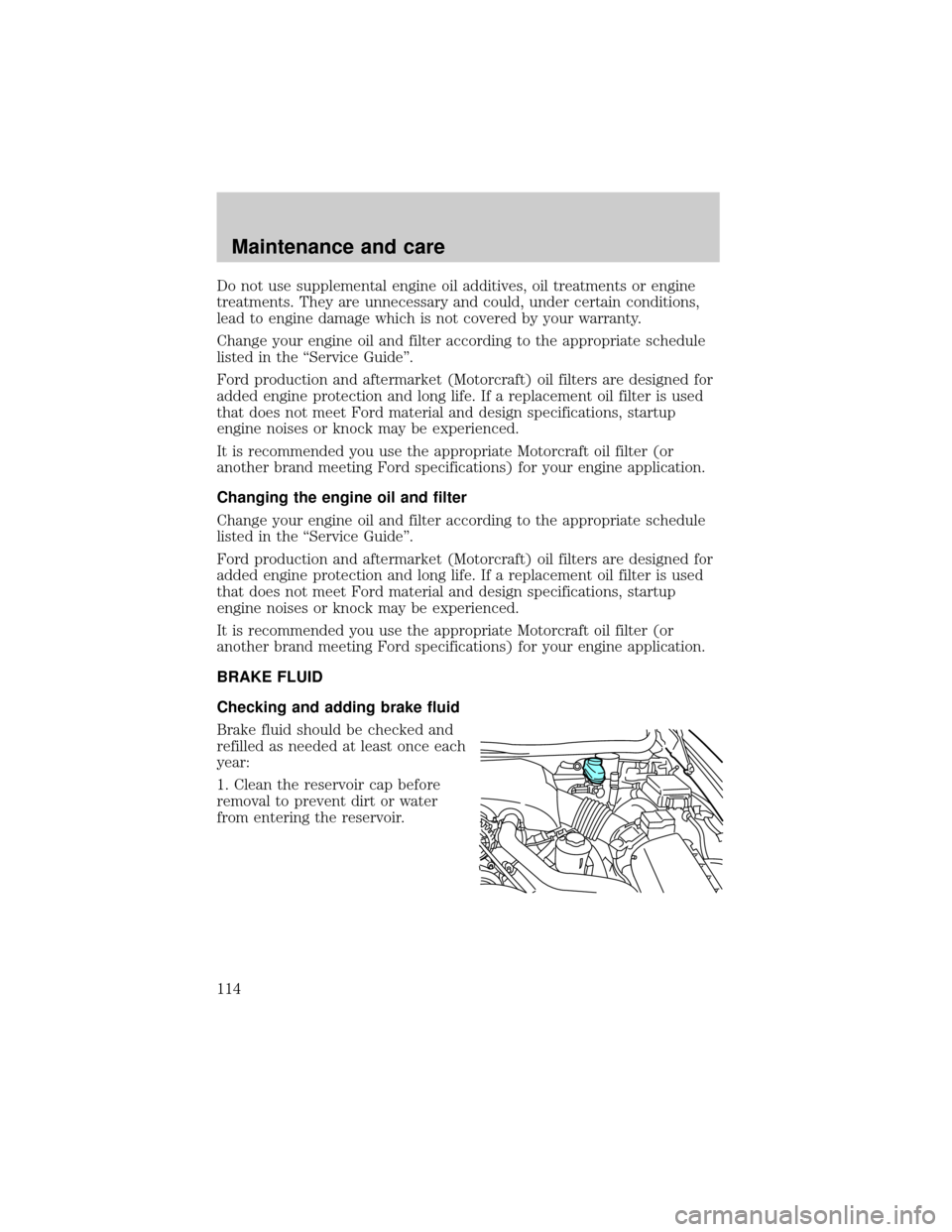
BRAKE FLUID
Checking and adding brake fluid
Brake fluid should be checked and
refilled as needed at least once each
year:
1. Clean the reservoir cap before
removal to prevent dirt or water
from entering the reservoir.
Maintenance and care
114
Page 115 of 160
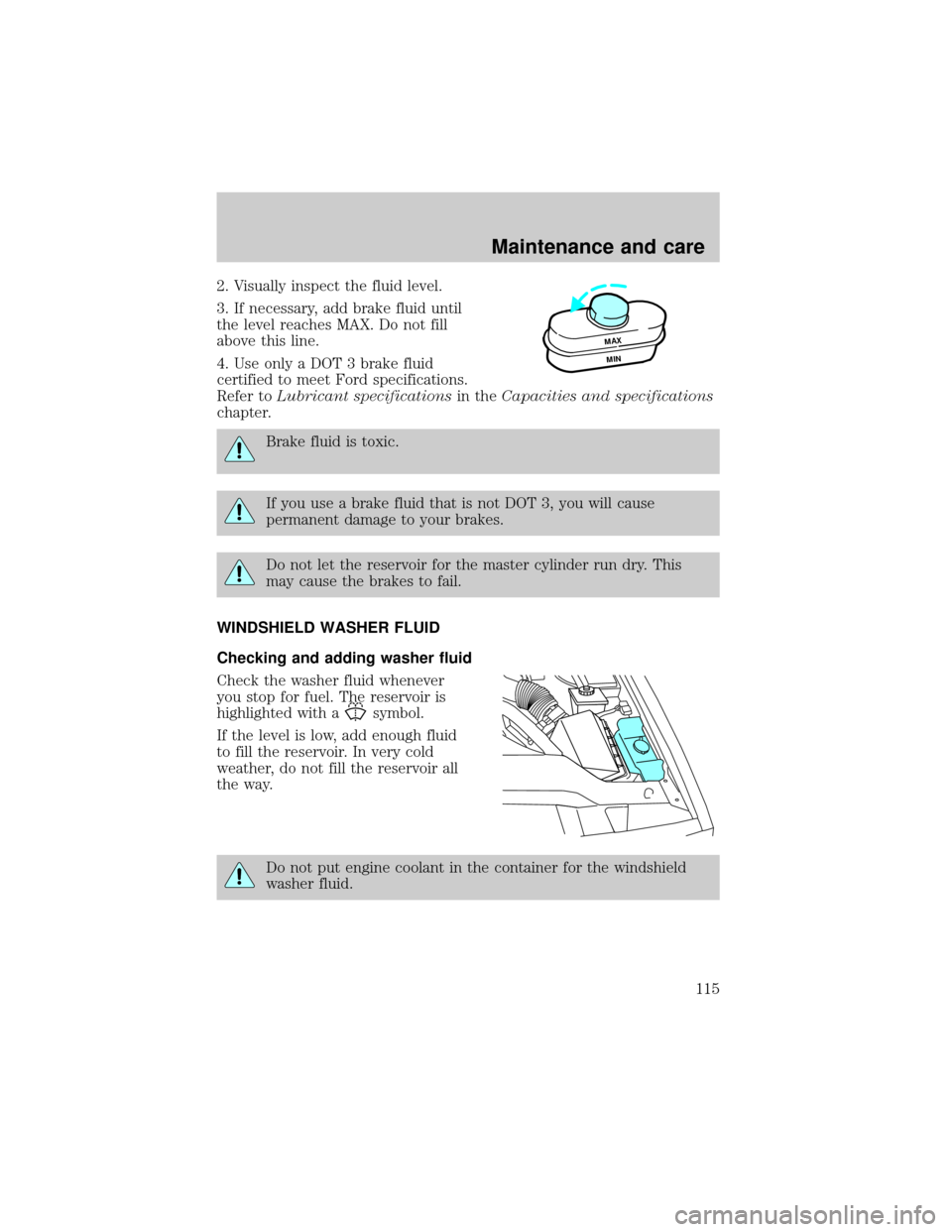
2. Visually inspect the fluid level.
3. If necessary, add brake fluid until
the level reaches MAX. Do not fill
above this line.
4. Use only a DOT 3 brake fluid
certified to meet Ford specifications.
Refer toLubricant specificationsin theCapacities and specifications
chapter.
Brake fluid is toxic.
If you use a brake fluid that is not DOT 3, you will cause
permanent damage to your brakes.
Do not let the reservoir for the master cylinder run dry. This
may cause the brakes to fail.
WINDSHIELD WASHER FLUID
Checking and adding washer fluid
Check the washer fluid whenever
you stop for fuel. The reservoir is
highlighted with a
symbol.
If the level is low, add enough fluid
to fill the reservoir. In very cold
weather, do not fill the reservoir all
the way.
Do not put engine coolant in the container for the windshield
washer fluid.
MAX
MIN
Maintenance and care
115
Page 123 of 160
If your vehicle has been operated for an extended period at high speeds,
in city traffic during hot weather or pulling a trailer, the vehicle should
be turned off for about 30 minutes to allow the fluid to cool before
checking.
1. Park the vehicle on a level surface and engage the parking brake.
2. With the parking brake engaged
and your foot on the brake pedal,
start the engine and move the
gearshift lever through all of the
gear ranges. Allow sufficient time for each gear to engage.
3. Latch the gearshift lever in P (Park) and leave the engine running.
4. Remove the dipstick, wiping it clean with a clean, dry lint free rag.
5. Install the dipstick making sure it is fully seated in the filler tube.
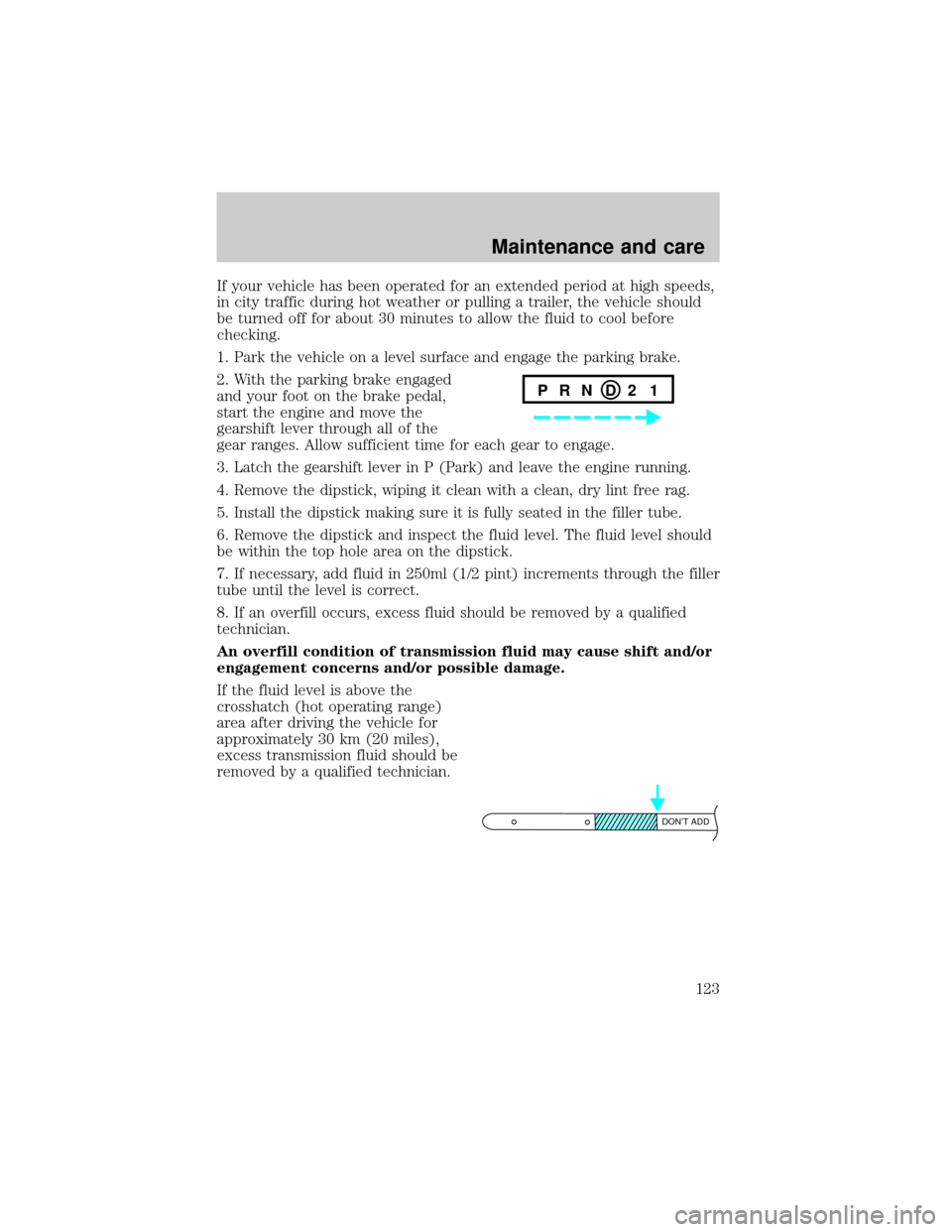
6. Remove the dipstick and inspect the fluid level. The fluid level should
be within the top hole area on the dipstick.
7. If necessary, add fluid in 250ml (1/2 pint) increments through the filler
tube until the level is correct.
8. If an overfill occurs, excess fluid should be removed by a qualified
technician.
An overfill condition of transmission fluid may cause shift and/or
engagement concerns and/or possible damage.
If the fluid level is above the
crosshatch (hot operating range)
area after driving the vehicle for
approximately 30 km (20 miles),
excess transmission fluid should be
removed by a qualified technician.
P R N D 2 1
DON’T ADD
Maintenance and care
123
Page 140 of 160
CLEANING AND CARING FOR YOUR VEHICLE
Refer to the ªCustomer Assistance Guideº for a list of Ford-approved
cleaners, polishes and waxes.
Washing your vehicle
Wash your vehicle regularly with
cold or lukewarm water. Never use
strong detergents or soap. If your
vehicle is particularly dirty, use a
quality car wash detergent. Always
use a clean sponge, washing glove
or similar device and plenty of water
for best results. To avoid spots,
avoid washing when the hood is still
warm, immediately after or during
exposure to strong sunlight.
During winter months, it is especially important to wash the vehicle on a
regular basis. Large quantities of dirt and road salt are difficult to
remove and also cause damage to the vehicle.
Remove any exterior accessories, such as antennas, before entering a car
wash. If you have wax applied to the vehicle at a commercial car wash, it
is recommended that you clean the wiper blades and windshield as
described inCleaning the wiper blades and windshield.
After washing, apply the brakes several times to dry them.
Waxing your vehicle
Wax when water stops beading on the surface. This could be every three
or four months, depending on operating conditions.
Use only carnauba or synthetic-based waxes. Use cleaning fluid or
alcohol with a clean cloth to remove any bugs and tar before waxing
vehicle. Use tar remover to remove any tar spots.
Avoid getting wax on the windshield. If you have wax applied at a
commercial car wash, it is recommended that you clean the wiper blades
and windshield as described inCleaning the wiper blades and
windshield.
Repairing paint chips
Minor scratches or paint damage from road debris may be repaired with
touch-up paint, repair foil or aerosol paint spray from the Ford accessory
line. Observe the application instructions on the products.
Maintenance and care
140
Page 146 of 160
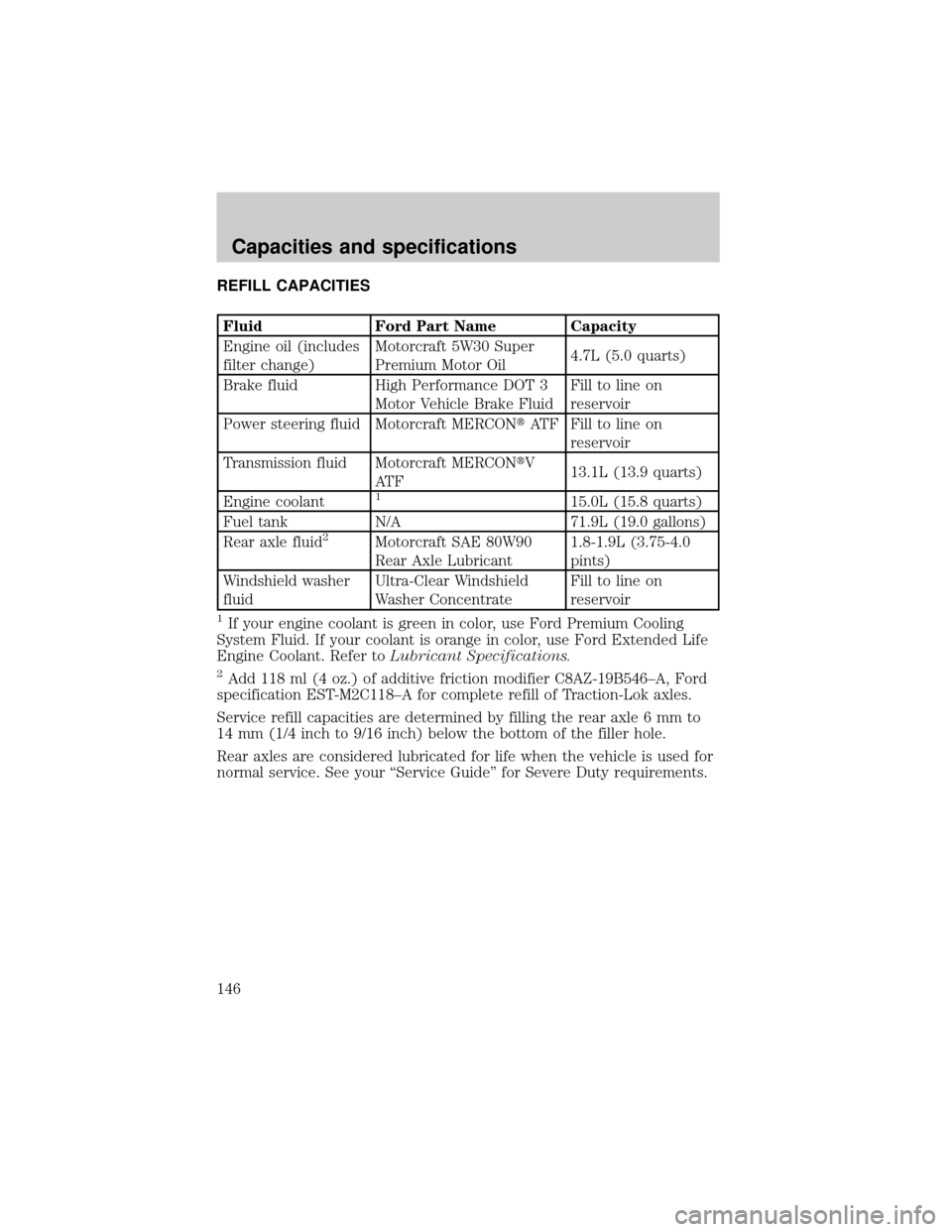
REFILL CAPACITIES
Fluid Ford Part Name Capacity
Engine oil (includes
filter change)Motorcraft 5W30 Super
Premium Motor Oil4.7L (5.0 quarts)
Brake fluid High Performance DOT 3
Motor Vehicle Brake FluidFill to line on
reservoir
Power steering fluid Motorcraft MERCONtATF Fill to line on
reservoir
Transmission fluid Motorcraft MERCONtV
AT F13.1L (13.9 quarts)
Engine coolant
115.0L (15.8 quarts)
Fuel tank N/A 71.9L (19.0 gallons)
Rear axle fluid
2Motorcraft SAE 80W90
Rear Axle Lubricant1.8-1.9L (3.75-4.0
pints)
Windshield washer
fluidUltra-Clear Windshield
Washer ConcentrateFill to line on
reservoir
1If your engine coolant is green in color, use Ford Premium Cooling
System Fluid. If your coolant is orange in color, use Ford Extended Life
Engine Coolant. Refer toLubricant Specifications.
2Add 118 ml (4 oz.) of additive friction modifier C8AZ-19B546±A, Ford
specification EST-M2C118±A for complete refill of Traction-Lok axles.
Service refill capacities are determined by filling the rear axle 6 mm to
14 mm (1/4 inch to 9/16 inch) below the bottom of the filler hole.
Rear axles are considered lubricated for life when the vehicle is used for
normal service. See your ªService Guideº for Severe Duty requirements.
Capacities and specifications
146
Page 147 of 160

LUBRICANT SPECIFICATIONS
Item Ford part name Ford part
numberFord
specification
Brake fluid High Performance
DOT 3 Motor
Vehicle Brake FluidC6AZ-19542-AB ESA-M6C25-A
and DOT 3
Door
weatherstripsSilicone Lubricant C0AZ-19553-AA
and
D7AZ-19553-AAESR-M13P4-A
Engine
coolantFord Premium
Engine Coolant
(green in color)E2FZ-19549-AA ESE-M97B44-A
Ford Extended Life
Engine Coolant
(orange in color)F6AZ-19544-AA WSS-M97B44-D
or DEX-COOLt
equivalent
Engine oil Motorcraft 5W30
Super Premium
Motor OilXO-5W30-QSP WSS-M2C153-G
with API
Certification
Mark
Hinges,
latches,
striker
plates, fuel
filler door
hinge and
seat tracksMulti-Purpose
GreaseDOAZ-19584-AA
or
F5AZ-19G209-AAESB-M1C93-B or
ESR-M1C159-A
Lock
cylindersPenetrating
LubricantE8AZ-19501-B none
Power
steering fluidMotorcraft
MERCONtAT FXT-2-QDX MERCONt
Automatic
transmission
(4R70W)Motorcraft
MERCONtVATFXT-5-QM
MERCONtV
Capacities and specifications
147
Page 152 of 160
Aiming headlamps ....................138
Air bag supplemental restraint
system ..........................................68
and child safety seats ..............69
description ................................68
disposal ......................................72
indicator light ...........................71
passenger air bag .....................70
Air conditioning
manual heating and air
conditioning system ............25,26
Air suspension
description ................................87
Anti-lock brake system
(ABS)description
Battery .......................................124
voltage gauge ............................16
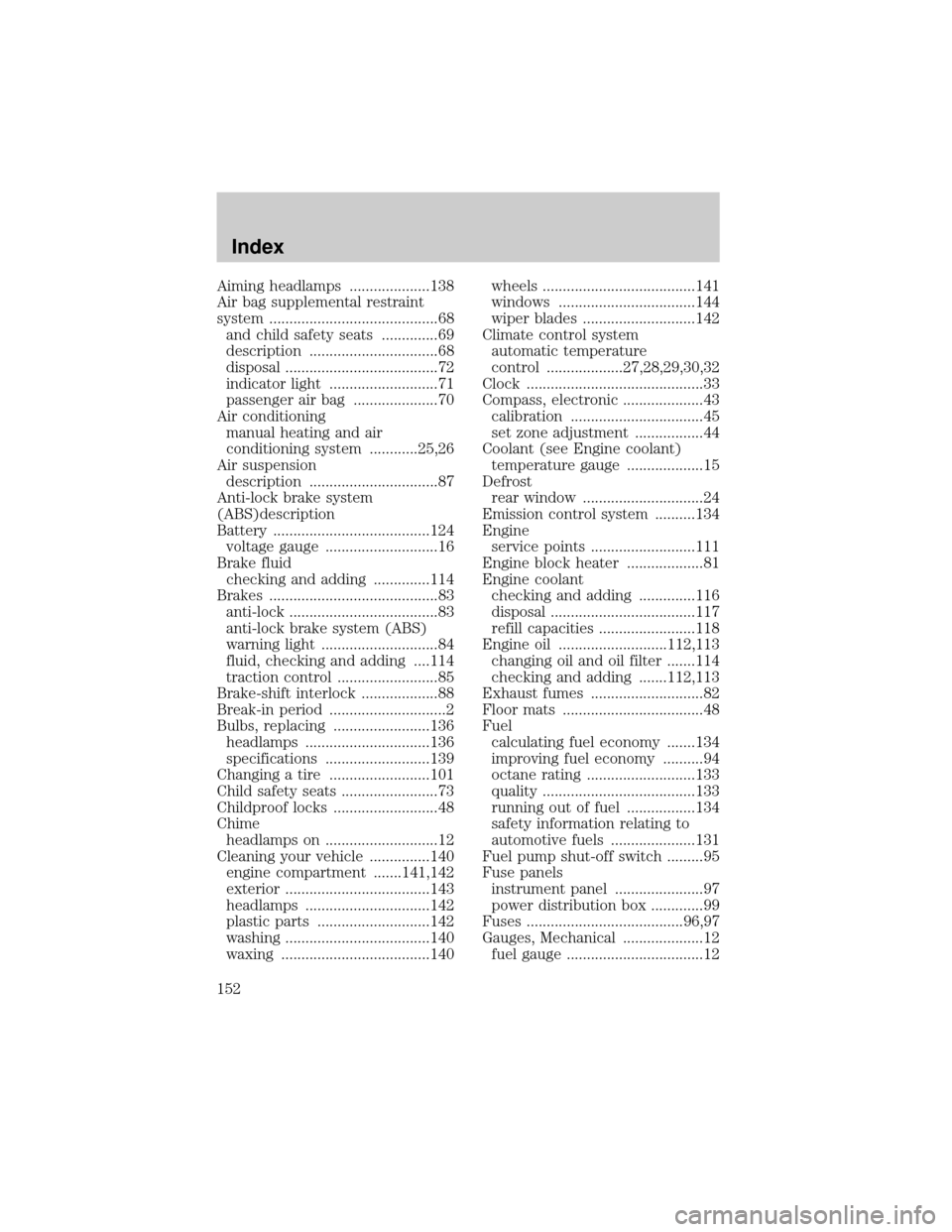
Brake fluid
checking and adding ..............114
Brakes ..........................................83
anti-lock .....................................83
anti-lock brake system (ABS)
warning light .............................84
fluid, checking and adding ....114
traction control .........................85
Brake-shift interlock ...................88
Break-in period .............................2
Bulbs, replacing ........................136
headlamps ...............................136
specifications ..........................139
Changing a tire .........................101
Child safety seats ........................73
Childproof locks ..........................48
Chime
headlamps on ............................12
Cleaning your vehicle ...............140
engine compartment .......141,142
exterior ....................................143
headlamps ...............................142
plastic parts ............................142
washing ....................................140
waxing .....................................140wheels ......................................141
windows ..................................144
wiper blades ............................142
Climate control system
automatic temperature
control ...................27,28,29,30,32
Clock ............................................33
Compass, electronic ....................43
calibration .................................45
set zone adjustment .................44
Coolant (see Engine coolant)
temperature gauge ...................15
Defrost
rear window ..............................24
Emission control system ..........134
Engine
service points ..........................111
Engine block heater ...................81
Engine coolant
checking and adding ..............116
disposal ....................................117
refill capacities ........................118
Engine oil ...........................112,113
changing oil and oil filter .......114
checking and adding .......112,113
Exhaust fumes ............................82
Floor mats ...................................48
Fuel
calculating fuel economy .......134
improving fuel economy ..........94
octane rating ...........................133
quality ......................................133
running out of fuel .................134
safety information relating to
automotive fuels .....................131
Fuel pump shut-off switch .........95
Fuse panels
instrument panel ......................97
power distribution box .............99
Fuses .......................................96,97
Gauges, Mechanical ....................12
fuel gauge ..................................12
Index
152