Page 111 of 200
Roadside emergencies
111
If your engine cranks but does not
start after a collision or substantial
jolt:
1. Turn the ignition key to the off
position.
2. Check under the vehicle for
leaking fuel.
3. If you do not see or smell fuel,
push the red reset button down. If
the button is already set, you may
have a different mechanical
problem.
4. Turn the ignition key to the on
position for a few seconds, then
turn it to the off position.
5. Check under the vehicle again
for leaking fuel. If you see or smell
fuel, do not start your vehicle
again. If you do not see or smell
fuel, you can try to start your
vehicle again.
If you see or smell fuel, do
not reset the switch or try to
start your vehicle. Have all the
passengers get out of the vehicle
and call the local fire department
or a towing service.
CDW IVC1-6Roads en C 5/15/97 8:53 PM Page 111
Page 114 of 200
Roadside emergencies
114Ampere
rating
Power distribution box (engine compartment)
Color
Circuits protected
1*
2*
3*
4
5
6
7
8
9
10
11
12
13
14
15
16
17
1880
60
60
20
15
—
20
—
20
20
3
15
20
15
10
10
10
10black
yellow
yellow
yellow
light blue
—
yellow
—
light blue
light blue
violet
light blue
yellow
light blue
red
red
red
redMain power supply to vehicle
electrical system
Engine cooling fan
ABS braking system, heater
blower
Ignition and EEC module
Foglamp
Not used
ABS system
not used
Electronic Engine Control (EEC)
Ignition switch
EEC ignition module (memory)
Horn and hazard flasher warning
system
HEGO sensor
Electrically operated fuel pump
Low beam headlamp –
(passenger’s side)
Low beam headlamp –
(driver’s side)
High beam headlamp –
(passenger’s side)
High beam headlamp –
(driver’s side)
* Have these fuses replaced by your dealer or qualified technician.
Fuse
CDW IVC1-6Roads en C 5/15/97 8:53 PM Page 114
Page 115 of 200
Roadside emergencies
115
Power distribution box (engine compartment)
RelayCircuits switched
R 1
R 2
R 3
R 4
R 5
R 6
R 7
R 8
R 9
R 10
R 11
D1
Passenger compartment fuse
panel
To check or change a fuse or a
relay, open the fuse box by pulling
down the lock release lever (1).
1
Daytime running lights
Radiator fan relay (high speed)
Air conditioning
Air conditioning clutch relay
Radiator fan relay (low speed)
Starter solenoid
Horn
Electrically operated fuel pump
Low beam headlamps
High beam headlamps
EEC module
Reverse voltage protection
CDW IVC1-6Roads en C 5/15/97 8:53 PM Page 115
Page 128 of 200
Maintenance and care
128SERVICE RECOMMENDATIONS
•We highlight do-it-yourself items
in the engine compartment for
easy location.
•As possible, we design parts that
can be replaced without tools.
•We provide you with a “Service
Guide” which makes tracking
routine service for your vehicle
easy.
If your vehicle requires
professional service, your Ford
dealership can provide necessary
parts and service. Check your
“Warranty Guide” to find out which
parts and services are covered.
Use only recommended fuels,
lubricants, fluids and service parts
conforming to specifications.
Motorcraft parts are designed and
built to provide the best
performance in your vehicle.
CDW VA1-19Maint en C 5/15/97 8:55 PM Page 128
Page 129 of 200
Maintenance and care
129 Precautions when servicing
your vehicle
Be especially careful when
inspecting or servicing your
vehicle. Here are some general
precautions for your safety:
•Do not work on a hot engine.
The cooling fan is automatic
and may come on at any
time. Always disconnect the
negative terminal of the battery
before working near the fan.
•If you must work with the engine
running, avoid wearing loose
clothing or jewelry that could get
caught in moving parts. Take
precautions with long hair.
•Do not work on a vehicle with the
engine running in an enclosed
space, unless you are sure you
have enough ventilation.
•Keep all lit cigarettes, open
flames and other lit material
away from the battery and all fuel
related parts.
If you disconnect the battery, the
engine must “relearn” its idle
conditions before your vehicle will
drive properly, as explained under
Battery in this chapter.
CDW VA1-19Maint en C 5/15/97 8:55 PM Page 129
Page 132 of 200
Maintenance and care
132Opening the hood
•Pull the handle (1) located under
the instrument panel.
000123000010 20 3040506070
80
90
100
110
120
130MPH20 406055
80120 100
140
160
180
200EF 1
/
2UNLEADED FUEL ONLY12
03x 1000
4
5
6
7
8
NORMALBRAKE
CHECK
ENGINE TRACTION
CONTROLO/D
OFF
MIRRORS
1
•Release the safety catch by
reaching under the hood (2)
(adjacent to the Ford emblem)
and pushing it up.
2
3
•Raise the hood and support it
with the strut (3) in the yellow
colored retainer, ensuring it is
secure. Hold the support at the
yellow colored insulation section.
To close, replace the support strut
in its retaining clip, lower the hood
and allow it to drop into the catch
for the last 20 – 30 cm
(8 – 12 inches).
Always check to ensure that the
hood lock is fully engaged.
CDW VA1-19Maint en C 5/15/97 8:56 PM Page 132
Page 135 of 200
Maintenance and care
135
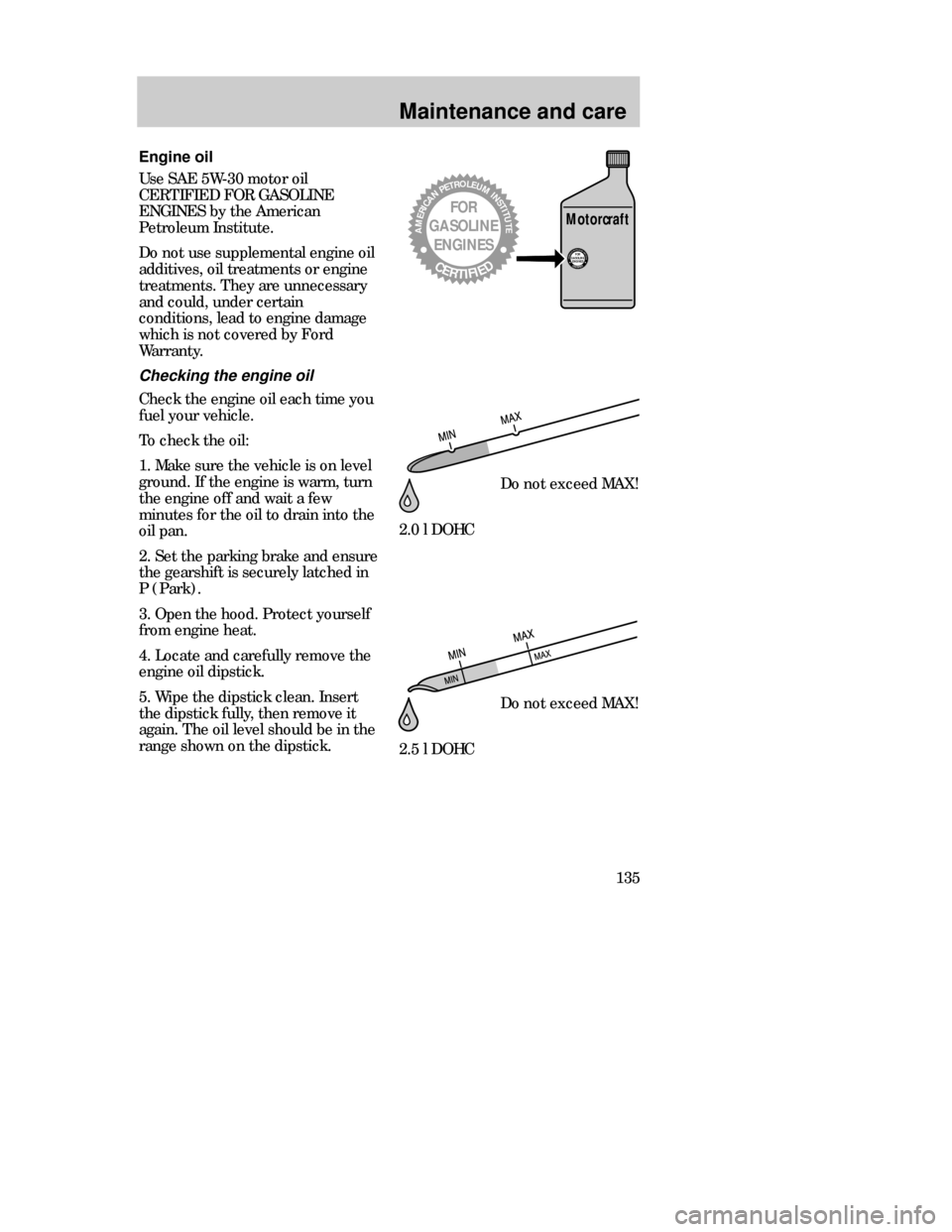
Engine oil
Use SAE 5W-30 motor oil
CERTIFIED FOR GASOLINE
ENGINES by the American
Petroleum Institute.
Do not use supplemental engine oil
additives, oil treatments or engine
treatments. They are unnecessary
and could, under certain
conditions, lead to engine damage
which is not covered by Ford
Warranty.
Checking the engine oil
Check the engine oil each time you
fuel your vehicle.
To check the oil:
1. Make sure the vehicle is on level
ground. If the engine is warm, turn
the engine off and wait a few
minutes for the oil to drain into the
oil pan.
2. Set the parking brake and ensure
the gearshift is securely latched in
P (Park).
3. Open the hood. Protect yourself
from engine heat.
4. Locate and carefully remove the
engine oil dipstick.
5. Wipe the dipstick clean. Insert
the dipstick fully, then remove it
again. The oil level should be in the
range shown on the dipstick.2.0 l DOHC
2.5 l DOHC
AMERICANPETROLEUMINSTITUTE
CERTIFIED
FOR
GASOLINE
ENGINES
AMERICANPETROLEUMINSTITUTECERTIFIEDFOR
GASOLINE
ENGINES
Motorcraft
Do not exceed MAX!
Do not exceed MAX!
CDW VA1-19Maint en C 5/15/97 8:56 PM Page 135
Page 150 of 200
Maintenance and care
150Checking wiper blades
Check the wiper blades on your
vehicle for roughness by running
the tips of your fingers over the
edge of the blade.
Traces of grease, silicone and fuel
prevent wiper blades from
functioning properly. We
recommend Ford cleaning
solutions or equivalent to clean
wiper blades.
Change the wiper blades on your
vehicle at least once a year.
Cabin air filter replacement
In your climate control system, you
have a filter that cleans the air
before it enters the interior of the
vehicle. This filter should be
replaced at the intervals in the
”Maintenance Schedule” booklet.
To replace the cabin air filter:
1. Remove both windshield wiper
arms. With the wiper arm in the
horizontal position, lift the arm
away from the windshield while
pulling the retaining clip at the
base toward the windshield.
Release the wiper arm, then lift it
off the base.
CDW VA1-19Maint en C 5/15/97 8:56 PM Page 150


