Page 119 of 200
Roadside emergencies
119
CHANGING TIRES
Park your vehicle in such a position
that neither the traffic nor you are
hindered or endangered when
changing the tire. Ensure that the
vehicle is on firm, level ground. If
necessary, secure your vehicle
further by blocking the wheels with
chocks.
Activate the hazard lights.
Apply the parking brake and
engage first or reverse gear or, if
the vehicle has an automatic
transaxle, select the P (Park)
position.
If parking on a slope is unavoidable,
secure the wheels with suitable
chocks.
CDW IVC1-6Roads en C 5/15/97 8:54 PM Page 119
Page 122 of 200
Roadside emergencies
122
Removing a tire
1. Apply the parking brake and 1
(first) gear (manual transaxle) or
the P (Park) position (automatic
transaxle).
2. Activate the hazard flashers.
3. The driver and all passengers
must leave the vehicle.
4. Secure the vehicle against rolling
or sliding.
5. Insert the tapered end of the
jack handle between the rim and
hub cover and push in. Twist off to
remove the cover.
6. Loosen the wheel nuts slightly.
Tire changing procedure
7. Place jack with complete support
surface on the ground.
8. The jack must be applied exactly
vertical to the jacking point of the
vehicle.
9. Jack up the vehicle until the tire
is clear of the ground. Unscrew and
remove the wheel nuts and remove
the wheel.
CDW IVC1-6Roads en C 5/15/97 8:54 PM Page 122
Page 123 of 200
Roadside emergencies
123
Replacing a tire
1. Push the spare tire onto the
wheel studs.
2.Screw on the wheel nuts,
ensuring the tapered end of the
wheel nuts are facing the wheel,
and secure in a clockwise direction.
3. Lower the vehicle and remove
the jack by turning the handle
counterclockwise.
4. Fully tighten the wheel nuts in a
crosswise pattern.
5. Align the hub cap with the valve
and push firmly into position with
the ball of the hand.
6. Stow the jack and damaged tire
in the luggage compartment by
reversing the spare tire removal
instructions.
3
42 1
CDW IVC1-6Roads en C 5/15/97 8:54 PM Page 123
Page 130 of 200
Maintenance and care
130Working with engine off
(automatic transaxle)
1. Set the parking brake fully and
ensure the gearshift is securely
latched in P (Park).
2. Turn off the engine and remove
the key.
3. Block the wheels to prevent the
vehicle from moving unexpectedly.
Working with engine off
(manual transaxle)
1. Set the parking brake, depress
the clutch and place the gearshift
in 1 (first) or R (Reverse).
2. Turn off the engine and remove
the key.
3. Block the wheels to prevent the
vehicle from moving unexpectedly.
CDW VA1-19Maint en C 5/15/97 8:55 PM Page 130
Page 131 of 200
Maintenance and care
131 Working with engine on
(automatic transaxle)
1. Set the parking brake fully and
ensure the gearshift is securely
latched in P (Park).
2. Block the wheels to prevent the
vehicle from moving unexpectedly.
Do not start your engine
with the air cleaner removed
and do not remove it while the
engine is running.
Working with engine on
(manual transaxle)
1. Set the parking brake, depress
the clutch and place the gearshift
in neutral.
2. Block the wheels to prevent the
vehicle from moving unexpectedly.
CDW VA1-19Maint en C 5/15/97 8:55 PM Page 131
Page 132 of 200
Maintenance and care
132Opening the hood
•Pull the handle (1) located under
the instrument panel.
000123000010 20 3040506070
80
90
100
110
120
130MPH20 406055
80120 100
140
160
180
200EF 1
/
2UNLEADED FUEL ONLY12
03x 1000
4
5
6
7
8
NORMALBRAKE
CHECK
ENGINE TRACTION
CONTROLO/D
OFF
MIRRORS
1
•Release the safety catch by
reaching under the hood (2)
(adjacent to the Ford emblem)
and pushing it up.
2
3
•Raise the hood and support it
with the strut (3) in the yellow
colored retainer, ensuring it is
secure. Hold the support at the
yellow colored insulation section.
To close, replace the support strut
in its retaining clip, lower the hood
and allow it to drop into the catch
for the last 20 – 30 cm
(8 – 12 inches).
Always check to ensure that the
hood lock is fully engaged.
CDW VA1-19Maint en C 5/15/97 8:56 PM Page 132
Page 135 of 200
Maintenance and care
135
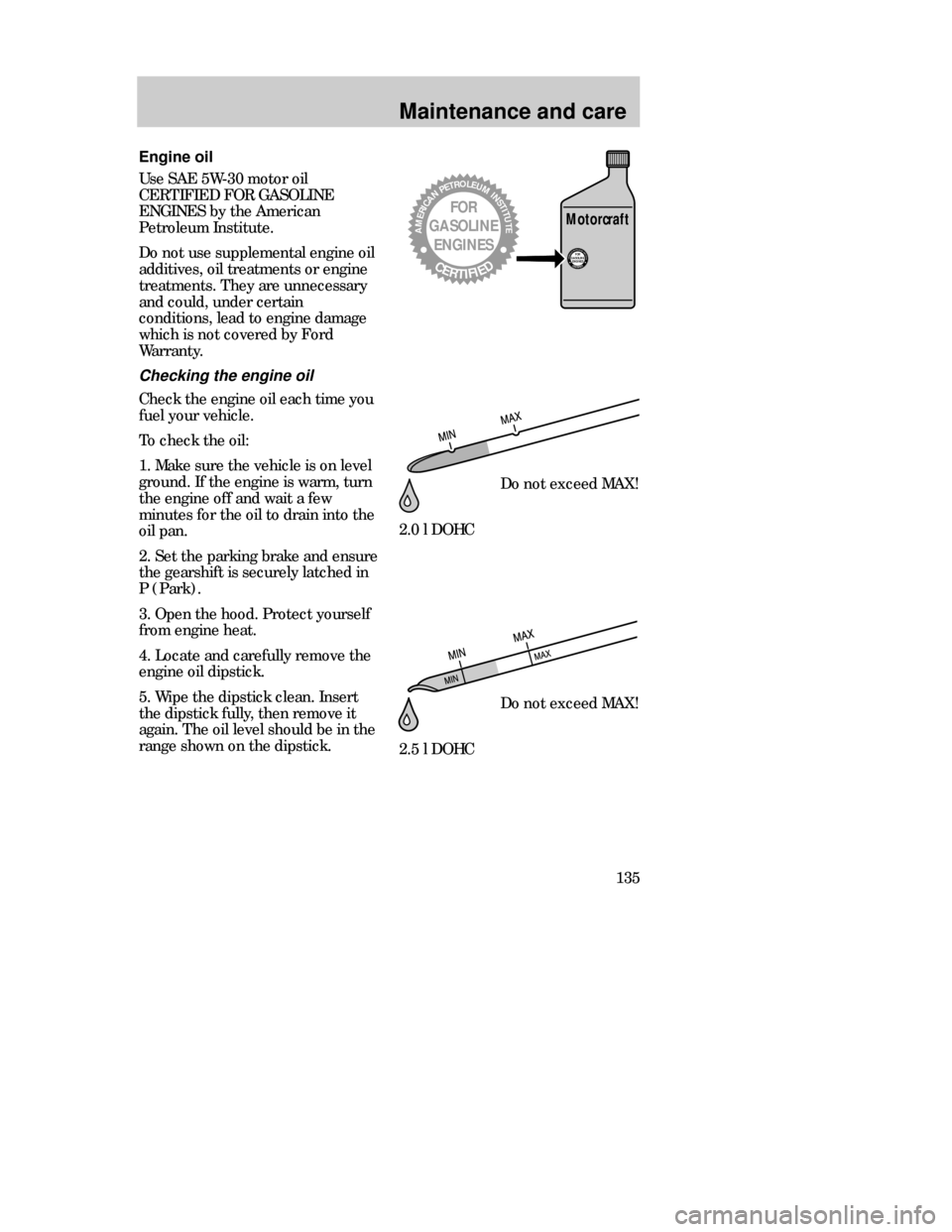
Engine oil
Use SAE 5W-30 motor oil
CERTIFIED FOR GASOLINE
ENGINES by the American
Petroleum Institute.
Do not use supplemental engine oil
additives, oil treatments or engine
treatments. They are unnecessary
and could, under certain
conditions, lead to engine damage
which is not covered by Ford
Warranty.
Checking the engine oil
Check the engine oil each time you
fuel your vehicle.
To check the oil:
1. Make sure the vehicle is on level
ground. If the engine is warm, turn
the engine off and wait a few
minutes for the oil to drain into the
oil pan.
2. Set the parking brake and ensure
the gearshift is securely latched in
P (Park).
3. Open the hood. Protect yourself
from engine heat.
4. Locate and carefully remove the
engine oil dipstick.
5. Wipe the dipstick clean. Insert
the dipstick fully, then remove it
again. The oil level should be in the
range shown on the dipstick.2.0 l DOHC
2.5 l DOHC
AMERICANPETROLEUMINSTITUTE
CERTIFIED
FOR
GASOLINE
ENGINES
AMERICANPETROLEUMINSTITUTECERTIFIEDFOR
GASOLINE
ENGINES
Motorcraft
Do not exceed MAX!
Do not exceed MAX!
CDW VA1-19Maint en C 5/15/97 8:56 PM Page 135
Page 145 of 200

Maintenance and care
145
Checking the automatic
transaxle fluid
With the vehicle on a level surface
and the brake fully applied, start
the engine and move the gearshift
lever through all of the gears.
Securely latch the lever in P
(Park). Set parking brake and leave
the engine running.
Wipe off the dipstick cap and pull
the dipstick out. Wipe indicator
clean. Put dipstick back into filler
tube and make sure it is fully
seated. Pull the dipstick out and
read the fluid level.
Note that your vehicle should not
be driven until some fluid has been
added if the fluid level is below the
bottom dimple on the dipstick and
the outside temperature is above
10°C (50°F). Add only enough fluid
to bring the level above the bottom
hole.
If the vehicle has not been driven
and the fluid level is above the
bottom dimple on the dipstick,
don’t add fluid. Recheck the level
after driving your vehicle
approximately 30 km (20 miles)
when the engine has reached
normal operating temperature. The
fluid level should be within the
crosshatched area on the dipstick.
CDW VA1-19Maint en C 5/15/97 8:56 PM Page 145


