1998 DODGE RAM 1500 Engine wiring
[x] Cancel search: Engine wiringPage 2094 of 2627

into the appropriate oil pump valve body bore (Fig.
102) (Fig. 103).
(4) Place the separator plate onto the oil pump
body (Fig. 101).
(5) Install the screws to hold the separator plate
onto the oil pump body (Fig. 101). Tighten the screws
to 4.5 N´m (40 in.lbs.).
(6) Position the oil pump cover onto the locating
dowels (Fig. 100).
(7) Seat the two oil pump halves together and
install all bolts finger tight.
(8) Torque all bolts down slowly starting in the
center and working outward. The correct torque is
4.5 N´m (40 in.lbs.).
(9) Verify that the oil pump gears rotate freely and
smoothly.
(10) Position the reaction shaft support into the oil
pump (Fig. 100).
(11) Install and torque the bolts to hold the reac-
tion shaft support to the oil pump (Fig. 100). The cor-
rect torque is 12 N´m (105 in.lbs.).
OIL PUMP FRONT SEAL
REMOVAL
(1) Remove transmission from the vehicle.
(2) Remove the torque converter from the trans-
mission.
(3) Using a screw mounted in a slide hammer,
remove the oil pump front seal.
INSTALLATION
(1) Clean seal bore of the oil pump of any residue
or particles from the original seal.
(2) Install new oil seal in the oil pump housing
using Seal Installer C-3860-A (Fig. 104).
OUTPUT SPEED SENSOR
DESCRIPTION
The Input and Output Speed Sensors are two-wire
magnetic pickup devices that generate AC signals as
rotation occurs. They are mounted in the left side of
the transmission case and are considered primary
inputs to the Transmission Control Module (TCM).
OPERATION
The Input Speed Sensor provides information on
how fast the input shaft is rotating. As the teeth of
the input clutch hub pass by the sensor coil, an AC
voltage is generated and sent to the TCM. The TCM
interprets this information as input shaft rpm.
The Output Speed Sensor generates an AC signal
in a similar fashion, though its coil is excited by rota-
tion of the rear planetary carrier lugs. The TCM
interprets this information as output shaft rpm.
The TCM compares the input and output speed
signals to determine the following:
²Transmission gear ratio
²Speed ratio error detection
²CVI calculation
The TCM also compares the input speed signal and
the engine speed signal to determine the following:
²Torque converter clutch slippage
²Torque converter element speed ratio
REMOVAL
(1) Raise vehicle.
(2) Place a suitable fluid catch pan under the
transmission.
(3) Remove the wiring connector from the output
speed sensor (Fig. 105).
(4) Remove the bolt holding the output speed sen-
sor to the transmission case.
(5) Remove the output speed sensor from the
transmission case.
Fig. 104 Install Oil Pump Front Seal
1 - TOOL C-3860-A
DRAUTOMATIC TRANSMISSION - 45RFE/545RFE 21 - 391
OIL PUMP (Continued)
Page 2494 of 2627
²Faulty A/C-heater control.
²Faulty related wiring harness or connectors.
²Improper engine coolant temperature.
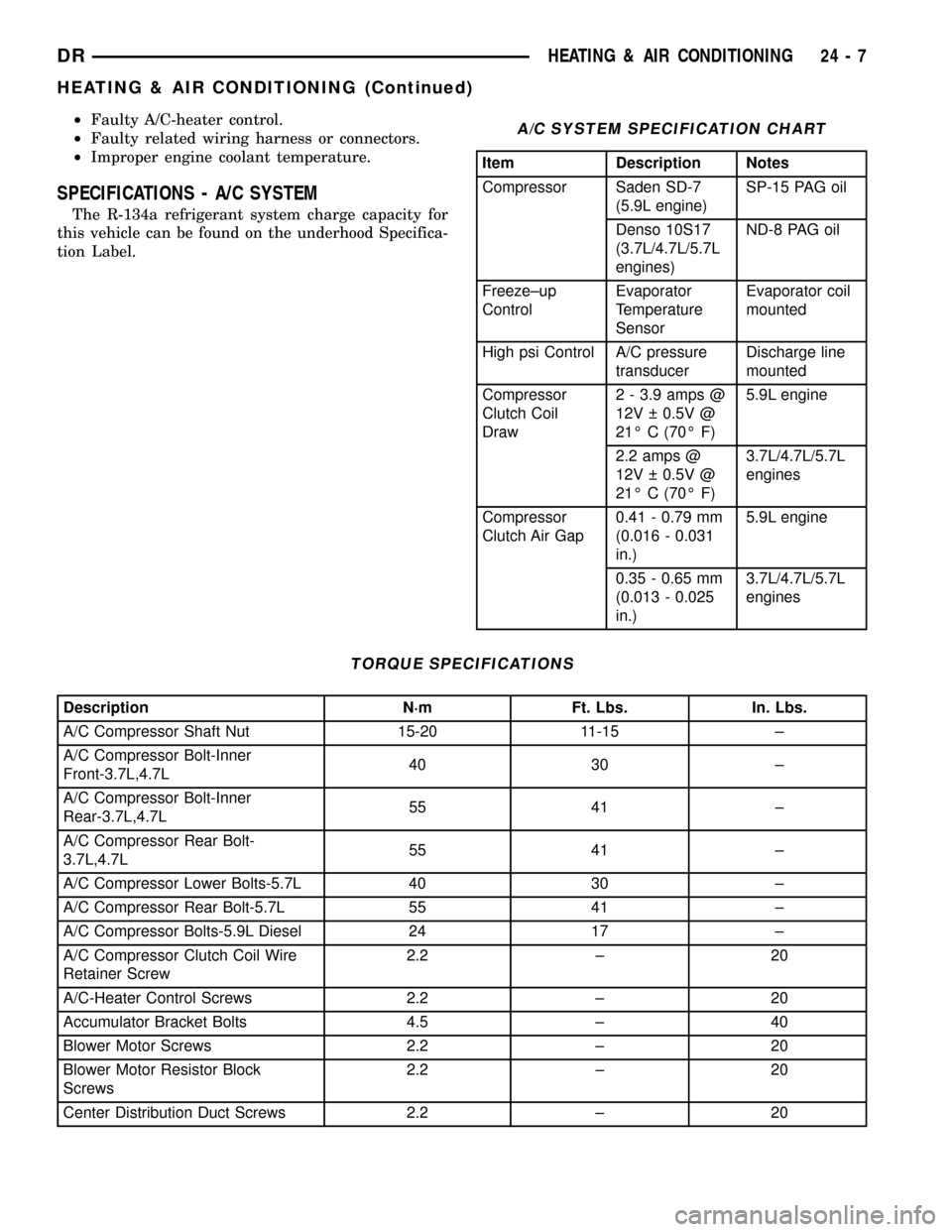
SPECIFICATIONS - A/C SYSTEM
The R-134a refrigerant system charge capacity for
this vehicle can be found on the underhood Specifica-
tion Label.
A/C SYSTEM SPECIFICATION CHART
Item Description Notes
Compressor Saden SD-7
(5.9L engine)SP-15 PAG oil
Denso 10S17
(3.7L/4.7L/5.7L
engines)ND-8 PAG oil
Freeze±up
ControlEvaporator
Temperature
SensorEvaporator coil
mounted
High psi Control A/C pressure
transducerDischarge line
mounted
Compressor
Clutch Coil
Draw2 - 3.9 amps @
12V 0.5V @
21É C (70É F)5.9L engine
2.2 amps @
12V 0.5V @
21É C (70É F)3.7L/4.7L/5.7L
engines
Compressor
Clutch Air Gap0.41 - 0.79 mm
(0.016 - 0.031
in.)5.9L engine
0.35 - 0.65 mm
(0.013 - 0.025
in.)3.7L/4.7L/5.7L
engines
TORQUE SPECIFICATIONS
Description N´m Ft. Lbs. In. Lbs.
A/C Compressor Shaft Nut 15-20 11-15 ±
A/C Compressor Bolt-Inner
Front-3.7L,4.7L40 30 ±
A/C Compressor Bolt-Inner
Rear-3.7L,4.7L55 41 ±
A/C Compressor Rear Bolt-
3.7L,4.7L55 41 ±
A/C Compressor Lower Bolts-5.7L 40 30 ±
A/C Compressor Rear Bolt-5.7L 55 41 ±
A/C Compressor Bolts-5.9L Diesel 24 17 ±
A/C Compressor Clutch Coil Wire
Retainer Screw2.2 ± 20
A/C-Heater Control Screws 2.2 ± 20
Accumulator Bracket Bolts 4.5 ± 40
Blower Motor Screws 2.2 ± 20
Blower Motor Resistor Block
Screws2.2 ± 20
Center Distribution Duct Screws 2.2 ± 20
DRHEATING & AIR CONDITIONING 24 - 7
HEATING & AIR CONDITIONING (Continued)
Page 2497 of 2627

and coil are the only serviced parts on the compres-
sor.
A/C compressor clutch engagement is controlled by
several components: the A/C-heater control, A/C pres-
sure transducer, A/C compressor clutch relay, evapo-
rator temperature sensor and the powertrain control
module (PCM). The PCM may delay compressor
clutch engagement for up to thirty seconds (Refer to
8 - ELECTRICAL/ELECTRONIC CONTROL MOD-
ULES/POWERTRAIN CONTROL MODULE -
DESCRIPTION).
DIAGNOSIS AND TESTING - A/C COMPRESSOR
CLUTCH COIL
For circuit descriptions and diagrams, (Refer to
Appropriate Wiring Information). The battery must
be fully-charged before performing the following
tests. Refer to Battery for more information.
(1) Connect an ammeter (0 to 10 ampere scale) in
series with the clutch coil terminal. Use a voltmeter
(0 to 20 volt scale) with clip-type leads for measuring
the voltage across the battery and the compressor
clutch coil.
(2) With the A/C-heater controls in any A/C mode,
and the blower motor switch in the lowest speed
position, start the engine and run it at normal idle.
(3) The compressor clutch coil voltage should read
within 0.2 volts of the battery voltage. If there is
voltage at the clutch coil, but the reading is not
within 0.2 volts of the battery voltage, test the clutch
coil feed circuit for excessive voltage drop and repair
as required. If there is no voltage reading at the
clutch coil, use a DRB IIItscan tool and (Refer to
Appropriate Diagnostic Information) for testing of thecompressor clutch circuit and PCM control. The fol-
lowing components must be checked and repaired as
required before you can complete testing of the clutch
coil:
²Fuses in the junction block and the power distri-
bution center (PDC)
²A/C-heater control
²A/C compressor clutch relay
²A/C pressure transducer
²Evaporator temperature sensor
²Powertrain control module (PCM)
(4) The compressor clutch coil is acceptable if the
current draw measured at the clutch coil is within
specifications with the electrical system voltage at
11.5 to 12.5 volts (Refer to 24 - HEATING & AIR
CONDITIONING - SPECIFICATIONS). This should
only be checked with the work area temperature at
21É C (70É F). If system voltage is more than 12.5
volts, add electrical loads by turning on electrical
accessories until the system voltage drops below 12.5
volts.
(a) If the clutch coil current reading is above
specifications, the coil is shorted and should be
replaced.
(b) If the clutch coil current reading is zero, the
coil is open and should be replaced.
STANDARD PROCEDURE - A/C COMPRESSOR
CLUTCH BREAK-IN
After a new compressor clutch has been installed,
cycle the compressor clutch approximately twenty
times (five seconds on, then five seconds off). During
this procedure, set the A/C-heater control to the
Recirculation Mode, the blower motor switch in the
highest speed position, and the engine speed at 1500
to 2000 rpm. This procedure (burnishing) will seat
the opposing friction surfaces and provide a higher
compressor clutch torque capability.
REMOVAL
The refrigerant system can remain fully-charged
during compressor clutch, rotor, or coil replacement.
The compressor clutch can be serviced in the vehicle.
(1) Disconnect and isolate the battery negative
cable.
(2) Remove the serpentine drive belt (Refer to 7 -
COOLING/ACCESSORY DRIVE/DRIVE BELTS -
REMOVAL).
(3) Disconnect the compressor clutch coil wire har-
ness connector.
(4) Remove the bolts that secure the compressor to
the mounting bracket.
(5) Remove the compressor from the mounting
bracket. Support the compressor in the engine com-
partment while servicing the clutch.
Fig. 1 Compressor Clutch - Typical
1 - CLUTCH PLATE
2 - SHAFT KEY (not used on KJ)
3 - ROTOR
4 - COIL
5 - CLUTCH SHIMS
6 - SNAP RING
7 - SNAP RING
24 - 10 CONTROLSDR
A/C COMPRESSOR CLUTCH/COIL (Continued)
Page 2523 of 2627

ING/CONTROLS/BLOWER MOTOR RESISTOR
BLOCK - INSTALLATION).
(5) If removed, install the blower motor (Refer to
24 - HEATING & AIR CONDITIONING/DISTRIBU-
TION/BLOWER MOTOR - INSTALLATION).
(6) Install the HVAC wire harness. Make sure the
wires are routed through all wiring retainers.
(7) Connect the wire harness to the blower motor,
blower motor resistor block, evaporator temperature
sensor and each actuator.
(8) Install the HVAC housing (Refer to 24 - HEAT-
ING & AIR CONDITIONING/DISTRIBUTION/HVAC
HOUSING - INSTALLATION).
INSTALLATION
WARNING: IF THE VEHICLE IS EQUIPPED WITH AIR
CONDITIONING, REVIEW THE WARNINGS AND
CAUTIONS IN PLUMBING BEFORE PERFORMING
THE FOLLOWING OPERATION. (Refer to 24 - HEAT-
ING & AIR CONDITIONING/PLUMBING - WARNING)
(Refer to 24 - HEATING & AIR CONDITIONING/
PLUMBING - CAUTION) (Refer to 24 - HEATING &
AIR CONDITIONING/PLUMBING - CAUTION -
REFRIGERANT HOSES/LINES/TUBES PRECAU-
TIONS)
(1) Position the HVAC housing into the vehicle. Be
certain that the evaporator condensate drain tube
and the housing mounting studs are inserted into
their correct locations.
(2) Install the two nuts that secure the HVAC
housing to the mounting studs in the passenger com-
partment. Tighten the nuts to 6.2 N´m (55 in. lbs.).
(3) Install the bolt that secures the HVAC housing
to the floor bracket in the passenger compartment.
Tighten the bolt to 6.2 N´m (55 in. lbs.).
(4) Install the instrument panel (Refer to 23 -
BODY/INSTRUMENT PANEL - INSTALLATION).
(5) Install the two nuts that secure the HVAC
housing to the mounting studs in the engine com-
partment. Tighten the nuts to 6.2 N´m (55 in. lbs.).
(6) Install the powertrain control module (PCM)
(Refer to 8 - ELECTRICAL/ELECTRONIC CON-
TROL MODULES/POWERTRAIN CONTROL MOD-
ULE - INSTALLATION).
(7) Unplug or remove the tape from the heater
core tubes and connect the heater hoses to the heater
core tubes.
(8) Unplug or remove the tape from the opened
refrigerant line fittings and the evaporator outlet
tube and install the accumulator (Refer to 24 -
HEATING & AIR CONDITIONING/PLUMBING/AC-
CUMULATOR - INSTALLATION).
(9) Unplug or remove the tape from the liquid line
and the evaporator inlet tube fittings. Connect the
liquid line coupler to the evaporator inlet tube (Referto 24 - HEATING & AIR CONDITIONING/PLUMB-
ING - STANDARD PROCEDURE - A/C LINE COU-
PLERS).
(10) Evacuate the refrigerant system (Refer to 24 -
HEATING & AIR CONDITIONING/PLUMBING -
STANDARD PROCEDURE - REFRIGERANT SYS-
TEM EVACUATE).
(11) Charge the refrigerant system (Refer to 24 -
HEATING & AIR CONDITIONING/PLUMBING -
STANDARD PROCEDURE - REFRIGERANT SYS-
TEM CHARGE).
(12) Fill the engine cooling system (Refer to 7 -
COOLING/ENGINE - STANDARD PROCEDURE).
(13) Connect the battery negative cable.
(14) Start the engine and check for proper opera-
tion of the heating and air conditioning systems.
INSTRUMENT PANEL
DEMISTER DUCTS
REMOVAL
WARNING: ON VEHICLES EQUIPPED WITH AIR-
BAGS, DISABLE THE AIRBAG SYSTEM BEFORE
ATTEMPTING ANY STEERING WHEEL, STEERING
COLUMN, OR INSTRUMENT PANEL COMPONENT
DIAGNOSIS OR SERVICE. DISCONNECT AND ISO-
LATE THE BATTERY NEGATIVE (GROUND) CABLE,
THEN WAIT TWO MINUTES FOR THE AIRBAG SYS-
TEM CAPACITOR TO DISCHARGE BEFORE PER-
FORMING FURTHER DIAGNOSIS OR SERVICE. THIS
IS THE ONLY SURE WAY TO DISABLE THE AIRBAG
SYSTEM. FAILURE TO TAKE THE PROPER PRE-
CAUTIONS COULD RESULT IN ACCIDENTAL AIR-
BAG DEPLOYMENT AND POSSIBLE PERSONAL
INJURY.
(1) Remove the defroster ducts (Refer to 24 -
HEATING & AIR CONDITIONING/DISTRIBUTION/
DEFROSTER DUCTS - REMOVAL).
(2) Remove the two screws that secure the center
distribution duct to the instrument panel support.
(3) Remove the center distribution duct from
instrument panel support, panel ducts and demister
ducts.
(4) Remove the right side panel duct adapter (Fig.
11).
(5) Remove the right side intermediate demister
duct.
(6) Remove the left side intermediate demister
duct.
(7) Remove the left side panel duct adapter.
(8) Remove the instrument panel cover (Refer to
23 - BODY/INSTRUMENT PANEL/INSTRUMENT
PANEL TOP COVER - REMOVAL).
24 - 36 DISTRIBUTIONDR
HVAC HOUSING (Continued)
Page 2535 of 2627

After the system has been tested for leaks and
evacuated, a refrigerant (R-134a) charge can be
injected into the system.
NOTE: When connecting the service equipment
coupling to the line fitting, verify that the valve of
the coupling is fully closed. This will reduce the
amount of effort required to make the connection.
(1) If using a separate vacuum pump close all
valves before disconnecting pump. Connect manifold
gauge set to the A/C service ports.
NOTE: Always refer to the underhood HVAC Speci-
fication label for the refrigerant fill level of the vehi-
cle being serviced.
(2) Measure refrigerant (refer to capacities). Refer
to the instructions provided with the equipment
being used.
(3) Verify engine is shut off. Open the suction and
discharge valves. Open the charge valve to allow the
refrigerant to flow into the system. When the trans-
fer of refrigerant has stopped, close the suction and
discharge valve.
(4) If all of the charge did not transfer from the
dispensing device, put vehicle controls into the fol-
lowing mode:
²Automatic transmission in park or manual
transmission in neutral
²Engine at idle
²A/C mode control set to outside air
²A/C mode control set to panel mode
²A/C temperature control set to full cool
²Blower motor control set on highest speed
²Vehicle windows closed
If the A/C compressor does not engage, test the
compressor clutch control circuit and correct any fail-
ure (Refer to 8 - ELECTRICAL/WIRING DIAGRAM
INFORMATION - DIAGNOSIS AND TESTING).
(5) Open the suction valve to allow the remaining
refrigerant to transfer to the system.
WARNING: TAKE CARE NOT TO OPEN THE DIS-
CHARGE (HIGH-PRESSURE) VALVE AT THIS TIME.
(6) Close all valves and test the A/C system perfor-
mance.
(7) Disconnect the charging station or manifold
gauge set. Install the service port caps.
REFRIGERANT CHARGE CAPACITY
The R-134a refrigerant system charge capacity for
this vehicle can be found on the underhood HVAC
specfication tag.
A/C COMPRESSOR
DESCRIPTION
DESCRIPTION - A/C COMPRESSOR
The A/C system on models equipped with the 5.9L
engine use a Sanden SD-7 reciprocating swash plate-
type compressor. This compressor has a fixed dis-
placement of 165 cubic centimeter (10.068 cubic
inches) and has both the suction and discharge ports
located on the cylinder head.
The A/C system on models equipped with the 3.7L,
4.7L and 5.7L engines use a Denso 10S17 reciprocat-
ing swash plate-type compressor. This compressor
has a fixed displacement of 170 cubic centimeter and
has both the suction and discharge ports located on
the cylinder head.
A label identifying the use of R-134a refrigerant is
located on both A/C compressors.
DESCRIPTION - HIGH PRESSURE RELIEF
VALVE
A high pressure relief valve is located on the com-
pressor cylinder head, which is on the rear of the
compressor. This mechanical valve is designed to
vent refrigerant from the system to protect against
damage to the compressor and other system compo-
nents, caused by condenser air flow restriction or an
overcharge of refrigerant.
OPERATION
OPERATION - A/C COMPRESSOR
The A/C compressor is driven by the engine
through an electric clutch, drive pulley and belt
arrangement. The compressor is lubricated by refrig-
erant oil that is circulated throughout the refrigerant
system with the refrigerant.
The compressor draws in low-pressure refrigerant
vapor from the evaporator through its suction port. It
then compresses the refrigerant into a high-pressure,
high-temperature refrigerant vapor, which is then
pumped to the condenser through the compressor dis-
charge port.
The compressor cannot be repaired. If faulty or
damaged, the entire compressor assembly must be
replaced. The compressor clutch, pulley and clutch
coil are available for service.
OPERATION - HIGH PRESSURE RELIEF VALVE
The high pressure relief valve vents the system
when a discharge pressure of 3445 to 4135 kPa (500
to 600 psi) or above is reached. The valve closes
24 - 48 PLUMBINGDR
PLUMBING (Continued)
Page 2562 of 2627

EMISSIONS CONTROL
TABLE OF CONTENTS
page page
EMISSIONS CONTROL
DESCRIPTION
DESCRIPTION - STATE DISPLAY TEST
MODE...............................1
DESCRIPTION - CIRCUIT ACTUATION TEST
MODE...............................1
DESCRIPTION - DIAGNOSTIC TROUBLE
CODES..............................1
DESCRIPTION - TASK MANAGER..........1DESCRIPTION - MONITORED SYSTEMS....2
DESCRIPTION - TRIP DEFINITION.........4
DESCRIPTION - COMPONENT MONITORS . . 4
OPERATION
OPERATION..........................5
OPERATION - TASK MANAGER...........5
OPERATION - NON-MONITORED CIRCUITS . . 8
EVAPORATIVE EMISSIONS................10
EMISSIONS CONTROL
DESCRIPTION
DESCRIPTION - STATE DISPLAY TEST MODE
The switch inputs to the Powertrain Control Mod-
ule (PCM) have two recognized states; HIGH and
LOW. For this reason, the PCM cannot recognize the
difference between a selected switch position versus
an open circuit, a short circuit, or a defective switch.
If the State Display screen shows the change from
HIGH to LOW or LOW to HIGH, assume the entire
switch circuit to the PCM functions properly. Connect
the DRB scan tool to the data link connector and
access the state display screen. Then access either
State Display Inputs and Outputs or State Display
Sensors.
DESCRIPTION - CIRCUIT ACTUATION TEST
MODE
The Circuit Actuation Test Mode checks for proper
operation of output circuits or devices the Powertrain
Control Module (PCM) may not internally recognize.
The PCM attempts to activate these outputs and
allow an observer to verify proper operation. Most of
the tests provide an audible or visual indication of
device operation (click of relay contacts, fuel spray,
etc.). Except for intermittent conditions, if a device
functions properly during testing, assume the device,
its associated wiring, and driver circuit work cor-
rectly. Connect the DRB scan tool to the data link
connector and access the Actuators screen.
DESCRIPTION - DIAGNOSTIC TROUBLE CODES
A Diagnostic Trouble Code (DTC) indicates the
PCM has recognized an abnormal condition in the
system.Remember that DTC's are the results of a sys-
tem or circuit failure, but do not directly iden-
tify the failed component or components.
BULB CHECK
Each time the ignition key is turned to the ON
position, the malfunction indicator (check engine)
lamp on the instrument panel should illuminate for
approximately 2 seconds then go out. This is done for
a bulb check.
OBTAINING DTC'S USING DRB SCAN TOOL
(1) Obtain the applicable Powertrain Diagnostic
Manual.
(2) Obtain the DRB Scan Tool.
(3) Connect the DRB Scan Tool to the data link
(diagnostic) connector. This connector is located in
the passenger compartment; at the lower edge of
instrument panel; near the steering column.
(4) Turn the ignition switch on and access the
ªRead Faultº screen.
(5) Record all the DTC's and ªfreeze frameº infor-
mation shown on the DRB scan tool.
(6) To erase DTC's, use the ªErase Trouble Codeº
data screen on the DRB scan tool.Do not erase any
DTC's until problems have been investigated
and repairs have been performed.
DESCRIPTION - TASK MANAGER
The PCM is responsible for efficiently coordinating
the operation of all the emissions-related compo-
nents. The PCM is also responsible for determining if
the diagnostic systems are operating properly. The
software designed to carry out these responsibilities
is call the 'Task Manager'.
DREMISSIONS CONTROL 25 - 1
Page 2573 of 2627

CCV HOSE
DESCRIPTION - 8.0L V-10
The 8.0L V-10 engine is equipped with a Crankcase
Ventilation (CCV) system. The CCV system performs
the same function as a conventional PCV system, but
does not use a vacuum controlled valve (PCV valve).
A molded vacuum tube connects manifold vacuum
to the top of the right cylinder head (valve) cover.
The vacuum tube connects to a fixed orifice fitting
(Fig. 2) of a calibrated size 2.6 mm (0.10 inches).
OPERATION - 8.0L V-10
A molded vacuum tube connects manifold vacuum
to the top of the right cylinder head (valve) cover.
The vacuum tube connects to a fixed orifice fitting
(Fig. 2) of a calibrated size 2.6 mm (0.10 inches). The
fitting meters the amount of crankcase vapors drawn
out of the engine.The fixed orifice fitting is grey
in color.A similar fitting (but does not contain a
fixed orifice) is used on the left cylinder head (valve)
cover. This fitting is black in color. Do not inter-
change these two fittings.
When the engine is operating, fresh air enters the
engine and mixes with crankcase vapors. Manifold
vacuum draws the vapor/air mixture through the
fixed orifice and into the intake manifold. The vapors
are then consumed during engine combustion.
EVAP/PURGE SOLENOID
DESCRIPTION
The duty cycle EVAP canister purge solenoid is
located in the engine compartment. It is attached to
the side of the Power Distribution Center (PDC).
OPERATION
The Powertrain Control Module (PCM) operates
the solenoid.
During the cold start warm-up period and the hot
start time delay, the PCM does not energize the sole-
noid. When de-energized, no vapors are purged. The
PCM de-energizes the solenoid during open loop oper-
ation.
The engine enters closed loop operation after it
reaches a specified temperature and the time delay
ends. During closed loop operation, the PCM ener-
gizes and de-energizes the solenoid 5 or 10 times per
second, depending upon operating conditions. The
PCM varies the vapor flow rate by changing solenoid
pulse width. Pulse width is the amount of time the
solenoid energizes. The PCM adjusts solenoid pulse
width based on engine operating condition.
REMOVAL
The duty cycle EVAP canister purge solenoid is
located in the engine compartment. It is attached to
the side of the Power Distribution Center (PDC) (Fig.
3).
(1) Disconnect electrical wiring connector at sole-
noid.
(2) Disconnect vacuum harness at solenoid (Fig. 3).
(3) Remove solenoid from mounting bracket.
INSTALLATION
(1) Install solenoid assembly to mounting bracket.
(2) Connect vacuum harness.
(3) Connect electrical connector.
Fig. 2 FIXED ORIFICE FITTING - 8.0L V-10 ENGINE -
TYPICAL
1 - VACUUM TUBE
2 - FIXED ORIFICE FITTING
3 - COIL PACKS
4 - ORIFICE FITTING HOSE CONNECTIONS
25 - 12 EVAPORATIVE EMISSIONSDR
Page 2597 of 2627

DEPLOYMENT - STANDARD
PROCEDURE, SERVICE AFTER A
SUPPLEMENTAL RESTRAINT............8O-7
DETECTION ASSY - DESCRIPTION,
NATURAL VAC LEAK..................25-23
DETECTION ASSY - INSTALLATION,
NATURAL VAC LEAK..................25-25
DETECTION ASSY - OPERATION,
NATURAL VAC LEAK..................25-23
DETECTION ASSY - REMOVAL, NATURAL
VAC LEAK..........................25-24
DETECTION PUMP - DESCRIPTION, LEAK . 25-13
DETECTION PUMP - INSTALLATION,
LEAK..............................25-16
DETECTION PUMP - OPERATION, LEAK . . . 25-14
DETECTION PUMP - REMOVAL, LEAK....25-16
DEVICES - STANDARD PROCEDURE,
ELECTROSTATIC DISCHARGE (ESD)
SENSITIVE........................8W-01-8
DIAGNOSTIC TROUBLE CODES -
DESCRIPTION........................25-1
DIAGNOSTICS (OBD) - DIAGNOSIS AND
TESTING, ON-BOARD...................7-5
DIAGRAMS - DESCRIPTION, HOW TO
USE WIRING......................8W-01-1
DIAGRAMS - HYDRAULIC SCHEMATICS,
SCHEMATICS.................21-176,21-337
DIESEL - CLEANING, RADIATOR - 5.9L....7-56
DIESEL - CLEANING, RADIATOR FAN -
5.9L................................7-35
DIESEL - CLEANING, WATER PUMP -
5.9L................................7-62
DIESEL - DESCRIPTION.................14-62
DIESEL - DESCRIPTION, 5.9L............11-3
DIESEL - DESCRIPTION, BELT
TENSIONER - 5.9L.....................7-23
DIESEL - DESCRIPTION, COOLING
SYSTEM FLOW - 5.9L...................7-3
DIESEL - DESCRIPTION, ENGINE 5.9L....9-232
DIESEL - DESCRIPTION, ENGINE BLOCK
HEATER - 5.9L........................7-37
DIESEL - DESCRIPTION, ENGINE
COOLANT THERMOSTAT - 5.9L...........7-46
DIESEL - DESCRIPTION, FAN DRIVE
VISCOUS CLUTCH - 5.9L...............7-52
DIESEL - DESCRIPTION, RADIATOR -
5.9L................................7-56
DIESEL - DESCRIPTION, TRANS COOLER
- 5.9L..............................7-68
DIESEL - DESCRIPTION, WATER PUMP -
5.9L................................7-62
DIESEL - FUEL INJECTOR FIRING ORDER . 14-48
DIESEL - INSPECTION, RADIATOR - 5.9L . . . 7-56
DIESEL - INSPECTION, RADIATOR FAN -
5.9L................................7-35
DIESEL - INSPECTION, TAILPIPE - 5.9L . . . 11-10
DIESEL - INSPECTION, WATER PUMP -
5.9L................................7-62
DIESEL - INSTALLATION................11-8
DIESEL - INSTALLATION...............14-62
DIESEL - INSTALLATION.....19-26,19-31,19-42
DIESEL - INSTALLATION, BELT
TENSIONER - 5.9L.....................7-24
DIESEL - INSTALLATION, DRIVE BELT -
5.9L
................................7-29
DIESEL - INSTALLATION, ENGINE BLOCK
HEATER - 5.9L
........................7-38
DIESEL - INSTALLATION, ENGINE
COOLANT THERMOSTAT - 5.9L
...........7-47
DIESEL - INSTALLATION, EXCEPT
........14-19
DIESEL - INSTALLATION, MUFFLER -
5.9L
...............................11-10
DIESEL - INSTALLATION, RADIATOR -
5.9L
................................7-57
DIESEL - INSTALLATION, RADIATOR FAN
- 5.9L
..............................7-36
DIESEL - INSTALLATION, TAILPIPE - 5.9L
. 11-11
DIESEL - INSTALLATION, WATER PUMP -
5.9L
................................7-62
DIESEL - MAINTENANCE SCHEDULES,
24-VALVE CUMMINS TURBO
.............0-12
DIESEL - OPERATION, BELT TENSIONER
- 5.9L
..............................7-23
DIESEL - OPERATION, ENGINE BLOCK
HEATER - 5.9L
........................7-38
DIESEL - OPERATION, ENGINE COOLANT
THERMOSTAT - 5.9L
...................7-46DIESEL - OPERATION, FAN DRIVE
VISCOUS CLUTCH - 5.9L...............7-52
DIESEL - OPERATION, RADIATOR - 5.9L . . . 7-56
DIESEL - OPERATION, TRANS COOLER -
5.9L................................7-69
DIESEL - OPERATION, WATER PUMP -
5.9L................................7-62
DIESEL - REMOVAL....................11-7
DIESEL - REMOVAL...................14-62
DIESEL - REMOVAL.........19-25,19-30,19-41
DIESEL - REMOVAL, BELT TENSIONER -
5.9L................................7-23
DIESEL - REMOVAL, DRIVE BELT - 5.9L....7-29
DIESEL - REMOVAL, ENGINE BLOCK
HEATER - 5.9L........................7-38
DIESEL - REMOVAL, ENGINE COOLANT
THERMOSTAT - 5.9L...................7-47
DIESEL - REMOVAL, EXCEPT...........14-17
DIESEL - REMOVAL, MUFFLER - 5.9L.....11-10
DIESEL - REMOVAL, RADIATOR - 5.9L.....7-56
DIESEL - REMOVAL, RADIATOR FAN -
5.9L................................7-35
DIESEL - REMOVAL, TAILPIPE - 5.9L.....11-10
DIESEL - REMOVAL, WATER PUMP -
5.9L................................7-62
DIESEL - SPECIFICATIONS, 5.9L.........9-244
DIESEL - TORQUE, FUEL SYSTEM -
EXCEPT.............................14-3
DIESEL ENGINE - DESCRIPTION, FUEL
REQUIREMENTS.......................0-1
DIESEL ENGINE - DIAGNOSIS AND
TESTING............................11-5
DIESEL ENGINE - DIAGNOSIS AND
TESTING, COOLING SYSTEM.............7-7
DIESEL ENGINE - INSTALLATION........8R-17
DIESEL ENGINE - INSTALLATION, 5.9L . . . 24-54,
24-58,24-72
DIESEL ENGINE - INSTALLATION,
EXCEPT............................8R-17
DIESEL ENGINE - REMOVAL............8R-16
DIESEL ENGINE - REMOVAL, 5.9L . . 24-53,24-56,
24-70
DIESEL ENGINE - REMOVAL, EXCEPT....8R-15
DIESEL ENGINE - STANDARD
PROCEDURE, DRAINING COOLING
SYSTEM 5.9L........................7-18
DIESEL ENGINE - STANDARD
PROCEDURE, REFILLING COOLING
SYSTEM 5.9L........................7-19
DIESEL ENGINE - TORQUE, FUEL
SYSTEM............................14-48
DIESEL ENGINE, SPECIAL TOOLS - 5.9L . . 9-246
DIESEL ENGINES - DESCRIPTION,
ENGINE OIL...........................0-2
DIESEL FUEL SYSTEM - DESCRIPTION . . . 14-45
DIESEL FUEL SYSTEM, SPECIAL TOOLS . . 14-49
DIESEL ONLY - ASSEMBLY, 5.9L..........7-70
DIESEL ONLY - DISASSEMBLY, 5.9L.......7-70
DIFFERENTIAL - ASSEMBLY . . . 3-129,3-156,3-47,
3-73,3-99
DIFFERENTIAL - DISASSEMBLY....3-128,3-155,
3-47,3-72,3-98
DIFFERENTIAL - INSTALLATION....3-130,3-157,
3-48,3-74,3-99
DIFFERENTIAL - REMOVAL
. . . 3-127,3-155,3-46,
3-72,3-97
DIFFERENTIAL CASE BEARINGS -
INSTALLATION
....3-106,3-134,3-161,3-48,3-75
DIFFERENTIAL CASE BEARINGS -
REMOVAL
........3-105,3-134,3-161,3-48,3-75
DIFFERENTIAL COVER - INSTALLATION
....3-97
DIFFERENTIAL COVER - REMOVAL
........3-97
DIFFERENTIAL TRAC-RITE - ASSEMBLY
. . 3-133,
3-161
DIFFERENTIAL TRAC-RITE - CLEANING
. . . 3-132,
3-160
DIFFERENTIAL TRAC-RITE -
DESCRIPTION
..................3-131,3-158
DIFFERENTIAL TRAC-RITE -
DISASSEMBLY
..................3-131,3-158
DIFFERENTIAL TRAC-RITE - INSPECTION
. 3-132,
3-160
DIFFERENTIAL TRAC-RITE - OPERATION
. . 3-131,
3-158
DIFFERENTIAL-TRAC-LOK - ASSEMBLY
. . . 3-103
DIFFERENTIAL-TRAC-LOK -
DESCRIPTION
.......................3-100DIFFERENTIAL-TRAC-LOK - DIAGNOSIS
AND TESTING.......................3-100
DIFFERENTIAL-TRAC-LOK -
DISASSEMBLY.......................3-101
DIFFERENTIAL-TRAC-LOK - OPERATION . . . 3-100
DIMENSIONS - SPECIFICATIONS, BODY
OPENING...........................23-99
DIMENSIONS - SPECIFICATIONS, FRAME . . 13-16
DIODE - INSTALLATION............8W-01-14
DIODE - REMOVAL................8W-01-14
DIODE REPLACEMENT - STANDARD
PROCEDURE........................24-45
DISC - INSTALLATION, CLUTCH...........6-5
DISC - REMOVAL, CLUTCH...............6-5
DISC BRAKE CALIPER ADAPTER MOUNT
- INSTALLATION......................5-22
DISC BRAKE CALIPERS - DESCRIPTION....5-16
DISC BRAKE CALIPERS - OPERATION.....5-16
DISC BRAKE ROTOR, DIAGNOSIS AND
TESTING............................5-32
DISCHARGE (ESD) SENSITIVE DEVICES -
STANDARD PROCEDURE,
ELECTROSTATIC...................8W-01-8
DISCHARGE LINE - DESCRIPTION, A/C....24-56
DISPLAY TEST MODE - DESCRIPTION,
STATE ..............................25-1
DISTRIBUTION - DESCRIPTION, POWER . 8W-97-1
DISTRIBUTION - OPERATION, POWER . . 8W-97-1
DISTRIBUTION DUCT - INSTALLATION,
FLOOR.............................24-34
DISTRIBUTION DUCT - REMOVAL,
FLOOR.............................24-33
DISTRIBUTION SYSTEMS, SPECIAL
TOOLS - POWER...................8W-97-2
DOME LAMP - DESCRIPTION...........8L-26
DOME LAMP - INSTALLATION..........8L-26
DOME LAMP - OPERATION.............8L-26
DOME LAMP - REMOVAL..............8L-26
DOOR - INSTALLATION...........23-18,23-28
DOOR - INSTALLATION, BLEND.........24-27
DOOR - INSTALLATION, DEFROST.......24-31
DOOR - INSTALLATION, FUEL FILL.......23-39
DOOR - INSTALLATION, MODE..........24-38
DOOR - INSTALLATION, RECIRCULATION . . 24-40
DOOR - REMOVAL...............23-18,23-28
DOOR - REMOVAL, BLEND.............24-27
DOOR - REMOVAL, DEFROST...........24-31
DOOR - REMOVAL, FUEL FILL..........23-39
DOOR - REMOVAL, MODE..............24-38
DOOR - REMOVAL, RECIRCULATION.....24-39
DOOR ACTUATOR - DESCRIPTION,
BLEND.............................24-17
DOOR ACTUATOR - DESCRIPTION,
DEFROST...........................24-20
DOOR ACTUATOR - DESCRIPTION,
MODE.............................24-23
DOOR ACTUATOR - DESCRIPTION,
RECIRCULATION.....................24-24
DOOR ACTUATOR - INSTALLATION,
BLEND.............................24-18
DOOR ACTUATOR - INSTALLATION,
DEFROST...........................24-21
DOOR ACTUATOR - INSTALLATION,
MODE.............................24-23
DOOR ACTUATOR - INSTALLATION,
RECIRCULATION.....................24-25
DOOR ACTUATOR - OPERATION, BLEND . . 24-17
DOOR ACTUATOR - OPERATION,
DEFROST...........................24-21
DOOR ACTUATOR - OPERATION, MODE . . . 24-23
DOOR ACTUATOR - OPERATION,
RECIRCULATION
.....................24-24
DOOR ACTUATOR - REMOVAL, BLEND
....24-17
DOOR ACTUATOR - REMOVAL, DEFROST
. . 24-21
DOOR ACTUATOR - REMOVAL, MODE
....24-23
DOOR ACTUATOR - REMOVAL,
RECIRCULATION
.....................24-24
DOOR AJAR INDICATOR - DESCRIPTION
. . 8J-23
DOOR AJAR INDICATOR - OPERATION
....8J-23
DOOR AJAR SWITCH - DESCRIPTION
....8L-27
DOOR AJAR SWITCH - OPERATION
......8L-27
DOOR GLASS - INSTALLATION
.....23-20,23-30
DOOR GLASS - REMOVAL
........23-20,23-30
DOOR GLASS RUN WEATHERSTRIP -
INSTALLATION, FRONT
................23-92
DOOR GLASS RUN WEATHERSTRIP -
INSTALLATION, REAR
.................23-93
10 INDEXDR
Description Group-Page Description Group-Page Description Group-Page