1998 DODGE RAM 1500 coolant level
[x] Cancel search: coolant levelPage 1905 of 2627

(2) Heavy duty operation with a vehicle not prop-
erly equipped for this type of operation. Trailer tow-
ing or similar high load operation will overheat the
transmission fluid if the vehicle is improperly
equipped. Such vehicles should have an auxiliary
transmission fluid cooler, a heavy duty cooling sys-
tem, and the engine/axle ratio combination needed to
handle heavy loads.
DIAGNOSIS AND TESTING - FLUID
CONTAMINATION
Transmission fluid contamination is generally a
result of:
²adding incorrect fluid
²failure to clean dipstick and fill tube when
checking level
²engine coolant entering the fluid
²internal failure that generates debris
²overheat that generates sludge (fluid break-
down)
²failure to replace contaminated converter after
repair
The use of non-recommended fluids can result in
transmission failure. The usual results are erratic
shifts, slippage, abnormal wear and eventual failure
due to fluid breakdown and sludge formation. Avoid
this condition by using recommended fluids only.
The dipstick cap and fill tube should be wiped
clean before checking fluid level. Dirt, grease and
other foreign material on the cap and tube could fall
into the tube if not removed beforehand. Take the
time to wipe the cap and tube clean before withdraw-
ing the dipstick.
Engine coolant in the transmission fluid is gener-
ally caused by a cooler malfunction. The only remedy
is to replace the radiator as the cooler in the radiator
is not a serviceable part. If coolant has circulated
through the transmission, an overhaul is necessary.
The torque converter should also be replaced when-
ever a failure generates sludge and debris. This is
necessary because normal converter flushing proce-
dures will not remove all contaminants.
STANDARD PROCEDURE
STANDARD PROCEDURE - FLUID LEVEL
CHECK
Low fluid level can cause a variety of conditions
because it allows the pump to take in air along with
the fluid. As in any hydraulic system, air bubbles
make the fluid spongy, therefore, pressures will be
low and build up slowly.
Improper filling can also raise the fluid level too
high. When the transmssion has too much fluid, thegeartrain churns up foam and cause the same condi-
tions which occur with a low fluid level.
In either case, air bubbles can cause overheating
and/or fluid oxidation, and varnishing. This can
interfere with normal valve, clutch, and accumulator
operation. Foaming can also result in fluid escaping
from the transmission vent where it may be mis-
taken for a leak.
After the fluid has been checked, seat the dipstick
fully to seal out water and dirt.
The transmission has a dipstick to check oil level.
It is located on the right side of the engine. Be sure
to wipe all dirt from dipstick handle before removing.
Fluid level is checked with the engine running at
curb idle speed, the transmission in NEUTRAL and
the transmission fluid at normal operating tempera-
ture.The engine should be running at idle
speed for at least one minute, with the vehicle
on level ground.
The transmission fluid level can be checked two
ways.
PROCEDURE ONE
(1) Transmission fluid must be at normal operat-
ing temperature for accurate fluid level check. Drive
vehicle if necessary to bring fluid temperature up to
normal hot operating temperature of 82ÉC (180ÉF).
(2) Position vehicle on level surface.
(3) Start and run engine at curb idle speed.
(4) Apply parking brakes.
(5) Shift transmission momentarily into all gear
ranges. Then shift transmission back to NEUTRAL.
(6) Clean top of filler tube and dipstick to keep
dirt from entering tube.
(7) Remove dipstick (Fig. 87) and check fluid level
as follows:
(a) Correct acceptable level is in crosshatch area.
(b) Correct maximum level is to MAX arrow
mark.
(c) Incorrect level is at or below MIN line.
(d) If fluid is low, add only enough MopartAT F
+4 to restore correct level. Do not overfill.
Fig. 87 Dipstick Fluid Level Marks - Typical
1 - DIPSTICK
2 - MAXIMUM CORRECT FLUID LEVEL
3 - ACCEPTABLE FLUID LEVEL
21 - 202 AUTOMATIC TRANSMISSION - 48REDR
FLUID AND FILTER (Continued)
Page 2069 of 2627

FLUID AND FILTER
DIAGNOSIS AND TESTING
DIAGNOSIS AND TESTING - EFFECTS OF
INCORRECT FLUID LEVEL
A low fluid level allows the pump to take in air
along with the fluid. Air in the fluid will cause fluid
pressures to be low and develop slower than normal.
If the transmission is overfilled, the gears churn the
fluid into foam. This aerates the fluid and causing
the same conditions occurring with a low level. In
either case, air bubbles cause fluid overheating, oxi-
dation and varnish buildup which interferes with
valve and clutch operation. Foaming also causes fluid
expansion which can result in fluid overflow from the
transmission vent or fill tube. Fluid overflow can eas-
ily be mistaken for a leak if inspection is not careful.
DIAGNOSIS AND TESTING - CAUSES OF
BURNT FLUID
Burnt, discolored fluid is a result of overheating
which has three primary causes.
(1) Internal clutch slippage, usually caused by low
line pressure, inadequate clutch apply pressure, or
clutch seal failure.
(2) A result of restricted fluid flow through the
main and/or auxiliary cooler. This condition is usu-
ally the result of a faulty or improperly installed
drainback valve, a damaged main cooler, or severe
restrictions in the coolers and lines caused by debris
or kinked lines.
(3) Heavy duty operation with a vehicle not prop-
erly equipped for this type of operation. Trailer tow-
ing or similar high load operation will overheat the
transmission fluid if the vehicle is improperly
equipped. Such vehicles should have an auxiliary
transmission fluid cooler, a heavy duty cooling sys-
tem, and the engine/axle ratio combination needed to
handle heavy loads.
DIAGNOSIS AND TESTING - FLUID
CONTAMINATION
Transmission fluid contamination is generally a
result of:
²adding incorrect fluid
²failure to clean dipstick and fill tube when
checking level
²engine coolant entering the fluid
²internal failure that generates debris
²overheat that generates sludge (fluid break-
down)
²failure to replace contaminated converter after
repairThe use of non-recommended fluids can result in
transmission failure. The usual results are erratic
shifts, slippage, abnormal wear and eventual failure
due to fluid breakdown and sludge formation. Avoid
this condition by using recommended fluids only.
The dipstick cap and fill tube should be wiped
clean before checking fluid level. Dirt, grease and
other foreign material on the cap and tube could fall
into the tube if not removed beforehand. Take the
time to wipe the cap and tube clean before withdraw-
ing the dipstick.
Engine coolant in the transmission fluid is gener-
ally caused by a cooler malfunction. The only remedy
is to replace the radiator as the cooler in the radiator
is not a serviceable part. If coolant has circulated
through the transmission, an overhaul is necessary.
The torque converter should also be replaced when-
ever a failure generates sludge and debris. This is
necessary because normal converter flushing proce-
dures will not remove all contaminants.
STANDARD PROCEDURE
STANDARD PROCEDURE - FLUID LEVEL
CHECK
Low fluid level can cause a variety of conditions
because it allows the pump to take in air along with
the fluid. As in any hydraulic system, air bubbles
make the fluid spongy, therefore, pressures will be
low and build up slowly.
Improper filling can also raise the fluid level too
high. When the transmssion has too much fluid, the
geartrain churns up foam and cause the same condi-
tions which occur with a low fluid level.
In either case, air bubbles can cause overheating
and/or fluid oxidation, and varnishing. This can
interfere with normal valve, clutch, and accumulator
operation. Foaming can also result in fluid escaping
from the transmission vent where it may be mis-
taken for a leak.
After the fluid has been checked, seat the dipstick
fully to seal out water and dirt.
The transmission has a dipstick to check oil level.
It is located on the right side of the engine. Be sure
to wipe all dirt from dipstick handle before removing.
The torque converter fills in both the P (PARK)
and N (NEUTRAL) positions. Place the selector lever
in P (PARK) to be sure that the fluid level check is
accurate.The engine should be running at idle
speed for at least one minute, with the vehicle
on level ground.At normal operating temperature
(approximately 82 C. or 180 F.), the fluid level is cor-
rect if it is in the HOT region (cross-hatched area) on
the oil level indicator. The fluid level will be approx-
21 - 366 AUTOMATIC TRANSMISSION - 45RFE/545RFEDR
Page 2488 of 2627

HEATING & AIR CONDITIONING
TABLE OF CONTENTS
page page
HEATING & AIR CONDITIONING
DESCRIPTION
DESCRIPTION - ENGINE COOLING
SYSTEM REQUIREMENTS...............1
DESCRIPTION - HEATER AND AIR
CONDITIONER........................1
OPERATION - HEATER AND AIR
CONDITIONER........................1
DIAGNOSIS AND TESTING
DIAGNOSIS AND TESTING - A/C
PERFORMANCE.......................3DIAGNOSIS AND TESTING - HEATER
PERFORMANCE TEST..................6
SPECIFICATIONS - A/C SYSTEM............7
CONTROLS.............................9
DISTRIBUTION..........................26
PLUMBING.............................41
HEATING & AIR
CONDITIONING
DESCRIPTION
DESCRIPTION - ENGINE COOLING SYSTEM
REQUIREMENTS
To maintain the performance level of the heating,
ventilation and air conditioning (HVAC) system, the
engine cooling system must be properly maintained.
The use of a bug screen is not recommended. Any
obstructions in front of the radiator or A/C condenser
will reduce the performance of the A/C and engine
cooling systems.
The engine cooling system includes the radiator,
thermostat, radiator hoses and the engine coolant
pump. Refer to Cooling for more information before
opening or attempting any service to the engine cool-
ing system.
DESCRIPTION - HEATER AND AIR
CONDITIONER
A manually controlled single zone type heating-air
conditioning system or a manually controlled dual
zone type heating-air conditioning system is available
on this model.
All vehicles are equipped with a common heater,
ventilation and air conditioning (HVAC) housing (Fig.
1). The system combines air conditioning, heating,
and ventilating capabilities in a single unit housing
mounted within the passenger compartment under
the instrument panel. The HVAC housing includes:
²Blower motor
²Blower motor resistor block²Heater core
²Evaporator coil
²Blend door and actuator
²Defrost door and actuator
²Mode door and actuator
²Recirculation door and actuator
Based upon the system and mode selected, condi-
tioned air can exit the HVAC housing through one or
a combination of the three main housing outlets:
defrost, panel or floor. The defrost outlet is located on
the top of the housing, the panel outlet is located on
the face of the housing and the floor outlet is located
on the bottom of the housing. Once the conditioned
air exits the unit housing, it is further directed
through molded plastic ducts to the various outlets in
the vehicle interior. These outlets and their locations
are as follows:
²Defroster Outlet- A single large defroster out-
let is located in the center of the instrument panel
top cover, near the base of the windshield.
²Side Window Demister Outlets- There are
two side window demister outlets, one is located at
each outboard end of the instrument panel top cover,
near the belt line at the A-pillars.
²Panel Outlets- There are four panel outlets in
the instrument panel, one located near each outboard
end of the instrument panel facing the rear of the
vehicle and two located near the top of the instru-
ment panel center bezel.
²Front Floor Outlets- There are two front floor
outlets, one located above each side of the floor panel
center tunnel near the dash panel.
OPERATION - HEATER AND AIR CONDITIONER
The heating and air conditioning systems pulls
outside (ambient) air through the cowl opening at the
base of the windshield, then into the plenum cham-
DRHEATING & AIR CONDITIONING 24 - 1
Page 2493 of 2627
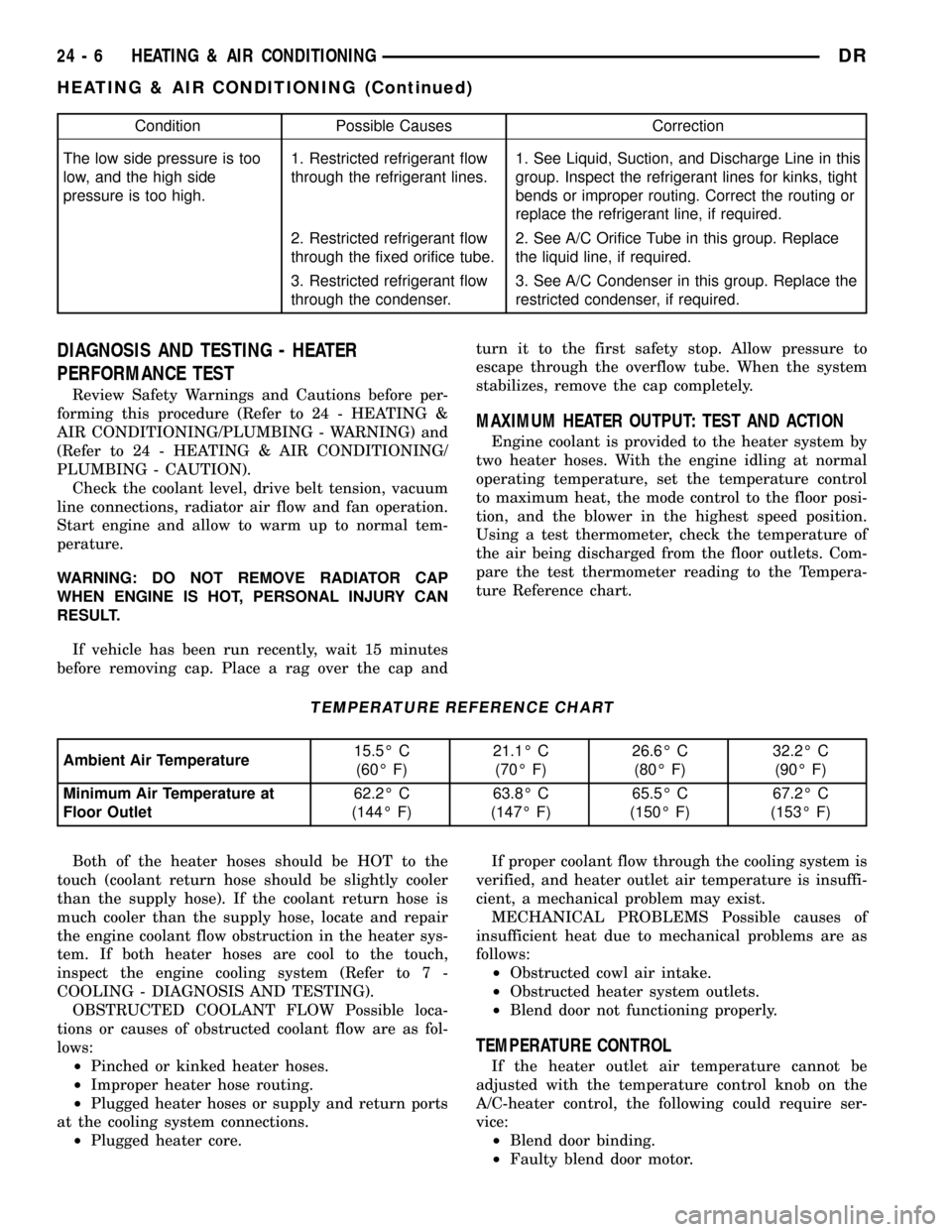
Condition Possible Causes Correction
The low side pressure is too
low, and the high side
pressure is too high.1. Restricted refrigerant flow
through the refrigerant lines.1. See Liquid, Suction, and Discharge Line in this
group. Inspect the refrigerant lines for kinks, tight
bends or improper routing. Correct the routing or
replace the refrigerant line, if required.
2. Restricted refrigerant flow
through the fixed orifice tube.2. See A/C Orifice Tube in this group. Replace
the liquid line, if required.
3. Restricted refrigerant flow
through the condenser.3. See A/C Condenser in this group. Replace the
restricted condenser, if required.
DIAGNOSIS AND TESTING - HEATER
PERFORMANCE TEST
Review Safety Warnings and Cautions before per-
forming this procedure (Refer to 24 - HEATING &
AIR CONDITIONING/PLUMBING - WARNING) and
(Refer to 24 - HEATING & AIR CONDITIONING/
PLUMBING - CAUTION).
Check the coolant level, drive belt tension, vacuum
line connections, radiator air flow and fan operation.
Start engine and allow to warm up to normal tem-
perature.
WARNING: DO NOT REMOVE RADIATOR CAP
WHEN ENGINE IS HOT, PERSONAL INJURY CAN
RESULT.
If vehicle has been run recently, wait 15 minutes
before removing cap. Place a rag over the cap andturn it to the first safety stop. Allow pressure to
escape through the overflow tube. When the system
stabilizes, remove the cap completely.
MAXIMUM HEATER OUTPUT: TEST AND ACTION
Engine coolant is provided to the heater system by
two heater hoses. With the engine idling at normal
operating temperature, set the temperature control
to maximum heat, the mode control to the floor posi-
tion, and the blower in the highest speed position.
Using a test thermometer, check the temperature of
the air being discharged from the floor outlets. Com-
pare the test thermometer reading to the Tempera-
ture Reference chart.
TEMPERATURE REFERENCE CHART
Ambient Air Temperature15.5É C
(60É F)21.1É C
(70É F)26.6É C
(80É F)32.2É C
(90É F)
Minimum Air Temperature at
Floor Outlet62.2É C
(144É F)63.8É C
(147É F)65.5É C
(150É F)67.2É C
(153É F)
Both of the heater hoses should be HOT to the
touch (coolant return hose should be slightly cooler
than the supply hose). If the coolant return hose is
much cooler than the supply hose, locate and repair
the engine coolant flow obstruction in the heater sys-
tem. If both heater hoses are cool to the touch,
inspect the engine cooling system (Refer to 7 -
COOLING - DIAGNOSIS AND TESTING).
OBSTRUCTED COOLANT FLOW Possible loca-
tions or causes of obstructed coolant flow are as fol-
lows:
²Pinched or kinked heater hoses.
²Improper heater hose routing.
²Plugged heater hoses or supply and return ports
at the cooling system connections.
²Plugged heater core.If proper coolant flow through the cooling system is
verified, and heater outlet air temperature is insuffi-
cient, a mechanical problem may exist.
MECHANICAL PROBLEMS Possible causes of
insufficient heat due to mechanical problems are as
follows:
²Obstructed cowl air intake.
²Obstructed heater system outlets.
²Blend door not functioning properly.
TEMPERATURE CONTROL
If the heater outlet air temperature cannot be
adjusted with the temperature control knob on the
A/C-heater control, the following could require ser-
vice:
²Blend door binding.
²Faulty blend door motor.
24 - 6 HEATING & AIR CONDITIONINGDR
HEATING & AIR CONDITIONING (Continued)
Page 2529 of 2627

REFRIGERANT OIL
DESCRIPTION.........................68
OPERATION...........................69
STANDARD PROCEDURE - REFRIGERANT
OIL LEVEL...........................69
SERVICE PORT VALVE CORE
DESCRIPTION.........................70
REMOVAL - SERVICE PORT VALVE CORES . . 70
INSTALLATION.........................70
SUCTION LINE
DESCRIPTION.........................70REMOVAL
REMOVAL - 5.9L DIESEL ENGINE.........70
REMOVAL - 3.7L/4.7L AND 5.7L HEMI
ENGINE.............................71
INSTALLATION
INSTALLATION - 5.9L DIESEL ENGINE.....72
INSTALLATION - 3.7L/4.7L AND 5.7L HEMI
ENGINE.............................73
PLUMBING
DESCRIPTION - REFRIGERANT LINE
The refrigerant lines and hoses are used to carry
the refrigerant between the various air conditioning
system components. A barrier hose design with a
nylon tube, which is sandwiched between rubber lay-
ers, is used for the R-134a air conditioning system on
this vehicle. This nylon tube helps to further contain
the R-134a refrigerant, which has a smaller molecu-
lar structure than R-12 refrigerant. The ends of the
refrigerant hoses are made from lightweight alumi-
num or steel, and commonly use braze-less fittings.
Any kinks or sharp bends in the refrigerant plumb-
ing will reduce the capacity of the entire air condi-
tioning system. Kinks and sharp bends reduce the
flow of refrigerant in the system. A good rule for the
flexible hose refrigerant lines is to keep the radius of
all bends at least ten times the diameter of the hose.
In addition, the flexible hose refrigerant lines should
be routed so they are at least 80 millimeters (3
inches) from an exhaust manifold.
OPERATION- REFRIGERANT LINES
High pressures are produced in the refrigerant sys-
tem when the air conditioning compressor is operat-
ing. Extreme care must be exercised to make sure
that each of the refrigerant system connections is
pressure-tight and leak free. It is a good practice to
inspect all flexible hose refrigerant lines at least once
a year to make sure they are in good condition and
properly routed.
The refrigerant lines and hoses are coupled with
other components of the HVAC system with either
O-rings or dual plane seals.
The refrigerant lines and hoses cannot be repaired
and, if faulty or damaged, they must be replaced.
WARNING
ENGINE COOLING SYSTEM
WARNING: THE ENGINE COOLING SYSTEM IS
DESIGNED TO DEVELOP INTERNAL PRESSURES
OF 97 TO 123 KILOPASCALS (14 TO 18 POUNDS
PER SQUARE INCH). DO NOT REMOVE OR
LOOSEN THE COOLANT PRESSURE CAP, CYLIN-
DER BLOCK DRAIN PLUGS, RADIATOR DRAIN,
RADIATOR HOSES, HEATER HOSES, OR HOSE
CLAMPS WHILE THE ENGINE COOLING SYSTEM IS
HOT AND UNDER PRESSURE. FAILURE TO
OBSERVE THIS WARNING CAN RESULT IN SERI-
OUS BURNS FROM THE HEATED ENGINE COOL-
ANT. ALLOW THE VEHICLE TO COOL FOR A
MINIMUM OF 15 MINUTES BEFORE OPENING THE
COOLING SYSTEM FOR SERVICE.
24 - 42 PLUMBINGDR
Page 2593 of 2627

CASE - NV271 - DESCRIPTION,
TRANSFER.........................21-447
CASE - NV271 - DIAGNOSIS AND
TESTING, TRANSFER.................21-448
CASE - NV271 - DISASSEMBLY,
TRANSFER.........................21-450
CASE - NV271 - INSPECTION, TRANSFER . 21-459
CASE - NV271 - INSTALLATION,
TRANSFER.........................21-473
CASE - NV271 - OPERATION, TRANSFER . 21-448
CASE - NV271 - REMOVAL, TRANSFER . . 21-450
CASE - NV273 - ASSEMBLY, TRANSFER . . 21-556
CASE - NV273 - CLEANING, TRANSFER . . 21-554
CASE - NV273 - DESCRIPTION,
TRANSFER.........................21-542
CASE - NV273 - DIAGNOSIS AND
TESTING, TRANSFER.................21-543
CASE - NV273 - DISASSEMBLY,
TRANSFER.........................21-544
CASE - NV273 - INSPECTION, TRANSFER . 21-554
CASE - NV273 - INSTALLATION,
TRANSFER.........................21-568
CASE - NV273 - OPERATION, TRANSFER . 21-543
CASE - NV273 - REMOVAL, TRANSFER . . 21-544
CASE BEARINGS - INSTALLATION,
DIFFERENTIAL.....3-106,3-134,3-161,3-48,3-75
CASE BEARINGS - REMOVAL,
DIFFERENTIAL.....3-105,3-134,3-161,3-48,3-75
CASE CONTROL MODULE -
DESCRIPTION, TRANSFER.............8E-16
CASE CONTROL MODULE - OPERATION,
TRANSFER..........................8E-16
CASE, NV241 GENII - TRANSFER.......21-438
CASE, NV241/NV243 - TRANSFER......21-439
CASE, NV243 - TRANSFER......21-505,21-506
CASE, NV244 GENII - TRANSFER.......21-535
CASE, NV271 - TRANSFER............21-473
CASE NV271/NV273, SPECIAL TOOLS -
TRANSFER...................21-474,21-569
CASE, NV273 - TRANSFER............21-568
CASE SKID PLATE - INSTALLATION,
TRANSFER..........................13-26
CASE SKID PLATE - REMOVAL,
TRANSFER..........................13-26
CASTER ADJUSTMENT - STANDARD
PROCEDURE, CAMBER..................2-4
CASTER AND TOE ADJUSTMENT -
STANDARD PROCEDURE, CAMBER........2-4
CATALYTIC CONVERTER - DESCRIPTION . . . 11-6
CATALYTIC CONVERTER - OPERATION.....11-6
CATCH - INSTALLATION, LATCH STRIKER
/ SECONDARY.......................23-48
CATCH - REMOVAL, LATCH STRIKER /
SECONDARY........................23-47
CAUTION - A/C SYSTEM...............24-43
CAUTION, HALF SHAFT.................3-20
CAUTION, INTERIOR..................23-62
CENTER - DESCRIPTION, ELECTRONIC
VEHICLE INFO.......................8M-7
CENTER - DIAGNOSIS AND TESTING,
ELECTRONIC VEHICLE INFORMATION.....8M-8
CENTER - INSTALLATION, ELECTRONIC
VEHICLE INFO.......................8M-9
CENTER & LEFT OUTBOARD -
INSTALLATION......................8O-50
CENTER & LEFT OUTBOARD - REMOVAL
. . 8O-48
CENTER - OPERATION, ELECTRONIC
VEHICLE INFO
.......................8M-7
CENTER - REMOVAL, ELECTRONIC
VEHICLE INFO
.......................8M-9
CENTER ANCHOR & RIGHT OUTBOARD -
INSTALLATION
......................8O-50
CENTER ANCHOR & RIGHT OUTBOARD -
REMOVAL
..........................8O-49
CENTER ARMREST / SEAT BACK -
INSTALLATION
.......................23-77
CENTER ARMREST / SEAT BACK -
REMOVAL
..........................23-76
CENTER BEARING - ADJUSTMENTS
........3-9
CENTER BEARING - INSTALLATION
........3-9
CENTER BEARING - REMOVAL
............3-9
CENTER BEZEL - INSTALLATION,
INSTRUMENT PANEL
..................23-57
CENTER BEZEL - REMOVAL,
INSTRUMENT PANEL
..................23-57
CENTER HIGH MOUNTED STOP LAMP -
INSTALLATION
.......................8L-11CENTER HIGH MOUNTED STOP LAMP -
REMOVAL..........................8L-11
CENTER HIGH MOUNTED STOP LAMP
UNIT - INSTALLATION.................8L-11
CENTER HIGH MOUNTED STOP LAMP
UNIT - REMOVAL....................8L-11
CENTER PROGRAMMING - STANDARD
PROCEDURE, ELECTRONIC VEHICLE
INFORMATION.......................8M-8
CENTER SEAT - INSTALLATION..........23-76
CENTER SEAT - REMOVAL.............23-75
CENTER SEAT BACK HINGE -
INSTALLATION.......................23-79
CENTER SEAT BACK HINGE - REMOVAL . . . 23-78
CENTER SEAT BACK INERTIA HINGE
COVER - INSTALLATION...............23-77
CENTER SEAT BACK INERTIA HINGE
COVER - REMOVAL...................23-77
CENTER SEAT BACK LID - INSTALLATION . 23-79
CENTER SEAT BACK LID - REMOVAL.....23-79
CENTER SEAT BELT - INSTALLATION,
FRONT.............................8O-31
CENTER SEAT BELT - REMOVAL, FRONT . . 8O-30
CENTER SEAT BELT & RETRACTOR -
INSTALLATION, FRONT................8O-29
CENTER SEAT BELT & RETRACTOR -
INSTALLATION, REAR.................8O-45
CENTER SEAT BELT & RETRACTOR -
REMOVAL, FRONT....................8O-29
CENTER SEAT BELT & RETRACTOR -
REMOVAL, REAR....................8O-44
CENTER SEAT CUSHION - INSTALLATION . . . 23-79
CENTER SEAT CUSHION - REMOVAL.....23-79
CENTER SEAT CUSHION COVER -
INSTALLATION.......................23-79
CENTER SEAT CUSHION COVER -
REMOVAL..........................23-79
CENTERING - STANDARD PROCEDURE,
CLOCKSPRING......................8O-19
CERTIFICATION LABEL - DESCRIPTION,
VEHICLE.........................Intro.-11
CHAIN COVER(S) - INSTALLATION,
TIMING BELT....................9-171,9-81
CHAIN COVER(S) - REMOVAL, TIMING
BELT ..........................9-170,9-81
CHAIN WEAR - STANDARD PROCEDURE,
MEASURING TIMING..................9-167
CHAIN WEAR, STANDARD PROCEDURE -
MEASURING TIMING...................9-77
CHAIN/TENSIONER - DESCRIPTION,
TIMING............................9-229
CHAIN/TENSIONER - OPERATION,
TIMING............................9-229
CHANNEL - INSTALLATION, GLASS RUN . . 23-22,
23-31
CHANNEL - REMOVAL, GLASS RUN . 23-21,23-30
CHARGE - STANDARD PROCEDURE,
REFRIGERANT SYSTEM...............24-47
CHARGE AIR COOLER AND PLUMBING -
CLEANING..........................11-17
CHARGE AIR COOLER AND PLUMBING -
DESCRIPTION.......................11-16
CHARGE AIR COOLER AND PLUMBING -
INSPECTION........................11-17
CHARGE AIR COOLER AND PLUMBING -
INSTALLATION.......................11-17
CHARGE AIR COOLER AND PLUMBING -
OPERATION
.........................11-16
CHARGE AIR COOLER AND PLUMBING -
REMOVAL
..........................11-17
CHARGE AIR COOLER SYSTEM - LEAKS
- DIAGNOSIS AND TESTING
............11-16
CHARGING - DESCRIPTION
.............8F-19
CHARGING - OPERATION
..............8F-19
CHARGING - STANDARD PROCEDURE,
BATTERY
............................8F-8
CHARGING SYSTEM - DIAGNOSIS AND
TESTING
...........................8F-19
CHARGING SYSTEM - SPECIFICATIONS,
TORQUE - GENERATOR
................8F-20
CHART - SPECIFICATIONS, TORQUE
........5-8
CHART, SPECIFICATIONS - TORQUE
.......5-46
CHART, SPECIFICATIONS - TORQUE
.....19-19,
19-23,19-35,19-42
CHART, SPECIFICATIONS - TORQUE
. . 2-10,2-29,
2-42
CHART, SPECIFICATIONS - TORQUE
......22-13CHARTS - DIAGNOSIS AND TESTING,
DIAGNOSIS........................21-145
CHARTS - DIAGNOSIS AND TESTING,
SMOKE DIAGNOSIS...................9-236
CHECK - STANDARD PROCEDURE,
COOLANT LEVEL......................7-17
CHECK - STANDARD PROCEDURE, FLUID
LEVEL......................21-202,21-366
CHECK - STANDARD PROCEDURE, OIL
PUMP VOLUME.....................21-387
CHECK CABLE - INSTALLATION.........23-15
CHECK CABLE - REMOVAL.............23-15
CHECK GAUGES INDICATOR -
DESCRIPTION.......................8J-21
CHECK GAUGES INDICATOR -
OPERATION.........................8J-21
CHECK VALVE - DESCRIPTION...........8R-7
CHECK VALVE - INSTALLATION..........8R-8
CHECK VALVE - OPERATION.............8R-8
CHECK VALVE - REMOVAL..............8R-8
CHILD RESTRAINT ANCHOR -
DESCRIPTION.......................8O-15
CHILD RESTRAINT ANCHOR -
INSTALLATION......................8O-18
CHILD RESTRAINT ANCHOR -
OPERATION.........................8O-17
CHILD RESTRAINT ANCHOR - REMOVAL . . 8O-17
CHIME WARNING SYSTEM -
DESCRIPTION........................8B-1
CHIME WARNING SYSTEM - DIAGNOSIS
AND TESTING........................8B-3
CHIME WARNING SYSTEM - OPERATION . . . 8B-1
CIGAR LIGHTER OUTLET -
DESCRIPTION.....................8W-97-2
CIGAR LIGHTER OUTLET - DIAGNOSIS
AND TESTING.....................8W-97-2
CIGAR LIGHTER OUTLET - OPERATION . 8W-97-2
CIRCUIT - DIAGNOSIS AND TESTING,
AMBIENT TEMPERATURE SENSOR......8M-10
CIRCUIT - OPERATION, FUEL DRAIN.....14-67
CIRCUIT ACTUATION TEST MODE -
DESCRIPTION........................25-1
CIRCUIT FUNCTIONS - DESCRIPTION . . 8W-01-6
CIRCUIT INFORMATION - DESCRIPTION . 8W-01-5
CIRCUIT SENSE - DESCRIPTION,
IGNITION...........................8E-10
CIRCUIT SENSE - OPERATION, IGNITION . . 8E-11
CIRCUITS - OPERATION, NON-
MONITORED.........................25-8
CLAMPS - DESCRIPTION, HOSE...........7-3
CLAMPS - OPERATION, HOSE.............7-5
CLEANING/REVERSE FLUSHING -
STANDARD PROCEDURE, COOLING
SYSTEM............................7-17
CLEARANCE - STANDARD PROCEDURE,
CONNECTING ROD BEARING AND
CRANKSHAFT JOURNAL...............9-272
CLEARANCE - STANDARD PROCEDURE,
MAIN BEARING......................9-274
CLEARANCE LAMP - INSTALLATION, CAB . 8L-12
CLEARANCE LAMP - REMOVAL, CAB.....8L-11
CLOCKSPRING - DESCRIPTION.........8O-18
CLOCKSPRING - INSTALLATION.........8O-21
CLOCKSPRING - OPERATION...........8O-19
CLOCKSPRING - REMOVAL............8O-20
CLOCKSPRING CENTERING - STANDARD
PROCEDURE........................8O-19
CLUSTER - ASSEMBLY, INSTRUMENT....8J-15
CLUSTER - DESCRIPTION, INSTRUMENT . . . 8J-2
CLUSTER - DIAGNOSIS AND TESTING,
INSTRUMENT........................8J-10
CLUSTER - DISASSEMBLY, INSTRUMENT . . 8J-14
CLUSTER - INSTALLATION, INSTRUMENT . 8J-16
CLUSTER - OPERATION, INSTRUMENT.....8J-6
CLUSTER - REMOVAL, INSTRUMENT.....8J-14
CLUSTER BEZEL - INSTALLATION........23-49
CLUSTER BEZEL - REMOVAL...........23-49
CLUTCH - 5.9L DIESEL - DESCRIPTION,
FAN DRIVE VISCOUS...................7-52
CLUTCH - 5.9L DIESEL - OPERATION,
FAN DRIVE VISCOUS...................7-52
CLUTCH - ASSEMBLY, FRONT..........21-207
CLUTCH - ASSEMBLY, LOW/REVERSE . . . 21-385
CLUTCH - ASSEMBLY, REAR
...........21-249
CLUTCH - CLEANING, LOW/REVERSE
....21-385
CLUTCH - CLEANING, REAR
...........21-248
CLUTCH - DESCRIPTION, FRONT
.......21-205
CLUTCH - DESCRIPTION, OVERDRIVE
. . . 21-217
6 INDEXDR
Description Group-Page Description Group-Page Description Group-Page
Page 2595 of 2627

CONTROL MODULE - DESCRIPTION,
AIRBAG............................8O-11
CONTROL MODULE - DESCRIPTION,
FRONT...........................8W-97-5
CONTROL MODULE - DESCRIPTION,
FRONT..............................8E-5
CONTROL MODULE - DESCRIPTION,
TRANSFER CASE.....................8E-16
CONTROL MODULE - DESCRIPTION,
TRANSMISSION......................8E-20
CONTROL MODULE - DIAGNOSIS AND
TESTING, FRONT...................8W-97-5
CONTROL MODULE - DIAGNOSIS AND
TESTING, FRONT......................8E-5
CONTROL MODULE - INSTALLATION,
AIRBAG............................8O-13
CONTROL MODULE - INSTALLATION,
ENGINE.............................8E-4
CONTROL MODULE - INSTALLATION,
FRONT...........................8W-97-6
CONTROL MODULE - INSTALLATION,
FRONT..............................8E-5
CONTROL MODULE - OPERATION,
AIRBAG............................8O-11
CONTROL MODULE - OPERATION,
FRONT...........................8W-97-5
CONTROL MODULE - OPERATION,
FRONT..............................8E-5
CONTROL MODULE - OPERATION,
TRANSFER CASE.....................8E-16
CONTROL MODULE - OPERATION,
TRANSMISSION......................8E-20
CONTROL MODULE - REMOVAL, AIRBAG . 8O-12
CONTROL MODULE - REMOVAL, ENGINE . . . 8E-4
CONTROL MODULE - REMOVAL, FRONT . 8W-97-6
CONTROL MODULE - REMOVAL, FRONT . . . 8E-5
CONTROL MOTOR - DESCRIPTION, IDLE
AIR ...............................14-28
CONTROL MOTOR - INSTALLATION, IDLE
AIR ...............................14-29
CONTROL MOTOR - OPERATION, IDLE
AIR ...............................14-28
CONTROL MOTOR - REMOVAL, IDLE AIR . . 14-29
CONTROL RELAY - DESCRIPTION,
TRANSMISSION.....................21-405
CONTROL RELAY - OPERATION,
TRANSMISSION.....................21-405
CONTROL SWITCH - DESCRIPTION,
LUMBAR...........................8N-17
CONTROL SWITCH - OPERATION,
LUMBAR...........................8N-18
CONTROL SWITCH - REMOVAL,
LUMBAR...........................8N-18
CONTROLLED VISCOUS FAN DRIVE -
DIAGNOSIS AND TESTING,
ELECTRONICALLY.....................7-52
CONTROLLER ANTILOCK BRAKE -
DESCRIPTION........................8E-3
CONTROLLER ANTILOCK BRAKE -
INSTALLATION........................8E-3
CONTROLLER ANTILOCK BRAKE -
OPERATION..........................8E-3
CONTROLLER ANTILOCK BRAKE -
REMOVAL...........................8E-3
CONTROLS - DIAGNOSIS AND TESTING,
OVERDRIVE ELECTRICAL.............21-262
CONVERTER - DESCRIPTION, CATALYTIC
. . . 11-6
CONVERTER - DESCRIPTION, TORQUE
. . 21-255,
21-399
CONVERTER - INSTALLATION, TORQUE
. . 21-260,
21-404
CONVERTER - OPERATION, CATALYTIC
....11-6
CONVERTER - OPERATION, TORQUE
....21-259,
21-403
CONVERTER - REMOVAL, TORQUE
.....21-260,
21-404
CONVERTER DRAINBACK VALVE -
DESCRIPTION, TORQUE
..............21-261
CONVERTER DRAINBACK VALVE -
OPERATION, TORQUE
................21-261
CONVERTER DRAINBACK VALVE -
STANDARD PROCEDURE, TORQUE
......21-261
CONVERTER HOUSING FLUID LEAK -
DIAGNOSIS AND TESTING
......21-144,21-318
COOLANT - DESCRIPTION, ENGINE
.......7-31
COOLANT - DESCRIPTION, ENGINE
........0-3
COOLANT - DESCRIPTION, HOAT
.........7-32COOLANT - STANDARD PROCEDURE,
ADDING ADDITIONAL..................7-19
COOLANT FLOW - DIAGNOSIS AND
TESTING, RADIATOR...............7-54,7-56
COOLANT LEVEL CHECK - STANDARD
PROCEDURE.........................7-17
COOLANT RECOVERY CONTAINER- GAS
ENGINES - DESCRIPTION...............7-33
COOLANT RECOVERY CONTAINER- GAS
ENGINES - INSTALLATION...............7-33
COOLANT RECOVERY CONTAINER- GAS
ENGINES - OPERATION.................7-33
COOLANT RECOVERY CONTAINER- GAS
ENGINES - REMOVAL..................7-33
COOLANT TEMPERATURE SENSOR -
DESCRIPTION, ENGINE.................7-38
COOLANT TEMPERATURE SENSOR -
INSTALLATION, ENGINE................7-41
COOLANT TEMPERATURE SENSOR -
OPERATION, ENGINE...................7-38
COOLANT TEMPERATURE SENSOR -
REMOVAL, ENGINE....................7-39
COOLANT THERMOSTAT - 3.7L/4.7L -
DESCRIPTION, ENGINE.................7-44
COOLANT THERMOSTAT - 3.7L/4.7L -
INSTALLATION, ENGINE................7-45
COOLANT THERMOSTAT - 3.7L/4.7L -
OPERATION, ENGINE...................7-44
COOLANT THERMOSTAT - 3.7L/4.7L -
REMOVAL, ENGINE....................7-45
COOLANT THERMOSTAT - 5.9L DIESEL -
DESCRIPTION, ENGINE.................7-46
COOLANT THERMOSTAT - 5.9L DIESEL -
INSTALLATION, ENGINE..................7-47
COOLANT THERMOSTAT - 5.9L DIESEL -
OPERATION, ENGINE...................7-46
COOLANT THERMOSTAT - 5.9L DIESEL -
REMOVAL, ENGINE....................7-47
COOLANT THERMOSTAT - 8.0L -
DESCRIPTION, ENGINE.................7-48
COOLANT THERMOSTAT - 8.0L -
INSTALLATION, ENGINE................7-49
COOLANT THERMOSTAT - 8.0L -
OPERATION, ENGINE...................7-48
COOLANT THERMOSTAT - 8.0L -
REMOVAL, ENGINE....................7-49
COOLANT THERMOSTAT-5.7L -
DESCRIPTION, ENGINE.................7-41
COOLANT THERMOSTAT-5.7L -
INSTALLATION, ENGINE................7-43
COOLANT THERMOSTAT-5.7L -
OPERATION, ENGINE...................7-41
COOLANT THERMOSTAT-5.7L -
REMOVAL, ENGINE....................7-42
COOLER - 5.9L DIESEL - DESCRIPTION,
TRANS..............................7-68
COOLER - 5.9L DIESEL - OPERATION,
TRANS..............................7-69
COOLER - DESCRIPTION, TRANS.........7-67
COOLER - INSTALLATION, AIR TO OIL.....7-70
COOLER - INSTALLATION, FLUID........19-43
COOLER - INSTALLATION, RETURN
HOSE - GEAR TO................19-44,19-45
COOLER - INSTALLATION, RETURN
HOSE - RESERVOIR TO...........19-44,19-45
COOLER - INSTALLATION, TRANS........7-68
COOLER - INSTALLATION, WATER-TO-
AIR
................................7-70
COOLER - OPERATION, TRANS
...........7-67
COOLER - REMOVAL, AIR TO OIL
.........7-69
COOLER - REMOVAL, FLUID
............19-43
COOLER - REMOVAL, RETURN HOSE -
GEAR TO
......................19-44,19-45
COOLER - REMOVAL, RETURN HOSE -
RESERVOIR TO
.................19-44,19-45
COOLER - REMOVAL, TRANS
............7-68
COOLER - REMOVAL, WATER TO OIL
......7-69
COOLER AND PLUMBING - CLEANING,
CHARGE AIR
........................11-17
COOLER AND PLUMBING -
DESCRIPTION, CHARGE AIR
............11-16
COOLER AND PLUMBING - INSPECTION,
CHARGE AIR
........................11-17
COOLER AND PLUMBING -
INSTALLATION, CHARGE AIR
...........11-17
COOLER AND PLUMBING - OPERATION,
CHARGE AIR
........................11-16COOLER AND PLUMBING - REMOVAL,
CHARGE AIR........................11-17
COOLER SYSTEM - LEAKS - DIAGNOSIS
AND TESTING, CHARGE AIR............11-16
COOLING, SPECIAL TOOLS..............7-20
COOLING SYSTEM - ALL GAS ENGINES -
STANDARD PROCEDURE, DRAINING......7-17
COOLING SYSTEM - ALL GAS ENGINES -
STANDARD PROCEDURE, REFILLING......7-18
COOLING SYSTEM - OPERATION..........7-5
COOLING SYSTEM - TESTING FOR
LEAKS - DIAGNOSIS AND TESTING........7-5
COOLING SYSTEM 5.9L DIESEL ENGINE
- STANDARD PROCEDURE, DRAINING.....7-18
COOLING SYSTEM 5.9L DIESEL ENGINE
- STANDARD PROCEDURE, REFILLING.....7-19
COOLING SYSTEM CLEANING/REVERSE
FLUSHING - STANDARD PROCEDURE.....7-17
COOLING SYSTEM DIESEL ENGINE -
DIAGNOSIS AND TESTING...............7-7
COOLING SYSTEM FLOW - 5.9L DIESEL
- DESCRIPTION........................7-3
COOLING SYSTEM FLOW 3.7L/4.7L/5.7L
ENGINE - DESCRIPTION.................7-1
COOLING SYSTEM REQUIREMENTS -
DESCRIPTION, ENGINE.................24-1
COOLING SYSTEM, WARNING - ENGINE . . 24-42
CORE - DESCRIPTION, HEATER.........24-63
CORE - DESCRIPTION, SERVICE PORT
VALVE .............................24-70
CORE - INSTALLATION, HEATER.........24-63
CORE - INSTALLATION, SERVICE PORT
VALVE .............................24-70
CORE - OPERATION, HEATER...........24-63
CORE - REMOVAL, HEATER............24-63
CORE HOLE PLUG - INSTALLATION,
CAMSHAFT.........................9-206
CORE HOLE PLUG - REMOVAL,
CAMSHAFT.........................9-205
CORE PLUGS - INSTALLATION..........9-131
CORE PLUGS - REMOVAL..............9-131
CORES - REMOVAL, SERVICE PORT
VALVE .............................24-70
COUPLER - DESCRIPTION,
REFRIGERANT LINE...................24-67
COUPLER - INSTALLATION,
REFRIGERANT LINE...................24-68
COUPLER - OPERATION, REFRIGERANT
LINE...............................24-67
COUPLER - REMOVAL, REFRIGERANT
LINE...............................24-68
COUPLING - INSTALLATION, UPPER
STEERING..........................19-13
COUPLING - REMOVAL, UPPER
STEERING..........................19-13
COVER - DESCRIPTION, STRUCTURAL . . . 9-145,
9-216,9-57
COVER - FRONT - INSTALLATION, SEAT
BACK CUSHION......................23-82
COVER - FRONT - INSTALLATION, SEAT
CUSHION...........................23-83
COVER - FRONT - REMOVAL, SEAT BACK
CUSHION...........................23-82
COVER - FRONT - REMOVAL, SEAT
CUSHION...........................23-83
COVER - INSTALLATION...............23-16
COVER - INSTALLATION, ACM
..........8O-10
COVER - INSTALLATION, CENTER SEAT
BACK INERTIA HINGE
.................23-77
COVER - INSTALLATION, CENTER SEAT
CUSHION
...........................23-79
COVER - INSTALLATION, CYLINDER
HEAD
..............................9-255
COVER - INSTALLATION, DIFFERENTIAL
....3-97
COVER - INSTALLATION, GEAR HOUSING
. 9-301
COVER - INSTALLATION, INSTRUMENT
PANEL TOP
.........................23-59
COVER - INSTALLATION, REAR DOOR
SILL TRIM
..........................23-71
COVER - INSTALLATION, SHIFT
. . . 21-129,21-87
COVER - INSTALLATION, STEERING
COLUMN OPENING
...................23-60
COVER - INSTALLATION, STRUCTURAL
. . . 9-145,
9-216,9-57
COVER - INSTALLATION, TIMING/CHAIN
. . 9-227
COVER - OPERATION, STRUCTURAL
.....9-145,
9-216,9-57
8 INDEXDR
Description Group-Page Description Group-Page Description Group-Page
Page 2598 of 2627

DOOR GLASS RUN WEATHERSTRIP -
REMOVAL, FRONT....................23-92
DOOR GLASS RUN WEATHERSTRIP -
REMOVAL, REAR.....................23-93
DOOR INNER BELT MOLDING -
INSTALLATION, FRONT................23-93
DOOR INNER BELT MOLDING -
INSTALLATION, REAR.................23-94
DOOR INNER BELT MOLDING -
REMOVAL, FRONT....................23-93
DOOR INNER BELT MOLDING -
REMOVAL, REAR.....................23-94
DOOR LOCK MOTOR - DESCRIPTION......8N-4
DOOR LOCK MOTOR - DIAGNOSIS AND
TESTING............................8N-4
DOOR LOCK MOTOR - OPERATION.......8N-4
DOOR MODULE - DESCRIPTION, DRIVER . . 8N-5
DOOR MODULE - DIAGNOSIS AND
TESTING, DRIVER.....................8N-6
DOOR MODULE - INSTALLATION,
DRIVER.............................8N-7
DOOR MODULE - OPERATION, DRIVER....8N-5
DOOR MODULE - REMOVAL, DRIVER.....8N-7
DOOR OPENING SEAL - INSTALLATION . . . 23-92
DOOR OPENING SEAL - REMOVAL.......23-92
DOOR OUTER BELT MOLDING -
INSTALLATION, FRONT................23-93
DOOR OUTER BELT MOLDING -
INSTALLATION, REAR.................23-94
DOOR OUTER BELT MOLDING -
REMOVAL, FRONT....................23-92
DOOR OUTER BELT MOLDING -
REMOVAL, REAR.....................23-93
DOOR SILL TRIM COVER -
INSTALLATION, REAR.................23-71
DOOR SILL TRIM COVER - REMOVAL,
REAR..............................23-71
DOUBLE CARDAN UNIVERSAL JOINTS -
ASSEMBLY..........................3-17
DOUBLE CARDAN UNIVERSAL JOINTS -
DISASSEMBLY........................3-16
DOUBLE INVERTED FLARING -
STANDARD PROCEDURE................5-10
DRAG LINK - INSTALLATION............19-36
DRAG LINK - REMOVAL...............19-36
DRAIN AND REFILL - STANDARD
PROCEDURE, FLUID.....21-441,21-476,21-507,
21-537,21-571
DRAIN CIRCUIT - OPERATION, FUEL.....14-67
DRAINBACK VALVE - DESCRIPTION,
TORQUE CONVERTER................21-261
DRAINBACK VALVE - OPERATION,
TORQUE CONVERTER................21-261
DRAINBACK VALVE - STANDARD
PROCEDURE, TORQUE CONVERTER.....21-261
DRAINING AT FUEL FILTER - STANDARD
PROCEDURES, WATER................14-47
DRAW TEST - STANDARD PROCEDURE,
IGNITION-OFF.......................8F-11
DRIP RAIL WEATHERSTRIP -
INSTALLATION.......................23-91
DRIP RAIL WEATHERSTRIP - REMOVAL . . 23-91
DRIP RAIL WEATHERSTRIP RETAINER -
INSTALLATION.......................23-92
DRIP RAIL WEATHERSTRIP RETAINER -
REMOVAL..........................23-92
DRIVE - DIAGNOSIS AND TESTING,
ELECTRONICALLY CONTROLLED
VISCOUS FAN........................7-52
DRIVE - DIAGNOSIS AND TESTING,
VISCOUS FAN........................7-50
DRIVE BELT - 3.7L / 4.7L -
INSTALLATION........................7-26
DRIVE BELT - 3.7L / 4.7L - REMOVAL.....7-26
DRIVE BELT - 5.9L DIESEL -
INSTALLATION........................7-29
DRIVE BELT - 5.9L DIESEL - REMOVAL....7-29
DRIVE BELT - DIAGNOSIS AND TESTING,
ACCESSORY.....................7-24,7-27
DRIVE LEARN - STANDARD PROCEDURE . . 8E-23
DRIVE SYSTEM - DESCRIPTION, TIMING
. . 9-166
DRIVE SYSTEM - OPERATION, TIMING
....9-166
DRIVE VISCOUS CLUTCH - 5.9L DIESEL
- DESCRIPTION, FAN
...................7-52
DRIVE VISCOUS CLUTCH - 5.9L DIESEL
- OPERATION, FAN
....................7-52
DRIVE VISCOUS CLUTCH-GAS ENGINES
- DESCRIPTION, FAN
...................7-50DRIVE VISCOUS CLUTCH-GAS ENGINES
- OPERATION, FAN....................7-50
DRIVER AIRBAG - ASSEMBLY..........8O-26
DRIVER AIRBAG - DESCRIPTION........8O-23
DRIVER AIRBAG - DISASSEMBLY........8O-25
DRIVER AIRBAG - INSTALLATION.......8O-28
DRIVER AIRBAG - OPERATION..........8O-23
DRIVER AIRBAG - REMOVAL...........8O-24
DRIVER DOOR MODULE - DESCRIPTION . . . 8N-5
DRIVER DOOR MODULE - DIAGNOSIS
AND TESTING........................8N-6
DRIVER DOOR MODULE - INSTALLATION . . 8N-7
DRIVER DOOR MODULE - OPERATION....8N-5
DRIVER DOOR MODULE - REMOVAL......8N-7
DRIVER SEAT SWITCH - DESCRIPTION . . . 8N-14
DRIVER SEAT SWITCH - DIAGNOSIS
AND TESTING.......................8N-14
DRIVER SEAT SWITCH - INSTALLATION . . 8N-15
DRIVER SEAT SWITCH - OPERATION.....8N-14
DRIVER SEAT SWITCH - REMOVAL......8N-15
DRIVER SIDE BEZEL - INSTALLATION,
INSTRUMENT PANEL..................23-58
DRIVER SIDE BEZEL - REMOVAL,
INSTRUMENT PANEL..................23-58
DROP - STANDARD PROCEDURE,
TESTING FOR A VOLTAGE...........8W-01-10
DRUM IN HAT BRAKE - CLEANING,
REAR...............................5-39
DRUM IN HAT BRAKE - INSPECTION,
REAR...............................5-39
DUAL REAR WHEEL INSTALLATION -
STANDARD PROCEDURE...............22-12
DUAL WHEELS - INSTALLATION, REAR....5-35
DUAL WHEELS - REMOVAL, REAR........5-34
DUCT - INSTALLATION, DEFROSTER.....24-32
DUCT - INSTALLATION, FLOOR
DISTRIBUTION.......................24-34
DUCT - REMOVAL, DEFROSTER.........24-32
DUCT - REMOVAL, FLOOR
DISTRIBUTION.......................24-33
DUCTS - INSTALLATION, INSTRUMENT
PANEL.............................24-37
DUCTS - INSTALLATION, INSTRUMENT
PANEL DEMISTER....................24-37
DUCTS - REMOVAL, INSTRUMENT
PANEL.............................24-37
DUCTS - REMOVAL, INSTRUMENT
PANEL DEMISTER....................24-36
DUST BOOT - INSTALLATION,
EXTENSION HOUSING SEAL.....21-476,21-571
DUST BOOT - REMOVAL, EXTENSION
HOUSING SEAL...............21-476,21-571
ECM - DESCRIPTION...................8E-3
ECM - OPERATION....................8E-3
EFFECTS OF INCORRECT FLUID LEVEL -
DIAGNOSIS AND TESTING......21-201,21-366
ELECTRICAL CONTROLS - DIAGNOSIS
AND TESTING, OVERDRIVE............21-262
ELECTRONIC GOVERNOR -
DESCRIPTION......................21-197
ELECTRONIC GOVERNOR -
INSTALLATION......................21-200
ELECTRONIC GOVERNOR - OPERATION . . 21-198
ELECTRONIC GOVERNOR - REMOVAL . . . 21-199
ELECTRONIC VARIABLE BRAKE
PROPORTIONING - DESCRIPTION........5-49
ELECTRONIC VARIABLE BRAKE
PROPORTIONING - OPERATION..........5-49
ELECTRONIC VEHICLE INFO CENTER -
DESCRIPTION........................8M-7
ELECTRONIC VEHICLE INFO CENTER -
INSTALLATION.......................8M-9
ELECTRONIC VEHICLE INFO CENTER -
OPERATION.........................8M-7
ELECTRONIC VEHICLE INFO CENTER -
REMOVAL...........................8M-9
ELECTRONIC VEHICLE INFORMATION
CENTER - DIAGNOSIS AND TESTING
......8M-8
ELECTRONIC VEHICLE INFORMATION
CENTER PROGRAMMING - STANDARD
PROCEDURE
.........................8M-8
ELECTRONICALLY CONTROLLED
VISCOUS FAN DRIVE - DIAGNOSIS
AND TESTING
........................7-52
ELECTROSTATIC DISCHARGE (ESD)
SENSITIVE DEVICES - STANDARD
PROCEDURE
......................8W-01-8
ELEMENT - DESCRIPTION, HEATED SEAT
. . 8G-9ELEMENT - DIAGNOSIS AND TESTING,
HEATED SEAT .......................8G-10
ELEMENT - INSTALLATION, AIR
CLEANER..................9-107,9-21,9-249
ELEMENT - INSTALLATION, HEATED
SEAT ..............................8G-10
ELEMENT - OPERATION, HEATED SEAT . . . 8G-10
ELEMENT - REMOVAL, AIR CLEANER....9-107,
9-21,9-248
ELEMENT - REMOVAL, HEATED SEAT....8G-10
EMISSION CONTROL INFORMATION
(VECI) - DESCRIPTION, VEHICLE.......Intro.-2
END - DIAGNOSIS AND TESTING, OUTER
TIE ROD............................19-32
END - INSTALLATION, OUTER TIE ROD . . . 19-33
END - INSTALLATION, TIE ROD.........19-37
END - REMOVAL, OUTER TIE ROD.......19-32
END - REMOVAL, TIE ROD.............19-37
ENGINE - 3.7L - DESCRIPTION............9-3
ENGINE - 5.7L - DESCRIPTION..........9-182
ENGINE - DESCRIPTION, COOLING
SYSTEM FLOW 3.7L/4.7L/5.7L............7-1
ENGINE - DESCRIPTION, FUEL
REQUIREMENTS - DIESEL...............0-1
ENGINE - DIAGNOSIS AND TESTING,
COOLING SYSTEM DIESEL...............7-7
ENGINE - DIAGNOSIS AND TESTING,
DIESEL.............................11-5
ENGINE - DIAGNOSIS AND TESTING,
GAS................................11-4
ENGINE - FIRING ORDER / CABLE
ROUTING, 5.7L V-8....................8I-4
ENGINE - INSTALLATION...............9-242
ENGINE - INSTALLATION, 3.7L/4.7L AND
5.7L HEMI.....................24-59,24-73
ENGINE - INSTALLATION, 5.9L DIESEL . . . 24-54,
24-58,24-72
ENGINE - INSTALLATION, DIESEL........8R-17
ENGINE - INSTALLATION, EXCEPT
DIESEL............................8R-17
ENGINE - INSTALLATION, GAS..........19-26
ENGINE - REMOVAL..................9-241
ENGINE - REMOVAL, 3.7L/4.7L AND 5.7L
HEMI.........................24-57,24-71
ENGINE - REMOVAL, 5.9L DIESEL . . 24-53,24-56,
24-70
ENGINE - REMOVAL, DIESEL...........8R-16
ENGINE - REMOVAL, EXCEPT DIESEL....8R-15
ENGINE - REMOVAL, GAS..............19-25
ENGINE - SPECIFICATIONS, 3.7L.........9-12
ENGINE - SPECIFICATIONS, 4.7L.........9-99
ENGINE - STANDARD PROCEDURE,
DRAINING COOLING SYSTEM 5.9L
DIESEL.............................7-18
ENGINE - STANDARD PROCEDURE,
REFILLING COOLING SYSTEM 5.9L
DIESEL.............................7-19
ENGINE - TORQUE, FUEL SYSTEM -
DIESEL............................14-48
ENGINE 5.9L DIESEL - DESCRIPTION.....9-232
ENGINE BLOCK - CLEANING . . . 9-128,9-205,9-39
ENGINE BLOCK - DESCRIPTION.....9-128,9-38
ENGINE BLOCK - INSPECTION . 9-128,9-205,9-39
ENGINE BLOCK HEATER - 5.9L DIESEL -
DESCRIPTION........................7-37
ENGINE BLOCK HEATER - 5.9L DIESEL -
INSTALLATION........................7-38
ENGINE BLOCK HEATER - 5.9L DIESEL -
OPERATION..........................7-38
ENGINE BLOCK HEATER - 5.9L DIESEL -
REMOVAL...........................7-38
ENGINE BLOCK HEATER - DESCRIPTION . . . 7-36
ENGINE BLOCK HEATER - DIAGNOSIS
AND TESTING........................7-36
ENGINE BLOCK HEATER - INSTALLATION . . . 7-37
ENGINE BLOCK HEATER - OPERATION.....7-36
ENGINE BLOCK HEATER - REMOVAL......7-37
ENGINE CONTROL MODULE -
INSTALLATION........................8E-4
ENGINE CONTROL MODULE - REMOVAL . . . 8E-4
ENGINE COOLANT - DESCRIPTION
........7-31
ENGINE COOLANT - DESCRIPTION
.........0-3
ENGINE COOLANT TEMPERATURE
SENSOR - DESCRIPTION
...............7-38
ENGINE COOLANT TEMPERATURE
SENSOR - INSTALLATION
...............7-41
ENGINE COOLANT TEMPERATURE
SENSOR - OPERATION
.................7-38
DRINDEX 11
Description Group-Page Description Group-Page Description Group-Page