1998 DODGE RAM 1500 trailer
[x] Cancel search: trailerPage 1556 of 2627

STANDARD PROCEDURE - REAR FRAME
H-SECTION REPLACEMENT
CAUTION: This procedure is designed to replace
the H-section/spare tire support located at the rear
of the frame assembly. Prior to any cutting, the
vehicle must be mounted on the appropriate frame
repair equipment (ªframe rackº), checked with three
dimensional measuring equipment, and the neces-
sary pull corrections made. If damage remains in
the frame beyond the area covered by this service
part after the pull, the frame must be replaced in its
entirety.
(1) Before proceding with this repair procedure
review the required service warnings and precau-
tions. (Refer to 13 - FRAME & BUMPERS/FRAME -
WARNING)
(2) Disconnect and isolate the battery negative
cable.
(3) Remove the cargo box. (Refer to 23 - BODY/EX-
TERIOR/CARGO BOX - REMOVAL)
(4) Remove the trailer hitch. (Refer to 13 - FRAME
& BUMPERS/FRAME/TRAILER HITCH -
REMOVAL)
(5) Raise and support the frame so the tires are off
floor.(6) Remove the shock absorbers. (Refer to 2 - SUS-
PENSION/REAR/SHOCK - REMOVAL)
(7) Remove the rear leaf spring shackle bolts and
let the axle rest on the ground. (Fig. 20)
(8) Remove the spare wheel.
Fig. 19 ENGINE COMPARTMENT/FRONT STRUCTURE
Fig. 20 REAR SPRING
1 - SPRING SHACKLE
2 - LEAF SPRING EYE BOLT/NUT
3 - REAR LEAF SPRING
DRFRAMES & BUMPERS 13 - 13
FRAME (Continued)
Page 1558 of 2627

(26) Install the lower shock absorber bolts. (Refer
to 2 - SUSPENSION/REAR/SHOCK - INSTALLA-
TION)
(27) Install the trailer hitch. (Refer to 13 - FRAME
& BUMPERS/FRAME/TRAILER HITCH - INSTAL-
LATION)(28) Install the cargo box. (Refer to 23 - BODY/EX-
TERIOR/CARGO BOX - INSTALLATION)
(29) Reconnect the battery ground.
SPECIFICATIONS
SPECIFICATIONS - WELD PROCESS
CAUTION: All welds should conform to
DaimlerChrysler vehicle engineering process stan-
dard ªps 9472º.
WELDING PROCESS FLUX CORED ARC GAS METAL ARC (MIG)* SHIELDED METAL ARC
(STICK)
Material Thickness3.7 mm to 4.2 mm 3.7 mm to 4.2 mm 3.7 mm to 4.2 mm
Electrode TypeLincoln Electrical Co.
Product #: NR-211 MP
(Do Not Substitute)AWS ER70S-3
(Do Not Substitute)** AWS E 7018
Electrodes Size Inches.045 Tubular .035 Solid 3/329
Electrode Stick Out3/89- 1/291/29- 5/89N/A
PolarityElectrode9-9
Work Piece9+9Electrode9+9
Work Piece9-9Electrode9+9
Work Piece9-9
Shielding GasSelf Shielded 75% Ar
25% CO2Self Shielded
Gas Flow RateN/A 25 - 35 CFM N/A
Wire Feed Speed
(inches per minute)110 - 130 Vertical Down
70 - 90 Flat & Overhead245 - 250 Vertical Down
210 - 225 Flat &
OverheadN/A
Approximate Amperage
Vertical110 - 130 175 85 (3/329Diameter)
Flat & Overhead70 - 90 155 90 (3/329Diameter)
Voltage15-18 19-20 N/A
Direction of Welding
VerticalVertical Down Hill (only) Vertical Down Hill (only) Vertical - Up Hill (only)
Flat & OverheadFlat - Push or Drag Flat - Push or Drag Flat - Drag
*First choice - Gas Metal Arc Welding Process:Butt joints - apply two layers (passes) of weld metal. First pass
should only fill approximately
1¤2the thickness. Vertical position welds - maintain electrode wire at leading edge of
weld puddle while traveling down hill to produce maximum penetration into the sleeve. These techniques work for
FCAW as well.
**E7018new electrodes may be exposed to the atmosphere for up to ten hours with no harmful effect.
Reconditioning schedules should come from the manufacturer.
DRFRAMES & BUMPERS 13 - 15
FRAME (Continued)
Page 1565 of 2627
SPECIFICATIONS - TORQUE
TORQUE SPECIFICATIONS
DESCRIPTION N´m Ft. Lbs. In. Lbs.
Cab mount bolts 81 60 Ð
Cargo box bolts 108 80 Ð
Front crossmember bolts - 2WD (light duty only) 61 45 Ð
Front crossmember bolts - 2WD (heavy duty only) 75 55 Ð
Front crossmember bolts - 4WD (light duty only) 102 75 Ð
Front skid plate bolts 34 25 Ð
Lower bumper support bracket bolt 54 40 Ð
Radiator crossmember bolts - lower 28 21 Ð
Radiator crossmember bolts - upper 28 21 Ð
Rear crossmember (light duty only) 102 75 Ð
Rear crossmember (heavy duty only) 115 85 Ð
Rear spring shackle bolts 163 120 Ð
Spare tire winch bolts 41 30 Ð
Trailer hitch reinforcement bracket bolt 170 125 Ð
Transfercase skid plate bolts 34 25 Ð
Transercase skid plate crossmember bolts 34 25 Ð
Transmission mount to crossmember nuts 54 40 Ð
FRONT CROSSMEMBER
REMOVAL
(1) Raise and support the vehicle. (Refer to
LUBRICATION & MAINTENANCE/HOISTING -
STANDARD PROCEDURE)
(2) Remove the front skid plate, if equipped. (Refer
to 13 - FRAME & BUMPERS/FRAME/FRONT SKID
PLATE - REMOVAL)
(3) Remove the bolts and remove the crossmember.
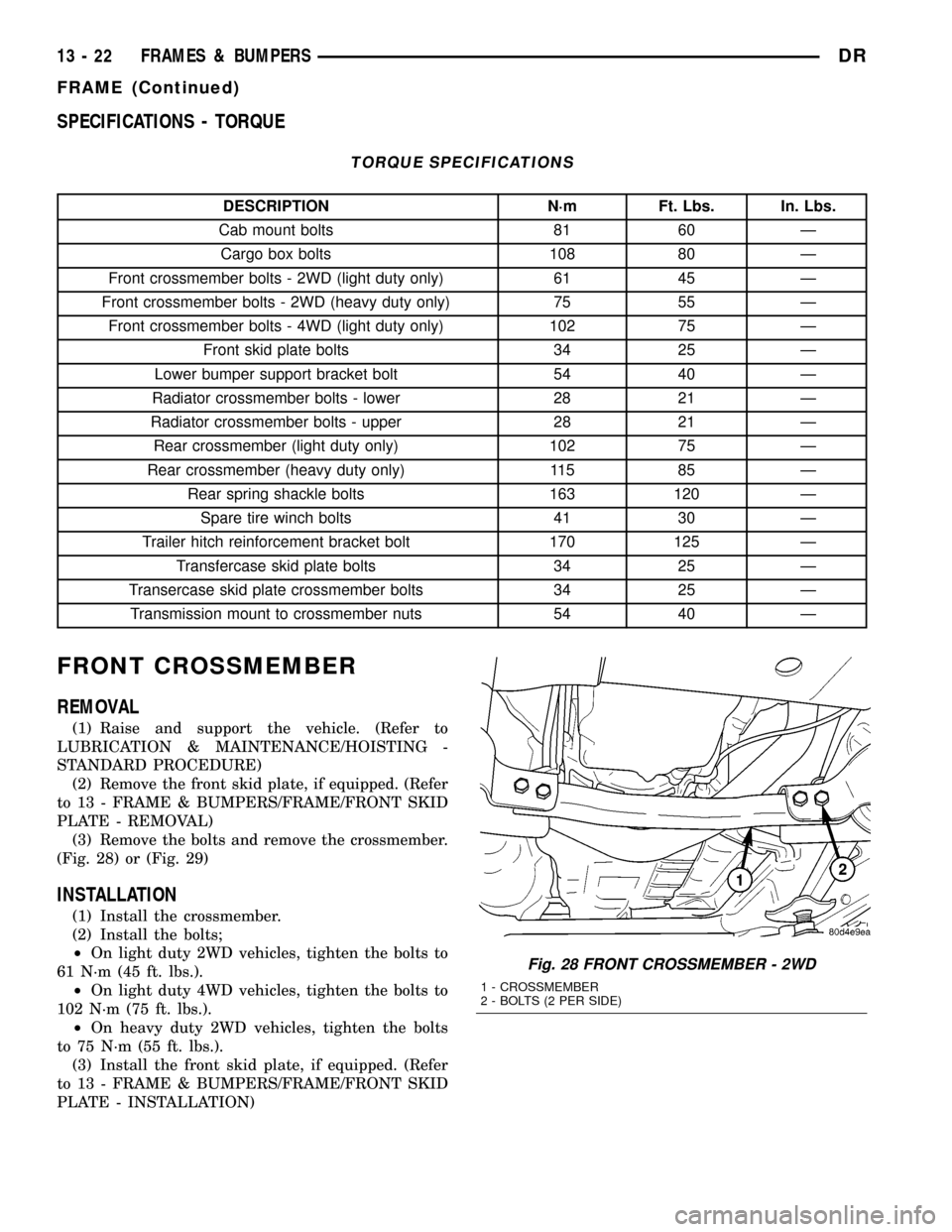
(Fig. 28) or (Fig. 29)
INSTALLATION
(1) Install the crossmember.
(2) Install the bolts;
²On light duty 2WD vehicles, tighten the bolts to
61 N´m (45 ft. lbs.).
²On light duty 4WD vehicles, tighten the bolts to
102 N´m (75 ft. lbs.).
²On heavy duty 2WD vehicles, tighten the bolts
to 75 N´m (55 ft. lbs.).
(3) Install the front skid plate, if equipped. (Refer
to 13 - FRAME & BUMPERS/FRAME/FRONT SKID
PLATE - INSTALLATION)
Fig. 28 FRONT CROSSMEMBER - 2WD
1 - CROSSMEMBER
2 - BOLTS (2 PER SIDE)
13 - 22 FRAMES & BUMPERSDR
FRAME (Continued)
Page 1568 of 2627

TRAILER HITCH
REMOVAL
(1) Remove the rear bumper. (Refer to 13 -
FRAME & BUMPERS/BUMPERS/REAR BUMPER -
REMOVAL)
(2) Remove the hitch bolts. (Fig. 35) and (Fig. 36)
(3) Disconnect all wire harness support push pins.
(4) Remove the rear two cargo box bolts and loosen
the remaining bolts. (Refer to 23 - BODY/EXTERI-
OR/CARGO BOX - REMOVAL)
(5) Using a suitable lifting device, lift and support
the rear of the cargo box and remove the hitch.
INSTALLATION
(1) Install the hitch onto the frame rails and make
sure the locators on the inside of the hitch brackets
are engaged with the holes in the top of the frame
rails properly.
(2) Lower the cargo box and install the rear bolts.
(Refer to 23 - BODY/EXTERIOR/CARGO BOX -
INSTALLATION)
(3) Install the hitch bolts and tighten to 170 N´m
(125 ft. lbs.).
(4) Connect all wire harness support push pins.
(5) Install the rear bumper. (Refer to 13 - FRAME
& BUMPERS/BUMPERS/REAR BUMPER - INSTAL-
LATION)
Fig. 35 TRAILER HITCH ± LIGHT DUTY
1 - LOCATING TAB HOLE
2 - LOCATING PIN HOLE
3 - U-NUTS (2)
4 - BUMPER SUPPORT BRACKETS5 - HITCH
6 - BUMPER BRACKET BOLTS (4)
7 - HITCH BOLTS (4)
DRFRAMES & BUMPERS 13 - 25
Page 1569 of 2627

TRANSFER CASE SKID PLATE
REMOVAL
(1) Raise and support the vehicle. (Refer to
LUBRICATION & MAINTENANCE/HOISTING -
STANDARD PROCEDURE)
(2) Support the skid plate and remove the bolts.
(Fig. 37)
(3) Remove the skid plate.
(4) Support the skid plate crossmember and
remove the bolts.
(5) Remove the skid plate crossmember.
INSTALLATION
(1) Install the skid plate crossmember and install
the bolts.
(2) Tighten the bolts to 34 N´m (25 ft. lbs.).
(3) Install the skid plate and install the bolts.
(4) Tighten the bolts to 34 N´m (25 ft. lbs.).
Fig. 37 TRANSFER CASE SKID PLATE
1 - CROSSMEMBER BOLTS (4)
2 - SKID PLATE CROSSMEMBER
3 - SKID PLATE
4 - SKID PLATE BOLTS (4)
Fig. 36 TRAILER HITCH ± HEAVY DUTY
1 - LOCATING TAB HOLE
2 - LOCATING PIN HOLE
3 - U-NUTS (2)
4 - BUMPER SUPPORT BRACKETS5 - HITCH
6 - HITCH TO FRAME NUTS (2)
7 - BUMPER BRACKET BOLTS (4)
8 - HITCH BOLTS (6)
13 - 26 FRAMES & BUMPERSDR
TRAILER HITCH (Continued)
Page 1905 of 2627

(2) Heavy duty operation with a vehicle not prop-
erly equipped for this type of operation. Trailer tow-
ing or similar high load operation will overheat the
transmission fluid if the vehicle is improperly
equipped. Such vehicles should have an auxiliary
transmission fluid cooler, a heavy duty cooling sys-
tem, and the engine/axle ratio combination needed to
handle heavy loads.
DIAGNOSIS AND TESTING - FLUID
CONTAMINATION
Transmission fluid contamination is generally a
result of:
²adding incorrect fluid
²failure to clean dipstick and fill tube when
checking level
²engine coolant entering the fluid
²internal failure that generates debris
²overheat that generates sludge (fluid break-
down)
²failure to replace contaminated converter after
repair
The use of non-recommended fluids can result in
transmission failure. The usual results are erratic
shifts, slippage, abnormal wear and eventual failure
due to fluid breakdown and sludge formation. Avoid
this condition by using recommended fluids only.
The dipstick cap and fill tube should be wiped
clean before checking fluid level. Dirt, grease and
other foreign material on the cap and tube could fall
into the tube if not removed beforehand. Take the
time to wipe the cap and tube clean before withdraw-
ing the dipstick.
Engine coolant in the transmission fluid is gener-
ally caused by a cooler malfunction. The only remedy
is to replace the radiator as the cooler in the radiator
is not a serviceable part. If coolant has circulated
through the transmission, an overhaul is necessary.
The torque converter should also be replaced when-
ever a failure generates sludge and debris. This is
necessary because normal converter flushing proce-
dures will not remove all contaminants.
STANDARD PROCEDURE
STANDARD PROCEDURE - FLUID LEVEL
CHECK
Low fluid level can cause a variety of conditions
because it allows the pump to take in air along with
the fluid. As in any hydraulic system, air bubbles
make the fluid spongy, therefore, pressures will be
low and build up slowly.
Improper filling can also raise the fluid level too
high. When the transmssion has too much fluid, thegeartrain churns up foam and cause the same condi-
tions which occur with a low fluid level.
In either case, air bubbles can cause overheating
and/or fluid oxidation, and varnishing. This can
interfere with normal valve, clutch, and accumulator
operation. Foaming can also result in fluid escaping
from the transmission vent where it may be mis-
taken for a leak.
After the fluid has been checked, seat the dipstick
fully to seal out water and dirt.
The transmission has a dipstick to check oil level.
It is located on the right side of the engine. Be sure
to wipe all dirt from dipstick handle before removing.
Fluid level is checked with the engine running at
curb idle speed, the transmission in NEUTRAL and
the transmission fluid at normal operating tempera-
ture.The engine should be running at idle
speed for at least one minute, with the vehicle
on level ground.
The transmission fluid level can be checked two
ways.
PROCEDURE ONE
(1) Transmission fluid must be at normal operat-
ing temperature for accurate fluid level check. Drive
vehicle if necessary to bring fluid temperature up to
normal hot operating temperature of 82ÉC (180ÉF).
(2) Position vehicle on level surface.
(3) Start and run engine at curb idle speed.
(4) Apply parking brakes.
(5) Shift transmission momentarily into all gear
ranges. Then shift transmission back to NEUTRAL.
(6) Clean top of filler tube and dipstick to keep
dirt from entering tube.
(7) Remove dipstick (Fig. 87) and check fluid level
as follows:
(a) Correct acceptable level is in crosshatch area.
(b) Correct maximum level is to MAX arrow
mark.
(c) Incorrect level is at or below MIN line.
(d) If fluid is low, add only enough MopartAT F
+4 to restore correct level. Do not overfill.
Fig. 87 Dipstick Fluid Level Marks - Typical
1 - DIPSTICK
2 - MAXIMUM CORRECT FLUID LEVEL
3 - ACCEPTABLE FLUID LEVEL
21 - 202 AUTOMATIC TRANSMISSION - 48REDR
FLUID AND FILTER (Continued)
Page 2069 of 2627

FLUID AND FILTER
DIAGNOSIS AND TESTING
DIAGNOSIS AND TESTING - EFFECTS OF
INCORRECT FLUID LEVEL
A low fluid level allows the pump to take in air
along with the fluid. Air in the fluid will cause fluid
pressures to be low and develop slower than normal.
If the transmission is overfilled, the gears churn the
fluid into foam. This aerates the fluid and causing
the same conditions occurring with a low level. In
either case, air bubbles cause fluid overheating, oxi-
dation and varnish buildup which interferes with
valve and clutch operation. Foaming also causes fluid
expansion which can result in fluid overflow from the
transmission vent or fill tube. Fluid overflow can eas-
ily be mistaken for a leak if inspection is not careful.
DIAGNOSIS AND TESTING - CAUSES OF
BURNT FLUID
Burnt, discolored fluid is a result of overheating
which has three primary causes.
(1) Internal clutch slippage, usually caused by low
line pressure, inadequate clutch apply pressure, or
clutch seal failure.
(2) A result of restricted fluid flow through the
main and/or auxiliary cooler. This condition is usu-
ally the result of a faulty or improperly installed
drainback valve, a damaged main cooler, or severe
restrictions in the coolers and lines caused by debris
or kinked lines.
(3) Heavy duty operation with a vehicle not prop-
erly equipped for this type of operation. Trailer tow-
ing or similar high load operation will overheat the
transmission fluid if the vehicle is improperly
equipped. Such vehicles should have an auxiliary
transmission fluid cooler, a heavy duty cooling sys-
tem, and the engine/axle ratio combination needed to
handle heavy loads.
DIAGNOSIS AND TESTING - FLUID
CONTAMINATION
Transmission fluid contamination is generally a
result of:
²adding incorrect fluid
²failure to clean dipstick and fill tube when
checking level
²engine coolant entering the fluid
²internal failure that generates debris
²overheat that generates sludge (fluid break-
down)
²failure to replace contaminated converter after
repairThe use of non-recommended fluids can result in
transmission failure. The usual results are erratic
shifts, slippage, abnormal wear and eventual failure
due to fluid breakdown and sludge formation. Avoid
this condition by using recommended fluids only.
The dipstick cap and fill tube should be wiped
clean before checking fluid level. Dirt, grease and
other foreign material on the cap and tube could fall
into the tube if not removed beforehand. Take the
time to wipe the cap and tube clean before withdraw-
ing the dipstick.
Engine coolant in the transmission fluid is gener-
ally caused by a cooler malfunction. The only remedy
is to replace the radiator as the cooler in the radiator
is not a serviceable part. If coolant has circulated
through the transmission, an overhaul is necessary.
The torque converter should also be replaced when-
ever a failure generates sludge and debris. This is
necessary because normal converter flushing proce-
dures will not remove all contaminants.
STANDARD PROCEDURE
STANDARD PROCEDURE - FLUID LEVEL
CHECK
Low fluid level can cause a variety of conditions
because it allows the pump to take in air along with
the fluid. As in any hydraulic system, air bubbles
make the fluid spongy, therefore, pressures will be
low and build up slowly.
Improper filling can also raise the fluid level too
high. When the transmssion has too much fluid, the
geartrain churns up foam and cause the same condi-
tions which occur with a low fluid level.
In either case, air bubbles can cause overheating
and/or fluid oxidation, and varnishing. This can
interfere with normal valve, clutch, and accumulator
operation. Foaming can also result in fluid escaping
from the transmission vent where it may be mis-
taken for a leak.
After the fluid has been checked, seat the dipstick
fully to seal out water and dirt.
The transmission has a dipstick to check oil level.
It is located on the right side of the engine. Be sure
to wipe all dirt from dipstick handle before removing.
The torque converter fills in both the P (PARK)
and N (NEUTRAL) positions. Place the selector lever
in P (PARK) to be sure that the fluid level check is
accurate.The engine should be running at idle
speed for at least one minute, with the vehicle
on level ground.At normal operating temperature
(approximately 82 C. or 180 F.), the fluid level is cor-
rect if it is in the HOT region (cross-hatched area) on
the oil level indicator. The fluid level will be approx-
21 - 366 AUTOMATIC TRANSMISSION - 45RFE/545RFEDR
Page 2603 of 2627

HEATED SEAT MODULE - INSTALLATION . . . 8E-7
HEATED SEAT MODULE - INSTALLATION . . 8G-15
HEATED SEAT MODULE - OPERATION.....8E-6
HEATED SEAT MODULE - OPERATION....8G-14
HEATED SEAT MODULE - REMOVAL.......8E-7
HEATED SEAT MODULE - REMOVAL.....8G-15
HEATED SEAT SENSOR - DESCRIPTION . . . 8G-11
HEATED SEAT SENSOR - DIAGNOSIS
AND TESTING.......................8G-11
HEATED SEAT SENSOR - OPERATION....8G-11
HEATED SEAT SENSOR - REMOVAL......8G-11
HEATED SEAT SWITCH - DESCRIPTION . . . 8G-11
HEATED SEAT SWITCH - DIAGNOSIS
AND TESTING.......................8G-12
HEATED SEAT SWITCH - INSTALLATION . . 8G-13
HEATED SEAT SWITCH - OPERATION.....8G-12
HEATED SEAT SWITCH - REMOVAL......8G-13
HEATED SEAT SYSTEM - DESCRIPTION....8G-7
HEATED SEAT SYSTEM - DIAGNOSIS
AND TESTING........................8G-8
HEATED SEAT SYSTEM - OPERATION.....8G-8
HEATER - 5.9L DIESEL - DESCRIPTION,
ENGINE BLOCK.......................7-37
HEATER - 5.9L DIESEL - INSTALLATION,
ENGINE BLOCK.......................7-38
HEATER - 5.9L DIESEL - OPERATION,
ENGINE BLOCK.......................7-38
HEATER - 5.9L DIESEL - REMOVAL,
ENGINE BLOCK.........................7-38
HEATER - DESCRIPTION, ENGINE BLOCK . . . 7-36
HEATER - DESCRIPTION, FUEL..........14-51
HEATER - DESCRIPTION, INTAKE AIR.....14-80
HEATER - DIAGNOSIS AND TESTING,
ENGINE BLOCK.......................7-36
HEATER - DIAGNOSIS AND TESTING,
FUEL..............................14-52
HEATER - INSTALLATION, ENGINE
BLOCK..............................7-37
HEATER - INSTALLATION, INTAKE AIR....14-80
HEATER - OPERATION, ENGINE BLOCK....7-36
HEATER - OPERATION, FUEL............14-51
HEATER - OPERATION, INTAKE AIR......14-80
HEATER - REMOVAL, ENGINE BLOCK......7-37
HEATER - REMOVAL, INTAKE AIR........14-80
HEATER AND AIR CONDITIONER -
DESCRIPTION........................24-1
HEATER AND AIR CONDITIONER -
OPERATION..........................24-1
HEATER CONTROL - DESCRIPTION, A/C . . . 24-14
HEATER CONTROL - INSTALLATION, A/C . . 24-15
HEATER CONTROL - REMOVAL, A/C......24-15
HEATER CORE - DESCRIPTION..........24-63
HEATER CORE - INSTALLATION.........24-63
HEATER CORE - OPERATION............24-63
HEATER CORE - REMOVAL.............24-63
HEATER INLET HOSE - INSTALLATION....24-64
HEATER INLET HOSE - REMOVAL........24-64
HEATER PERFORMANCE TEST -
DIAGNOSIS AND TESTING..............24-6
HEATER RELAY - DESCRIPTION, FUEL....14-52
HEATER RELAY - DESCRIPTION, INTAKE
AIR ...............................14-82
HEATER RELAY - INSTALLATION, FUEL . . . 14-53
HEATER RELAY - INSTALLATION, INTAKE
AIR ...............................14-82
HEATER RELAY - OPERATION, FUEL......14-52
HEATER RELAY - OPERATION, INTAKE
AIR ...............................14-82
HEATER RELAY - REMOVAL, FUEL.......14-52
HEATER RELAY - REMOVAL, INTAKE AIR . . 14-82
HEATER RETURN HOSE - INSTALLATION . . 24-65
HEATER RETURN HOSE - REMOVAL......24-64
HEIGHT ADJUSTMENT - 4WD (LD) -
STANDARD PROCEDURE.................2-3
HEIGHT MEASUREMENT - 4WD (LD) -
STANDARD PROCEDURE.................2-3
HEMI ENGINE - INSTALLATION, 3.7L/4.7L
AND 5.7L......................24-59,24-73
HEMI ENGINE - REMOVAL, 3.7L/4.7L
AND 5.7L......................24-57,24-71
HIGH BEAM INDICATOR - DESCRIPTION
. . 8J-28
HIGH BEAM INDICATOR - OPERATION
....8J-28
HIGH MOUNTED STOP LAMP -
INSTALLATION, CENTER
...............8L-11
HIGH MOUNTED STOP LAMP -
REMOVAL, CENTER
...................8L-11
HIGH MOUNTED STOP LAMP UNIT -
INSTALLATION, CENTER
...............8L-11HIGH MOUNTED STOP LAMP UNIT -
REMOVAL, CENTER...................8L-11
HIGH PRESSURE RELIEF VALVE -
DESCRIPTION.......................24-48
HIGH PRESSURE RELIEF VALVE -
OPERATION.........................24-48
HIGH SPEEDS - DESCRIPTION, TIRE
PRESSURE..........................22-7
HIGH/LOW RELAY - DESCRIPTION,
WIPER.............................8R-20
HIGH/LOW RELAY - DIAGNOSIS AND
TESTING, WIPER.....................8R-21
HIGH/LOW RELAY - INSTALLATION,
WIPER.............................8R-22
HIGH/LOW RELAY - OPERATION, WIPER . . 8R-20
HIGH/LOW RELAY - REMOVAL, WIPER . . . 8R-21
HIGH-PRESSURE FUEL LINE LEAKS -
DIAGNOSIS AND TESTING.............14-58
HINGE - INSTALLATION.....23-16,23-22,23-31,
23-46
HINGE - INSTALLATION, CENTER SEAT
BACK..............................23-79
HINGE - REMOVAL....23-16,23-22,23-31,23-46
HINGE - REMOVAL, CENTER SEAT BACK . . 23-78
HINGE COVER - INSTALLATION, CENTER
SEAT BACK INERTIA..................23-77
HINGE COVER - REMOVAL, CENTER
SEAT BACK INERTIA..................23-77
HITCH - INSTALLATION, TRAILER........13-25
HITCH - REMOVAL, TRAILER...........13-25
HOAT COOLANT - DESCRIPTION..........7-32
HOISTING - STANDARD PROCEDURE......0-20
HOLDDOWN - DESCRIPTION, BATTERY . . . 8F-14
HOLDDOWN - INSTALLATION, BATTERY . . . 8F-14
HOLDDOWN - OPERATION, BATTERY.....8F-14
HOLDDOWN - REMOVAL, BATTERY......8F-14
HOLDER - INSTALLATION, CUP.........23-51
HOLDER - REMOVAL, CUP.............23-51
HOLDING CLUTCHES - DESCRIPTION....21-371
HOLDING CLUTCHES - OPERATION.....21-372
HOLE PLUG - INSTALLATION, CAMSHAFT
CORE..............................9-206
HOLE PLUG - REMOVAL, CAMSHAFT
CORE..............................9-205
HOLE REPAIR - DESCRIPTION,
THREADED........................Intro.-8
HONING - STANDARD PROCEDURE,
CYLINDER BORE.................9-128,9-38
HOOD - INSTALLATION................23-47
HOOD - REMOVAL....................23-46
HOOK - INSTALLATION, COAT...........23-66
HOOK - REMOVAL, COAT..............23-66
HOOK ASSEMBLY - INSTALLATION,
FRONT TOW........................13-23
HOOK ASSEMBLY - REMOVAL, FRONT
TOW ..............................13-23
HORN - DIAGNOSIS AND TESTING.......8H-1
HORN - INSTALLATION.................8H-2
HORN - REMOVAL....................8H-2
HORN SWITCH - DESCRIPTION..........8H-2
HORN SWITCH - DIAGNOSIS AND
TESTING............................8H-2
HORN SYSTEM - DESCRIPTION..........8H-1
HORN SYSTEM - DIAGNOSIS AND
TESTING............................8H-1
HORN SYSTEM - OPERATION............8H-1
HOSE - GEAR TO COOLER -
INSTALLATION, RETURN..........19-44,19-45
HOSE - GEAR TO COOLER - REMOVAL,
RETURN......................19-44,19-45
HOSE - INSTALLATION, FRONT BRAKE.....5-13
HOSE - INSTALLATION, HEATER INLET....24-64
HOSE - INSTALLATION, HEATER RETURN . 24-65
HOSE - INSTALLATION, PRESSURE . 19-44,19-45
HOSE - INSTALLATION, REAR BRAKE......5-12
HOSE - REMOVAL, FRONT..............5-12
HOSE - REMOVAL, HEATER INLET.......24-64
HOSE - REMOVAL, HEATER RETURN.....24-64
HOSE - REMOVAL, PRESSURE.....19-44,19-45
HOSE - REMOVAL, REAR BRAKE
.........5-11
HOSE - RESERVOIR TO COOLER -
INSTALLATION, RETURN
..........19-44,19-45
HOSE - RESERVOIR TO COOLER -
REMOVAL, RETURN
.............19-44,19-45
HOSE ASSEMBLY - INSTALLATION, REAR
TUBE
...............................5-13
HOSE ASSEMBLY - REMOVAL, REAR
TUBE
...............................5-12HOSE CLAMPS - DESCRIPTION...........7-3
HOSE CLAMPS - OPERATION.............7-5
HOSES/TUBES - DESCRIPTION, WASHER . 8R-11
HOSES/TUBES - OPERATION, WASHER . . . 8R-11
HOUSING - ASSEMBLY, HVAC...........24-35
HOUSING - DIAGNOSIS AND TESTING,
CLUTCH..............................6-7
HOUSING - DISASSEMBLY, HVAC........24-35
HOUSING - INSTALLATION, CLUTCH.......6-9
HOUSING - INSTALLATION, GEAR........9-300
HOUSING - INSTALLATION, HVAC........24-36
HOUSING - INSTALLATION, ROCKER.....9-255
HOUSING - REMOVAL, CLUTCH...........6-9
HOUSING - REMOVAL, GEAR...........9-299
HOUSING - REMOVAL, HVAC...........24-34
HOUSING - REMOVAL, ROCKER.........9-255
HOUSING BUSHING AND SEAL -
INSTALLATION, EXTENSION...........21-440
HOUSING BUSHING AND SEAL -
REMOVAL, EXTENSION...............21-440
HOUSING COVER - INSTALLATION, GEAR . 9-301
HOUSING COVER - REMOVAL, GEAR.....9-301
HOUSING FLUID LEAK - DIAGNOSIS AND
TESTING, CONVERTER.........21-144,21-318
HOUSING SEAL - INSTALLATION,
ADAPTER...............21-128,21-364,21-85
HOUSING SEAL - INSTALLATION,
EXTENSION . 21-128,21-201,21-507,21-536,21-85
HOUSING SEAL - REMOVAL, ADAPTER . . 21-128,
21-364,21-85
HOUSING SEAL - REMOVAL,
EXTENSION . 21-128,21-201,21-507,21-536,21-85
HOUSING SEAL AND DUST BOOT -
INSTALLATION, EXTENSION.....21-476,21-571
HOUSING SEAL AND DUST BOOT -
REMOVAL, EXTENSION.........21-476,21-571
HOW TO USE WIRING DIAGRAMS -
DESCRIPTION.....................8W-01-1
H-SECTION REPLACEMENT - STANDARD
PROCEDURE, REAR FRAME............13-13
HUB / BEARING - INSTALLATION.........2-32
HUB / BEARING - REMOVAL.............2-31
HVAC HOUSING - ASSEMBLY...........24-35
HVAC HOUSING - DISASSEMBLY........24-35
HVAC HOUSING - INSTALLATION........24-36
HVAC HOUSING - REMOVAL............24-34
HYDRAULIC BOOSTER - DIAGNOSIS
AND TESTING........................5-30
HYDRAULIC LASH ADJUSTER -
DIAGNOSIS AND TESTING.........9-125,9-32
HYDRAULIC PRESSURE TEST -
DIAGNOSIS AND TESTING......21-141,21-316
HYDRAULIC SCHEMATICS, SCHEMATICS
AND DIAGRAMS..............21-176,21-337
HYDRAULIC TAPPETS - DIAGNOSIS AND
TESTING...........................9-210
HYDRAULIC TAPPETS - INSTALLATION . . . 9-211
HYDRAULIC TAPPETS - REMOVAL.......9-211
HYDROBOOST - INSTALLATION..........5-27
HYDROBOOST - INSTALLATION, ALL
EXCEPT.............................5-27
HYDROBOOST - REMOVAL..............5-26
HYDROBOOST - REMOVAL, ALL EXCEPT . . . 5-26
HYDRO-BOOST BRAKE BOOSTER -
INSTALLATION........................5-32
HYDRO-BOOST BRAKE BOOSTER -
REMOVAL
...........................5-31
HYDROFORM FENDER RAIL REPAIR -
STANDARD PROCEDURE
...............13-11
HYDROSTATIC LOCK - STANDARD
PROCEDURE
...................9-190,9-240
IDENTIFICATION - DESCRIPTION,
FASTENER
.........................Intro.-5
IDENTIFICATION AND INFORMATION -
DESCRIPTION, SECTION
.............8W-01-6
IDENTIFICATION NUMBER -
DESCRIPTION, VEHICLE
..............Intro.-1
IDLE AIR CONTROL MOTOR -
DESCRIPTION
.......................14-28
IDLE AIR CONTROL MOTOR -
INSTALLATION
.......................14-29
IDLE AIR CONTROL MOTOR -
OPERATION
.........................14-28
IDLE AIR CONTROL MOTOR - REMOVAL
. . 14-29
IDLER SHAFT - INSTALLATION
......9-179,9-81
IDLER SHAFT - REMOVAL
..........9-179,9-81
IGNITION - SPECIFICATIONS, TORQUE
.....8I-3
16 INDEXDR
Description Group-Page Description Group-Page Description Group-Page