1998 DODGE RAM 1500 Fluid
[x] Cancel search: FluidPage 2275 of 2627

(6) Fill transfer case to bottom edge of fill plug
opening with MopartATF +4, Automatic Transmis-
sion fluid.
(7) Install and tighten fill plug to 41-54 N´m
(30-40 ft. lbs.).
(8) Lower vehicle.
FRONT OUTPUT SHAFT SEAL
REMOVAL
(1) Remove the front propeller shaft (Refer to 3 -
DIFFERENTIAL & DRIVELINE/PROPELLER
SHAFT/PROPELLER SHAFT - REMOVAL).
(2) Install two bolts 180É apart into the front out-
put shaft companion flange.
(3) Place holder over the bolts and against the
companion flange (Fig. 92).
(4) Remove and discard the front companion flange
nut.
(5) Remove the companion flange from the front
output shaft. It may be necessary to use Flange
puller 8992 to remove the companion flange.
(6) Using a screw and a slide hammer, remove the
front output shaft seal.
INSTALLATION
(1) Install the new front output shaft seal with
Installer MB991168A.
(2) Install the front companion flange onto the
front output shaft.
(3) Install two bolts 180É apart into the front out-
put shaft companion flange.
(4) Place holder over the bolts and against the
companion flange (Fig. 93).
(5) Install a new front companion flange nut.
Tighten the companion flange nut to 258-312 N´m
(190-230 ft.lbs.).
(6) Install front propeller shaft (Refer to 3 - DIF-
FERENTIAL & DRIVELINE/PROPELLER SHAFT/
PROPELLER SHAFT - INSTALLATION).
Fig. 92 Remove Companion Flange Nut
1 - HOLDER 6719
2 - BOLTS
Fig. 93 Install Companion Flange Nut
1 - HOLDER 6719
2 - BOLTS
21 - 572 TRANSFER CASE - NV273DR
FLUID (Continued)
Page 2540 of 2627

REMOVAL - 5.9L DIESEL ENGINE
WARNING: REVIEW THE WARNINGS AND CAU-
TIONS IN THE FRONT OF THIS SECTION BEFORE
PERFORMING THE FOLLOWING OPERATION (Refer
to 24 - HEATING & AIR CONDITIONING/PLUMBING -
WARNING) and (Refer to 24 - HEATING & AIR CON-
DITIONING/PLUMBING - CAUTION).
(1) Disconnect and isolate the battery negative
cable.
(2) Recover the refrigerant from the refrigerant
system (Refer to 24 - HEATING & AIR CONDITION-
ING/PLUMBING - STANDARD PROCEDURE -
REFRIGERANT RECOVERY).
(3) Remove the plastic cover from the condenser
inlet stud.
(4) Remove the nut that secures the discharge line
fitting to the condenser inlet port (Fig. 12).
(5) Disconnect the discharge line from the con-
denser.
(6) Remove the seal from the discharge line fitting
and discard.
(7) Install plugs in, or tape over the discharge line
fitting and condenser inlet port.
(8) Remove the plastic cover from the condenser
outlet stud.
(9) Remove the nut that secures the liquid line fit-
ting to the condenser outlet.
(10) Disconnect the liquid line from the condenser.
(11) Remove the seal from the liquid line fitting
and discard.
(12) Install plugs in, or tape over the liquid line
fitting and condenser inlet port.
(13) Remove the four bolts that secure the con-
denser to the charge air cooler.
(14) Remove the condenser from the engine com-
partment.
INSTALLATION
INSTALLATION - 3.7, 4.7 AND 5.7L ENGINES
NOTE: If the condenser is replaced, add 30 millili-
ters (1 fluid ounce) of refrigerant oil to the refriger-
ant system. Use only refrigerant oil of the type
recommended for the compressor in the vehicle.
(1) Position the condenser cooling fan onto the A/C
condenser.
(2) Install and tighten the four screws that secure
the condenser cooling fan to the A/C condenser.
Tighten the screws to 2.2 N´m (20 in. lbs.).
(3) Carefully position the condenser/cooling fan
assembly into the engine compartment.
Fig. 10 A/C Discharge Line - 3.7L Shown, 4.7L/5.7L
Typical
1 - NUT
2 - FRONT UPPER CROSSMEMBER
3 - A/C CONDENSER
4 - NUT (2)
5 - SUCTION LINE
6 - A/C COMPRESSOR
7 - A/C PRESSURE TRANSDUCER
8 - WIRE HARNESS CONNECTOR
9 - A/C DISCHARGE LINE
Fig. 11 Condenser/Cooling Fan Assembly
1 - LH MOUNTING BOLT
2 - FRONT UPPER CROSSMEMBER
3 - LOWER MOUNTING FLANGE
4 - UPPER MOUNTING SCREW (2)
5 - LOWER MOUNTING SCREW (2)
6 - MOUNTING TABS
7 - CONDENSER COOLING FAN MOTOR
8 - COOLING FAN WIRE CONNECTOR
9 - RH MOUNTING BOLT
DRPLUMBING 24 - 53
A/C CONDENSER (Continued)
Page 2541 of 2627

(4) Align the condenser lower mounting tabs to the
mounting flanges.
(5) Install the two bolts that secure the condenser/
cooling fan assembly to the upper front crossmember.
Tighten the bolts to 10.5 N´m (95 in. lbs.).
(6) Connect the wire harness connector to the con-
denser cooling fan motor.
(7) Remove the tape or plugs from the liquid line
fitting and condenser outlet port.
(8) Lubricate a new rubber O-ring seal with clean
refrigerant oil and install it on the liquid line fitting.
Use only the specified O-ring as it is made of a spe-
cial material for the R-134a system. Use only refrig-
erant oil of the type recommended for the A/C
compressor in the vehicle.
(9) Connect the liquid line to the condenser outlet
port.
(10) Install and tighten the nut that secures the
liquid line fitting to the condenser. Tighten the nut to
20 N´m (180 in. lbs.).
(11) Install the plastic cover onto the condenser
outlet stud.
(12) Remove the tape or plugs from the discharge
line fitting and condenser inlet port.(13) Lubricate a new rubber O-ring seal with clean
refrigerant oil and install it on the discharge line fit-
ting. Use only the specified O-ring as it is made of a
special material for the R-134a system. Use only
refrigerant oil of the type recommended for the A/C
compressor in the vehicle.
(14) Connect the discharge line to the condenser
inlet port.
(15) Install and tighten the nut that secures the
discharge line fitting to the condenser. Tighten the
nut to 20 N´m (180 in. lbs.).
(16) Reconnect the battery negative cable.
(17) Evacuate the refrigerant system (Refer to 24 -
HEATING & AIR CONDITIONING/PLUMBING -
STANDARD PROCEDURE - REFRIGERANT SYS-
TEM EVACUATE).
(18) Charge the refrigerant system (Refer to 24 -
HEATING & AIR CONDITIONING/PLUMBING -
STANDARD PROCEDURE - REFRIGERANT SYS-
TEM CHARGE).
INSTALLATION - 5.9L DIESEL ENGINE
NOTE: If the condenser is replaced, add 30 millili-
ters (1 fluid ounce) of refrigerant oil to the refriger-
ant system. Use only refrigerant oil of the type
recommended for the compressor in the vehicle.
(1) Position the condenser into the engine compart-
ment.
(2) Install the four bolts that secure the condenser
to the charge air cooler. Tighten the bolts to 10.5 N´m
(95 in. lbs.).
(3) Remove the tape or plugs from the liquid line
fitting and condenser outlet port.
(4) Lubricate a new rubber O-ring seal with clean
refrigerant oil and install it on the liquid line fitting.
Use only the specified O-ring as it is made of a spe-
cial material for the R-134a system. Use only refrig-
erant oil of the type recommended for the A/C
compressor in the vehicle.
(5) Connect the liquid line to the condenser outlet
port.
(6) Install and tighten the nut that secures the liq-
uid line fitting to the condenser. Tighten the nut to
20 N´m (180 in. lbs.).
(7) Install the plastic cover onto the condenser out-
let stud.
(8) Remove the tape or plugs from the discharge
line fitting and condenser inlet port.
(9) Lubricate a new rubber O-ring seal with clean
refrigerant oil and install it on the discharge line fit-
ting. Use only the specified O-ring as it is made of a
special material for the R-134a system. Use only
refrigerant oil of the type recommended for the A/C
compressor in the vehicle.
Fig. 12 Condenser - 5.9L Diesel Engine
1 - DISCHARGE LINE
2 - MOUNTING BOLT
3 - LIQUID LINE
4 - MOUNTING BOLT
5 - A/C CONDENSER
6 - MOUNTING BOLT
7 - MOUNTING BOLT
24 - 54 PLUMBINGDR
A/C CONDENSER (Continued)
Page 2547 of 2627

REMOVAL
WARNING: ON VEHICLES EQUIPPED WITH AIR-
BAGS, DISABLE THE AIRBAG SYSTEM BEFORE
ATTEMPTING ANY STEERING WHEEL, STEERING
COLUMN, OR INSTRUMENT PANEL COMPONENT
DIAGNOSIS OR SERVICE. DISCONNECT AND ISO-
LATE THE BATTERY NEGATIVE (GROUND) CABLE,
THEN WAIT TWO MINUTES FOR THE AIRBAG SYS-
TEM CAPACITOR TO DISCHARGE BEFORE PER-
FORMING FURTHER DIAGNOSIS OR SERVICE. THIS
IS THE ONLY SURE WAY TO DISABLE THE AIRBAG
SYSTEM. FAILURE TO TAKE THE PROPER PRE-
CAUTIONS COULD RESULT IN ACCIDENTAL AIR-
BAG DEPLOYMENT AND POSSIBLE PERSONAL
INJURY.
(1) Remove the HVAC housing (Refer to 24 -
HEATING & AIR CONDITIONING/DISTRIBUTION/
HVAC HOUSING - REMOVAL).
(2) Disassemble the HVAC housing to access the
A/C evaporator (Refer to 24 - HEATING & AIR CON-
DITIONING/DISTRIBUTION/HVAC HOUSING -
DISASSEMBLY).
(3) Remove the evaporator temperature sensor
probe from the A/C evaporator.
(4) Lift the A/C evaporator out of the HVAC hous-
ing (Fig. 19).
INSTALLATION
NOTE: If the A/C evaporator is being replaced, add
60 milliliters (2 fluid ounces) of refrigerant oil to the
refrigerant system. Use only refrigerant oil of the
type recommended for the compressor in the vehi-
cle.
(1) Install the A/C evaporator into the HVAC hous-
ing. Make sure that the evaporator drain is clean
and unrestricted and that the evaporator deflector
shield is installed.
(2) Install the evaporator temperature sensor
probe into the A/C evaporator.
(3) Assemble the HVAC housing (Refer to 24 -
HEATING & AIR CONDITIONING/DISTRIBUTION/
HVAC HOUSING - ASSEMBLY).
(4) Install the HVAC housing (Refer to 24 - HEAT-
ING & AIR CONDITIONING/DISTRIBUTION/HVAC
HOUSING - INSTALLATION).
A/C ORIFICE TUBE
DESCRIPTION
The fixed A/C orifice tube (Fig. 20) is installed in
the liquid line between the outlet of the condenser
and the inlet of the evaporator. The A/C orifice tube
is only serviced as an part of the liquid line.
OPERATION
The fixed A/C orifice tube is used to meter the flow
of liquid refrigerant into the evaporator coil. The
high-pressure liquid refrigerant from the condenser
expands into a low-pressure liquid as it passes
through the metering orifice and diffuser screen of
the A/C orifice tube.
The A/C orifice tube is not serviceable. The A/C ori-
fice tube cannot be repaired and, if faulty or plugged,
it must be replaced as part of the liquid line.
Fig. 19 A/C Evaporator - Typical
1 - PASSENGER SIDE BLEND DOOR LEVER
2 - PASSENGER SIDE BLEND DOOR
3 - EVAPORATOR TEMPERATURE SENSOR WIRE
4 - HVAC HOUSING
5 - A/C EVAPORATOR
6 - EVAPORATOR TEMPERATURE SENSOR PROBE
7 - DRIVER SIDE BLEND DOOR
8 - DRIVER SIDE BLEND DOOR LEVER
Fig. 20 Fixed A/C Orifice Tube - Typical
1 - DIFFUSER SCREEN
2 - O-RING SEALS
3 - INLET FILTER SCREEN
4 - ORIFICE
24 - 60 PLUMBINGDR
A/C EVAPORATOR (Continued)
Page 2549 of 2627

ING/PLUMBING - STANDARD PROCEDURE -
REFRIGERANT RECOVERY).
(3) Remove the air filter housing cover to gain
access to the accumulator (Refer to 9 - ENGINE/AIR
INTAKE SYSTEM).
(4) Remove the secondary retaining clip from the
spring-lock coupler that secures the suction line to
the accumulator outlet tube (Fig. 22).
(5) Using the proper A/C line disconnect tool, dis-
connect the suction line from the accumulator outlet
tube (Refer to 24 - HEATING & AIR CONDITION-
ING/PLUMBING/REFRIGERANT LINE COUPLER -
REMOVAL).
(6) Remove the O-ring seal from the accumulator
outlet tube fitting and discard.
(7) Install plugs in, or tape over the opened suc-
tion line and the accumulator outlet tube fitting.
(8) Loosen the bolts that secure the accumulator to
the bracket located on the dash panel.
(9) Remove the secondary retaining clip from the
spring-lock coupler that secures the accumulator to
the evaporator outlet tube.
(10) Using the proper A/C line disconnect tool, dis-
connect the accumulator inlet tube fitting from the
evaporator outlet tube (Refer to 24 - HEATING &
AIR CONDITIONING/PLUMBING/REFRIGERANT
LINE COUPLER - REMOVAL).
(11) Remove the O-ring seal from the accumulator
inlet tube fitting and discard.
(12) Install plugs in, or tape over the opened accu-
mulator inlet tube fitting and the evaporator outlet
tube.
(13) Remove the accumulator from the engine com-
partment.
INSTALLATION
NOTE: If the accumulator is being replaced, add 60
milliliters (2 fluid ounces) of refrigerant oil to the
refrigerant system. Use only refrigerant oil of the
type recommended for the compressor in the vehi-
cle.
(1) Position the accumulator onto the dash panel
bracket in the engine compartment. Do not tighten
the bolts at this time.
(2) Remove the tape or plugs from the accumulator
inlet tube fitting and the evaporator outlet tube.
(3) Lubricate a new rubber O-ring seal with clean
refrigerant oil and install it on the accumulator inlet
tube fitting. Use only the specified O-ring as it is
made of a special material for the R-134a system.
Use only refrigerant oil of the type recommended for
the A/C compressor in the vehicle.
(4) Connect the accumulator inlet tube fitting to
the evaporator outlet tube (Refer to 24 - HEATING &AIR CONDITIONING/PLUMBING/REFRIGERANT
LINE COUPLER - INSTALLATION).
(5) Install the secondary retaining clip onto the
spring-lock coupler that secures the accumulator
inlet tube fitting to the evaporator outlet tube.
(6) Tighten the accumulator bracket bolts to 4.5
N´m (40 in. lbs.).
(7) Remove the tape or plugs from the suction line
fitting and the accumulator outlet tube.
(8) Lubricate a new rubber O-ring seal with clean
refrigerant oil and install it on the accumulator out-
let tube fitting. Use only the specified O-ring as it is
made of a special material for the R-134a system.
Use only refrigerant oil of the type recommended for
the A/C compressor in the vehicle.
(9) Connect the suction line to the accumulator
outlet tube (Refer to 24 - HEATING & AIR CONDI-
TIONING/PLUMBING/REFRIGERANT LINE COU-
PLER - INSTALLATION).
(10) Install the secondary retaining clip onto the
spring-lock coupler that secures the suction line to
the accumulator outlet tube.
(11) Install the air filter housing cover to gain
access to the accumulator (Refer to 9 - ENGINE/AIR
INTAKE SYSTEM).
Fig. 22 A/C Accumulator - Typical
1 - RH INNER FENDER
2 - ACCUMULATOR INLET TUBE
3 - A/C LINE SECONDARY RETAINING CLIP
4 - EVAPORATOR OUTLET TUBE
5 - BOLTS (2)
6 - ACCUMULATOR
7 - SUCTION LINE
8 - A/C LOW PRESSURE SERVICE PORT
9 - A/C LINE SECONDARY RETAINING CLIP
24 - 62 PLUMBINGDR
ACCUMULATOR (Continued)
Page 2556 of 2627
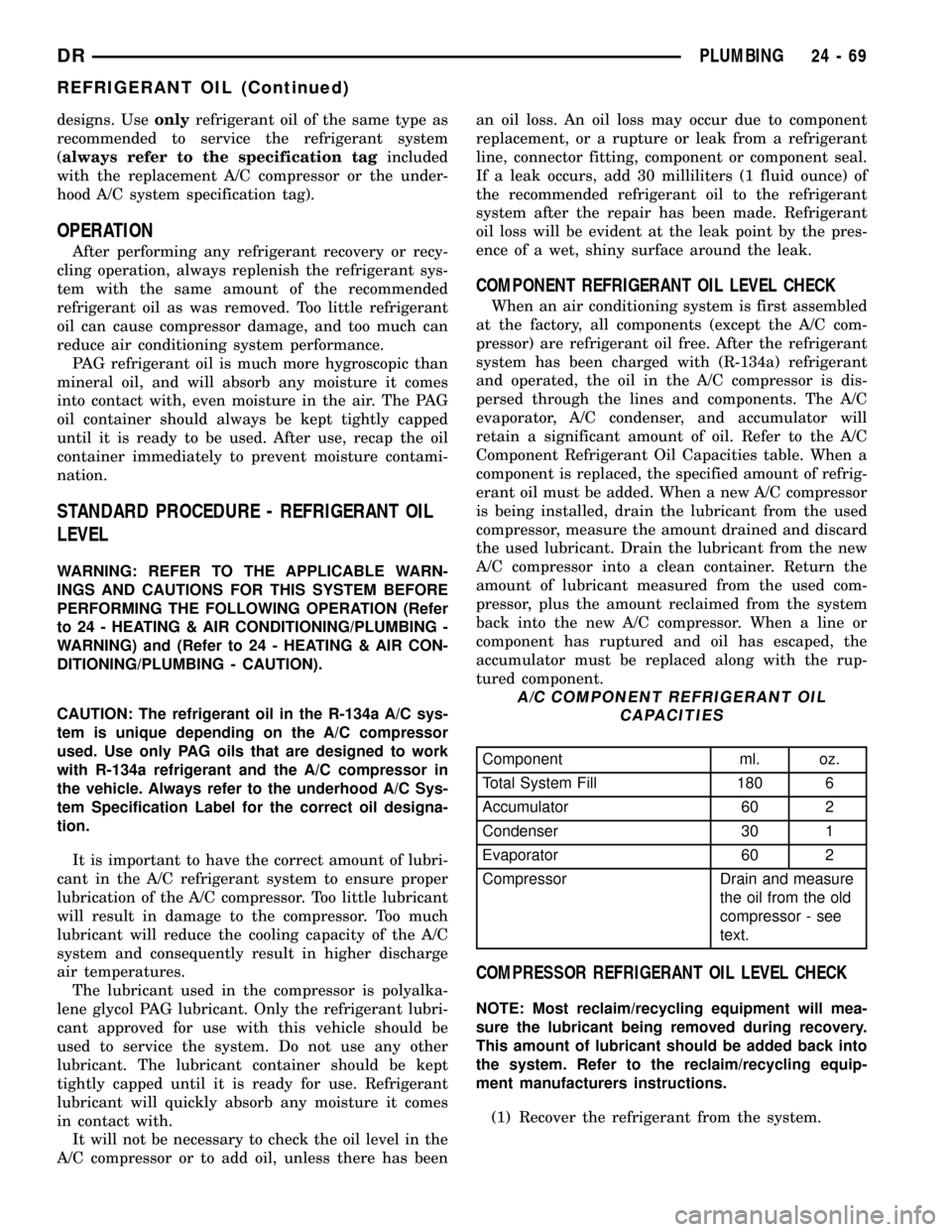
designs. Useonlyrefrigerant oil of the same type as
recommended to service the refrigerant system
(always refer to the specification tagincluded
with the replacement A/C compressor or the under-
hood A/C system specification tag).
OPERATION
After performing any refrigerant recovery or recy-
cling operation, always replenish the refrigerant sys-
tem with the same amount of the recommended
refrigerant oil as was removed. Too little refrigerant
oil can cause compressor damage, and too much can
reduce air conditioning system performance.
PAG refrigerant oil is much more hygroscopic than
mineral oil, and will absorb any moisture it comes
into contact with, even moisture in the air. The PAG
oil container should always be kept tightly capped
until it is ready to be used. After use, recap the oil
container immediately to prevent moisture contami-
nation.
STANDARD PROCEDURE - REFRIGERANT OIL
LEVEL
WARNING: REFER TO THE APPLICABLE WARN-
INGS AND CAUTIONS FOR THIS SYSTEM BEFORE
PERFORMING THE FOLLOWING OPERATION (Refer
to 24 - HEATING & AIR CONDITIONING/PLUMBING -
WARNING) and (Refer to 24 - HEATING & AIR CON-
DITIONING/PLUMBING - CAUTION).
CAUTION: The refrigerant oil in the R-134a A/C sys-
tem is unique depending on the A/C compressor
used. Use only PAG oils that are designed to work
with R-134a refrigerant and the A/C compressor in
the vehicle. Always refer to the underhood A/C Sys-
tem Specification Label for the correct oil designa-
tion.
It is important to have the correct amount of lubri-
cant in the A/C refrigerant system to ensure proper
lubrication of the A/C compressor. Too little lubricant
will result in damage to the compressor. Too much
lubricant will reduce the cooling capacity of the A/C
system and consequently result in higher discharge
air temperatures.
The lubricant used in the compressor is polyalka-
lene glycol PAG lubricant. Only the refrigerant lubri-
cant approved for use with this vehicle should be
used to service the system. Do not use any other
lubricant. The lubricant container should be kept
tightly capped until it is ready for use. Refrigerant
lubricant will quickly absorb any moisture it comes
in contact with.
It will not be necessary to check the oil level in the
A/C compressor or to add oil, unless there has beenan oil loss. An oil loss may occur due to component
replacement, or a rupture or leak from a refrigerant
line, connector fitting, component or component seal.
If a leak occurs, add 30 milliliters (1 fluid ounce) of
the recommended refrigerant oil to the refrigerant
system after the repair has been made. Refrigerant
oil loss will be evident at the leak point by the pres-
ence of a wet, shiny surface around the leak.
COMPONENT REFRIGERANT OIL LEVEL CHECK
When an air conditioning system is first assembled
at the factory, all components (except the A/C com-
pressor) are refrigerant oil free. After the refrigerant
system has been charged with (R-134a) refrigerant
and operated, the oil in the A/C compressor is dis-
persed through the lines and components. The A/C
evaporator, A/C condenser, and accumulator will
retain a significant amount of oil. Refer to the A/C
Component Refrigerant Oil Capacities table. When a
component is replaced, the specified amount of refrig-
erant oil must be added. When a new A/C compressor
is being installed, drain the lubricant from the used
compressor, measure the amount drained and discard
the used lubricant. Drain the lubricant from the new
A/C compressor into a clean container. Return the
amount of lubricant measured from the used com-
pressor, plus the amount reclaimed from the system
back into the new A/C compressor. When a line or
component has ruptured and oil has escaped, the
accumulator must be replaced along with the rup-
tured component.
A/C COMPONENT REFRIGERANT OIL
CAPACITIES
Component ml. oz.
Total System Fill 180 6
Accumulator 60 2
Condenser 30 1
Evaporator 60 2
Compressor Drain and measure
the oil from the old
compressor - see
text.
COMPRESSOR REFRIGERANT OIL LEVEL CHECK
NOTE: Most reclaim/recycling equipment will mea-
sure the lubricant being removed during recovery.
This amount of lubricant should be added back into
the system. Refer to the reclaim/recycling equip-
ment manufacturers instructions.
(1) Recover the refrigerant from the system.
DRPLUMBING 24 - 69
REFRIGERANT OIL (Continued)
Page 2578 of 2627

Check the vapor/vacuum lines at the LDP, LDP
filter and EVAP canister purge solenoid for
damage or leaks. If a leak is present, a Diagnos-
tic Trouble Code (DTC) may be set.
(4) Connect electrical connector to LDP.
ORVR
DESCRIPTION
The ORVR (On-Board Refueling Vapor Recovery)
system consists of a unique fuel tank, flow manage-
ment valve, fluid control valve, one-way check valve
and vapor canister.
OPERATION
The ORVR (On-Board Refueling Vapor Recovery)
system is used to remove excess fuel tank vapors.
This is done while the vehicle is being refueled.
Fuel flowing into the fuel filler tube (approx. 1º
I.D.) creates an aspiration effect drawing air into the
fuel fill tube. During refueling, the fuel tank is
vented to the EVAP canister to capture escaping
vapors. With air flowing into the filler tube, there are
no fuel vapors escaping to the atmosphere. Once the
refueling vapors are captured by the EVAP canister,
the vehicle's computer controlled purge system draws
vapor out of the canister for the engine to burn. The
vapor flow is metered by the purge solenoid so that
there is no, or minimal impact on driveability or
tailpipe emissions.
As fuel starts to flow through the fuel fill tube, it
opens the normally closed check valve and enters the
fuel tank. Vapor or air is expelled from the tank
through the control valve and on to the vapor canis-
ter. Vapor is absorbed in the EVAP canister until
vapor flow in the lines stops. This stoppage occurs
following fuel shut-off, or by having the fuel level in
the tank rise high enough to close the control valve.
This control valve contains a float that rises to seal
the large diameter vent path to the EVAP canister.
At this point in the refueling process, fuel tank pres-
sure increases, the check valve closes (preventing liq-
uid fuel from spiting back at the operator), and fuel
then rises up the fuel filler tube to shut off the dis-
pensing nozzle.
PCV VALVE
DESCRIPTION
3.7L V-6 / 4.7L V-8
The 3.7L V-6 and 4.7L V-8 engines are equipped
with a closed crankcase ventilation system and a
Positive Crankcase Ventilation (PCV) valve.
This system consists of:
²a PCV valve mounted to the oil filler housing
(Fig. 10). The PCV valve is sealed to the oil filler
housing with an o-ring.
²the air cleaner housing
²two interconnected breathers threaded into the
rear of each cylinder head (Fig. 11).
²tubes and hoses to connect the system compo-
nents.
Fig. 10 PCV VALVE - 3.7L V-6 / 4.7L V-8
1 - O-RING
2 - LOCATING TABS
3 - CAM LOCK
4 - OIL FILLER TUBE
5 - PCV LINE/HOSE
6 - P C V VA LV E
DREVAPORATIVE EMISSIONS 25 - 17
LEAK DETECTION PUMP (Continued)
Page 2589 of 2627

AIRBAG INDICATOR - OPERATION.......8J-18
AIRBAG ON/OFF SWITCH -
DESCRIPTION, PASSENGER............8O-42
AIRBAG ON/OFF SWITCH -
INSTALLATION, PASSENGER...........8O-44
AIRBAG ON/OFF SWITCH - OPERATION,
PASSENGER........................8O-43
AIRBAG ON/OFF SWITCH - REMOVAL,
PASSENGER........................8O-43
AJAR INDICATOR - DESCRIPTION, DOOR . . 8J-23
AJAR INDICATOR - OPERATION, DOOR . . . 8J-23
AJAR SWITCH - DESCRIPTION, DOOR....8L-27
AJAR SWITCH - OPERATION, DOOR......8L-27
ALIGNMENT - DESCRIPTION, WHEEL.......2-1
ALIGNMENT - OPERATION, WHEEL........2-2
ALIGNMENT LINK/COIL SUSPENSION -
STANDARD PROCEDURE.................2-5
ALIGNMENT, SPECIAL TOOLS - WHEEL.....2-7
ALIGNMENT, SPECIFICATIONS............2-6
ALUMINUM THREAD REPAIR -
STANDARD PROCEDURE........21-158,21-318
AMBIENT TEMP SENSOR - DESCRIPTION . 8M-10
AMBIENT TEMP SENSOR - OPERATION . . 8M-10
AMBIENT TEMPERATURE SENSOR -
DIAGNOSIS AND TESTING.............8M-10
AMBIENT TEMPERATURE SENSOR
CIRCUIT - DIAGNOSIS AND TESTING....8M-10
AMPLIFIER - DESCRIPTION.............8A-3
AMPLIFIER - INSTALLATION.............8A-4
AMPLIFIER - OPERATION...............8A-3
AMPLIFIER - REMOVAL................8A-3
ANCHOR - DESCRIPTION, CHILD
RESTRAINT.........................8O-15
ANCHOR - INSTALLATION, CHILD
RESTRAINT.........................8O-18
ANCHOR - OPERATION, CHILD
RESTRAINT.........................8O-17
ANCHOR - REMOVAL, CHILD RESTRAINT . 8O-17
ANCHOR & RIGHT OUTBOARD -
INSTALLATION, CENTER...............8O-50
ANCHOR & RIGHT OUTBOARD -
REMOVAL, CENTER...................8O-49
ANTENNA - NAVIGATION -
INSTALLATION.......................8A-6
ANTENNA - NAVIGATION - REMOVAL......8A-6
ANTENNA BODY & CABLE -
DESCRIPTION........................8A-4
ANTENNA BODY & CABLE -
INSTALLATION.......................8A-6
ANTENNA BODY & CABLE - OPERATION . . . 8A-4
ANTENNA BODY & CABLE - REMOVAL.....8A-6
ANTENNA BODY AND CABLE -
DIAGNOSIS AND TESTING..............8A-4
ANTENNA CABLE - INSTALLATION,
INSTRUMENT PANEL..................8A-7
ANTENNA CABLE - REMOVAL,
INSTRUMENT PANEL..................8A-7
ANTILOCK - DIAGNOSIS AND TESTING,
REAR WHEEL........................5-48
ANTILOCK BRAKE - DESCRIPTION,
CONTROLLER........................8E-3
ANTILOCK BRAKE - INSTALLATION,
CONTROLLER
........................8E-3
ANTILOCK BRAKE - OPERATION,
CONTROLLER
........................8E-3
ANTILOCK BRAKE - REMOVAL,
CONTROLLER
........................8E-3
A-PILLAR TRIM/GRAB HANDLE -
INSTALLATION
.......................23-63
A-PILLAR TRIM/GRAB HANDLE -
REMOVAL
..........................23-63
A-PILLAR WEATHERSTRIP RETAINER -
INSTALLATION
.......................23-91
A-PILLAR WEATHERSTRIP RETAINER -
REMOVAL
..........................23-91
AREA LEAKS - DIAGNOSIS AND
TESTING, REAR SEAL
........9-137,9-209,9-65
ARM / ADJUSTER ASSEMBLY -
DESCRIPTION, ROCKER
...............9-125
ARM / ADJUSTER ASSEMBLY -
INSTALLATION, ROCKER
...............9-126
ARM / ADJUSTER ASSEMBLY -
REMOVAL, ROCKER
..................9-126
ARM / ADJUSTER ASSY - CLEANING,
ROCKER
............................9-262
ARM / ADJUSTER ASSY - DESCRIPTION,
ROCKER
............................9-261ARM / ADJUSTER ASSY - INSPECTION,
ROCKER............................9-262
ARM / ADJUSTER ASSY -
INSTALLATION, ROCKER..........9-203,9-263
ARM / ADJUSTER ASSY - REMOVAL,
ROCKER......................9-203,9-261
ARM - DESCRIPTION, ROCKER......9-31,9-37
ARM - DESCRIPTION, WIPER...........8R-17
ARM - INSTALLATION, LOWER
SUSPENSION.........................2-38
ARM - INSTALLATION, PITMAN.........19-37
ARM - INSTALLATION, ROCKER..........9-31
ARM - INSTALLATION, UPPER CONTROL . . . 2-28
ARM - INSTALLATION, WIPER..........8R-18
ARM - OPERATION, WIPER............8R-18
ARM - REMOVAL, LOWER SUSPENSION . . . 2-38
ARM - REMOVAL, PITMAN.............19-36
ARM - REMOVAL, ROCKER..........9-31,9-37
ARM - REMOVAL, UPPER CONTROL......2-28
ARM - REMOVAL, WIPER..............8R-18
ARM BUSHINGS - 2WD (LD) -
INSTALLATION, LOWER CONTROL........2-15
ARM BUSHINGS - 2WD (LD) -
REMOVAL, LOWER CONTROL............2-13
ARM BUSHINGS - 4WD (LD) -
INSTALLATION, LOWER CONTROL........2-14
ARM BUSHINGS - 4WD (LD) -
REMOVAL, LOWER CONTROL............2-13
ARMREST / SEAT BACK - INSTALLATION,
CENTER.............................23-77
ARMREST / SEAT BACK - REMOVAL,
CENTER............................23-76
ASD AND FUEL PUMP RELAYS -
DIAGNOSIS AND TESTING...............8I-5
ASD SENSE - PCM INPUT - OPERATION....8I-5
ASH RECEIVER - INSTALLATION.........23-51
ASH RECEIVER - REMOVAL............23-50
AUDIO - DESCRIPTION.................8A-1
AUDIO - DIAGNOSIS AND TESTING.......8A-2
AUDIO - OPERATION...................8A-1
AUTOMATIC DAY / NIGHT MIRROR -
DESCRIPTION.......................8N-11
AUTOMATIC DAY / NIGHT MIRROR -
DIAGNOSIS AND TESTING.............8N-11
AUTOMATIC DAY / NIGHT MIRROR -
OPERATION.........................8N-11
AUTOMATIC DAY / NIGHT MIRROR -
REMOVAL..........................8N-12
AUTOMATIC LOCKING RETRACTOR -
DESCRIPTION.......................8O-14
AUTOMATIC LOCKING RETRACTOR -
OPERATION.........................8O-14
AUTOMATIC TRANSMISSION -
45RFE/545RFE - DESCRIPTION.........21-312
AUTOMATIC TRANSMISSION -
45RFE/545RFE - OPERATION...........21-313
AUTOMATIC TRANSMISSION - 48RE -
DESCRIPTION......................21-132
AUTOMATIC TRANSMISSION - 48RE -
OPERATION........................21-134
AUTOMATIC TRANSMISSION -
DIAGNOSIS AND TESTING......21-140,21-314
AUTOMATIC TRANSMISSION FLUID -
DESCRIPTION.........................0-4
AUTOMATIC TRANSMISSION FLUID -
OPERATION...........................0-5
AUXILIARY SPRING BUMPERS (3500) -
INSTALLATION........................2-43
AUXILIARY SPRING BUMPERS (3500) -
REMOVAL...........................2-43
AXLE - 10 1/2 AA - ADJUSTMENTS,
REAR..............................3-116
AXLE - 10 1/2 AA - DIAGNOSIS AND
TESTING, REAR......................3-112
AXLE - 10 1/2 AA - INSTALLATION,
REAR..............................3-116
AXLE - 10 1/2 AA - REMOVAL, REAR.....3-115
AXLE - 10 1/2 AA - SPECIAL TOOLS,
REAR..............................3-120
AXLE - 10 1/2 AA - SPECIFICATIONS,
REAR
..............................3-120
AXLE - 11 1/2 AA - ADJUSTMENTS,
REAR
..............................3-144
AXLE - 11 1/2 AA - DIAGNOSIS AND
TESTING, REAR
......................3-140
AXLE - 11 1/2 AA - INSTALLATION,
REAR
..............................3-144
AXLE - 11 1/2 AA - REMOVAL, REAR
.....3-143AXLE - 11 1/2 AA - SPECIAL TOOLS,
REAR..............................3-148
AXLE - 11 1/2 AA - SPECIFICATIONS,
REAR..............................3-148
AXLE - 9 1/4 - ADJUSTMENTS, REAR.....3-83
AXLE - 9 1/4 - DIAGNOSIS AND
TESTING, REAR.......................3-80
AXLE - 9 1/4 - INSTALLATION, REAR......3-83
AXLE - 9 1/4 - REMOVAL, REAR..........3-83
AXLE - 9 1/4 - SPECIAL TOOLS, REAR.....3-90
AXLE - 9 1/4 - SPECIFICATIONS, REAR....3-90
AXLE - 9 1/4 AA - ADJUSTMENTS,
FRONT..............................3-59
AXLE - 9 1/4 AA - DIAGNOSIS AND
TESTING, FRONT......................3-54
AXLE - 9 1/4 AA - INSTALLATION,
FRONT..............................3-58
AXLE - 9 1/4 AA - REMOVAL, FRONT......3-57
AXLE - 9 1/4 AA - SPECIAL TOOLS,
FRONT..............................3-64
AXLE - 9 1/4 AA - SPECIFICATIONS,
FRONT..............................3-63
AXLE - C205F - ADJUSTMENTS, FRONT....3-32
AXLE - C205F - DIAGNOSIS AND
TESTING, FRONT......................3-27
AXLE - C205F - INSTALLATION, FRONT....3-31
AXLE - C205F - REMOVAL, FRONT........3-31
AXLE - C205F - SPECIAL TOOLS, FRONT . . . 3-40
AXLE - C205F - SPECIFICATIONS, FRONT . . . 3-39
AXLE - DESCRIPTION.....................0-4
AXLE BEARINGS - INSTALLATION . . 3-125,3-153,
3-44,3-95
AXLE BEARINGS - REMOVAL . . 3-125,3-152,3-43,
3-95
AXLE SHAFT SEALS - INSTALLATION . 3-43,3-70,
3-94
AXLE SHAFT SEALS - REMOVAL . 3-43,3-69,3-94
AXLE SHAFTS - ASSEMBLY.............3-69
AXLE SHAFTS - DISASSEMBLY...........3-68
AXLE SHAFTS - INSTALLATION....3-124,3-152,
3-43,3-69,3-94
AXLE SHAFTS - REMOVAL....3-124,3-152,3-43,
3-67,3-93
BACK - INSTALLATION, CENTER
ARMREST / SEAT....................23-77
BACK - REAR - INSTALLATION, SEAT.....23-83
BACK - REAR - REMOVAL, SEAT........23-83
BACK - REMOVAL, CENTER ARMREST /
SEAT ..............................23-76
BACK CUSHION / COVER - FRONT -
INSTALLATION, SEAT.................23-82
BACK CUSHION / COVER - FRONT -
REMOVAL, SEAT.....................23-82
BACK CUSHION / COVER - REAR -
INSTALLATION, SEAT.................23-84
BACK CUSHION / COVER - REAR -
REMOVAL, SEAT.....................23-84
BACK HINGE - INSTALLATION, CENTER
SEAT ..............................23-79
BACK HINGE - REMOVAL, CENTER SEAT . . 23-78
BACK INERTIA HINGE COVER -
INSTALLATION, CENTER SEAT..........23-77
BACK INERTIA HINGE COVER -
REMOVAL, CENTER SEAT..............23-77
BACK LID - INSTALLATION, CENTER
SEAT ..............................23-79
BACK LID - REMOVAL, CENTER SEAT....23-79
BACK PANEL TRIM - INSTALLATION,
REAR CAB..........................23-69
BACK PANEL TRIM - REMOVAL, REAR
CAB
...............................23-68
BACK REAR - FOOTMANS LOOP
BRACKETS - INSTALLATION, SEAT
.......23-85
BACK REAR - FOOTMANS LOOP
BRACKETS - REMOVAL, SEAT
...........23-85
BACKLITE - INSTALLATION
.............23-86
BACKLITE - REMOVAL
.................23-86
BACKLITE VENT GLASS - INSTALLATION
. . 23-87
BACKLITE VENT GLASS - REMOVAL
......23-87
BACKUP LAMP SWITCH - DESCRIPTION
. . . 8L-8
BACKUP LAMP SWITCH - DIAGNOSIS
AND TESTING
........................8L-8
BACKUP LAMP SWITCH - OPERATION
.....8L-8
BALANCE - STANDARD PROCEDURE,
TIRE AND WHEEL
.....................22-4
BALANCE SHAFT - INSTALLATION
........9-80
BALANCE SHAFT - REMOVAL
............9-80
2 INDEXDR
Description Group-Page Description Group-Page Description Group-Page