1998 DODGE RAM 1500 Power distribution center
[x] Cancel search: Power distribution centerPage 1622 of 2627

(3) Check condition of relay terminals and PDC
connector terminals for damage or corrosion. Repair
if necessary before installing relay.
(4) Check for pin height (pin height should be the
same for all terminals within the PDC connector).
Repair if necessary before installing relay.
INSTALLATION
The fuel heater relay is located in the Power Dis-
tribution Center (PDC) (Fig. 6). Refer to label under
PDC cover for relay location.
(1) Install relay to PDC.
(2) Install cover to PDC.
FUEL INJECTION PUMP
DESCRIPTION
A Robert Bosch high-pressure fuel injection pump
is used. The pump is attached to the back of the tim-
ing gear cover at the left / rear side of the engine.
OPERATION
The fuel injection pump supplies high pressure to
the fuel rail independent of engine speed. This high
pressure is then accumulated in the fuel rail. High
pressure fuel is constantly supplied to the injectors
by the fuel rail. The Engine Control Module (ECM)
controls the fueling and timing of the engine by actu-
ating the injectors.
Fuel enters the system from the electric fuel trans-
fer (lift) pump, which is attached to the fuel filter
assembly. Fuel is forced through the fuel filter ele-
ment and then enters the Fuel Pump/Gear Pump,
which is attached to the rear of the fuel injection
pump. The Fuel Pump/Gear Pump is a low-pressure
pump and produce pressures ranging from 551.5 kpa
(80 psi) to 1241 kpa (180) psi. Fuel then enters the
fuel injection pump. Low pressure fuel is then sup-
plied to the FCA (Fuel Control Actuator).
The FCA is an electronically controlled solenoid
valve. The ECM controls the amount of fuel that
enters the high-pressure pumping chambers by open-
ing and closing the FCA based on a demanded fuel
pressure. The FPS (Fuel Pressure Sensor) on the fuel
rail provides the actual fuel pressure. When the
actuator is opened, the maximum amount of fuel is
being supplied to the fuel injection pump. Any fuel
that does not enter the injection pump is directed to
the cascade overflow valve. The cascade overflow
valve regulates how much excess fuel is used for
lubrication of the pump and how much is returned to
the tank through the drain manifold.
Fuel entering the injection pump is pressurized to
between 300-1600 bar (4351-23206 psi) by three
radial pumping chambers. The pressurized fuel is
then supplied to the fuel rail.
DIAGNOSIS AND TESTING - FUEL INJECTION
PUMP TIMING
With the Bosch injection pump, there are no
mechanical adjustments needed or necessary to
accomplish fuel injection timing. All timing and fuel
adjustments are electrically made by the engine
mounted Engine Control Module (ECM).
Fig. 6 POWER DISTRIBUTION CENTER LOCATION
1 - CLIP
2 - BATTERY
3 - TRAY
4 - NEGATIVE CABLE
5 - POSITIVE CABLE
6 - CLIP
7 - FENDER INNER SHIELD
8 - POWER DISTRIBUTION CENTER
DRFUEL DELIVERY - DIESEL 14 - 53
FUEL HEATER RELAY (Continued)
Page 2491 of 2627
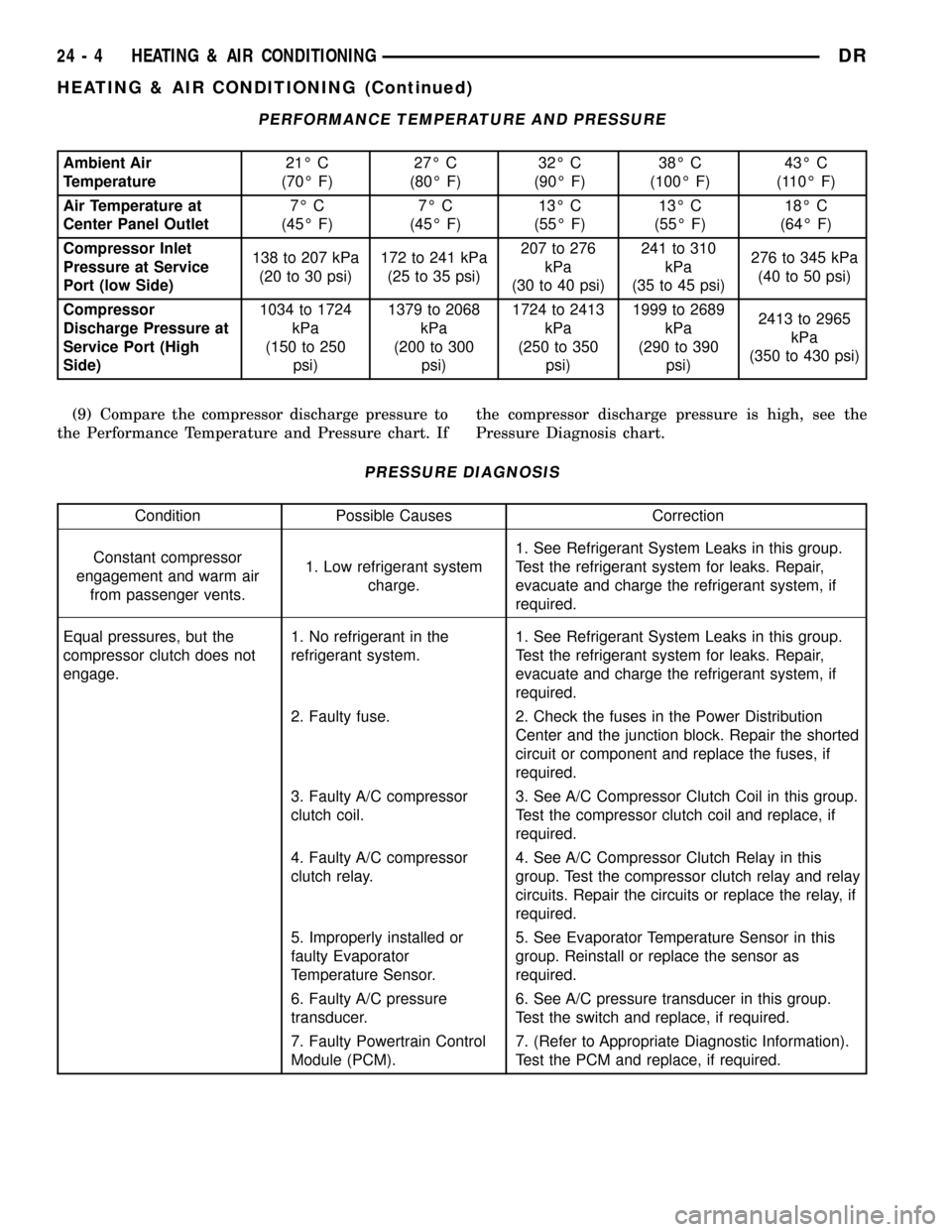
PERFORMANCE TEMPERATURE AND PRESSURE
Ambient Air
Temperature21É C
(70É F)27É C
(80É F)32É C
(90É F)38É C
(100É F)43É C
(110É F)
Air Temperature at
Center Panel Outlet7É C
(45É F)7É C
(45É F)13É C
(55É F)13É C
(55É F)18É C
(64É F)
Compressor Inlet
Pressure at Service
Port (low Side)138 to 207 kPa
(20 to 30 psi)172 to 241 kPa
(25 to 35 psi)207 to 276
kPa
(30 to 40 psi)241 to 310
kPa
(35 to 45 psi)276 to 345 kPa
(40 to 50 psi)
Compressor
Discharge Pressure at
Service Port (High
Side)1034 to 1724
kPa
(150 to 250
psi)1379 to 2068
kPa
(200 to 300
psi)1724 to 2413
kPa
(250 to 350
psi)1999 to 2689
kPa
(290 to 390
psi)2413 to 2965
kPa
(350 to 430 psi)
(9) Compare the compressor discharge pressure to
the Performance Temperature and Pressure chart. Ifthe compressor discharge pressure is high, see the
Pressure Diagnosis chart.
PRESSURE DIAGNOSIS
Condition Possible Causes Correction
Constant compressor
engagement and warm air
from passenger vents.1. Low refrigerant system
charge.1. See Refrigerant System Leaks in this group.
Test the refrigerant system for leaks. Repair,
evacuate and charge the refrigerant system, if
required.
Equal pressures, but the
compressor clutch does not
engage.1. No refrigerant in the
refrigerant system.1. See Refrigerant System Leaks in this group.
Test the refrigerant system for leaks. Repair,
evacuate and charge the refrigerant system, if
required.
2. Faulty fuse. 2. Check the fuses in the Power Distribution
Center and the junction block. Repair the shorted
circuit or component and replace the fuses, if
required.
3. Faulty A/C compressor
clutch coil.3. See A/C Compressor Clutch Coil in this group.
Test the compressor clutch coil and replace, if
required.
4. Faulty A/C compressor
clutch relay.4. See A/C Compressor Clutch Relay in this
group. Test the compressor clutch relay and relay
circuits. Repair the circuits or replace the relay, if
required.
5. Improperly installed or
faulty Evaporator
Temperature Sensor.5. See Evaporator Temperature Sensor in this
group. Reinstall or replace the sensor as
required.
6. Faulty A/C pressure
transducer.6. See A/C pressure transducer in this group.
Test the switch and replace, if required.
7. Faulty Powertrain Control
Module (PCM).7. (Refer to Appropriate Diagnostic Information).
Test the PCM and replace, if required.
24 - 4 HEATING & AIR CONDITIONINGDR
HEATING & AIR CONDITIONING (Continued)
Page 2507 of 2627

BLOWER MOTOR SWITCH
DESCRIPTION
The blower motor is controlled by a rotary-type
blower motor switch, mounted in the A/C-heater con-
trol. The switch allows the selection of one of four
different blower motor speeds and includes an Off
position.
OPERATION
The blower motor switch provides a blower motor
ground path through the A/C-heater mode control
switch. The blower motor switch directs this ground
path through or around the blower motor resistor
wires, as required to achieve the selected blower
motor speed.
The blower motor switch cannot be repaired and, if
faulty or damaged, the entire A/C-heater control
must be replaced.
DIAGNOSIS AND TESTING - BLOWER MOTOR
SWITCH
For circuit descriptions and diagrams, refer to the
appropriate wiring information. The wiring informa-
tion includes wiring diagrams, proper wire and con-
nector repair procedures, further details on wire
harness routing and retention, as well as pin-out and
location views for the various wire harness connec-
tors, splices and grounds.
WARNING: ON VEHICLES EQUIPPED WITH AIR-
BAGS, DISABLE THE AIRBAG SYSTEM BEFORE
ATTEMPTING ANY STEERING WHEEL, STEERING
COLUMN, OR INSTRUMENT PANEL COMPONENT
DIAGNOSIS OR SERVICE. DISCONNECT AND ISO-LATE THE BATTERY NEGATIVE (GROUND) CABLE,
THEN WAIT TWO MINUTES FOR THE AIRBAG SYS-
TEM CAPACITOR TO DISCHARGE BEFORE PER-
FORMING FURTHER DIAGNOSIS OR SERVICE. THIS
IS THE ONLY SURE WAY TO DISABLE THE AIRBAG
SYSTEM. FAILURE TO TAKE THE PROPER PRE-
CAUTIONS COULD RESULT IN AN ACCIDENTAL
AIRBAG DEPLOYMENT AND POSSIBLE PERSONAL
INJURY.
(1) Check for battery voltage at the fuse in the
Power Distribution Center (PDC). If OK, go to Step
2. If not OK, repair the shorted circuit or component
as required and replace the faulty fuse.
(2) Turn the ignition switch to the Off position.
Disconnect and isolate the battery negative cable.
Remove the A/C-heater control from the instrument
panel (Refer to 24 - HEATING & AIR CONDITION-
ING/CONTROLS/A/C HEATER CONTROL -
REMOVAL). Check for continuity between the
ground circuit cavity of the A/C-heater control wire
harness connector and a good ground. There should
be continuity. If OK, go to Step 3. If not OK, repair
the open circuit to ground as required.
(3) With the A/C-heater control wire harness con-
nector disconnected, place the A/C-heater mode con-
trol switch in any position except the Off position.
Check for continuity between the ground circuit ter-
minal and each of the blower motor driver circuit ter-
minals of the A/C-heater control as you move the
blower motor switch to each of the four speed posi-
tions. There should be continuity at each driver cir-
cuit terminal in only one blower motor switch speed
position. If OK, test and repair the blower driver cir-
cuits between the A/C-heater control connector and
the blower motor resistor as required. If not OK,
replace the faulty A/C-heater control.
DEFROST DOOR ACTUATOR
DESCRIPTION
The defrost door actuator is a reversible, 12-volt
Direct Current (DC), servo motor. The defrost door
actuator is located on the driver side end of the
HVAC housing, underneath the instrument panel
and is mechanically connected to the defroster door.
The defrost door actuator is interchangeable with
the actuators for the mode door, blend door(s) and
the recirculation door. Each actuator is contained
within an identical black molded plastic housing with
an integral wire connector receptacle. Integral
mounting tabs allow the actuator to be secured with
three screws to the HVAC housing. Each actuator
also has an identical output shaft with splines that
connects it to the linkage that drives the proper door.
The defrost door actuator does not require mechani-
Fig. 18 A/C-Heater Control - Single Zone Shown,
Dual Zone Typical
1 - MOUNTING TAB (4)
2 - A/C BUTTON
3 - SIDEVIEW MIRROR DEFROSTER BUTTON (IF EQUIPED)
4 - MODE CONTROL SWITCH
5 - TEMPERATURE CONTROL SWITCH
6 - BLOWER MOTOR SWITCH
24 - 20 CONTROLSDR
Page 2515 of 2627

(5) Install the HVAC housing (Refer to 24 - HEAT-
ING & AIR CONDITIONING/DISTRIBUTION/HVAC
HOUSING - INSTALLATION)
BLOWER MOTOR
DESCRIPTION
The blower motor and blower wheel are located in
the passenger side end of the HVAC housing, below
the glove box. The blower motor controls the velocity
of air flowing through the HVAC housing by spinning
a squirrel cage-type blower wheel within the housing
at the selected speed. The blower motor and wheel
can be removed from the housing inside the vehicle
without removing the instrument panel or HVAC
housing.
OPERATION
The blower motor will only operate with the igni-
tion switch in the On position and the A/C-heater
mode control switch in any position, except Off. The
blower motor receives a fused battery feed circuit
through a fuse in the Power Distribution Center
(PDC) whenever the ignition switch is in the On posi-
tion. Blower motor speed is controlled by regulating
the ground path through or around the blower motor
resistor block and through the A/C-heater blower
motor switch.
The blower motor and blower motor wheel are ser-
viced only as a unit and cannot be repaired and, if
faulty or damaged, must be replaced.
DIAGNOSIS AND TESTING - BLOWER MOTOR
BLOWER MOTOR INOPERATIVE
WARNING: ON VEHICLES EQUIPPED WITH AIR-
BAGS, DISABLE THE AIRBAG SYSTEM BEFORE
ATTEMPTING ANY STEERING WHEEL, STEERING
COLUMN, OR INSTRUMENT PANEL COMPONENT
DIAGNOSIS OR SERVICE. DISCONNECT AND ISO-
LATE THE BATTERY NEGATIVE (GROUND) CABLE,
THEN WAIT TWO MINUTES FOR THE AIRBAG SYS-
TEM CAPACITOR TO DISCHARGE BEFORE PER-
FORMING FURTHER DIAGNOSIS OR SERVICE. THIS
IS THE ONLY SURE WAY TO DISABLE THE AIRBAG
SYSTEM. FAILURE TO TAKE THE PROPER PRE-
CAUTIONS COULD RESULT IN ACCIDENTAL AIR-
BAG DEPLOYMENT AND POSSIBLE PERSONAL
INJURY.
For circuit descriptions and diagrams, refer to the
appropriate wiring information. The wiring informa-
tion includes wiring, diagrams, proper wire and con-
nector repair procedures, further details on wire
harness routing and retention, as well as pin-out and
location views for the various wire harness connec-
tors, splices and grounds.
BLOWER MOTOR ELECTRICAL DIAGNOSIS
Refer to the Blower Motor Electrical Diagnosis
chart for basic checks of the blower motor circuit
(Fig. 3).
BLOWER MOTOR NOISE OR VIBRATION
Refer to the Blower Motor Noise/Vibration Diagno-
sis chart for basic checks of the blower motor when a
vibration or noise is present (Fig. 4).
24 - 28 DISTRIBUTIONDR
BLEND DOOR (Continued)
Page 2521 of 2627

INSTALLATION
(1) Install the floor distribution duct onto the bot-
tom of the HVAC housing.
(2) Install the five screws that secure the floor dis-
tribution duct to the HVAC housing. Tighten the
screws to 2.2 N´m (20 in. lbs.).
(3) Install the HVAC housing (Refer to 24 - HEAT-
ING & AIR CONDITIONING/DISTRIBUTION/HVAC
HOUSING - INSTALLATION).
HVAC HOUSING
REMOVAL
WARNING: ON VEHICLES EQUIPPED WITH AIR-
BAGS, DISABLE THE AIRBAG SYSTEM BEFORE
ATTEMPTING ANY STEERING WHEEL, STEERING
COLUMN, OR INSTRUMENT PANEL COMPONENT
DIAGNOSIS OR SERVICE. DISCONNECT AND ISO-
LATE THE BATTERY NEGATIVE (GROUND) CABLE,
THEN WAIT TWO MINUTES FOR THE AIRBAG SYS-
TEM CAPACITOR TO DISCHARGE BEFORE PER-
FORMING FURTHER DIAGNOSIS OR SERVICE. THIS
IS THE ONLY SURE WAY TO DISABLE THE AIRBAG
SYSTEM. FAILURE TO TAKE THE PROPER PRE-
CAUTIONS COULD RESULT IN AN ACCIDENTAL
AIRBAG DEPLOYMENT AND POSSIBLE PERSONAL
INJURY.
NOTE: The HVAC housing must be removed from
the vehicle and the two halves of the housing sep-
arated for service access of the heater core, evap-
orator coil, defrost door, blend door(s) and the
recirculation door.
(1) Disconnect and isolate the battery negative
cable.
(2) Drain the engine cooling system (Refer to 7 -
COOLING - STANDARD PROCEDURE).
(3) Recover the refrigerant from the refrigerant
system (Refer to 24 - HEATING & AIR CONDITION-
ING/PLUMBING - STANDARD PROCEDURE -
REFRIGERANT RECOVERY).
(4) Disconnect the liquid refrigerant line fitting
from the evaporator inlet tube (Refer to 24 - HEAT-
ING & AIR CONDITIONING/PLUMBING/REFRIG-
ERANT LINE COUPLER - REMOVAL). Discard the
O-ring seal and install plugs in, or tape over the
opened liquid refrigerant line fitting and evaporator
inlet tube.
(5) Remove the accumulator (Refer to 24 - HEAT-
ING & AIR CONDITIONING/PLUMBING/ACCU-
MULATOR - REMOVAL). Discard the O-ring seals
and install plugs in, or tape over the opened refrig-
erant line fittings and evaporator outlet tube.(6) Disconnect the heater hoses from the heater
core tubes. Install plugs in, or tape over the opened
heater core tubes.
(7) Remove the powertrain control module (PCM)
from the engine compartment to gain access to the
HVAC housing retaining nuts (Refer to 8 - ELECTRI-
CAL/ELECTRONIC CONTROL MODULES/POWER-
TRAIN CONTROL MODULE - REMOVAL).
(8) Remove the two nuts from the HVAC housing
mounting studs in the engine compartment.
(9) Remove the instrument panel from the vehicle
(Refer to 23 - BODY/INSTRUMENT PANEL -
REMOVAL).
(10) Remove the bolt that secures the HVAC hous-
ing to the floor bracket located in the center of the
vehicle (Fig. 9).
(11) Remove the two nuts from the HVAC housing
mounting studs in the passenger compartment.
(12) Remove the HVAC housing from inside the
vehicle. Take care not to allow any remaining coolant
to drain onto the vehicles interior.
Fig. 9 HVAC Housing - Dual Zone Shown, Single
Zone Typical
1 - NUT
2 - PASSENGER BLEND DOOR ACTUATOR
3 - NUT
4 - INLET BAFFLE
5 - RECIRCULATION DOOR ACTUATOR
6 - RECIRCULATION DOOR
7 - DRIVER SIDE BLEND DOOR ACTUATOR
8 - HVAC HOUSING
9 - BOLT
10 - DEFROSTER DOOR ACTUATOR
11 - MODE DOOR ACTUATOR
24 - 34 DISTRIBUTIONDR
FLOOR DISTRIBUTION DUCT (Continued)
Page 2523 of 2627

ING/CONTROLS/BLOWER MOTOR RESISTOR
BLOCK - INSTALLATION).
(5) If removed, install the blower motor (Refer to
24 - HEATING & AIR CONDITIONING/DISTRIBU-
TION/BLOWER MOTOR - INSTALLATION).
(6) Install the HVAC wire harness. Make sure the
wires are routed through all wiring retainers.
(7) Connect the wire harness to the blower motor,
blower motor resistor block, evaporator temperature
sensor and each actuator.
(8) Install the HVAC housing (Refer to 24 - HEAT-
ING & AIR CONDITIONING/DISTRIBUTION/HVAC
HOUSING - INSTALLATION).
INSTALLATION
WARNING: IF THE VEHICLE IS EQUIPPED WITH AIR
CONDITIONING, REVIEW THE WARNINGS AND
CAUTIONS IN PLUMBING BEFORE PERFORMING
THE FOLLOWING OPERATION. (Refer to 24 - HEAT-
ING & AIR CONDITIONING/PLUMBING - WARNING)
(Refer to 24 - HEATING & AIR CONDITIONING/
PLUMBING - CAUTION) (Refer to 24 - HEATING &
AIR CONDITIONING/PLUMBING - CAUTION -
REFRIGERANT HOSES/LINES/TUBES PRECAU-
TIONS)
(1) Position the HVAC housing into the vehicle. Be
certain that the evaporator condensate drain tube
and the housing mounting studs are inserted into
their correct locations.
(2) Install the two nuts that secure the HVAC
housing to the mounting studs in the passenger com-
partment. Tighten the nuts to 6.2 N´m (55 in. lbs.).
(3) Install the bolt that secures the HVAC housing
to the floor bracket in the passenger compartment.
Tighten the bolt to 6.2 N´m (55 in. lbs.).
(4) Install the instrument panel (Refer to 23 -
BODY/INSTRUMENT PANEL - INSTALLATION).
(5) Install the two nuts that secure the HVAC
housing to the mounting studs in the engine com-
partment. Tighten the nuts to 6.2 N´m (55 in. lbs.).
(6) Install the powertrain control module (PCM)
(Refer to 8 - ELECTRICAL/ELECTRONIC CON-
TROL MODULES/POWERTRAIN CONTROL MOD-
ULE - INSTALLATION).
(7) Unplug or remove the tape from the heater
core tubes and connect the heater hoses to the heater
core tubes.
(8) Unplug or remove the tape from the opened
refrigerant line fittings and the evaporator outlet
tube and install the accumulator (Refer to 24 -
HEATING & AIR CONDITIONING/PLUMBING/AC-
CUMULATOR - INSTALLATION).
(9) Unplug or remove the tape from the liquid line
and the evaporator inlet tube fittings. Connect the
liquid line coupler to the evaporator inlet tube (Referto 24 - HEATING & AIR CONDITIONING/PLUMB-
ING - STANDARD PROCEDURE - A/C LINE COU-
PLERS).
(10) Evacuate the refrigerant system (Refer to 24 -
HEATING & AIR CONDITIONING/PLUMBING -
STANDARD PROCEDURE - REFRIGERANT SYS-
TEM EVACUATE).
(11) Charge the refrigerant system (Refer to 24 -
HEATING & AIR CONDITIONING/PLUMBING -
STANDARD PROCEDURE - REFRIGERANT SYS-
TEM CHARGE).
(12) Fill the engine cooling system (Refer to 7 -
COOLING/ENGINE - STANDARD PROCEDURE).
(13) Connect the battery negative cable.
(14) Start the engine and check for proper opera-
tion of the heating and air conditioning systems.
INSTRUMENT PANEL
DEMISTER DUCTS
REMOVAL
WARNING: ON VEHICLES EQUIPPED WITH AIR-
BAGS, DISABLE THE AIRBAG SYSTEM BEFORE
ATTEMPTING ANY STEERING WHEEL, STEERING
COLUMN, OR INSTRUMENT PANEL COMPONENT
DIAGNOSIS OR SERVICE. DISCONNECT AND ISO-
LATE THE BATTERY NEGATIVE (GROUND) CABLE,
THEN WAIT TWO MINUTES FOR THE AIRBAG SYS-
TEM CAPACITOR TO DISCHARGE BEFORE PER-
FORMING FURTHER DIAGNOSIS OR SERVICE. THIS
IS THE ONLY SURE WAY TO DISABLE THE AIRBAG
SYSTEM. FAILURE TO TAKE THE PROPER PRE-
CAUTIONS COULD RESULT IN ACCIDENTAL AIR-
BAG DEPLOYMENT AND POSSIBLE PERSONAL
INJURY.
(1) Remove the defroster ducts (Refer to 24 -
HEATING & AIR CONDITIONING/DISTRIBUTION/
DEFROSTER DUCTS - REMOVAL).
(2) Remove the two screws that secure the center
distribution duct to the instrument panel support.
(3) Remove the center distribution duct from
instrument panel support, panel ducts and demister
ducts.
(4) Remove the right side panel duct adapter (Fig.
11).
(5) Remove the right side intermediate demister
duct.
(6) Remove the left side intermediate demister
duct.
(7) Remove the left side panel duct adapter.
(8) Remove the instrument panel cover (Refer to
23 - BODY/INSTRUMENT PANEL/INSTRUMENT
PANEL TOP COVER - REMOVAL).
24 - 36 DISTRIBUTIONDR
HVAC HOUSING (Continued)
Page 2573 of 2627

CCV HOSE
DESCRIPTION - 8.0L V-10
The 8.0L V-10 engine is equipped with a Crankcase
Ventilation (CCV) system. The CCV system performs
the same function as a conventional PCV system, but
does not use a vacuum controlled valve (PCV valve).
A molded vacuum tube connects manifold vacuum
to the top of the right cylinder head (valve) cover.
The vacuum tube connects to a fixed orifice fitting
(Fig. 2) of a calibrated size 2.6 mm (0.10 inches).
OPERATION - 8.0L V-10
A molded vacuum tube connects manifold vacuum
to the top of the right cylinder head (valve) cover.
The vacuum tube connects to a fixed orifice fitting
(Fig. 2) of a calibrated size 2.6 mm (0.10 inches). The
fitting meters the amount of crankcase vapors drawn
out of the engine.The fixed orifice fitting is grey
in color.A similar fitting (but does not contain a
fixed orifice) is used on the left cylinder head (valve)
cover. This fitting is black in color. Do not inter-
change these two fittings.
When the engine is operating, fresh air enters the
engine and mixes with crankcase vapors. Manifold
vacuum draws the vapor/air mixture through the
fixed orifice and into the intake manifold. The vapors
are then consumed during engine combustion.
EVAP/PURGE SOLENOID
DESCRIPTION
The duty cycle EVAP canister purge solenoid is
located in the engine compartment. It is attached to
the side of the Power Distribution Center (PDC).
OPERATION
The Powertrain Control Module (PCM) operates
the solenoid.
During the cold start warm-up period and the hot
start time delay, the PCM does not energize the sole-
noid. When de-energized, no vapors are purged. The
PCM de-energizes the solenoid during open loop oper-
ation.
The engine enters closed loop operation after it
reaches a specified temperature and the time delay
ends. During closed loop operation, the PCM ener-
gizes and de-energizes the solenoid 5 or 10 times per
second, depending upon operating conditions. The
PCM varies the vapor flow rate by changing solenoid
pulse width. Pulse width is the amount of time the
solenoid energizes. The PCM adjusts solenoid pulse
width based on engine operating condition.
REMOVAL
The duty cycle EVAP canister purge solenoid is
located in the engine compartment. It is attached to
the side of the Power Distribution Center (PDC) (Fig.
3).
(1) Disconnect electrical wiring connector at sole-
noid.
(2) Disconnect vacuum harness at solenoid (Fig. 3).
(3) Remove solenoid from mounting bracket.
INSTALLATION
(1) Install solenoid assembly to mounting bracket.
(2) Connect vacuum harness.
(3) Connect electrical connector.
Fig. 2 FIXED ORIFICE FITTING - 8.0L V-10 ENGINE -
TYPICAL
1 - VACUUM TUBE
2 - FIXED ORIFICE FITTING
3 - COIL PACKS
4 - ORIFICE FITTING HOSE CONNECTIONS
25 - 12 EVAPORATIVE EMISSIONSDR
Page 2600 of 2627

FIRING ORDER / CABLE ROUTING, 5.7L
V-8 ENGINE..........................8I-4
FIRING ORDER, 3.7L V-6 - ENGINE........8I-4
FIRING ORDER, 4.7L V-8 - ENGINE........8I-4
FIRING ORDER, DIESEL - FUEL
INJECTOR..........................14-48
FITTING - DESCRIPTION, QUICK
CONNECT............................14-8
FITTING - STANDARD PROCEDURE,
CONNECTING ROD BEARING...........9-129
FITTING - STANDARD PROCEDURE,
CRANKSHAFT MAIN BEARING.....9-134,9-207
FITTING - STANDARD PROCEDURE,
PISTON...................9-139,9-211,9-51
FITTING - STANDARD PROCEDURE,
PISTON RING.........9-142,9-213,9-284,9-53
FITTING, STANDARD PROCEDURE -
CONNECTING ROD BEARING............9-49
FITTING, STANDARD PROCEDURE -
MAIN BEARING.......................9-44
FITTINGS - STANDARD PROCEDURE,
HANDLING TUBING...................24-45
FITTINGS - STANDARD PROCEDURE,
QUICK-CONNECT......................14-8
FLAG - INSTALLATION, SIDE VIEW
MIRROR...........................23-27
FLAG - REMOVAL, SIDE VIEW MIRROR . . . 23-27
FLARING - STANDARD PROCEDURE,
DOUBLE INVERTED....................5-10
FLARING - STANDARD PROCEDURE, ISO . . . 5-11
FLEX PLATE - INSTALLATION . . 9-138,9-210,9-48
FLEX PLATE - REMOVAL.......9-138,9-210,9-48
FLOOR - INSTALLATION, LOAD..........23-72
FLOOR - REMOVAL, LOAD.............23-71
FLOOR CONSOLE - INSTALLATION.......23-67
FLOOR CONSOLE - REMOVAL...........23-67
FLOOR DISTRIBUTION DUCT -
INSTALLATION.......................24-34
FLOOR DISTRIBUTION DUCT - REMOVAL . 24-33
FLOOR MATS - INSTALLATION, CARPETS . 23-65
FLOOR MATS - REMOVAL, CARPETS.....23-65
FLOOR SHIFT BOOT - INSTALLATION,
4WD ..............................23-62
FLOOR SHIFT BOOT - REMOVAL, 4WD....23-62
FLOOR SUPPORT CYLINDER -
INSTALLATION, LOAD.................23-72
FLOOR SUPPORT CYLINDER -
REMOVAL, LOAD.....................23-72
FLOW - 5.9L DIESEL - DESCRIPTION,
COOLING SYSTEM.....................7-3
FLOW - DIAGNOSIS AND TESTING,
RADIATOR COOLANT..............7-54,7-56
FLOW 3.7L/4.7L/5.7L ENGINE -
DESCRIPTION, COOLING SYSTEM.........7-1
FLOW AND PRESSURE - DIAGNOSIS
AND TESTING, POWER STEERING........19-4
FLUID - DESCRIPTION................19-43
FLUID - DESCRIPTION, AUTOMATIC
TRANSMISSION.......................0-4
FLUID - DESCRIPTION, POWER
STEERING............................0-3
FLUID - DIAGNOSIS AND TESTING,
CAUSES OF BURNT............21-201,21-366
FLUID - OPERATION, AUTOMATIC
TRANSMISSION.......................0-5
FLUID AND FILTER REPLACEMENT -
STANDARD PROCEDURE........21-203,21-367
FLUID CAPACITIES, SPECIFICATIONS.......0-5
FLUID CONTAMINATION - DIAGNOSIS
AND TESTING................21-202,21-366
FLUID CONTAMINATION - DIAGNOSIS
AND TESTING, BRAKE..................5-23
FLUID COOLER - INSTALLATION.........19-43
FLUID COOLER - REMOVAL............19-43
FLUID DRAIN AND REFILL - STANDARD
PROCEDURE.....21-441,21-476,21-507,21-537,
21-571
FLUID INDICATOR - DESCRIPTION,
WASHER
...........................8J-44
FLUID INDICATOR - OPERATION,
WASHER
...........................8J-44
FLUID LEAK - DIAGNOSIS AND TESTING,
CONVERTER HOUSING
.........21-144,21-318
FLUID LEVEL - DIAGNOSIS AND
TESTING, EFFECTS OF INCORRECT
.....21-201,
21-366
FLUID LEVEL - STANDARD PROCEDURE,
BRAKE
..............................5-23FLUID LEVEL CHECK - STANDARD
PROCEDURE.................21-202,21-366
FLUID LEVEL CHECKING - STANDARD
PROCEDURE, POWER STEERING........19-43
FLUID LEVEL SWITCH - DESCRIPTION,
WASHER............................8R-9
FLUID LEVEL SWITCH - INSTALLATION,
WASHER...........................8R-11
FLUID LEVEL SWITCH - OPERATION,
WASHER............................8R-9
FLUID LEVEL SWITCH - REMOVAL,
WASHER...........................8R-10
FLUID RESERVOIR - INSTALLATION.......5-24
FLUID RESERVOIR - REMOVAL..........5-23
FLUID, SPECIFICATIONS - BRAKE.........5-23
FLUSH - SPECIFICATIONS, GAP.........23-95
FLUSHING - STANDARD PROCEDURE,
COOLING SYSTEM CLEANING/
REVERSE............................7-17
FLUSHING POWER STEERING SYSTEM -
STANDARD PROCEDURE...............19-40
FLYWHEEL - ASSEMBLY................6-11
FLYWHEEL - DIAGNOSIS AND TESTING....6-10
FLYWHEEL - DISASSEMBLY.............6-11
FLYWHEEL - INSTALLATION.............6-11
FLYWHEEL - REMOVAL.................6-11
FOG LAMP - INSTALLATION............8L-12
FOG LAMP - REMOVAL................8L-12
FOG LAMP RELAY - DESCRIPTION.......8L-12
FOG LAMP RELAY - INSTALLATION........8L-13
FOG LAMP RELAY - OPERATION.........8L-13
FOG LAMP RELAY - REMOVAL..........8L-13
FOOTMANS LOOP BRACKETS -
INSTALLATION, SEAT BACK REAR.......23-85
FOOTMANS LOOP BRACKETS -
REMOVAL, SEAT BACK REAR...........23-85
FORM-IN-PLACE GASKETS AND
SEALERS - STANDARD PROCEDURE . . 9-239,9-9,
9-94
FRAME - INSTALLATION, GRILLE........23-40
FRAME - REAR - INSTALLATION, SEAT
CUSHION...........................23-85
FRAME - REAR - REMOVAL, SEAT
CUSHION...........................23-85
FRAME - REMOVAL, GRILLE............23-40
FRAME DIMENSIONS - SPECIFICATIONS . . 13-16
FRAME H-SECTION REPLACEMENT -
STANDARD PROCEDURE, REAR.........13-13
FRAME RAIL TIP REPLACEMENT -
STANDARD PROCEDURE, LIGHT DUTY
FRONT..............................13-4
FREE MODULE - INSTALLATION, HANDS . . . 8T-2
FREE MODULE - REMOVAL, HANDS.......8T-2
FRONT - INSTALLATION....5-16,5-21,5-22,5-34
FRONT - INSTALLATION...............22-14
FRONT - INSTALLATION, CRANKSHAFT
OIL SEAL.............9-136,9-208,9-275,9-46
FRONT - INSTALLATION, PROPELLER
SHAFT - HD...........................3-7
FRONT - INSTALLATION, PROPELLER
SHAFT- LD............................3-7
FRONT - INSTALLATION, SEAT..........23-81
FRONT - INSTALLATION, SEAT BACK
CUSHION / COVER...................23-82
FRONT - INSTALLATION, SEAT CUSHION
/ COVER............................23-83
FRONT - REMOVAL........5-13,5-17,5-21,5-33
FRONT - REMOVAL, CRANKSHAFT OIL
SEAL................9-135,9-208,9-275,9-46
FRONT - REMOVAL, PROPELLER SHAFT
- HD ................................3-7
FRONT - REMOVAL, PROPELLER SHAFT-
LD ..................................3-6
FRONT - REMOVAL, SEAT..............23-81
FRONT - REMOVAL, SEAT BACK
CUSHION / COVER...................23-82
FRONT - REMOVAL, SEAT CUSHION /
COVER.............................23-83
FRONT AIR DAM - INSTALLATION........13-2
FRONT AIR DAM - REMOVAL............13-2
FRONT AXLE - 9 1/4 AA -
ADJUSTMENTS
.......................3-59
FRONT AXLE - 9 1/4 AA - DIAGNOSIS
AND TESTING
........................3-54
FRONT AXLE - 9 1/4 AA - INSTALLATION
. . . 3-58
FRONT AXLE - 9 1/4 AA - REMOVAL
......3-57
FRONT AXLE - 9 1/4 AA - SPECIAL
TOOLS
..............................3-64FRONT AXLE - 9 1/4 AA -
SPECIFICATIONS......................3-63
FRONT AXLE - C205F - ADJUSTMENTS....3-32
FRONT AXLE - C205F - DIAGNOSIS AND
TESTING............................3-27
FRONT AXLE - C205F - INSTALLATION.....3-31
FRONT AXLE - C205F - REMOVAL........3-31
FRONT AXLE - C205F - SPECIAL TOOLS . . . 3-40
FRONT AXLE - C205F - SPECIFICATIONS . . . 3-39
FRONT BEARING - INSTALLATION,
OUTPUT SHAFT.....................21-216
FRONT BEARING - REMOVAL, OUTPUT
SHAFT............................21-216
FRONT BRAKE HOSE - INSTALLATION.....5-13
FRONT BUMPER - INSTALLATION.........13-2
FRONT BUMPER - REMOVAL............13-2
FRONT CENTER SEAT BELT -
INSTALLATION......................8O-31
FRONT CENTER SEAT BELT - REMOVAL . . 8O-30
FRONT CENTER SEAT BELT &
RETRACTOR - INSTALLATION...........8O-29
FRONT CENTER SEAT BELT &
RETRACTOR - REMOVAL..............8O-29
FRONT CLUTCH - ASSEMBLY..........21-207
FRONT CLUTCH - DESCRIPTION........21-205
FRONT CLUTCH - DISASSEMBLY.......21-205
FRONT CLUTCH - INSPECTION.........21-206
FRONT CLUTCH - OPERATION.........21-205
FRONT CONTROL MODULE -
DESCRIPTION.....................8W-97-5
FRONT CONTROL MODULE -
DESCRIPTION........................8E-5
FRONT CONTROL MODULE - DIAGNOSIS
AND TESTING.....................8W-97-5
FRONT CONTROL MODULE - DIAGNOSIS
AND TESTING........................8E-5
FRONT CONTROL MODULE -
INSTALLATION....................8W-97-6
FRONT CONTROL MODULE -
INSTALLATION........................8E-5
FRONT CONTROL MODULE - OPERATION . 8W-97-5
FRONT CONTROL MODULE - OPERATION . . 8E-5
FRONT CONTROL MODULE - REMOVAL . 8W-97-6
FRONT CONTROL MODULE - REMOVAL....8E-5
FRONT CROSSMEMBER - INSTALLATION . . 13-22
FRONT CROSSMEMBER - REMOVAL.....13-22
FRONT DOOR GLASS RUN
WEATHERSTRIP - INSTALLATION........23-92
FRONT DOOR GLASS RUN
WEATHERSTRIP - REMOVAL............23-92
FRONT DOOR INNER BELT MOLDING -
INSTALLATION.......................23-93
FRONT DOOR INNER BELT MOLDING -
REMOVAL..........................23-93
FRONT DOOR OUTER BELT MOLDING -
INSTALLATION.......................23-93
FRONT DOOR OUTER BELT MOLDING -
REMOVAL..........................23-92
FRONT FASCIA - INSTALLATION..........13-3
FRONT FASCIA - REMOVAL..............13-2
FRONT FENDER - INSTALLATION........23-39
FRONT FENDER - REMOVAL............23-39
FRONT FRAME RAIL TIP REPLACEMENT
- STANDARD PROCEDURE, LIGHT
DUTY...............................13-4
FRONT HOSE - REMOVAL...............5-12
FRONT MOUNT - INSTALLATION . . . 9-147,9-218,
9-287,9-59
FRONT MOUNT - REMOVAL . . 9-146,9-217,9-286,
9-58
FRONT OUTBOARD SEAT BELT BUCKLE -
INSTALLATION......................8O-38
FRONT OUTBOARD SEAT BELT BUCKLE -
REMOVAL..........................8O-37
FRONT OUTPUT SHAFT SEAL -
INSTALLATION . . . 21-442,21-477,21-508,21-538,
21-572
FRONT OUTPUT SHAFT SEAL -
REMOVAL . 21-441,21-477,21-507,21-537,21-572
FRONT PARKING BRAKE CABLE -
INSTALLATION........................5-38
FRONT PARKING BRAKE CABLE -
REMOVAL
...........................5-36
FRONT SEAL - INSTALLATION, OIL
PUMP
............................21-391
FRONT SEAL - REMOVAL, OIL PUMP
....21-391
FRONT SERVO - ASSEMBLY
...........21-209
FRONT SERVO - CLEANING
...........21-209
DRINDEX 13
Description Group-Page Description Group-Page Description Group-Page