1998 DODGE RAM 1500 Brake lines
[x] Cancel search: Brake linesPage 259 of 2627
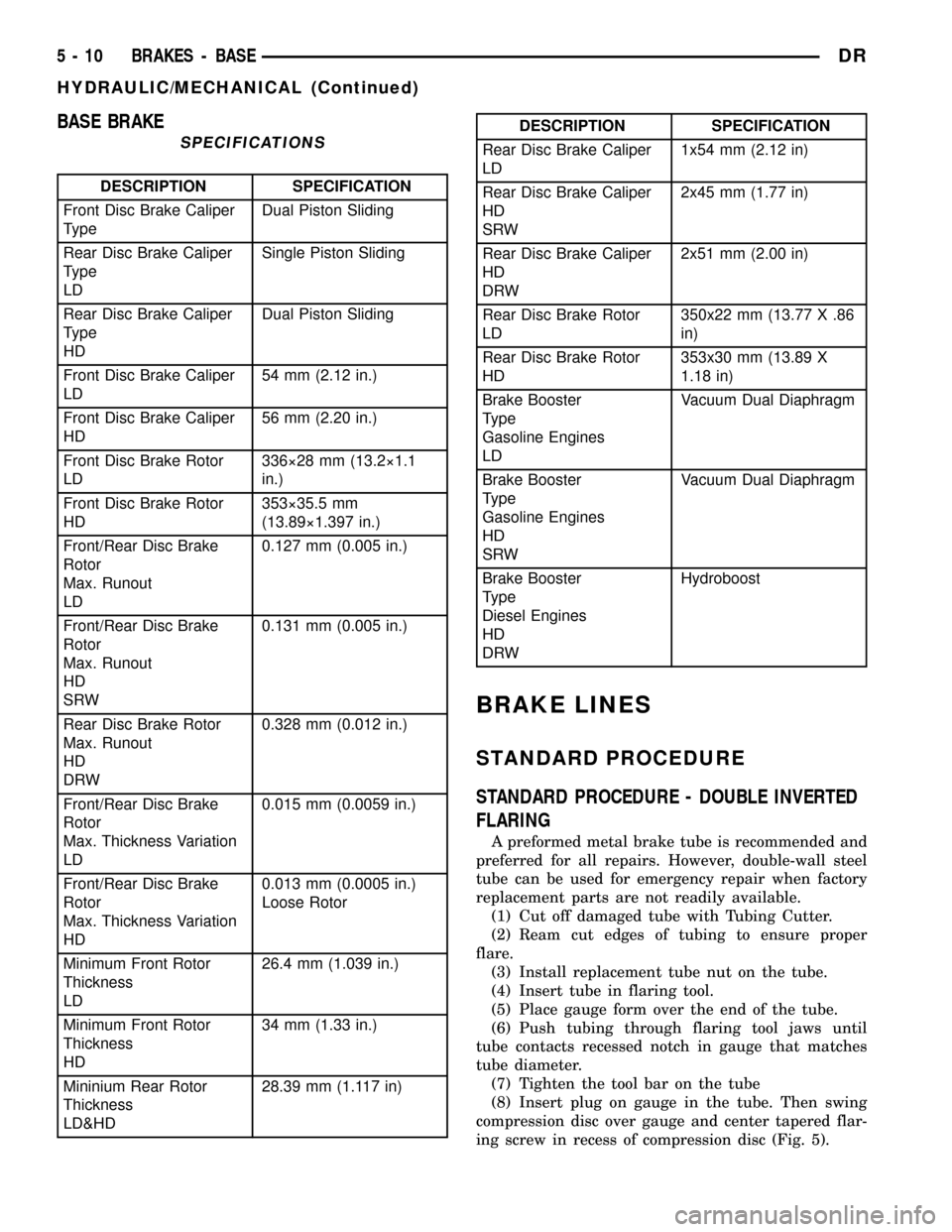
BASE BRAKE
SPECIFICATIONS
DESCRIPTION SPECIFICATION
Front Disc Brake Caliper
TypeDual Piston Sliding
Rear Disc Brake Caliper
Type
LDSingle Piston Sliding
Rear Disc Brake Caliper
Type
HDDual Piston Sliding
Front Disc Brake Caliper
LD54 mm (2.12 in.)
Front Disc Brake Caliper
HD56 mm (2.20 in.)
Front Disc Brake Rotor
LD336ý28 mm (13.2ý1.1
in.)
Front Disc Brake Rotor
HD353ý35.5 mm
(13.89ý1.397 in.)
Front/Rear Disc Brake
Rotor
Max. Runout
LD0.127 mm (0.005 in.)
Front/Rear Disc Brake
Rotor
Max. Runout
HD
SRW0.131 mm (0.005 in.)
Rear Disc Brake Rotor
Max. Runout
HD
DRW0.328 mm (0.012 in.)
Front/Rear Disc Brake
Rotor
Max. Thickness Variation
LD0.015 mm (0.0059 in.)
Front/Rear Disc Brake
Rotor
Max. Thickness Variation
HD0.013 mm (0.0005 in.)
Loose Rotor
Minimum Front Rotor
Thickness
LD26.4 mm (1.039 in.)
Minimum Front Rotor
Thickness
HD34 mm (1.33 in.)
Mininium Rear Rotor
Thickness
LD&HD28.39 mm (1.117 in)
DESCRIPTION SPECIFICATION
Rear Disc Brake Caliper
LD1x54 mm (2.12 in)
Rear Disc Brake Caliper
HD
SRW2x45 mm (1.77 in)
Rear Disc Brake Caliper
HD
DRW2x51 mm (2.00 in)
Rear Disc Brake Rotor
LD350x22 mm (13.77 X .86
in)
Rear Disc Brake Rotor
HD353x30 mm (13.89 X
1.18 in)
Brake Booster
Type
Gasoline Engines
LDVacuum Dual Diaphragm
Brake Booster
Type
Gasoline Engines
HD
SRWVacuum Dual Diaphragm
Brake Booster
Type
Diesel Engines
HD
DRWHydroboost
BRAKE LINES
STANDARD PROCEDURE
STANDARD PROCEDURE - DOUBLE INVERTED
FLARING
A preformed metal brake tube is recommended and
preferred for all repairs. However, double-wall steel
tube can be used for emergency repair when factory
replacement parts are not readily available.
(1) Cut off damaged tube with Tubing Cutter.
(2) Ream cut edges of tubing to ensure proper
flare.
(3) Install replacement tube nut on the tube.
(4) Insert tube in flaring tool.
(5) Place gauge form over the end of the tube.
(6) Push tubing through flaring tool jaws until
tube contacts recessed notch in gauge that matches
tube diameter.
(7) Tighten the tool bar on the tube
(8) Insert plug on gauge in the tube. Then swing
compression disc over gauge and center tapered flar-
ing screw in recess of compression disc (Fig. 5).
5 - 10 BRAKES - BASEDR
HYDRAULIC/MECHANICAL (Continued)
Page 260 of 2627

(9) Tighten tool handle until plug gauge is
squarely seated on jaws of flaring tool. This will start
the inverted flare.
(10) Remove the plug gauge and complete the
inverted flare.
STANDARD PROCEDURE - ISO FLARING
A preformed metal brake tube is recommended and
preferred for all repairs. However, double-wall steel
tube can be used for emergency repair when factory
replacement parts are not readily available.
To make a ISO flare use an ISO flaring tool kit.
(1) Cut off damaged tube with Tubing Cutter.
(2) Remove any burrs from the inside of the tube.
(3) Install tube nut on the tube.
(4) Position the tube in the flaring tool flush with
the top of the tool bar (Fig. 6). Then tighten the tool
bar on the tube.
(5) Install the correct size adaptor on the flaring
tool yoke screw.
(6) Lubricate the adaptor.
(7) Align the adaptor and yoke screw over the tube
(Fig. 6).
(8) Turn the yoke screw in until the adaptor is
squarely seated on the tool bar.
REMOVAL
REMOVAL - REAR BRAKE HOSE
(1) Install prop rod on the brake pedal to keep
pressure on the brake system.
(2) Raise and support the vehicle.(3) Remove the brake line from the hose at the
frame (Fig. 7).
(4) Remove the brake hose clip at the top of the
hose located at the frame (Fig. 7).
(5) Remove the vent tube (Fig. 8).
(6) Remove the two brake lines at the bottom of
the hose located at the axle (Fig. 8).
Fig. 5 Inverted Flare Tools
Fig. 6 ISO Flaring
1 - ADAPTER
2 - LUBRICATE HERE
3 - PILOT
4 - FLUSH WITH BAR
5 - TUBING
6 - BAR ASSEMBLY
Fig. 7 BRAKE LINE CLIP
1 - BRAKE HOSE
2 - CLIP
3 - BRAKE LINE
DRBRAKES - BASE 5 - 11
BRAKE LINES (Continued)
Page 261 of 2627

(7) Remove the mounting bolt for the brake hose
at the axle (Fig. 8).
(8) Remove the hose.
REMOVAL - REAR TUBE / HOSE ASSEMBLY
(1) Install prop rod on the brake pedal to keep
pressure on the brake system.
(2) Raise and support the vehicle.
(3) Remove the brake line located at the axle.
(4) Remove the mounting bolt for the brake hose
at the axle (Fig. 9).
(5) Remove the banjo bolt at the caliper (Fig. 9).
(6) Remove the hose.
REMOVAL - FRONT HOSE
(1) Install a prop rod on the brake pedal to keep
pressure on the brake system.
(2) Raise and support vehicle.
(3) Remove the tire and wheel assembly.
(4) Remove the brake hose from the brake line
located at the frame (Fig. 10).
(5) Remove the brake hose banjo bolt at the caliper
(Fig. 10).
(6) Remove the mounting bolt securing the brake
hose to the frame and remove the wheel speed sensor
wire from the brake hose (Fig. 10).
(7) Remove the hose.
INSTALLATION
INSTALLATION - REAR BRAKE HOSE
(1) Install the hose.
(2) Install the mounting bolt for the brake hose at
the axle (Fig. 8).
(3) Install the two brake lines at the bottom of the
hose located at the axle (Fig. 8).
(4) Install the vent tube (Fig. 8).
(5) Install the brake hose clip at the top of the
hose located at the frame (Fig. 7).
(6) Install the brake line to the hose at the frame
(Fig. 7).
(7) Lower the vehicle and remove the support.
(8) Remove the prop rod.
(9) Bleed the brake system (Refer to 5 - BRAKES -
STANDARD PROCEDURE).
Fig. 8 REAR HOSE
1 - BRAKE HOSE
2 - VENT HOSE
3 - BRAKE LINES
Fig. 9 BRAKE LINE WITH RUBBER HOSE
1 - BANJO BOLT
2 - MOUNTING BOLT
3 - REAR TUBE / HOSE ASSEMBLY
Fig. 10 BRAKE HOSE MOUNTED PASSENGER SIDE
1 - MOUNTING BOLT
2 - BRAKE HOSE
3 - BANJO BOLT
4 - WHEEL SPEED SENSOR WIRE
5 - 12 BRAKES - BASEDR
BRAKE LINES (Continued)
Page 262 of 2627

INSTALLATION - REAR TUBE / HOSE
ASSEMBLY
(1) Install the hose.
(2) Install the banjo bolt at the caliper (Fig. 9) and
tighten fitting bolt to 27 N´m (245 in. lbs.).
(3) Install the mounting bolt for the brake hose at
the axle (Fig. 9).
(4) Install the brake line located at the axle.
(5) Lower the vehicle and remove the support.
(6) Remove the prop rod.
(7) Bleed the brake system (Refer to 5 - BRAKES -
STANDARD PROCEDURE).
INSTALLATION - FRONT BRAKE HOSE
(1) Install the hose.
(2) Install the mounting bolt for the brake hose at
the frame (Fig. 11).
(3) Install the brake hose banjo bolt at the caliper
(Fig. 10).
(4) Reinstall the wheel speed sensor wire to the
brake hose (Fig. 10).
(5) Remove the support and lower the vehicle.
(6) Remove the prop rod from the brake pedal.
(7) Bleed the brake system (Refer to 5 - BRAKES -
STANDARD PROCEDURE).
BRAKE PADS/SHOES
REMOVAL
REMOVAL - FRONT
(1) Raise and support vehicle.
(2) Remove the wheel and tire assemblies.(3) Compress the caliper.
(4) Remove the caliper, (Refer to 5 - BRAKES/HY-
DRAULIC/MECHANICAL/DISC BRAKE CALIPERS
- REMOVAL).
(5) Remove the caliper by tilting the top up and off
the caliper adapter (Fig. 12).
NOTE: Do not allow brake hose to support caliper
assembly.
(6) Support and hang the caliper. (Fig. 13)
(7) Remove the inboard brake shoe from the cali-
per adapter (Fig. 14).
Fig. 11 BRAKE HOSE MOUNT DRIVERS SIDE
1 - MOUNTING BOLT
2 - WHEEL SPEED SENSOR WIRE
3 - BRAKE HOSE
Fig. 12 Caliper
1 - CALIPER
2 - CALIPER ADAPTER
Fig. 13 DISC BRAKE CALIPER - FRONT
1 - STEERING KNUCKLE
2 - DISC BRAKE CALIPER
3 - CALIPER MOUNTING ADAPTER
4 - DISC BRAKE ROTOR
DRBRAKES - BASE 5 - 13
BRAKE LINES (Continued)
Page 273 of 2627

(5) Remove the reservoir from the master cylinder
by pulling upwards.
(6) Remove old grommets from cylinder body (Fig.
42).
INSTALLATION
CAUTION: Do not use any type of tool to install the
grommets. Tools may cut, or tear the grommets cre-
ating a leak problem after installation. Install the
grommets using finger pressure only.
(1) Lubricate the new grommets with clean brake
fluid and Install new grommets in cylinder body. Use
finger pressure to install and seat grommets.
(2) Start the reservoir in grommets. Then rock the
reservoir back and forth while pressing downward to
seat it into the grommets.
(3) Install the mounting bolt for the reservoir to
the master cylinder.
(4) Reconnect the electrical connector to the fluid
reservoir level switch.
(5) Remove the prop rod from the vehicle.
(6) Fill and bleed base brake system,(Refer to 5 -
BRAKES - STANDARD PROCEDURE).
BRAKE JUNCTION BLOCK
REMOVAL
(1) Remove the brake lines from the junction block
(Fig. 43).
(2) Remove the junction block mounting bolt and
remove the junction block from the bracket (Fig. 43).
INSTALLATION
(1) Position the junction block on the bracket and
install the mounting bolt. Tighten the mounting bolt
to 23 N´m (210 in. lbs.) (Fig. 43).
(2) Install the brake lines into the junction block
and tighten to 19-23 N´m (170-200 in. lbs.) (Fig. 43).
(3) Bleed the base brake system, (Refer to 5 -
BRAKES/HYDRAULIC/MECHANICAL - STAN-
DARD PROCEDURE).
MASTER CYLINDER
DESCRIPTION
A two-piece master cylinder is used on all models.
The cylinder body containing the primary and sec-
ondary pistons is made of aluminum. The removable
fluid reservoir is made of nylon reinforced with glass
fiber. The reservoir stores reserve brake fluid for the
hydraulic brake circuits and has a switch for indicat-
ing low fluid levels. The reservoir is the only service-
able component.
The fluid compartments of the nylon reservoir are
interconnected to permit fluid level equalization.
However, the equalization feature does not affect cir-
cuit separation in the event of a front or rear brake
malfunction. The reservoir compartments will retain
enough fluid to operate the functioning hydraulic cir-
cuit.
Care must be exercised when removing/installing
the master cylinder connecting lines. The threads in
the cylinder fluid ports can be damaged if care is not
exercised. Start all brake line fittings by hand to
avoid cross threading.
Fig. 42 FLUID RESERVOIR
1 - MASTER CYLINDER CAP
2 - FLUID RESERVOIR
3 - FLUID LEVEL SWITCH
4 - MASTER CYLINDER
5 - MOUNTING BOLT
6 - GROMMETS
Fig. 43 JUNCTION BLOCK
1 - BRAKE LINES
2 - JUNCTION BLOCK
5 - 24 BRAKES - BASEDR
FLUID RESERVOIR (Continued)
Page 275 of 2627

STANDARD PROCEDURE - MASTER CYLINDER
BLEEDING
A new master cylinder should be bled before instal-
lation on the vehicle. Required bleeding tools include
bleed tubes and a wood dowel to stroke the pistons.
Bleed tubes can be fabricated from brake line.
(1) Mount master cylinder in vise.
(2) Attach bleed tubes to cylinder outlet ports.
Then position each tube end into reservoir (Fig. 46).
(3) Fill reservoir with fresh brake fluid.
(4) Press cylinder pistons inward with wood dowel.
Then release pistons and allow them to return under
spring pressure. Continue bleeding operations until
air bubbles are no longer visible in fluid.
REMOVAL
REMOVAL - ALL EXCEPT HYDROBOOST
(1) Depress the brake pedal five times to deplete
any vacuum that may remain in the booster unit.
(2) Siphon and drain the fluid from the reservoir.
(3) Disconnect the electrical connector for the low
fluid level.
(4) Place a towel or rag under the master cylinder
outlet port area to protect the vehicle from brake
fluid damage.
(5) Remove the brake lines from the master cylin-
der (Fig. 47).
(6) Remove the mounting nuts from the master
cylinder (Fig. 47).
(7) Remove the master cylinder.NOTE: Gently ease the master cylinder & reservoir
assembly away from the booster, During removal
the master cylinder should be kept as perpendicular
to the front of the booster as possible to avoid
excess interference with the booster output rod
(Fig. 49) and in order not to dislodge the output rod
from its seat inside the booster.
REMOVAL - HYDROBOOST
(1) Remove the brake lines from the master cylin-
der (Fig. 48).
(2) Disconnect the electrical connector for the low
fluid level.
(3) Remove the mounting nuts from the master
cylinder (Fig. 48).
(4) Remove the master cylinder.
NOTE: Using care remove the master cylinder
directly forward in order not to dislodge the output
rod from its seat inside the booster.Fig. 46 Master Cylinder Bleeding±Typical
1 - BLEEDING TUBES
2 - RESERVOIR
Fig. 47 MASTER CYLINDER
1 - MASTER CYLINDER RESERVOIR
2 - POWER BRAKE BOOSTER
3 - BRAKE LINES
4 - MASTER CYLINDER
5 - 26 BRAKES - BASEDR
MASTER CYLINDER (Continued)
Page 276 of 2627

INSTALLATION
INSTALLATION - ALL EXCEPT HYDROBOOST
NOTE: If master cylinder is replaced bleed cylinder
before installation.
NOTE: Make sure the output rod of the brake
booster is in position and retained by a output rod
retaining ring, by looking into the boosters master
cylinder mounting hole. This position will enable
the output rod to enter inside of the master cylinder
plunger sleeve during installation. Proper position
is obtained when the output rod is centered perpen-
dicular to the master cylinder mounting hole (Fig.
49).
NOTE: Prior to installing the master cylinder assem-
bly check that there is a vacuum seal present at the
shoulder of the master cylinder flange and it's neck.
A square seal must be present to ensure vacuum
integrity with the booster.
(1) Gently install the master cylinder on the
booster mounting studs.
NOTE: Take precautions to locate the master cylin-
der plunger over the booster output rod, before
installing the master cylinder. If correctly fitted the
master cylinder should slide easily onto the booster
output rod before the mounting studs are engaged
in the flange holes of the master cylinder.(2) Install new mounting nuts and tighten to 25
N´m (221 in. lbs.)
(3) Install the brake lines and tighten to 19 N´m
(170 in. lbs.)
(4) Reconnect the electrical connector for the low
fluid level switch.
(5) Fill and bleed the base brake system. (Refer to
5 - BRAKES - STANDARD PROCEDURE).
INSTALLATION - HYDROBOOST
NOTE: If master cylinder is replaced bleed cylinder
before installation.
(1) Install the master cylinder on the booster
mounting studs (Fig. 48).
(2) Install new mounting nuts and tighten to 25
N´m (221 in. lbs.)
(3) Install the brake lines and tighten to 19 N´m
(170 in. lbs.)
(4) Reconnect the elctrical connector for the low
fluid level switch.
(5) Fill and bleed the base brake system. (Refer to
5 - BRAKES - STANDARD PROCEDURE).
Fig. 48 HYDROBOOST MASTER CYLINDER
1 - HYDROBOOST UNIT
2 - MASTER CYLINDER RESERVOIR
3 - MASTER CYLINDER
4 - MOUNTING NUTS
Fig. 49 OUTPUT ROD ORIENTATION
1 - MASTER CYLINDER RESERVOIR
2 - CHECK VALVE
3 - VACUUM BOOST UNIT
4 - BOOSTER MOUNTING STUDS
5 - INPUT ROD
6 - OUTPUT ROD
7 - MASTER CYLINDER MOUNTING STUDS
8 - MASTER CYLINDER PLUNGER SLEEVE
9- MASTER CYLINDER
10 - ELECTRICAL CONNECTOR
DRBRAKES - BASE 5 - 27
MASTER CYLINDER (Continued)
Page 279 of 2627

HYDRO-BOOST BRAKE
BOOSTER
DIAGNOSIS AND TESTING - HYDRAULIC
BOOSTER
The hydraulic booster uses hydraulic pressure from
the power steering pump. Before diagnosing a
booster problem, first verify the power steering pump
is operating properly. Perform the following checks.
²Check the power steering fluid level.
²Check the brake fluid level.
²Check all power steering hoses and lines for
leaks and restrictions.
²Check power steering pump pressure.
NOISES
The hydraulic booster unit will produce certain
characteristic booster noises. The noises may occur
when the brake pedal is used in a manner not asso-
ciated with normal braking or driving habits.
HISSING
A hissing noise may be noticed when above normal
brake pedal pressure is applied, 40 lbs. or above. The
noise will be more noticeable if the vehicle is not
moving. The noise will increase with the brake pedal
pressure and an increase of system operating temper-
ature.
CLUNK-CHATTER-CLICKING
A clunk-chatter-clicking may be noticed when the
brake pedal is released quickly, after above normal
brake pedal pressure is applied 50-100 lbs..
BOOSTER FUNCTION TEST
With the engine off depress the brake pedal several
times to discharge the accumulator. Then depress the
brake pedal using 40 lbs. of force and start the
engine. The brake pedal should fall and then push
back against your foot. This indicates the booster is
operating properly.
ACCUMULATOR LEAKDOWN
(1) Start the engine, apply the brakes and turn the
steering wheel from lock to lock. This will ensure the
accumulator is charged. Turn off the engine and let
the vehicle sit for one hour. After one hour thereshould be at least two power assisted brake applica-
tion with the engine off. If the system does not retain
a charge the booster must be replaced.
(2) With the engine off depress the brake pedal
several times to discharge the accumulator. Grasp
the accumulator and see if it wobbles or turns. If it
does the accumulator has lost a gas charge and the
booster must be replaced.
SEAL LEAKAGE
If the booster leaks from any of the seals the
booster assembly must be replaced (Fig. 54).
²INPUT ROD SEAL:Fluid leakage from rear
end of the booster.
²PISTON SEAL:Fluid leakage from vent at
front of booster.
²HOUSING SEAL:Fluid leakage between hous-
ing and housing cover.
²SPOOL VALVE SEAL:Fluid leakage near
spool plug.
²RETURN PORT FITTING SEAL:Fluid leak-
age from port fitting.
Fig. 54 Hydraulic Booster Seals
1 - PUMP
2 - GEAR
3 - INPUT SEAL
4 - HOUSING SEAL
5 - ACCUMULATOR SEAL
6 - PISTON SEAL
7 - SPOOL PLUG SEAL
8 - RETURN
5 - 30 BRAKES - BASEDR