1998 DODGE RAM 1500 Connector location
[x] Cancel search: Connector locationPage 2415 of 2627
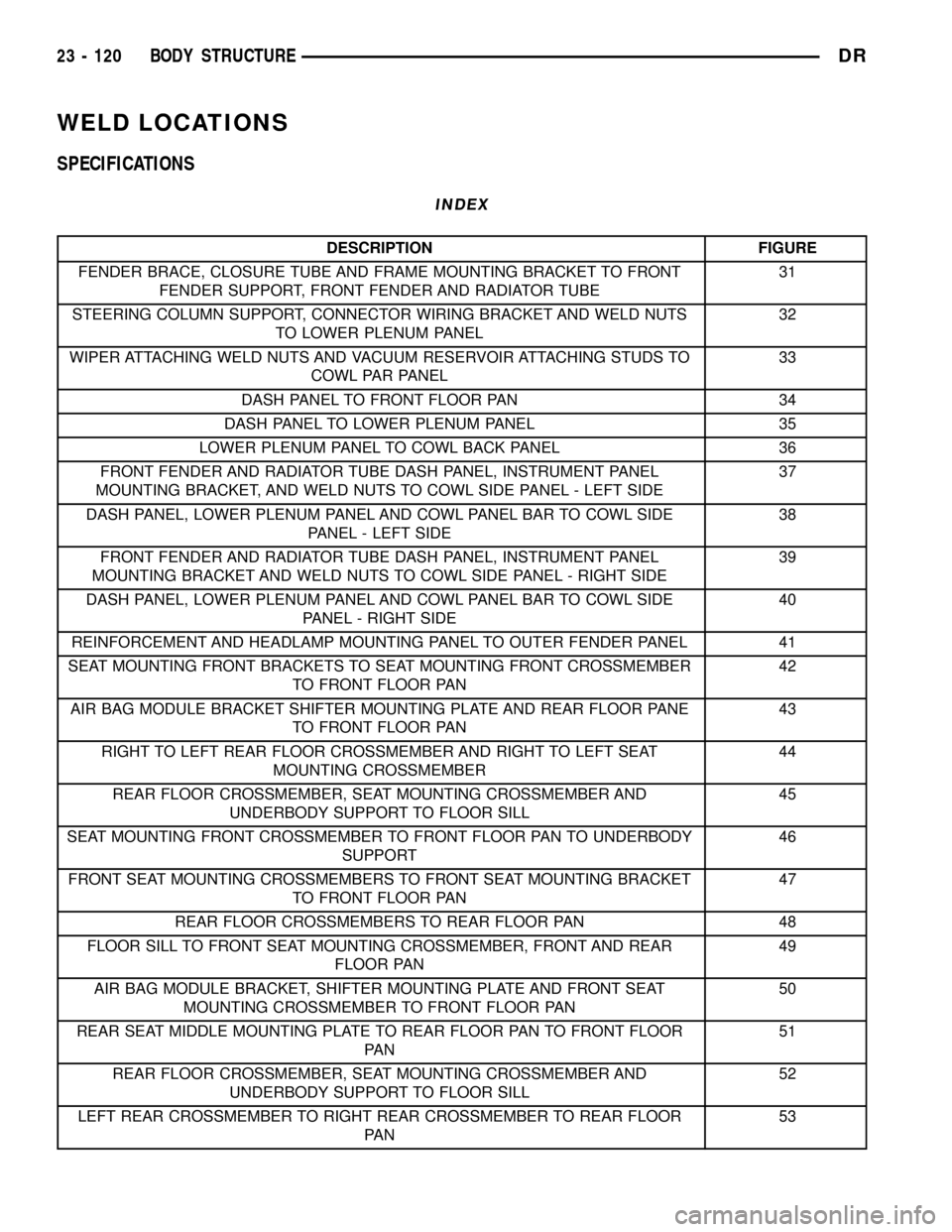
WELD LOCATIONS
SPECIFICATIONS
INDEX
DESCRIPTION FIGURE
FENDER BRACE, CLOSURE TUBE AND FRAME MOUNTING BRACKET TO FRONT
FENDER SUPPORT, FRONT FENDER AND RADIATOR TUBE31
STEERING COLUMN SUPPORT, CONNECTOR WIRING BRACKET AND WELD NUTS
TO LOWER PLENUM PANEL32
WIPER ATTACHING WELD NUTS AND VACUUM RESERVOIR ATTACHING STUDS TO
COWL PAR PANEL33
DASH PANEL TO FRONT FLOOR PAN 34
DASH PANEL TO LOWER PLENUM PANEL 35
LOWER PLENUM PANEL TO COWL BACK PANEL 36
FRONT FENDER AND RADIATOR TUBE DASH PANEL, INSTRUMENT PANEL
MOUNTING BRACKET, AND WELD NUTS TO COWL SIDE PANEL - LEFT SIDE37
DASH PANEL, LOWER PLENUM PANEL AND COWL PANEL BAR TO COWL SIDE
PANEL - LEFT SIDE38
FRONT FENDER AND RADIATOR TUBE DASH PANEL, INSTRUMENT PANEL
MOUNTING BRACKET AND WELD NUTS TO COWL SIDE PANEL - RIGHT SIDE39
DASH PANEL, LOWER PLENUM PANEL AND COWL PANEL BAR TO COWL SIDE
PANEL - RIGHT SIDE40
REINFORCEMENT AND HEADLAMP MOUNTING PANEL TO OUTER FENDER PANEL 41
SEAT MOUNTING FRONT BRACKETS TO SEAT MOUNTING FRONT CROSSMEMBER
TO FRONT FLOOR PAN42
AIR BAG MODULE BRACKET SHIFTER MOUNTING PLATE AND REAR FLOOR PANE
TO FRONT FLOOR PAN43
RIGHT TO LEFT REAR FLOOR CROSSMEMBER AND RIGHT TO LEFT SEAT
MOUNTING CROSSMEMBER44
REAR FLOOR CROSSMEMBER, SEAT MOUNTING CROSSMEMBER AND
UNDERBODY SUPPORT TO FLOOR SILL45
SEAT MOUNTING FRONT CROSSMEMBER TO FRONT FLOOR PAN TO UNDERBODY
SUPPORT46
FRONT SEAT MOUNTING CROSSMEMBERS TO FRONT SEAT MOUNTING BRACKET
TO FRONT FLOOR PAN47
REAR FLOOR CROSSMEMBERS TO REAR FLOOR PAN 48
FLOOR SILL TO FRONT SEAT MOUNTING CROSSMEMBER, FRONT AND REAR
FLOOR PAN49
AIR BAG MODULE BRACKET, SHIFTER MOUNTING PLATE AND FRONT SEAT
MOUNTING CROSSMEMBER TO FRONT FLOOR PAN50
REAR SEAT MIDDLE MOUNTING PLATE TO REAR FLOOR PAN TO FRONT FLOOR
PA N51
REAR FLOOR CROSSMEMBER, SEAT MOUNTING CROSSMEMBER AND
UNDERBODY SUPPORT TO FLOOR SILL52
LEFT REAR CROSSMEMBER TO RIGHT REAR CROSSMEMBER TO REAR FLOOR
PA N53
23 - 120 BODY STRUCTUREDR
Page 2506 of 2627

DIAGNOSIS AND TESTING - BLOWER MOTOR
RESISTOR BLOCK
WARNING: ON VEHICLES EQUIPPED WITH AIR-
BAGS, DISABLE THE AIRBAG SYSTEM BEFORE
ATTEMPTING ANY STEERING WHEEL, STEERING
COLUMN, OR INSTRUMENT PANEL COMPONENT
DIAGNOSIS OR SERVICE. DISCONNECT AND ISO-
LATE THE BATTERY NEGATIVE (GROUND) CABLE,
THEN WAIT TWO MINUTES FOR THE AIRBAG SYS-
TEM CAPACITOR TO DISCHARGE BEFORE PER-
FORMING FURTHER DIAGNOSIS OR SERVICE. THIS
IS THE ONLY SURE WAY TO DISABLE THE AIRBAG
SYSTEM. FAILURE TO TAKE THE PROPER PRE-
CAUTIONS COULD RESULT IN AN ACCIDENTAL
AIRBAG DEPLOYMENT AND POSSIBLE PERSONAL
INJURY.
For circuit descriptions and diagrams, refer to the
appropriate wiring information. The wiring informa-
tion includes wiring diagrams, proper wire and con-
nector repair procedures, further details on wire
harness routing and retention, as well as pin-out and
location views for the various wire harness connec-
tors, splices and grounds.
(1) Disconnect and isolate the negative battery
cable.
(2) Disconnect the wire harness connector from the
blower motor resistor block.
(3) Check for continuity between each of the
blower motor switch input terminals of the resistor
and the resistor output terminal. In each case there
should be continuity. If OK, repair the wire harness
circuits between the blower motor switch and blower
motor resistor or blower motor as required. If not
OK, replace the faulty blower motor resistor block.
REMOVAL
WARNING: ON VEHICLES EQUIPPED WITH AIR-
BAGS, DISABLE THE AIRBAG SYSTEM BEFORE
ATTEMPTING ANY STEERING WHEEL, STEERING
COLUMN, OR INSTRUMENT PANEL COMPONENT
DIAGNOSIS OR SERVICE. DISCONNECT AND ISO-
LATE THE BATTERY NEGATIVE (GROUND) CABLE,
THEN WAIT TWO MINUTES FOR THE AIRBAG SYS-
TEM CAPACITOR TO DISCHARGE BEFORE PER-
FORMING FURTHER DIAGNOSIS OR SERVICE. THIS
IS THE ONLY SURE WAY TO DISABLE THE AIRBAG
SYSTEM. FAILURE TO TAKE THE PROPER PRE-
CAUTIONS COULD RESULT IN AN ACCIDENTAL
AIRBAG DEPLOYMENT AND POSSIBLE PERSONAL
INJURY.CAUTION: Stay clear of the blower motor resistor
block heat sink (Hot). Do not operate the blower
motor with the resistor block removed.
(1) Disconnect and isolate the negative battery
cable.
(2) Reach under the instrument panel near the
blower motor and disconnect the wire harness con-
nector from the blower motor resistor block.
(3) Remove the two screws that secure the blower
motor resistor block to the HVAC housing.
(4) Remove the resistor block from the HVAC
housing.
INSTALLATION
(1) Position the blower motor resistor block into
the HVAC housing.
(2) Install the two screws that secure the resistor
block to the HVAC housing. Tighten the screws to 2.2
N´m (20 in. lbs.).
(3) Connect the wire harness connector to the
resistor block.
(4) Reconnect the battery negative cable.
Fig. 17 Blower Motor Resistor Block
1 - SCREW (2)
2 - WIRE HARNESS CONNECTOR
3 - HVAC HOUSING
4 - BLOWER MOTOR RESISTOR BLOCK
5 - BLOWER MOTOR
DRCONTROLS 24 - 19
BLOWER MOTOR RESISTOR BLOCK (Continued)
Page 2507 of 2627

BLOWER MOTOR SWITCH
DESCRIPTION
The blower motor is controlled by a rotary-type
blower motor switch, mounted in the A/C-heater con-
trol. The switch allows the selection of one of four
different blower motor speeds and includes an Off
position.
OPERATION
The blower motor switch provides a blower motor
ground path through the A/C-heater mode control
switch. The blower motor switch directs this ground
path through or around the blower motor resistor
wires, as required to achieve the selected blower
motor speed.
The blower motor switch cannot be repaired and, if
faulty or damaged, the entire A/C-heater control
must be replaced.
DIAGNOSIS AND TESTING - BLOWER MOTOR
SWITCH
For circuit descriptions and diagrams, refer to the
appropriate wiring information. The wiring informa-
tion includes wiring diagrams, proper wire and con-
nector repair procedures, further details on wire
harness routing and retention, as well as pin-out and
location views for the various wire harness connec-
tors, splices and grounds.
WARNING: ON VEHICLES EQUIPPED WITH AIR-
BAGS, DISABLE THE AIRBAG SYSTEM BEFORE
ATTEMPTING ANY STEERING WHEEL, STEERING
COLUMN, OR INSTRUMENT PANEL COMPONENT
DIAGNOSIS OR SERVICE. DISCONNECT AND ISO-LATE THE BATTERY NEGATIVE (GROUND) CABLE,
THEN WAIT TWO MINUTES FOR THE AIRBAG SYS-
TEM CAPACITOR TO DISCHARGE BEFORE PER-
FORMING FURTHER DIAGNOSIS OR SERVICE. THIS
IS THE ONLY SURE WAY TO DISABLE THE AIRBAG
SYSTEM. FAILURE TO TAKE THE PROPER PRE-
CAUTIONS COULD RESULT IN AN ACCIDENTAL
AIRBAG DEPLOYMENT AND POSSIBLE PERSONAL
INJURY.
(1) Check for battery voltage at the fuse in the
Power Distribution Center (PDC). If OK, go to Step
2. If not OK, repair the shorted circuit or component
as required and replace the faulty fuse.
(2) Turn the ignition switch to the Off position.
Disconnect and isolate the battery negative cable.
Remove the A/C-heater control from the instrument
panel (Refer to 24 - HEATING & AIR CONDITION-
ING/CONTROLS/A/C HEATER CONTROL -
REMOVAL). Check for continuity between the
ground circuit cavity of the A/C-heater control wire
harness connector and a good ground. There should
be continuity. If OK, go to Step 3. If not OK, repair
the open circuit to ground as required.
(3) With the A/C-heater control wire harness con-
nector disconnected, place the A/C-heater mode con-
trol switch in any position except the Off position.
Check for continuity between the ground circuit ter-
minal and each of the blower motor driver circuit ter-
minals of the A/C-heater control as you move the
blower motor switch to each of the four speed posi-
tions. There should be continuity at each driver cir-
cuit terminal in only one blower motor switch speed
position. If OK, test and repair the blower driver cir-
cuits between the A/C-heater control connector and
the blower motor resistor as required. If not OK,
replace the faulty A/C-heater control.
DEFROST DOOR ACTUATOR
DESCRIPTION
The defrost door actuator is a reversible, 12-volt
Direct Current (DC), servo motor. The defrost door
actuator is located on the driver side end of the
HVAC housing, underneath the instrument panel
and is mechanically connected to the defroster door.
The defrost door actuator is interchangeable with
the actuators for the mode door, blend door(s) and
the recirculation door. Each actuator is contained
within an identical black molded plastic housing with
an integral wire connector receptacle. Integral
mounting tabs allow the actuator to be secured with
three screws to the HVAC housing. Each actuator
also has an identical output shaft with splines that
connects it to the linkage that drives the proper door.
The defrost door actuator does not require mechani-
Fig. 18 A/C-Heater Control - Single Zone Shown,
Dual Zone Typical
1 - MOUNTING TAB (4)
2 - A/C BUTTON
3 - SIDEVIEW MIRROR DEFROSTER BUTTON (IF EQUIPED)
4 - MODE CONTROL SWITCH
5 - TEMPERATURE CONTROL SWITCH
6 - BLOWER MOTOR SWITCH
24 - 20 CONTROLSDR
Page 2566 of 2627

OPERATION
OPERATION
The Powertrain Control Module (PCM) monitors
many different circuits in the fuel injection, ignition,
emission and engine systems. If the PCM senses a
problem with a monitored circuit often enough to
indicate an actual problem, it stores a Diagnostic
Trouble Code (DTC) in the PCM's memory. If the
problem is repaired or ceases to exist, the PCM can-
cels the code after 40 warm-up cycles. Diagnostic
trouble codes that affect vehicle emissions illuminate
the Malfunction Indicator Lamp (MIL). The MIL is
displayed as an engine icon (graphic) on the instru-
ment panel. Refer to Malfunction Indicator Lamp in
this section.
Certain criteria must be met before the PCM
stores a DTC in memory. The criteria may be a spe-
cific range of engine RPM, engine temperature,
and/or input voltage to the PCM.
The PCM might not store a DTC for a monitored
circuit even though a malfunction has occurred. This
may happen because one of the DTC criteria for the
circuit has not been met.For example,assume the
diagnostic trouble code criteria requires the PCM to
monitor the circuit only when the engine operates
between 750 and 2000 RPM. Suppose the sensor's
output circuit shorts to ground when engine operates
above 2400 RPM (resulting in 0 volt input to the
PCM). Because the condition happens at an engine
speed above the maximum threshold (2000 rpm), the
PCM will not store a DTC.
There are several operating conditions for which
the PCM monitors and sets DTC's. Refer to Moni-
tored Systems, Components, and Non-Monitored Cir-
cuits in this section.
Technicians must retrieve stored DTC's by connect-
ing the DRB scan tool (or an equivalent scan tool) to
the 16±way data link connector. The connector is
located on the bottom edge of the instrument panel
near the steering column (Fig. 1).
NOTE: Various diagnostic procedures may actually
cause a diagnostic monitor to set a DTC. For
instance, pulling a spark plug wire to perform a
spark test may set the misfire code. When a repair
is completed and verified, connect the DRB scan
tool to the 16±way data link connector to erase all
DTC's and extinguish the MIL.
OPERATION - TASK MANAGER
The Task Manager determines which tests happen
when and which functions occur when. Many of the
diagnostic steps required by OBD II must be per-
formed under specific operating conditions. The TaskManager software organizes and prioritizes the diag-
nostic procedures. The job of the Task Manager is to
determine if conditions are appropriate for tests to be
run, monitor the parameters for a trip for each test,
and record the results of the test. Following are the
responsibilities of the Task Manager software:
²Test Sequence
²MIL Illumination
²Diagnostic Trouble Codes (DTCs)
²Trip Indicator
²Freeze Frame Data Storage
²Similar Conditions Window
Test Sequence
In many instances, emissions systems must fail
diagnostic tests more than once before the PCM illu-
minates the MIL. These tests are know as 'two trip
monitors.' Other tests that turn the MIL lamp on
after a single failure are known as 'one trip moni-
tors.' A trip is defined as 'start the vehicle and oper-
ate it to meet the criteria necessary to run the given
monitor.'
Many of the diagnostic tests must be performed
under certain operating conditions. However, there
are times when tests cannot be run because another
test is in progress (conflict), another test has failed
(pending) or the Task Manager has set a fault that
may cause a failure of the test (suspend).
²Pending
Under some situations the Task Manager will not
run a monitor if the MIL is illuminated and a fault is
stored from another monitor. In these situations, the
Task Manager postpones monitorspendingresolu-
tion of the original fault. The Task Manager does not
run the test until the problem is remedied.
Fig. 1 DATA LINK CONNECTOR LOCATION - TYPICAL
1 - 16-WAY DATA LINK CONNECTOR
DREMISSIONS CONTROL 25 - 5
EMISSIONS CONTROL (Continued)
Page 2577 of 2627

PUMPING ACTION
Action : During portions of this test, the PCM uses
the reed switch to monitor diaphragm movement.
The solenoid is only turned on by the PCM after the
reed switch changes from open to closed, indicating
that the diaphragm has moved down. At other times
during the test, the PCM will rapidly cycle the LDP
solenoid on and off to quickly pressurize the system.
During rapid cycling, the diaphragm will not move
enough to change the reed switch state. In the state
of rapid cycling, the PCM will use a fixed time inter-
val to cycle the solenoid. If the system does not pass
the EVAP Leak Detection Test, the following DTCs
may be set:
²P0442 - EVAP LEAK MONITOR 0.0409LEAK
DETECTED
²P0455 - EVAP LEAK MONITOR LARGE LEAK
DETECTED
²P0456 - EVAP LEAK MONITOR 0.0209LEAK
DETECTED
²P1486 - EVAP LEAK MON PINCHED HOSE
FOUND
²P1494 - LEAK DETECTION PUMP SW OR
MECH FAULT
²P1495 - LEAK DETECTION PUMP SOLENOID
CIRCUIT
REMOVAL
The Leak Detection Pump (LDP) and LDP filter
are attached to the front of the EVAP canister
mounting bracket (Fig. 9). This is located near the
front of the fuel tank. The LDP and LDP filter are
replaced (serviced) as one unit.
(1) Raise and support vehicle.
(2) Carefully remove hose at LDP filter.
(3) Remove LDP filter mounting bolt and remove
from vehicle.
(4) Carefully remove vapor/vacuum lines at LDP.
(5) Disconnect electrical connector at LDP.
(6) Remove LDP mounting bolt and remove LDP
from vehicle.
INSTALLATION
The LDP and LDP filter are attached to the front
of the EVAP canister mounting bracket. The LDP
and LDP filter are replaced (serviced) as one unit.
(1) Install LDP to mounting bracket. Refer to
Torque Specifications.
(2) Install LDP filter to mounting bracket. Refer to
Torque Specifications.
(3) Carefully install vapor/vacuum lines to LDP,
and install hose to LDP filter.The vapor/vacuum
lines and hoses must be firmly connected.
Fig. 8 DIAPHRAGM DOWNWARD MOVEMENT
1 - Diaphragm
2 - Inlet Check Valve (Closed)
3 - Vent Valve (Closed)
4 - From Air Filter
5 - To Canister
6 - Outlet Check Valve (Open)
7 - Engine Vacuum (Closed)
Fig. 9 LDP AND LDP FILTER LOCATION
1 - LDP
2 - LDP MOUNTING BOLT
3 - ELEC. CONNEC.
4 - FILTER MOUNTING BOLT
5 - LDP FILTER
6 - CONNECTING HOSE
7 - EVAP CANISTER MOUNTING BRACKET
8 - EVAP CANISTERS (2)
25 - 16 EVAPORATIVE EMISSIONSDR
LEAK DETECTION PUMP (Continued)
Page 2585 of 2627

The NVLD device is designed with a normally open
vacuum switch, a normally closed solenoid, and a
seal, which is actuated by both the solenoid and a
diaphragm. The NVLD is located on the atmospheric
vent side of the canister. The NVLD assembly may
be mounted on top of the canister outlet, or in-line
between the canister and atmospheric vent filter. The
normally open vacuum switch will close with about 19
H2O (0.25 KPA) vacuum in the evaporative system.
The diaphragm actuates the switch. This is above the
opening point of the fuel inlet check valve in the fill
tube so cap off leaks can be detected. Submerged fill
systems must have recirculation lines that do not
have the in-line normally closed check valve that pro-
tects the system from failed nozzle liquid ingestion,
in order to detect cap off conditions.
The normally closed valve in the NVLD is intended
to maintain the seal on the evaporative system dur-
ing the engine off condition. If vacuum in the evapo-
rative system exceeds 39to 69H2O (0.75 to 1.5 KPA),
the valve will be pulled off the seat, opening the seal.
This will protect the system from excessive vacuum
as well as allowing sufficient purge flow in the event
that the solenoid was to become inoperative.
The solenoid actuates the valve to unseal the can-
ister vent while the engine is running. It also will be
used to close the vent during the medium and large
leak tests and during the purge flow check. This sole-
noid requires initial 1.5 amps of current to pull the
valve open but after 100 ms. will be duty cycled down
to an average of about 150 mA for the remainder of
the drive cycle.
Another feature in the device is a diaphragm that
will open the seal in the NVLD with pressure in the
evaporative system. The device will9blow off9at
about 0.59H2O (0.12 KPA) pressure to permit the
venting of vapors during refueling. An added benefit
to this is that it will also allow the tank to9breathe9
during increasing temperatures, thus limiting the
pressure in the tank to this low level. This is benefi-
cial because the induced vacuum during a subse-
quent declining temperature will achieve the switch
closed (pass threshold) sooner than if the tank had to
decay from a built up pressure.
The device itself has 3 wires: Switch sense, sole-
noid driver and ground. It also includes a resistor to
protect the switch from a short to battery or a short
to ground. The NGC utilizes a high-side driver to
energize and duty-cycle the solenoid.REMOVAL
The NVLD pump and filter are attached to the
front of the EVAP canister mounting bracket (Fig.
25). This is located near the front of the fuel tank.
The pump and filter are replaced (serviced) as one
unit.
(1) Raise and support vehicle.
(2) Carefully remove pump hose clamp and hose at
filter.
(3) Carefully remove other vapor/vacuum hose at
pump.
(4) Disconnect 3±way electrical connector at pump.
(5) The NVLD pump snaps onto the EVAP canister
mounting bracket. Press on release tab (Fig. 26)
while sliding pump from bracket.
Fig. 25 NVLD PUMP LOCATION
1 - EVAP CANISTER MOUNTING BRACKET
2 - NVLD PUMP
3 - FILTER
25 - 24 EVAPORATIVE EMISSIONSDR
NATURAL VAC LEAK DETECTION ASSY (Continued)
Page 2594 of 2627

CLUTCH - DESCRIPTION, REAR........21-247
CLUTCH - DIAGNOSIS AND TESTING.......6-1
CLUTCH - DISASSEMBLY, FRONT.......21-205
CLUTCH - DISASSEMBLY, LOW/REVERSE . 21-384
CLUTCH - DISASSEMBLY, REAR........21-248
CLUTCH - INSPECTION, FRONT........21-206
CLUTCH - INSPECTION, LOW/REVERSE . . 21-385
CLUTCH - INSPECTION, REAR.........21-248
CLUTCH - OPERATION, FRONT.........21-205
CLUTCH - OPERATION, OVERDRIVE.....21-217
CLUTCH - OPERATION, REAR..........21-248
CLUTCH - SPECIFICATIONS...............6-5
CLUTCH - WARNING....................6-1
CLUTCH AND BAND OPERATION -
DIAGNOSIS AND TESTING, AIR
TESTING TRANSMISSION.............21-144
CLUTCH ASSEMBLY - ASSEMBLY, INPUT . 21-378
CLUTCH ASSEMBLY - DESCRIPTION,
INPUT............................21-373
CLUTCH ASSEMBLY - DISASSEMBLY,
INPUT............................21-374
CLUTCH ASSEMBLY - OPERATION,
INPUT............................21-373
CLUTCH BREAK-IN - STANDARD
PROCEDURE, A/C COMPRESSOR........24-10
CLUTCH CAM/OVERDRIVE PISTON
RETAINER - ASSEMBLY,
OVERRUNNING.....................21-237
CLUTCH CAM/OVERDRIVE PISTON
RETAINER - CLEANING, OVERRUNNING. . . 21-236
CLUTCH CAM/OVERDRIVE PISTON
RETAINER - DESCRIPTION,
OVERRUNNING.....................21-236
CLUTCH CAM/OVERDRIVE PISTON
RETAINER - DISASSEMBLY,
OVERRUNNING.....................21-236
CLUTCH CAM/OVERDRIVE PISTON
RETAINER - INSPECTION,
OVERRUNNING.....................21-237
CLUTCH CAM/OVERDRIVE PISTON
RETAINER - OPERATION,
OVERRUNNING.....................21-236
CLUTCH COIL - DIAGNOSIS AND
TESTING, A/C COMPRESSOR...........24-10
CLUTCH DISC - INSTALLATION............6-5
CLUTCH DISC - REMOVAL...............6-5
CLUTCH HOUSING - DIAGNOSIS AND
TESTING.............................6-7
CLUTCH HOUSING - INSTALLATION........6-9
CLUTCH HOUSING - REMOVAL............6-9
CLUTCH OPERATION - DIAGNOSIS AND
TESTING, AIR CHECKING
TRANSMISSION.....................21-317
CLUTCH PEDAL POSITION SWITCH -
DESCRIPTION........................6-13
CLUTCH PEDAL POSITION SWITCH -
DIAGNOSIS AND TESTING..............6-13
CLUTCH PEDAL POSITION SWITCH -
OPERATION..........................6-13
CLUTCH RELAY - DESCRIPTION, A/C
COMPRESSOR.......................24-13
CLUTCH RELAY - INSTALLATION, A/C
COMPRESSOR.......................24-14
CLUTCH RELAY - OPERATION, A/C
COMPRESSOR.......................24-13
CLUTCH RELAY - REMOVAL, A/C
COMPRESSOR.......................24-14
CLUTCH RELEASE BEARING -
INSTALLATION........................6-10
CLUTCH RELEASE BEARING - REMOVAL....6-9
CLUTCH/COIL - DESCRIPTION, A/C
COMPRESSOR........................24-9
CLUTCH/COIL - INSPECTION, A/C
COMPRESSOR.......................24-11
CLUTCH/COIL - INSTALLATION, A/C
COMPRESSOR.......................24-12
CLUTCH/COIL - OPERATION, A/C
COMPRESSOR........................24-9
CLUTCH/COIL - REMOVAL, A/C
COMPRESSOR.......................24-10
CLUTCHES - DESCRIPTION, HOLDING . . . 21-371
CLUTCHES - OPERATION, HOLDING
.....21-372
CLUTCH-GAS ENGINES - DESCRIPTION,
FAN DRIVE VISCOUS
...................7-50
CLUTCH-GAS ENGINES - OPERATION,
FAN DRIVE VISCOUS
...................7-50
COAT HOOK - INSTALLATION
...........23-66
COAT HOOK - REMOVAL
...............23-66CODE - DESCRIPTION, PAINT...........23-73
CODE PLATE - DESCRIPTION, BODY....Intro.-3
CODES - DESCRIPTION, DIAGNOSTIC
TROUBLE............................25-1
CODES - SPECIFICATIONS, PAINT........23-73
CODES - STANDARD PROCEDURE,
ERASING TRANSMITTER..............8M-12
CODES - STANDARD PROCEDURE,
SETTING TRANSMITTER..............8M-12
COIL - DESCRIPTION, IGNITION.........8I-11
COIL - DIAGNOSIS AND TESTING, A/C
COMPRESSOR CLUTCH...............24-10
COIL - INSTALLATION, IGNITION.........8I-14
COIL - OPERATION, IGNITION...........8I-12
COIL - REMOVAL, IGNITION............8I-13
COIL CAPACITOR - DESCRIPTION,
IGNITION...........................8I-21
COIL CAPACITOR - INSTALLATION,
IGNITION...........................8I-21
COIL CAPACITOR - OPERATION,
IGNITION...........................8I-21
COIL CAPACITOR - REMOVAL, IGNITION . . . 8I-21
COIL RESISTANCE, 3.7L V-6 - IGNITION....8I-5
COIL RESISTANCE, 4.7L V-8 - IGNITION....8I-5
COIL RESISTANCE, 5.7L V-8 - IGNITION....8I-5
COLUMN - DESCRIPTION...............19-6
COLUMN - DIAGNOSIS AND TESTING,
STEERING...........................19-7
COLUMN - INSTALLATION...............19-9
COLUMN - REMOVAL..................19-7
COLUMN OPENING COVER -
INSTALLATION, STEERING.............23-60
COLUMN OPENING COVER - REMOVAL,
STEERING..........................23-60
COLUMN OPENING SUPPORT BRACKET
- INSTALLATION, STEERING............23-60
COLUMN OPENING SUPPORT BRACKET
- REMOVAL, STEERING................23-60
COMBUSTION PRESSURE LEAKAGE -
DIAGNOSIS AND TESTING, CYLINDER....9-186,
9-8,9-93
COMMUNICATION - DESCRIPTION........8E-1
COMMUNICATION - OPERATION..........8E-2
COMPASS CALIBRATION - STANDARD
PROCEDURE.........................8M-3
COMPASS DEMAGNETIZING -
STANDARD PROCEDURE...............8M-4
COMPASS MINI-TRIP COMPUTER -
DIAGNOSIS AND TESTING..............8M-6
COMPASS VARIATION ADJUSTMENT -
STANDARD PROCEDURE...............8M-5
COMPASS/MINI-TRIP COMPUTER -
DESCRIPTION........................8M-6
COMPASS/MINI-TRIP COMPUTER -
INSTALLATION.......................8M-6
COMPASS/MINI-TRIP COMPUTER -
OPERATION.........................8M-6
COMPASS/MINI-TRIP COMPUTER -
REMOVAL...........................8M-6
COMPRESSION PRESSURE - DIAGNOSIS
AND TESTING, CYLINDER.......9-186,9-8,9-93
COMPRESSION/LEAKAGE TESTS -
DIAGNOSIS AND TESTING, CYLINDER....9-239
COMPRESSOR - DESCRIPTION, A/C
......24-48
COMPRESSOR - DIAGNOSIS AND
TESTING, A/C
.......................24-49
COMPRESSOR - OPERATION, A/C
........24-48
COMPRESSOR CLUTCH BREAK-IN -
STANDARD PROCEDURE, A/C
...........24-10
COMPRESSOR CLUTCH COIL -
DIAGNOSIS AND TESTING, A/C
..........24-10
COMPRESSOR CLUTCH RELAY -
DESCRIPTION, A/C
...................24-13
COMPRESSOR CLUTCH RELAY -
INSTALLATION, A/C
...................24-14
COMPRESSOR CLUTCH RELAY -
OPERATION, A/C
.....................24-13
COMPRESSOR CLUTCH RELAY -
REMOVAL, A/C
......................24-14
COMPRESSOR CLUTCH/COIL -
DESCRIPTION, A/C
....................24-9
COMPRESSOR CLUTCH/COIL -
INSPECTION, A/C
.....................24-11
COMPRESSOR CLUTCH/COIL -
INSTALLATION, A/C
...................24-12
COMPRESSOR CLUTCH/COIL -
OPERATION, A/C
......................24-9COMPRESSOR CLUTCH/COIL -
REMOVAL, A/C......................24-10
COMPUTER - DESCRIPTION, COMPASS/
MINI-TRIP..........................8M-6
COMPUTER - DIAGNOSIS AND TESTING,
COMPASS MINI-TRIP..................8M-6
COMPUTER - INSTALLATION, COMPASS/
MINI-TRIP..........................8M-6
COMPUTER - OPERATION, COMPASS/
MINI-TRIP..........................8M-6
COMPUTER - REMOVAL, COMPASS/
MINI-TRIP..........................8M-6
CONDENSER - DESCRIPTION, A/C.......24-52
CONDENSER - OPERATION, A/C.........24-52
CONDITIONER - DESCRIPTION, HEATER
AND AIR ............................24-1
CONDITIONER - OPERATION, HEATER
AND AIR ............................24-1
CONNECTING ROD - CLEANING, PISTON . . 9-282
CONNECTING ROD - CLEANING, PISTON . . 9-140,
9-212
CONNECTING ROD - DESCRIPTION,
PISTON..............9-139,9-211,9-281,9-48
CONNECTING ROD - INSPECTION........9-283
CONNECTING ROD - INSPECTION,
PISTON.......................9-140,9-213
CONNECTING ROD - INSTALLATION,
PISTON.......................9-140,9-213
CONNECTING ROD - REMOVAL, PISTON . . 9-139,
9-212,9-281
CONNECTING ROD BEARING AND
CRANKSHAFT JOURNAL CLEARANCE -
STANDARD PROCEDURE................9-272
CONNECTING ROD BEARING FITTING -
STANDARD PROCEDURE...............9-129
CONNECTING ROD BEARING FITTING,
STANDARD PROCEDURE................9-49
CONNECTOR - DESCRIPTION, DATA LINK . . 8E-3
CONNECTOR - INSTALLATION.......8W-01-11
CONNECTOR - OPERATION, DATA LINK....8E-3
CONNECTOR - REMOVAL...........8W-01-11
CONNECTOR, GROUND AND SPLICE
INFORMATION - DESCRIPTION........8W-01-7
CONNECTOR/GROUND/SPLICE LOCATION
- DESCRIPTION....................8W-91-1
CONSOLE - DESCRIPTION, OVERHEAD....8M-1
CONSOLE - DIAGNOSIS AND TESTING,
OVERHEAD..........................8M-2
CONSOLE - INSTALLATION, FLOOR......23-67
CONSOLE - OPERATION, OVERHEAD......8M-2
CONSOLE - REMOVAL, FLOOR..........23-67
CONSOLE REMOVAL, REMOVAL -
OVERHEAD..........................8M-6
CONTAINER- GAS ENGINES -
DESCRIPTION, COOLANT RECOVERY......7-33
CONTAINER- GAS ENGINES -
INSTALLATION, COOLANT RECOVERY.....7-33
CONTAINER- GAS ENGINES -
OPERATION, COOLANT RECOVERY........7-33
CONTAINER- GAS ENGINES - REMOVAL,
COOLANT RECOVERY..................7-33
CONTAMINATION - DIAGNOSIS AND
TESTING, BRAKE FLUID................5-23
CONTAMINATION - DIAGNOSIS AND
TESTING, FLUID..............21-202,21-366
CONTINUITY - STANDARD PROCEDURE,
TESTING.........................8W-01-9
CONTROL ACTUATOR - DESCRIPTION,
FUEL..............................14-74
CONTROL ACTUATOR - OPERATION,
FUEL..............................14-74
CONTROL ACTUATOR - REMOVAL, FUEL . . 14-74
CONTROL ARM - INSTALLATION, UPPER . . . 2-28
CONTROL ARM - REMOVAL, UPPER......2-28
CONTROL ARM BUSHINGS - 2WD (LD) -
INSTALLATION, LOWER.................2-15
CONTROL ARM BUSHINGS - 2WD (LD) -
REMOVAL, LOWER....................2-13
CONTROL ARM BUSHINGS - 4WD (LD) -
INSTALLATION, LOWER
.................2-14
CONTROL ARM BUSHINGS - 4WD (LD) -
REMOVAL, LOWER
....................2-13
CONTROL CABLE - INSTALLATION,
THROTTLE
.....................14-40,14-84
CONTROL CABLE - REMOVAL,
THROTTLE
.....................14-38,14-83
CONTROL INFORMATION (VECI) -
DESCRIPTION, VEHICLE EMISSION
.....Intro.-2
DRINDEX 7
Description Group-Page Description Group-Page Description Group-Page
Page 2606 of 2627

LATCH STRIKER - INSTALLATION . . 23-17,23-23,
23-33
LATCH STRIKER - REMOVAL . 23-16,23-23,23-33
LATCH STRIKER / SECONDARY CATCH -
INSTALLATION.......................23-48
LATCH STRIKER / SECONDARY CATCH -
REMOVAL..........................23-47
LD & HD EXCEPT 4X4 HD -
INSTALLATION, ALL..................19-14
LD & HD EXCEPT 4X4 HD - REMOVAL,
ALL ...............................19-14
LD FRONT - INSTALLATION, PROPELLER
SHAFT...............................3-7
LD FRONT - REMOVAL, PROPELLER
SHAFT...............................3-6
LEAD - DIAGNOSIS AND TESTING,
TIRE/VEHICLE........................22-8
LEAK - DIAGNOSIS AND TESTING,
CONVERTER HOUSING FLUID....21-144,21-318
LEAK - DIAGNOSIS AND TESTING,
ENGINE OIL................9-152,9-220,9-64
LEAK DETECTION ASSY - DESCRIPTION,
NATURAL VAC.......................25-23
LEAK DETECTION ASSY - INSTALLATION,
NATURAL VAC.......................25-25
LEAK DETECTION ASSY - OPERATION,
NATURAL VAC.......................25-23
LEAK DETECTION ASSY - REMOVAL,
NATURAL VAC.......................25-24
LEAK DETECTION PUMP - DESCRIPTION . . 25-13
LEAK DETECTION PUMP - INSTALLATION . 25-16
LEAK DETECTION PUMP - OPERATION....25-14
LEAK DETECTION PUMP - REMOVAL.....25-16
LEAKAGE - DIAGNOSIS AND TESTING,
CYLINDER COMBUSTION PRESSURE . 9-186,9-8,
9-93
LEAKAGE - DIAGNOSIS AND TESTING,
INTAKE MANIFOLD..............9-159,9-225
LEAKAGE - DIAGNOSIS AND TESTING,
PUMP.............................19-40
LEAKS - DIAGNOSIS AND TESTING,
CHARGE AIR COOLER SYSTEM.........11-16
LEAKS - DIAGNOSIS AND TESTING,
COOLING SYSTEM - TESTING.............7-5
LEAKS - DIAGNOSIS AND TESTING,
HIGH-PRESSURE FUEL LINE............14-58
LEAKS - DIAGNOSIS AND TESTING,
INTAKE MANIFOLD....................9-72
LEAKS - DIAGNOSIS AND TESTING,
REAR SEAL AREA...........9-137,9-209,9-65
LEAKS - DIAGNOSIS AND TESTING,
REFRIGERANT SYSTEM...............24-44
LEAKS - DIAGNOSIS AND TESTING,
WATER .............................23-1
LEAKS - STANDARD PROCEDURE,
REPAIRING.........................22-10
LEARN - STANDARD PROCEDURE,
DRIVE.............................8E-23
LEARN - STANDARD PROCEDURE, TCM
QUICK.............................8E-23
LEFT CYLINDER HEAD - INSTALLATION . . . 9-112
LEFT CYLINDER HEAD - REMOVAL.......9-108
LEFT REAR CABLE - INSTALLATION.......5-39
LEFT REAR CABLE - REMOVAL...........5-38
LENS REPLACEMENT - STANDARD
PROCEDURE, MODULE................8M-3
LEVEL - DIAGNOSIS AND TESTING,
EFFECTS OF INCORRECT FLUID . . 21-201,21-366
LEVEL - STANDARD PROCEDURE,
BRAKE FLUID........................5-23
LEVEL - STANDARD PROCEDURE,
ENGINE OIL.........................9-292
LEVEL - STANDARD PROCEDURE,
REFRIGERANT OIL...................24-69
LEVEL CHECK - STANDARD
PROCEDURE, COOLANT................7-17
LEVEL CHECK - STANDARD
PROCEDURE, FLUID...........21-202,21-366
LEVEL CHECKING - STANDARD
PROCEDURE, POWER STEERING FLUID
. . . 19-43
LEVEL SENDING UNIT / SENSOR -
DESCRIPTION, FUEL
..............14-57,14-6
LEVEL SENDING UNIT / SENSOR -
INSTALLATION, FUEL
..................14-7
LEVEL SENDING UNIT / SENSOR -
OPERATION, FUEL
................14-57,14-6
LEVEL SENDING UNIT / SENSOR -
REMOVAL, FUEL
......................14-7LEVEL SWITCH - DESCRIPTION,
WASHER FLUID......................8R-9
LEVEL SWITCH - INSTALLATION,
WASHER FLUID.....................8R-11
LEVEL SWITCH - OPERATION, WASHER
FLUID..............................8R-9
LEVEL SWITCH - REMOVAL, WASHER
FLUID.............................8R-10
LEVER - ADJUSTMENT, SHIFT . . . 21-446,21-481
LEVER - INSTALLATION, GEAR SHIFT.....19-12
LEVER - INSTALLATION, SHIFT . . . 21-445,21-480
LEVER - REMOVAL, GEAR SHIFT........19-12
LEVER - REMOVAL, SHIFT......21-444,21-479
LEVER KNOB RELEASE - INSTALLATION,
TILT ...............................19-16
LEVER KNOB RELEASE - REMOVAL, TILT . . 19-16
LICENSE PLATE LAMP - INSTALLATION . . . 8L-17
LICENSE PLATE LAMP - REMOVAL.......8L-17
LICENSE PLATE LAMP UNIT -
INSTALLATION.......................8L-17
LICENSE PLATE LAMP UNIT - REMOVAL . . 8L-17
LID - INSTALLATION, CENTER SEAT
BACK..............................23-79
LID - INSTALLATION, UNDER SEAT
STORAGE BIN.......................23-80
LID - REMOVAL, CENTER SEAT BACK....23-79
LID - REMOVAL, UNDER SEAT STORAGE
BIN ...............................23-80
LIFTERS/TAPPETS - CLEANING, SOLID....9-279
LIFTERS/TAPPETS - INSPECTION, SOLID . . . 9-279
LIFTERS/TAPPETS - INSTALLATION,
SOLID.............................9-280
LIFTERS/TAPPETS - REMOVAL, SOLID....9-279
LIGHT DUTY FRONT FRAME RAIL TIP
REPLACEMENT - STANDARD
PROCEDURE.........................13-4
LIGHTER OUTLET - DESCRIPTION,
CIGAR...........................8W-97-2
LIGHTER OUTLET - DIAGNOSIS AND
TESTING, CIGAR...................8W-97-2
LIGHTER OUTLET - OPERATION, CIGAR . 8W-97-2
LIMITING VALVE - DESCRIPTION, FUEL
PRESSURE.........................14-61
LIMITING VALVE - INSTALLATION, FUEL
PRESSURE.........................14-61
LIMITING VALVE - OPERATION, FUEL
PRESSURE.........................14-61
LIMITING VALVE - REMOVAL, FUEL
PRESSURE.........................14-61
LINE - DESCRIPTION, A/C DISCHARGE....24-56
LINE - DESCRIPTION, LIQUID...........24-65
LINE - DESCRIPTION, REFRIGERANT.....24-42
LINE - DESCRIPTION, SUCTION.........24-70
LINE - INSTALLATION, LIQUID..........24-66
LINE - REMOVAL, LIQUID..............24-65
LINE AND TERMINAL REPAIR -
STANDARD PROCEDURE, GRID..........8G-4
LINE COUPLER - DESCRIPTION,
REFRIGERANT.......................24-67
LINE COUPLER - INSTALLATION,
REFRIGERANT.......................24-68
LINE COUPLER - OPERATION,
REFRIGERANT.......................24-67
LINE COUPLER - REMOVAL,
REFRIGERANT.......................24-68
LINE LEAKS - DIAGNOSIS AND TESTING,
HIGH-PRESSURE FUEL................14-58
LINE PRESSURE (LP) SENSOR -
DESCRIPTION......................21-382
LINE PRESSURE (LP) SENSOR -
INSTALLATION......................21-383
LINE PRESSURE (LP) SENSOR -
OPERATION........................21-383
LINE PRESSURE (LP) SENSOR -
REMOVAL.........................21-383
LINES - DESCRIPTION, FUEL.......14-57,14-7
LINES - DESCRIPTION, VACUUM........25-22
LINES - INSTALLATION, FUEL...........14-60
LINES - OPERATION, FUEL.............14-57
LINES - OPERATION, REFRIGERANT......24-42
LINES - REMOVAL, FUEL..............14-58
LINK - INSTALLATION, DRAG...........19-36
LINK - REMOVAL, DRAG...............19-36
LINK CONNECTOR - DESCRIPTION, DATA
. . 8E-3
LINK CONNECTOR - OPERATION, DATA
....8E-3
LINKAGE - INSTALLATION
...............6-12
LINKAGE - LINK/COIL - DESCRIPTION
....19-34
LINKAGE - REMOVAL
..................6-12LINKAGE, SPECIAL TOOLS - STEERING . . . 19-35
LINK/COIL - DESCRIPTION, GEAR........19-20
LINK/COIL - DESCRIPTION, LINKAGE.....19-34
LINK/COIL - INSTALLATION, GEAR.......19-21
LINK/COIL - OPERATION, GEAR.........19-20
LINK/COIL - REMOVAL, GEAR...........19-20
LINK/COIL SUSPENSION - STANDARD
PROCEDURE, ALIGNMENT...............2-5
LIQUID LINE - DESCRIPTION...........24-65
LIQUID LINE - INSTALLATION...........24-66
LIQUID LINE - REMOVAL..............24-65
LOAD FLOOR - INSTALLATION..........23-72
LOAD FLOOR - REMOVAL..............23-71
LOAD FLOOR SUPPORT CYLINDER -
INSTALLATION.......................23-72
LOAD FLOOR SUPPORT CYLINDER -
REMOVAL..........................23-72
LOCATION - DESCRIPTION, CONNECTOR/
GROUND/SPLICE...................8W-91-1
LOCATIONS - SPECIFICATIONS, SEALER . 23-102
LOCATIONS - SPECIFICATIONS,
STRUCTURAL ADHESIVE..............23-112
LOCATIONS - SPECIFICATIONS, WELD . . . 23-120
LOCK - STANDARD PROCEDURE,
HYDROSTATIC..................9-190,9-240
LOCK CYLINDER - DIAGNOSIS AND
TESTING, IGNITION SWITCH AND KEY....19-11
LOCK CYLINDER - INSTALLATION.......23-24
LOCK CYLINDER - REMOVAL.............23-24
LOCK MOTOR - DESCRIPTION, DOOR.....8N-4
LOCK MOTOR - DIAGNOSIS AND
TESTING, DOOR......................8N-4
LOCK MOTOR - OPERATION, DOOR.......8N-4
LOCK SWITCH - DIAGNOSIS AND
TESTING, POWER.....................8N-4
LOCK SWITCH - INSTALLATION, POWER . . . 8N-4
LOCK SWITCH - REMOVAL, POWER......8N-4
LOCKING RETRACTOR - DESCRIPTION,
AUTOMATIC........................8O-14
LOCKING RETRACTOR - OPERATION,
AUTOMATIC........................8O-14
LOCKS - DESCRIPTION, POWER.........8N-1
LOCKS - DIAGNOSIS AND TESTING,
POWER.............................8N-3
LOCKS - OPERATION, POWER...........8N-2
LOOP ADJUSTER - INSTALLATION, SEAT
BELT TURNING......................8O-55
LOOP ADJUSTER - REMOVAL, SEAT
BELT TURNING......................8O-55
LOOP BRACKETS - INSTALLATION, SEAT
BACK REAR - FOOTMANS..............23-85
LOOP BRACKETS - REMOVAL, SEAT
BACK REAR - FOOTMANS..............23-85
LOW FUEL INDICATOR - DESCRIPTION . . . 8J-30
LOW FUEL INDICATOR - OPERATION.....8J-30
LOWER BALL JOINT - DIAGNOSIS AND
TESTING........................2-19,2-34
LOWER BALL JOINT - INSTALLATION . 2-20,2-35
LOWER BALL JOINT - REMOVAL.....2-19,2-35
LOWER CONTROL ARM BUSHINGS -
2WD (LD) - INSTALLATION..............2-15
LOWER CONTROL ARM BUSHINGS -
2WD (LD) - REMOVAL.................2-13
LOWER CONTROL ARM BUSHINGS -
4WD (LD) - INSTALLATION..............2-14
LOWER CONTROL ARM BUSHINGS -
4WD (LD) - REMOVAL.................2-13
LOWER SURROUND - INSTALLATION,
INSTRUMENT PANEL..................23-59
LOWER SURROUND - REMOVAL,
INSTRUMENT PANEL..................23-59
LOWER SUSPENSION ARM -
INSTALLATION........................2-38
LOWER SUSPENSION ARM - REMOVAL....2-38
LOWER TRIM - INSTALLATION,
B-PILLAR...........................23-64
LOWER TRIM - INSTALLATION,
C-PILLAR...........................23-67
LOWER TRIM - REMOVAL, B-PILLAR.....23-63
LOWER TRIM - REMOVAL, C-PILLAR.....23-66
LOW/REVERSE CLUTCH - ASSEMBLY....21-385
LOW/REVERSE CLUTCH - CLEANING
....21-385
LOW/REVERSE CLUTCH - DISASSEMBLY
. 21-384
LOW/REVERSE CLUTCH - INSPECTION
. . 21-385
LUBRICANTS - DESCRIPTION, ENGINE
OIL
.................................0-1
LUBRICATION - DESCRIPTION
.....9-150,9-220,
9-289,9-61
DRINDEX 19
Description Group-Page Description Group-Page Description Group-Page