1998 DODGE RAM 1500 overdrive
[x] Cancel search: overdrivePage 2005 of 2627

UPPER AND LOWER HOUSING
(1) Position upper housing so internal passages
and check ball seats are facing upward. Then install
check balls in housing (Fig. 310). Seven check balls
are used. The single large check ball is approxi-
mately 8.7 mm (11/32 in.) diameter. The single small
check ball is approximately 4.8 mm (3/16 in.) in
diameter. The remaining 5 check balls are approxi-
mately 6.3 mm (1/4 in.) in diameter.
(2) Position assembled transfer plate and upper
housing separator plate on upper housing (Fig. 311).
Be sure filter screen is seated in proper housing
recess.(3) Install the Number 10 check ball into the
transfer plate (Fig. 312). The check ball is approxi-
mately 4.8 mm (3/16 in.) in diameter.
(4) Position lower housing separator plate on
transfer plate (Fig. 313).
Fig. 310 Check Ball Locations In Upper Housing
1 - SMALL DIAMETER CHECK BALLS (5)
2 - LARGE DIAMETER CHECK BALL (1)
Fig. 311 Installing Transfer Plate On Upper Housing
1 - FILTER SCREEN
2 - TRANSFER PLATE/SEPARATOR PLATE ASSEMBLY
3 - UPPER HOUSING
Fig. 312 Number 10 Check Ball
1 - NUMBER 10 CHECK BALL (3/169)
Fig. 313 Lower Housing Separator Plate
1 - BE SURE TO ALIGN BORES
2 - TRANSFER PLATE
3 - LOWER HOUSING (OVERDRIVE) SEPARATOR PLATE
21 - 302 AUTOMATIC TRANSMISSION - 48REDR
VALVE BODY (Continued)
Page 2011 of 2627

(7) Verify that throttle lever is aligned with end of
kickdown valve stem and that manual lever arm is
engaged in manual valve (Fig. 324).
(8) Position line pressure adjusting screw in
adjusting screw bracket.
(9) Install spring on end of line pressure regulator
valve.
(10) Install switch valve spring on tang at end of
adjusting screw bracket.
(11) Install manual valve.
(12) Install throttle valve and spring.
(13) Install kickdown valve and detent.
(14) Install pressure regulator valve.
(15) Install switch valve.
(16) Position adjusting screw bracket on valve
body. Align valve springs and press bracket into
place. Install short, upper bracket screws first and
long bottom screw last. Verify that valve springs and
bracket are properly aligned. Then tighten all three
bracket screws to 4 N´m (35 in. lbs.) torque.
(17) Perform Line Pressure and Throttle Pressure
adjustments. (Refer to 21 - TRANSMISSION/TRANS-
AXLE/AUTOMATIC/VALVE BODY - ADJUST-
MENTS)
(18) Lubricate solenoid case connector O-rings and
shaft of manual lever with light coat of petroleum
jelly.
(19) Attach solenoid case connector to 3-4 accumu-
lator with shoulder-type screw. Connector has small
locating tang that fits in dimple at top of accumula-
tor housing (Fig. 325). Seat tang in dimple before
tightening connector screw.
(20) Install solenoid assembly and gasket. Tighten
solenoid attaching screws to 8 N´m (72 in. lbs.)
torque.(21) Verify that solenoid wire harness is properly
routed (Fig. 326). Solenoid harness must be clear of
manual lever and park rod and not be pinched
between accumulator housing and cover.
Fig. 324 Manual And Throttle Lever Alignment
1 - THROTTLE LEVER
2 - MANUAL LEVER VALVE ARM
3 - MANUAL VALVE
4 - KICKDOWN VALVE
Fig. 325 Solenoid Harness Case Connector
Shoulder Bolt
1 - SOLENOID HARNESS CASE CONNECTOR
2 - 3-4 ACCUMULATOR HOUSING
Fig. 326 Solenoid Harness Routing
1 - OVERDRIVE/CONVERTER SOLENOID WIRE HARNESS
2 - 3-4 ACCUMULATOR COVER PLATE
21 - 308 AUTOMATIC TRANSMISSION - 48REDR
VALVE BODY (Continued)
Page 2015 of 2627

INSTALLATION........................391
OUTPUT SPEED SENSOR
DESCRIPTION........................391
OPERATION..........................391
REMOVAL............................391
INSTALLATION........................392
TOW/HAUL OVERDRIVE SWITCH
DESCRIPTION........................392
OPERATION..........................392
REMOVAL............................392
INSTALLATION........................393
PISTONS
DESCRIPTION........................393
OPERATION..........................393
PLANETARY GEARTRAIN
DESCRIPTION........................395
OPERATION..........................396
DISASSEMBLY........................396
CLEANING...........................396
INSPECTION.........................397
ASSEMBLY...........................397
SHIFT MECHANISM
DESCRIPTION........................398
OPERATION..........................398
SOLENOID SWITCH VALVE
DESCRIPTION........................398
OPERATION..........................398
SOLENOIDS
DESCRIPTION........................398OPERATION..........................399
TORQUE CONVERTER
DESCRIPTION........................399
OPERATION..........................403
REMOVAL............................404
INSTALLATION........................404
TRANSMISSION CONTROL RELAY
DESCRIPTION........................405
OPERATION..........................405
TRANSMISSION RANGE SENSOR
DESCRIPTION........................405
OPERATION..........................405
TRANSMISSION SOLENOID/TRS ASSEMBLY
DESCRIPTION........................406
OPERATION..........................406
REMOVAL............................407
INSTALLATION........................408
TRANSMISSION TEMPERATURE SENSOR
DESCRIPTION........................408
OPERATION..........................408
VALVE BODY
DESCRIPTION........................408
OPERATION..........................408
REMOVAL............................410
DISASSEMBLY........................410
CLEANING...........................412
INSPECTION.........................413
ASSEMBLY...........................414
INSTALLATION........................414
AUTOMATIC TRANSMISSION -
45RFE/545RFE
DESCRIPTION
The 45RFE/545RFE automatic transmissions is a
sophisticated, multi-range, electronically controlled
transmission which combines optimized gear ratios
for responsive performance, state of the art efficiency
features and low NVH. Other features include driver
adaptive shifting and three planetary gear sets to
provide wide ratio capability with precise ratio steps
for optimum driveability. The three planetary gear
sets also make available a unique alternate second
gear ratio. The primary 2nd gear ratio fits between
1st and 3rd gears for normal through-gear accelera-
tions. The alternate second gear ratio (2prime) allows
smoother 4-2 kickdowns at high speeds to provide
2nd gear passing performance over a wider highway
cruising range.
The hydraulic portion of the transmission consists
of the transmission fluid, fluid passages, hydraulic
valves, and various line pressure control components.The primary mechanical components of the trans-
mission consist of the following:
²Three multiple disc input clutches
²Three multiple disc holding clutches
²Five hydraulic accumulators
²Three planetary gear sets
²Dual Stage Hydraulic oil pump
²Valve body
²Solenoid pack
The TCM is the ªheartº or ªbrainº of the electronic
control system and relies on information from vari-
ous direct and indirect inputs (sensors, switches, etc.)
to determine driver demand and vehicle operating
conditions. With this information, the TCM can cal-
culate and perform timely and quality shifts through
various output or control devices (solenoid pack,
transmission control relay, etc.).
21 - 312 AUTOMATIC TRANSMISSION - 45RFE/545RFEDR
Page 2018 of 2627

45RFE CLUTCH APPLICATION CHART
SLP UD OD R 2C 4C L/R OVERRUNNING
P±PARKON
R±REVERSEON ON
N-NEUTRALON
D±OVERDRIVE
FIRSTON ON* ON
SECONDON ON
SECOND PRIMEON ON
THIRDON ON
FOURTHON ON
LIMP-INON ON
2±FIRSTON ON* ON
SECONDON ON
LIMP-INON ON
1±LOWON ON ON
*L/R clutch is on only with the output shaft speed below 150 rpm.
545RFE CLUTCH APPLICATION CHART
SLP UD OD R 2C 4C L/R OVERRUNNING
P±PARKON
R±REVERSEON ON
N-NEUTRALON
D±OVERDRIVE
FIRSTON ON* ON
SECONDON ON
SECOND PRIMEON ON
THIRDON ON
FOURTHON ON
FIFTHON ON
LIMP-INON ON
2±FIRSTON ON* ON
SECONDON ON
LIMP-INON ON
1±LOWON ON ON
*L/R clutch is on only with the output shaft speed below 150 rpm.
DRAUTOMATIC TRANSMISSION - 45RFE/545RFE 21 - 315
AUTOMATIC TRANSMISSION - 45RFE/545RFE (Continued)
Page 2020 of 2627
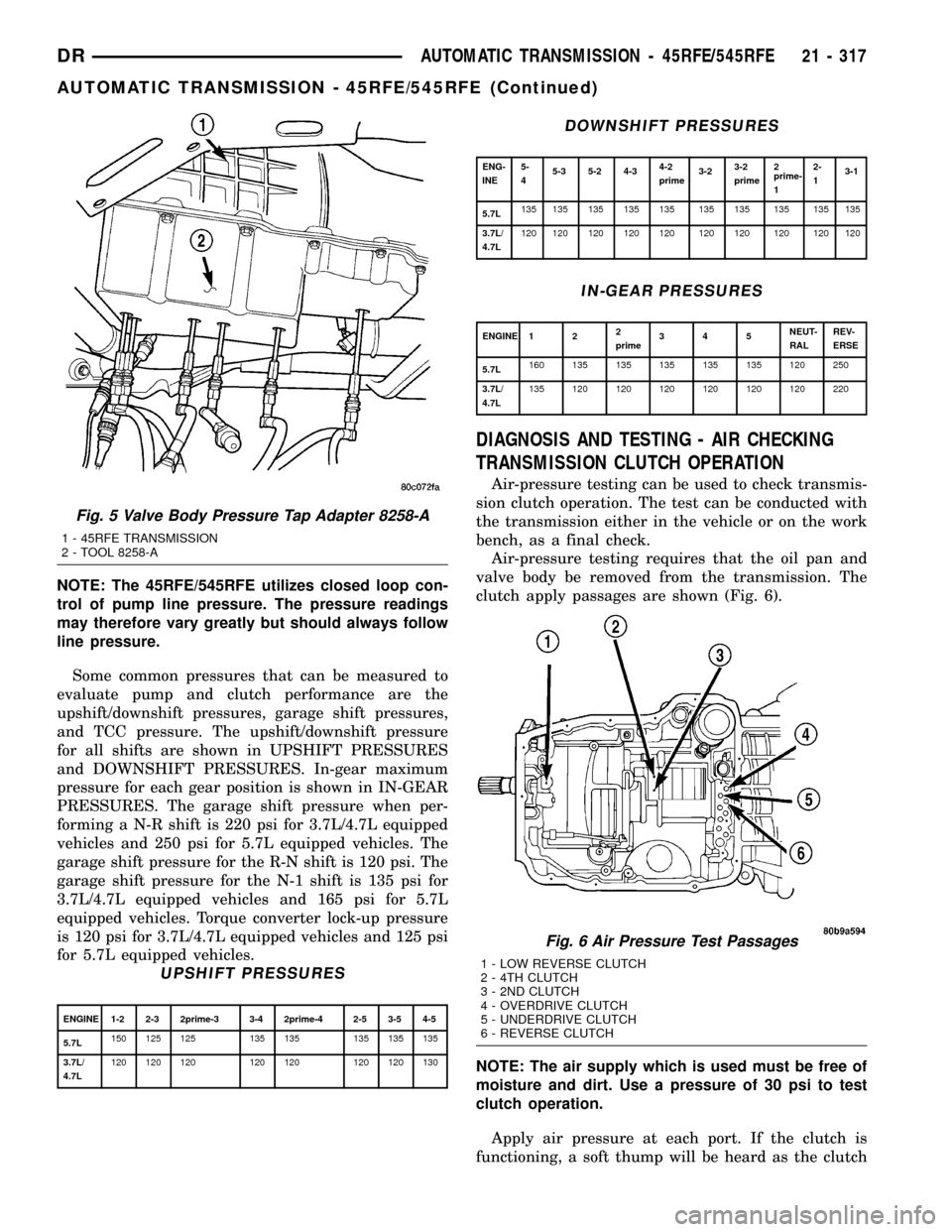
NOTE: The 45RFE/545RFE utilizes closed loop con-
trol of pump line pressure. The pressure readings
may therefore vary greatly but should always follow
line pressure.
Some common pressures that can be measured to
evaluate pump and clutch performance are the
upshift/downshift pressures, garage shift pressures,
and TCC pressure. The upshift/downshift pressure
for all shifts are shown in UPSHIFT PRESSURES
and DOWNSHIFT PRESSURES. In-gear maximum
pressure for each gear position is shown in IN-GEAR
PRESSURES. The garage shift pressure when per-
forming a N-R shift is 220 psi for 3.7L/4.7L equipped
vehicles and 250 psi for 5.7L equipped vehicles. The
garage shift pressure for the R-N shift is 120 psi. The
garage shift pressure for the N-1 shift is 135 psi for
3.7L/4.7L equipped vehicles and 165 psi for 5.7L
equipped vehicles. Torque converter lock-up pressure
is 120 psi for 3.7L/4.7L equipped vehicles and 125 psi
for 5.7L equipped vehicles.
UPSHIFT PRESSURES
ENGINE 1-2 2-3 2prime-3 3-4 2prime-4 2-5 3-5 4-5
5.7L150 125 125 135 135 135 135 135
3.7L/
4.7L120 120 120 120 120 120 120 130
DOWNSHIFT PRESSURES
ENG-
INE5-
45-3 5-2 4-34-2
prime3-23-2
prime2
prime-
12-
13-1
5.7L135 135 135 135 135 135 135 135 135 135
3.7L/
4.7L120 120 120 120 120 120 120 120 120 120
IN-GEAR PRESSURES
ENGINE 1 22
prime345NEUT-
RALREV-
ERSE
5.7L160 135 135 135 135 135 120 250
3.7L/
4.7L135 120 120 120 120 120 120 220
DIAGNOSIS AND TESTING - AIR CHECKING
TRANSMISSION CLUTCH OPERATION
Air-pressure testing can be used to check transmis-
sion clutch operation. The test can be conducted with
the transmission either in the vehicle or on the work
bench, as a final check.
Air-pressure testing requires that the oil pan and
valve body be removed from the transmission. The
clutch apply passages are shown (Fig. 6).
NOTE: The air supply which is used must be free of
moisture and dirt. Use a pressure of 30 psi to test
clutch operation.
Apply air pressure at each port. If the clutch is
functioning, a soft thump will be heard as the clutch
Fig. 5 Valve Body Pressure Tap Adapter 8258-A
1 - 45RFE TRANSMISSION
2 - TOOL 8258-A
Fig. 6 Air Pressure Test Passages
1 - LOW REVERSE CLUTCH
2 - 4TH CLUTCH
3 - 2ND CLUTCH
4 - OVERDRIVE CLUTCH
5 - UNDERDRIVE CLUTCH
6 - REVERSE CLUTCH
DRAUTOMATIC TRANSMISSION - 45RFE/545RFE 21 - 317
AUTOMATIC TRANSMISSION - 45RFE/545RFE (Continued)
Page 2076 of 2627

INPUT CLUTCH ASSEMBLY
DESCRIPTION
Three hydraulically applied input clutches are used
to drive planetary components. The underdrive, over-
drive, and reverse clutches are considered input
clutches and are contained within the input clutch
assembly (Fig. 77) and (Fig. 78). The input clutch
assembly also contains:
²Input shaft
²Input hub
²Clutch retainer
²Underdrive piston
²Overdrive/reverse piston²Overdrive hub
²Underdrive hubOPERATION
The three input clutches are responsible for driving
different components of the planetary geartrain.
UNDERDRIVE CLUTCH
The underdrive clutch is hydraulically applied in
first, second, second prime, and third (direct) gears
by pressurized fluid against the underdrive piston.
When the underdrive clutch is applied, the under-
drive hub drives the input sun gear.
Fig. 77 Input Clutch Assembly - Part 1
1 - INPUT CLUTCH HUB 11 - UD CLUTCH
2 - O-RING SEALS 12 - PLATE
3 - SEAL 13 - CLUTCH RETAINER
4 - SNAP-RING 14 - SEAL
5 - SNAP-RING 15 - OD/REV PISTON
6 - UD BALANCE PISTON 16 - BELLEVILLE SPRING
7 - SNAP-RING 17 - SNAP-RING
8 - UD PISTON 18 - SEAL RINGS
9 - SPRING 19 - INPUT SHAFT
10 - DISC 20 - LUBRICATION CHECK VALVE AND SNAP-RING
DRAUTOMATIC TRANSMISSION - 45RFE/545RFE 21 - 373
Page 2077 of 2627

OVERDRIVE CLUTCH
The overdrive clutch is hydraulically applied in
third (direct), fourth, and fifth gears by pressurized
fluid against the overdrive/reverse piston. When the
overdrive clutch is applied, the overdrive hub drives
the reverse carrier/input annulus assembly.
REVERSE CLUTCH
The reverse clutch is hydraulically applied in
reverse gear by pressurized fluid against the over-
drive/reverse piston. When the reverse clutch is
applied, the reaction annulus gear is driven.
DISASSEMBLY
(1) Remove the reverse reaction plate selective
snap-ring from the input clutch retainer (Fig. 79).
(2) Remove the reverse reaction plate from the
input clutch retainer.
(3) Remove the reverse hub and reverse clutch
pack from the input clutch retainer.
(4) Remove the number 4 bearing from the over-
drive hub.
(5) Remove the overdrive hub from the input
clutch retainer (Fig. 79).
Fig. 78 Input Clutch Assembly - Part 2
1 - BEARING NUMBER 3 10 - SNAP-RING (SELECT)
2 - OD HUB/SHAFT 11 - PLATE
3 - SNAP-RING (WAVE) 12 - DISC
4 - REV/OD REACTION PLATE 13 - OD CLUTCH
5 - BEARING NUMBER 4 14 - SNAP-RING (TAPERED)
6 - SNAP-RING (FLAT) 15 - UD/OD REACTION PLATE
7 - REVERSE HUB/SHAFT 16 - SNAP-RING (FLAT)
8 - REVERSE CLUTCH 17 - UD HUB/SHAFT
9 - REVERSE REACTION PLATE 18 - BEARING NUMBER 2
21 - 374 AUTOMATIC TRANSMISSION - 45RFE/545RFEDR
INPUT CLUTCH ASSEMBLY (Continued)
Page 2078 of 2627

(6) Remove the number 3 bearing from the under-
drive hub.
(7) Remove the OD/reverse reaction plate snap-
ring from the input clutch retainer.
(8) Remove the underdrive hub, overdrive clutch,
and overdrive reaction plate from the input clutch
retainer (Fig. 79).
NOTE: The overdrive friction discs and steel discs
are thicker than the matching components in the
underdrive and reverse clutches.(9) Remove the number 2 bearing from the input
clutch hub.
(10) Remove the overdrive clutch wave snap-ring
from the input clutch retainer.
(11) Remove the UD/OD reaction plate tapered
snap-ring from the input clutch retainer.
(12) Remove the UD/OD reaction plate from the
input clutch retainer.
(13) Remove the UD/OD reaction plate flat snap-
ring from the input clutch retainer (Fig. 79).
(14) Remove the underdrive clutch pack from the
input clutch retainer (Fig. 81).
Fig. 79 Input Clutch Assembly - Part 2
1 - BEARING NUMBER 3 10 - SNAP-RING (SELECT)
2 - OD HUB/SHAFT 11 - PLATE
3 - SNAP-RING (WAVE) 12 - DISC
4 - REV/OD REACTION PLATE 13 - OD CLUTCH
5 - BEARING NUMBER 4 14 - SNAP-RING (TAPERED)
6 - SNAP-RING (FLAT) 15 - UD/OD REACTION PLATE
7 - REVERSE HUB/SHAFT 16 - SNAP-RING (FLAT)
8 - REVERSE CLUTCH 17 - UD HUB/SHAFT
9 - REVERSE REACTION PLATE 18 - BEARING NUMBER 2
DRAUTOMATIC TRANSMISSION - 45RFE/545RFE 21 - 375
INPUT CLUTCH ASSEMBLY (Continued)