Page 292 of 474
Making nrns
NOTICE:
Making very sharp turns while trailering could
cause the trailer
to come in contact with the
vehicle. Your vehicle could be damaged.
Avoid
making very sharp turns while trailering.
When you’re turning with a trailer, make wider turns
than normal.
Do this so your trailer won’t strike soft
shoulders, curbs, road signs, trees or other objects.
Avoid jerky or sudden maneuvers. Signal well
in advance.
Turn Signals When Towing a Trailer
When you tow a trailer, your vehicle has to have
extra wiring.
The arrows on your instrument panel will flash
whenever you signal a turn or lane change. Properly
hooked up, the trailer lamps will also flash, telling other
drivers you’re about to turn, change lanes
or stop.
When towing a trailer, the arrows on your instrument
panel will flash
for turns even if the bulbs on the trailer
are burned out. Thus, you may think drivers behind
you
are seeing your signal when they are not. It’s important
to check occasionally to be sure the trailer bulbs are
still working.
4-39
ProCarManuals.com
Page 293 of 474
Driving On Grades
Reduce speed and shift to a lower gear before you start
down
a long or steep downgrade. If you don’t shift
down,
you might have to use your brakes so much that
they would get hot and no longer work well.
On a long uphill grade, shift down and reduce your
speed to around
45 mph (70 kmih) to reduce the
possibility of engine and transaxle overheating.
If you are towing a trailer that weighs more than
1,000 lbs. (450 kg), you may prefer to drive in
THIRD
(3) instead of AUTOMATIC OVERDRIVE (D)
(or, as you need to, a lower gear). This will minimize
heat build-up and extend the life
of your transaxle.
Parking on Hills
You really should not park your vehicle, with a trailer
attached, on a hill. If something goes wrong, your rig
could start to move. People can be injured, and both
your vehicle and the trailer can be damaged.
But if you ever have to park your rig on a hill, here’s
how to do it:
1. Apply your regular brakes, but don’t shift into
PARK (P) yet.
2. Have someone place chocks under the trailer wheels.
3. When the wheel chocks are in place, release the
regular brakes until the chocks absorb the load.
4. Reapply the regular brakes. Then apply your parking
brake, and then shift to PARK (P).
5. Release the regular brakes.
4-40
ProCarManuals.com
Page 294 of 474
When You Are Ready to Leave After
Parking
on a Hill
1. Apply your regular brakes and hold the pedal down
while you:
Start your engine;
@ Shift into a gear; and
Release the parking brake.
2. Let up on the brake pedal.
3. Drive slowly until thc .ailer
is clear of the chocks.
4. Stop and have son --- pick up and store the chocks.
’
Maintenance When Trailer Towing
Your vehicle will need service more often when you’re
pulling a trailer. See the Maintenance Schedule for more
on this. Things that are especially important in trailer
operation are automatic transaxle fluid (don’t overfill),
engine oil, belts, cooling system and brake adjustment.
Each
of these is covered in this manual, and the Index
will help you find them quickly. If you’re trailering, it’s
a good idea to review these sections before
you start
your trip.
Check periodically to see that all hitch nuts and bolts
are tight.
ProCarManuals.com
Page 298 of 474
0 Section 5 Problems on the Road
Here you’ll find what to do about some problems that can occur on the road.
5-2
5-2
5-3
5-8
5-13
5-24
Hazard Warning Flashers
Other Warning Devices
Jump Starting
Towing
Your Vehicle
Engine Overheating
If a Tire Goes Flat
5 -24
5-24
5-34
5-35
Air Inflator (Option)
Changing a Flat Tire
Compact Spare Tire
If You’re
Stuck: In Sand, Mud,
Ice or Snow
5-1
ProCarManuals.com
Page 305 of 474
Towing Your Vehicle
Try to have a GM dealer or a professional towing
service tow your vehicle. They can provide the right
equipment and know how to tow it without damage. See
“Roadside Assistance” in the Index.
If your vehicle has been changed or modified since it
was factory-new
by adding aftermarket items like fog
lamps, aero skirting,
or special tires and wheels, these
things can be damaged during towing.
Before you do anything, turn on the hazard
warning flashers.
When you call, tell
the towing service:
0 That your vehicle has front-wheel drive.
That your vehicle cannot be towed from the front or
0 The make, model and year of your vehicle.
Wether you can still move the shift lever.
0 If there was an accident, what was damaged.
rear with sling-type
equipment.
To
0
0
e
0
0
0
help avoid
injury to you or others:
Never let passengers ride in a vehicle that is
being towed.
Never tow faster than safe
or posted speeds.
Never tow with damaged parts not
fully secured.
Never get under your vehicle after it has
been lifted by the tow truck.
Always use separate safety chains on each
side when towing a vehicle.
Never use J-hooks. Use T-hooks instead.
5-8
ProCarManuals.com
Page 306 of 474
A vehicle can fall from a car carrier if it isn’t
adequately secured. This can cause a collision,
serious personal injury and vehicle damage. The
vehicle should be tightly secured with chains or
steel cables before it is transported.
Don’t use substitutes (ropes, leather straps,
canvas webbing, etc.) that can be cut
by sharp
edges underneath the towed vehicle. Always use
T-hooks inserted in the T-hook slots. Never use
J-hooks. They will damage drivetrain and
suspension components.
~~
NOTICE:
If you are using car-carrier equipment, you must
pull the Electronic Level Control (ELC) fuse, in
the instrument panel fuse block, before securing
the vehicle.
Damage to the shocks or leveling system may
occur if the Electronic Level Control (ELC) fuse
is not disabled.
When your vehicle is being towed, have the ignition key
in
OFF. The steering wheel should be clamped in a
straight-ahead position, with a clamping device
designed for towing service.
Do not use the vehicle’s
steering column lock for this. For front towing, the
transaxle should be in
PARK (P) and the parking brake
released. For rear towing, the transaxle should be in
NEUTRAL (N) and the parking brake engaged.
5-9
ProCarManuals.com
Page 307 of 474
I NOTICE:
Your vehicle has front-wheel drive; do not have it
towed with the front wheels in contact with the
ground or vehicle damage may occur.
A dolly
must be used under the front wheels when towing
from the rear or the vehicle must be transported
on a flat bed carrier.
I NOTICE:
Do not have your vehicle towed with the front
wheels in contact with the ground. This will
damage the transaxle.
If the vehicle must be towed on the front wheels,
it cannot be towed more than a total of 500 miles
(800 km) for the lifetime of the vehicle.
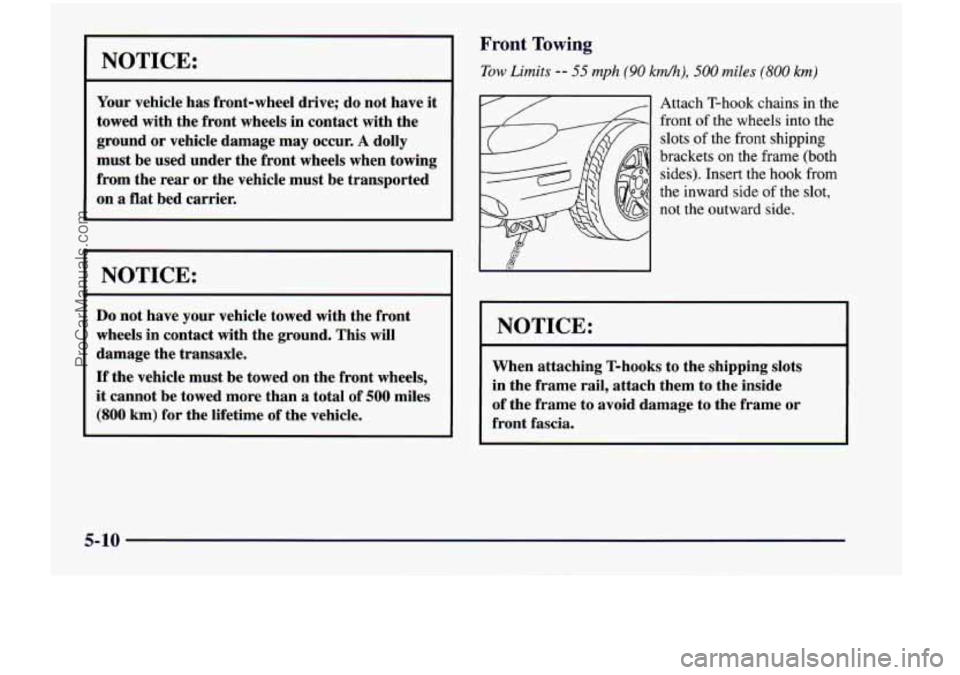
Front Towing
Tow Limits -- 55 mph (90 km/h), 500 miles (800 km)
Attach T-hook chains in the
front of the wheels into the
slots
of the front shipping
brackets
on the frame (both
sides). Insert the hook from
the inward side of the slot,
not the outward side.
I NOTICE:
When attaching T-hooks to the shipping slots
in the frame rail, attach them to the inside
of the frame to avoid damage to the frame or
front fascia.
5-10
ProCarManuals.com
Page 308 of 474
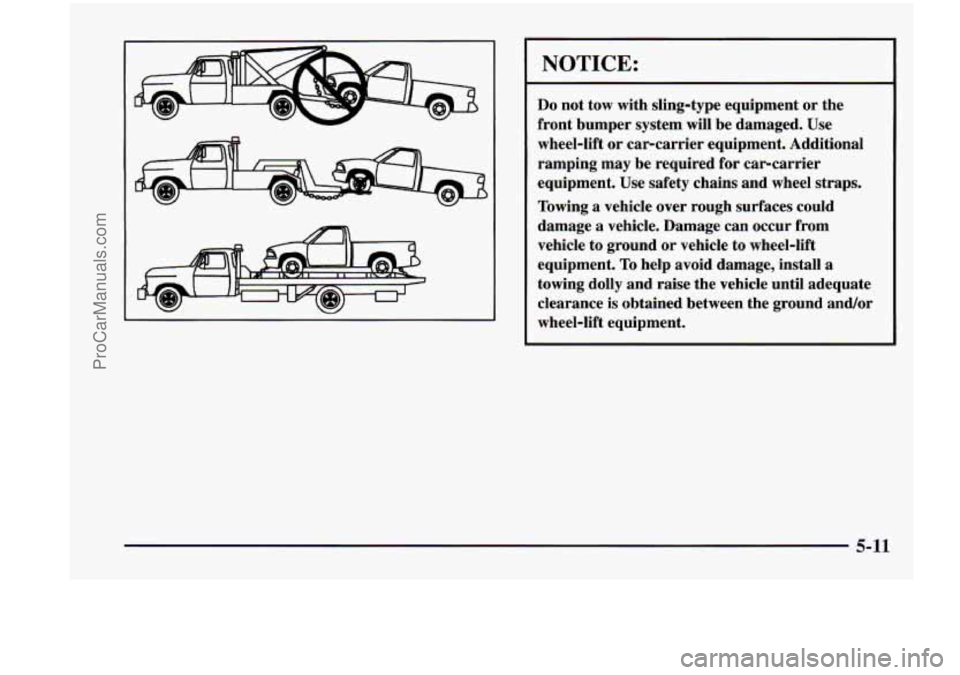
NOTICE:
Do not tow with sling-type equipment or the
front bumper system will be damaged. Use
wheel-lift or car-carrier equipment. Additional
ramping may be required for car-carrier
equipment. Use safety chains and wheel straps.
Towing
a vehicle over rough surfaces could
damage
a vehicle. Damage can occur from
vehicle to ground or vehicle to wheel-lift
equipment.
To help avoid damage, install a
towing dolly and raise the vehicle until adequate
clearance
is obtained between the ground and/or
wheel-lift equipment.
5-11
ProCarManuals.com