Page 14 of 364
Downloaded from www.Manualslib.com manuals search engine Vehicle Symbols
These are some of the symbols you may find on your vehicle.
For example,
these symbols
are used
on an
original battery:
POSSIBLE A
CAUTION
INJURY
PROTECT EYES BY
SHIELDING
Q
CAUSTIC
ACID COULD BATTERY
CAUSE
BURNS
AVOID
SPARKS
OR
FLAMES
SPARK
OR ,111,
COULD FLAME
EXPLODE BATTERY
These symbols are important
for you and
your passengers whenever your
vehicle
is
driven:
DOOR LOCK
UNLOCK
FASTEN SEAT
BELTS
These symbols
have to do with
your lamps:
SIGNALS e e
TURN
FOG LAMPS
$0
These symbols are
on some of
your controls:
WINDSHIELD
WIPER
WINDSHIELD DEFROSTER
WINDOW
DEFOGGER
VENTILATING FAN
These symbols are used on
warning and
indicator lights:
ENGINE t
COOLANT t- TEMP -
CHARGING I-1
BATTERY
SYSTEM
BRAKE
(0)
COOLANT a
ENGINE OIL w,
PRESSURE
ANTI-LOCK
(8)
BRAKES
Here are some
other symbols
you may see:
FUSE
LIGHTER
a
HORN )tr
SPEAKER
b
FUEL p3
viii
Page 16 of 364
Downloaded from www.Manualslib.com manuals search engine Seats and Seat Controls
This part tells you about the seats -- how to adjust them,
and also about reclining front seatbacks, head restraints
and rear folding seatbacks.
Manual Front Seats
You can lose control of the vehicle if you try to
adjust a manual driver’s seat while the vehicle is
moving. The sudden movement could startle and confuse
you, or make you push a pedal when you
don’t want to. Adjust the driver’s seat only when
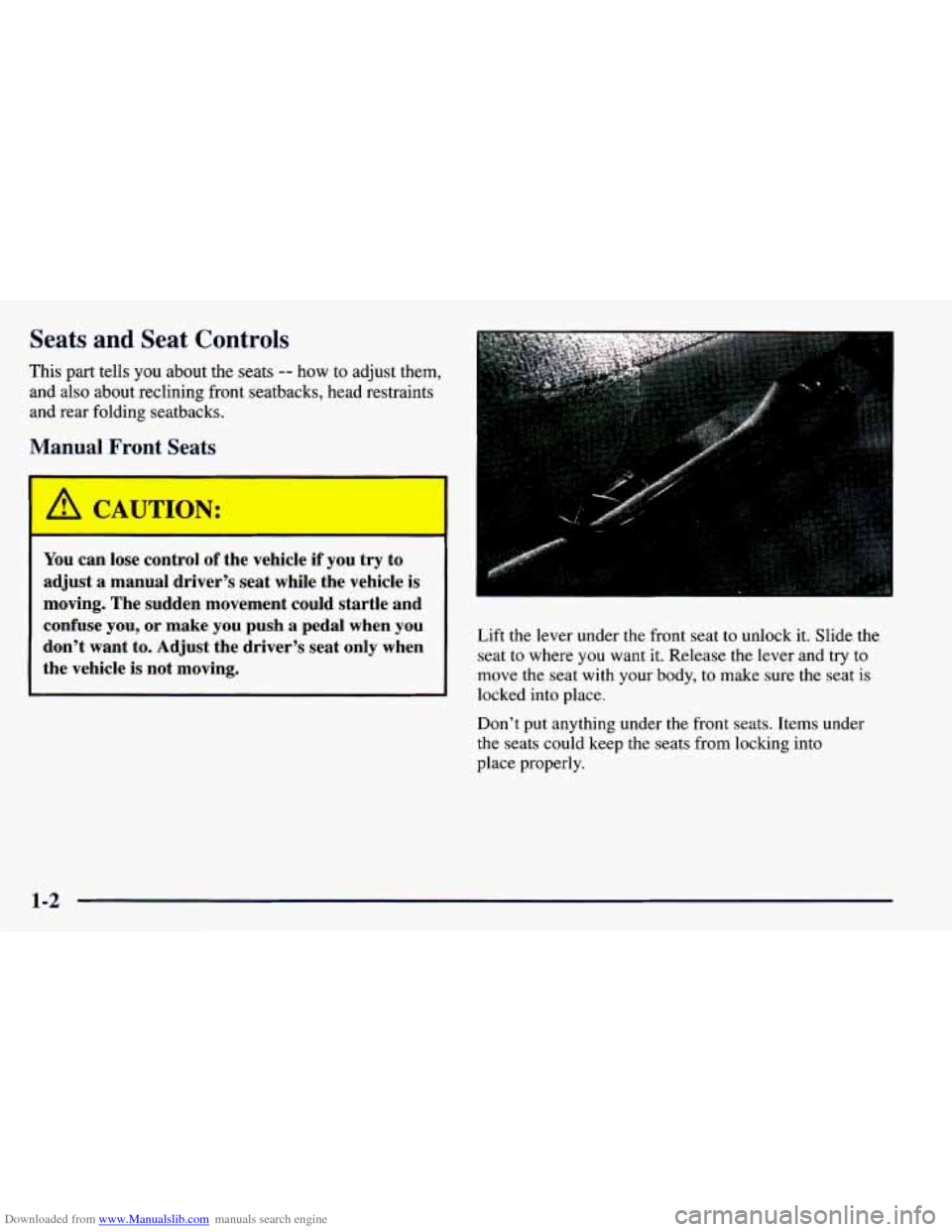
the vehicle is not moving. Lift the lever under the front seat to unlock it. Slide the
seat to where you want it. Release the lever and try to
move the seat with your body,
to make sure the seat is
locked into place.
Don’t put anything under the front seats. Items under
the seats could keep the seats from locking
into
place properly.
1-2
Page 105 of 364

Downloaded from www.Manualslib.com manuals search engine Turn SignaUMultifunction Lever
The lever on the left side
of the steering column
includes your:
0 Turn Signal and Lane Change Indicator
0 Headlamp High/Low Beam Changer
Flash-to-Pass
Turn Signal and Lane Change Indicator
The turn signal has two upward (for right) and two
downward (for left) positions. These positions allow
you to signal a turn or a lane change.
To signal a turn, move the lever all the way up or
down. When the turn is finished, the lever will
return automatically. An
arrow on the instrument
panel will flash in the
direction
of the turn or
lane change.
To signal a lane change, just raise
or lower the lever
until the arrow starts to flash. Hold it there until you
complete your lane change. The lever will return by
itself when you release it.
If you signal a turn or a lane change, and notice the
arrow flashing rapidly, a signal bulb may be burned out
and other drivers won’t
see your turn signal.
If a bulb is burned out, have it replaced to help avoid an
accident.
If the arrows don’t go on at all when you
signal a turn, check for burned-out bulbs and then check
the fuse
(see “Fuses and Circuit Breakers” in the Index).
2-27
Page 119 of 364
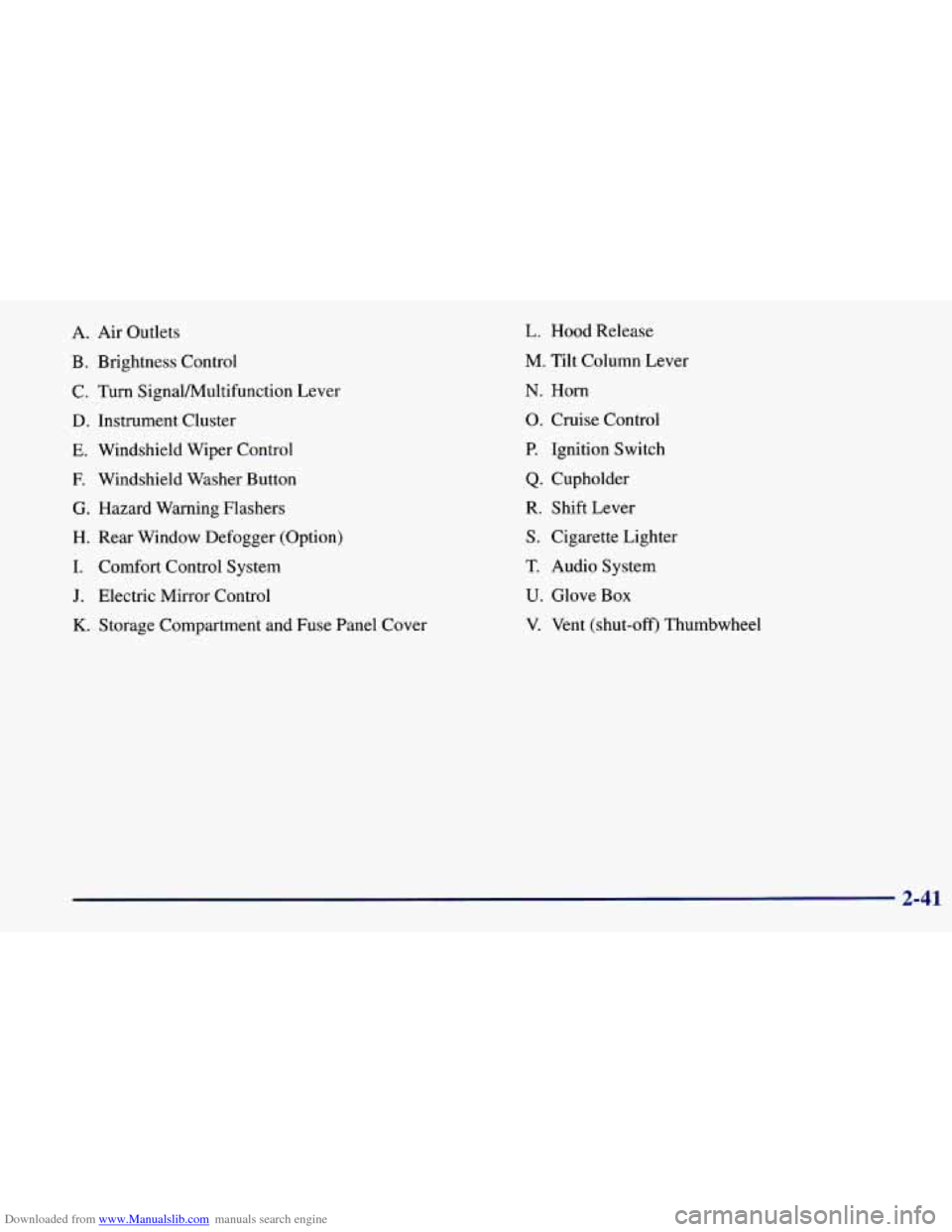
Downloaded from www.Manualslib.com manuals search engine A. Air Outlets
B. Brightness Control
C.
Turn SignalMultifunction Lever
D. Instrument Cluster
E. Windshield Wiper Control
E Windshield Washer Button
G. Hazard Warning Flashers
H. Rear Window Defogger (Option)
I. Comfort Control System
J. Electric Mirror Control
K. Storage Compartment and Fuse Panel Cover L.
Hood Release
M. Tilt Column Lever
N. Horn
0. Cruise Control
P. Ignition Switch
Q. Cupholder
R. Shift Lever
S. Cigarette Lighter
T. Audio System
U. Glove Box
V. Vent (shut-off) Thumbwheel
2-41
Page 130 of 364

Downloaded from www.Manualslib.com manuals search engine Engine Oil Pressure Light
If you have a problem with
your oil, this light may stay
on after you start your
engine or come on when
you are driving.
This indicates that there is not enough oil pressure
to keep your engine properly lubricated and cool.
The engine could be low on
oil, or have some other
oil related problem. Have it fixed right away.
The oil light could also come on in three
other situations.
When the ignition is on but the engine is not running,
the light will come on as a test to show you it is
working, but the light will go out when you turn the
ignition to STMT.
If it doesn’t come on with the
ignition on, you may have a problem with the fuse
or bulb. Have it fixed right away.
Sometimes when the engine is idling at a stop, the
light may blink on and
off. This is normal.
If you make a hard stop, the light may come on for a
moment. This
is normal.
Don’t keep driving if the oil pressure is low. If
you do, your engine can become so hot that it
catches fire. You or others could be burned.
Check your oil as soon as possible and have your
vehicle serviced.
NOTICE:
Damage to your engine from neglected oil
problems can be costly and is not covered
by
your warranty.
2-52
Page 229 of 364
Downloaded from www.Manualslib.com manuals search engine You can be injured and your vehicle could be
damaged if you
try to do service work on a
vehicle without knowing enough about it.
Be sure you have sufficient knowledge,
experience, the proper replacement parts
and tools before you attempt any vehicle
maintenance task.
Be sure to use the proper nuts, bolts and
other fasteners. “English” and “metric”
fasteners can be easily confused.
If you use
the wrong fasteners, parts can later break
or fall
off. You could be hurt.
Adding Equipn- -~- -1 the Out le of
Your Vehicle
Things you might add to the outside of your vehicle can
affect the airflow around it. This may cause wind noise
and affect windshield washer performance. Check with
your dealer before adding equipment to the outside of
your vehicle.
Fuel
Use regular unleaded gasoline rated at 87 octane
or higher. At
a minimum, it should meet specifications
ASTM
D4814 in the United States and CGSB 3.5-M93
in Canada. Improved gasoline specifications have been
developed by the American Automobile Manufacturers
Association (AAMA) for better vehicle performance
and engine protection. Gasolines meeting the AAMA
specification could provide improved driveability
and emission control system protection compared to
other gasolines.
6-3
Page 237 of 364
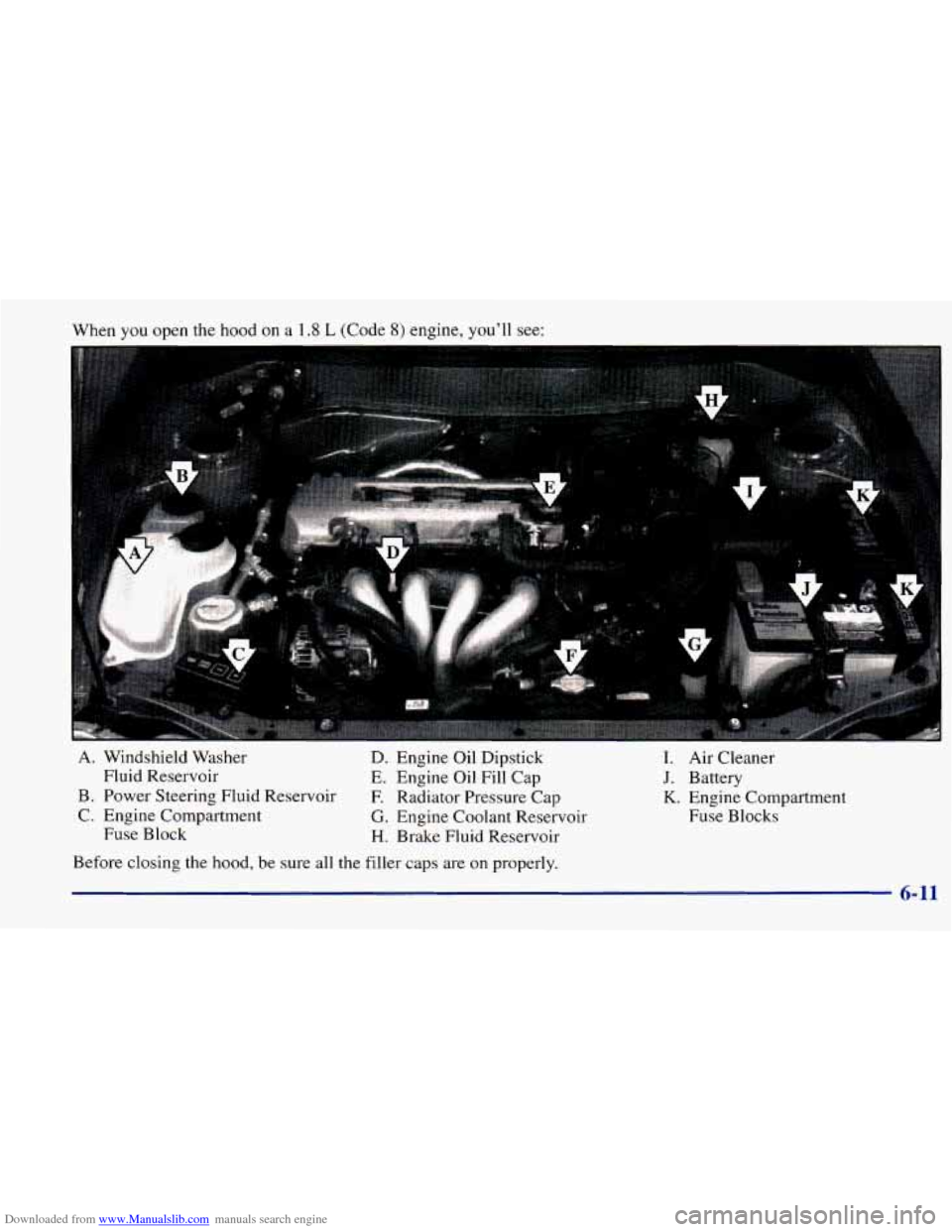
Downloaded from www.Manualslib.com manuals search engine When you open the hood on a 1.8 L (Code 8) engine, you'll see:
A. Windshield Washer
D. Engine Oil Dipstick I. Air Cleaner
Fluid Reservoir
E. Engine Oil Fill Cap
J. Battery
B. Power Steering Fluid Reservoir
F. Radiator Pressure Cap K. Engine Compartment
C. Engine Compartment
G. Engine Coolant Reservoir Fuse Blocks
Fuse Block
H. Brake Fluid Reservoir
Before closing the hood, be sure all the filler caps are on properly.
6-11
Page 280 of 364

Downloaded from www.Manualslib.com manuals search engine Headlamps Wiring Fuses and Circuit Breakers
The
headlamp wiring is protected by a circuit breaker.
An electrical overload will cause the lamps to go on and
off, or in some cases to remain
off. If this happens, have
your headlamp wiring checked right away.
Windshield Wipers Fuses
The windshield wiper motor is protected by a circuit
breaker and a fuse. If the motor overheats due to heavy
snow, etc., the wiper will stop until the motor cools. If
the overload is caused by some electrical problem, and
not snow, etc., be sure to get it fixed.
Power Windows and Other Power Options
Circuit breakers protect the power windows and other
power accessories. When the current load is too heavy,
the circuit breaker opens and closes, protecting the
circuit until the problem is fixed or goes away. The wiring circuits in your vehicle are protected from
short circuits by fuses, circuit breakers and fusible
thermal links in
the wiring itself. This greatly reduces
the chance of fires caused by electrical problems.
Look at the silver-colored band inside the fuse. If the
band is broken or melted, replace the fuse. Be sure you
replace
a bad fuse with a new one of the correct size.
If you ever have a problem on the road and don’t
have a
spare fuse, you can borrow one. Just pick some feature
of your vehicle that you can get along without -- like the
radio or air conditioner
-- and use its fuse, if it is of the
value you need. Replace it as soon as you can.
Before replacing
a fuse, turn every electrical switch off.
6-54