1998 CHEVROLET PRIZM stop start
[x] Cancel search: stop startPage 188 of 364

Downloaded from www.Manualslib.com manuals search engine Turn Signals When Towing a Trailer
When you tow a trailer, your vehicle may need a
different turn signal flasher and/or extra wiring. Check with your Chevrolet dealer. The green arrows on your
instrument panel will flash whenever you signal a
turn
or lane change. Properly hooked up, the trailer lamps
will also flash, telling other drivers you’re about to turn,
change lanes or stop.
When towing a trailer, the green arrows on your
instrument panel will flash for turns
even if the bulbs on
the trailer are burned out. Thus, you may think drivers
behind
you are seeing your signal when they are not.
It’s important to check occasionally to be sure the
trailer bulbs are still working.
Driving On Grades
Reduce speed and shift to a lower gear before you start
down a long or steep downgrade. If you don’t shift
down, you might have to use your brakes
so much that
they would get hot and no longer work well.
On
a long uphill grade, shift down and reduce your
speed to
45 mph (70 km/h) to reduce the possibility
of engine and transaxle overheating.
If you are towing a trailer that weighs more than
1,000 lbs. (450 kg), and you have an automatic transaxle
with overdrive, you may prefer to drive in DRIVE
(D)
rather than OVERDRIVE 0 (or, as you need to, a
lower gear). Or, if you have a manual transaxle with
FIFTH (3, it’s better not to use FIFTH (5). Just drive
in
FOURTH (4) (or, as you need to, a lower gear).
Parking on Hills
You really should not park your vehicle, with a trailer
attached, on a hill. If something goes wrong, your rig
could start to move. People can be injured, and both
your vehicle and the trailer can be damaged.
But if you ever have to park your
rig on a hill, here’s
how to do it:
1. Apply your regular brakes, but don’t shift into
PARK (P) yet, or into gear for a manual transaxle.
2. Have someone place chocks under the trailer wheels.
3. When the wheel chocks are in place, release the
regular brakes until the chocks absorb thc lad.
4. Reapply your regular brakes. Then apply your
parking brake, and then shift to PARK
(P), or
REVERSE
(R) for a manual transaxle.
5. Release the regular brakes.
4-36
Page 189 of 364

Downloaded from www.Manualslib.com manuals search engine When You Are Ready to Leave After
Parking on a
Hill
1. Apply your regular brakes and hold the pedal down
while you:
0 Start your engine;
0 Shift into a gear; and
0 Release the parking brake.
2. Let up on the brake pedal.
3. Drive slowly until the trailer is clear of the chocks.
4. Stop and have someone pick up and store the chocks.
Maintenance When Trailer Towing
Your vehicle will need service more often when you’re
pulling a trailer. See the Maintenance Schedule for more
on this. Things that are especially important in trailer
operation are automatic transaxle fluid (don’t overfill),
engine oil, drive belt, cooling system and brake
adjustment. Each of
these is covered in this manual,
and the Index will help you find them quickly. If you’re
trailering, it’s a good idea to review these sections
before you start your trip.
Check periodically to
see that all hitch nuts and bolts
are tight.
Engine Cooling When Trailer Towing
Your cooling system may temporarily overheat during
severe operating conditions. See “Engine Overheating”
in the Index.
4-37
Page 241 of 364
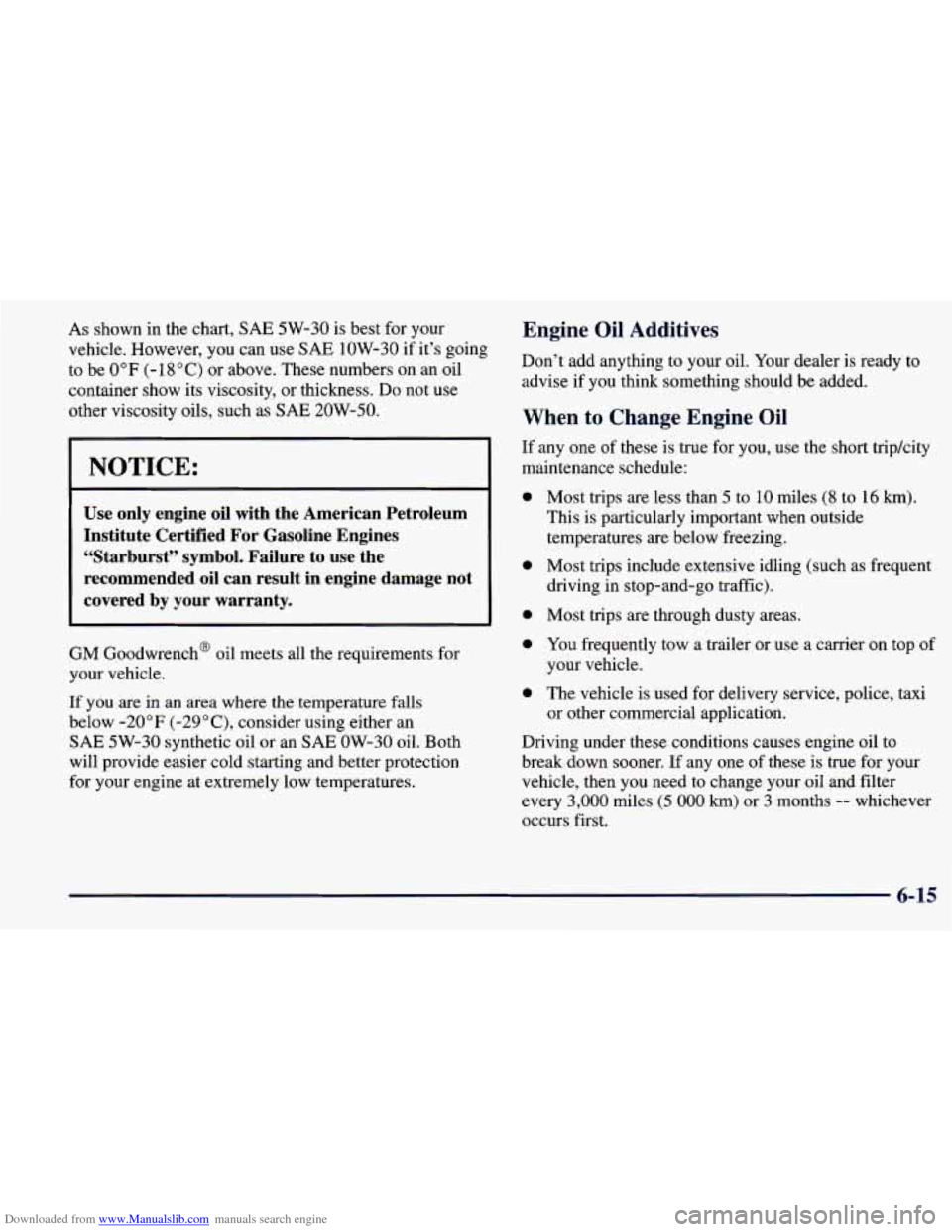
Downloaded from www.Manualslib.com manuals search engine As shown in the chart, SAE 5W-30 is best for your
vehicle. However, you can use
SAE 1OW-30 if it's going
to be
0" F (- 18 " C) or above. These numbers on an oil
container show its viscosity, or thickness.
Do not use
other viscosity oils, such as
SAE 20W-50.
NOTICE:
Use only engine oil with the American Petroleum
Institute Certified For Gasoline Engines
"Starburst" symbol. Failure to use the
recommended oil can result in engine damage not
covered by your warranty.
GM Goodwrench@ oil meets all the requirements for
your vehicle.
If you are in an area where the temperature falls
below -20°F (-29 "C), consider using either an
SAE 5W-30 synthetic oil or an SAE OW-30 oil. Both
will provide easier cold starting and better protection
for your engine at extremely low temperatures.
Engine Oil Additives
Don't add anything to your oil. Your dealer is ready to
advise
if you think something should be added.
When to Change Engine Oil
If any one of these is true for you, use the short tripkity
maintenance schedule:
0
0
0
0
0
Most trips are less than 5 to 10 miles (8 to 16 km).
This is particularly important when outside
temperatures are below freezing.
Most trips include extensive idling (such as frequent
driving in stop-and-go traffic).
Most trips are through dusty areas.
You frequently tow a trailer or use a carrier on top of
your vehicle.
The vehicle is used for delivery service, police, taxi
or other commercial application.
Driving under these conditions causes engine oil to
break down sooner.
If any one of these is true for your
vehicle, then you need to change your oil and filter
every
3,000 miles (5 000 km) or 3 months -- whichever
occurs first.
6-15
Page 258 of 364
Downloaded from www.Manualslib.com manuals search engine Brake Adjustment
Every time you make a moderate brake stop, your disc
brakes adjust for wear. If you rarely make a moderate
or heavier stop, then your brakes might not adjust
correctly. If you drive in that way, then
-- very
carefully
-- make a few moderate brake stops about
every
1,000 miles (1 600 km), so your brakes will
adjust properly.
Replacing Brake System Parts
The braking system on a modern vehicle is complex.
Its many parts have to be of top quality and work well
together
if the vehicle is to have really good braking.
Your vehicle was designed and tested with top-quality
GM brake parts. When you replace parts of your braking
system
-- for example, when your brake linings wear
down and you have to have new ones put in
-- be sure
you get new approved
GM replacement parts. If you
don’t, your brakes may no longer work properly. For
example, if someone puts in brake linings that are wrong
for your vehicle, the balance between your front and
rear brakes can change
-- for the worse. The braking
performance you’ve come to expect can change
in many
other ways if someone puts in the wrong replacement
brake parts.
Battery
Every new Chevrolet has an ACDelco Freedom@
battery.
You never have to add water to one of these.
When it’s time for a new battery, we recommend
an ACDelco Freedom battery. Get one that has
the replacement number shown on the original
battery’s label.
Vehicle Storage
If you’re not going to drive your vehicle for 25 days
or more, remove the black, negative
(-) cable from
the battery. This will help keep your battery from
running down.
Batteries have acid that can burn you and gas
that can explode.
You can be badly hurt if you
aren’t careful. See
“Jump Starting’’ in the Index
for tips on working around a battery without
getting hurt.
1
Contact your dealer to learn how to prepare your vehicle
for longer storage periods.
6-32
Page 281 of 364
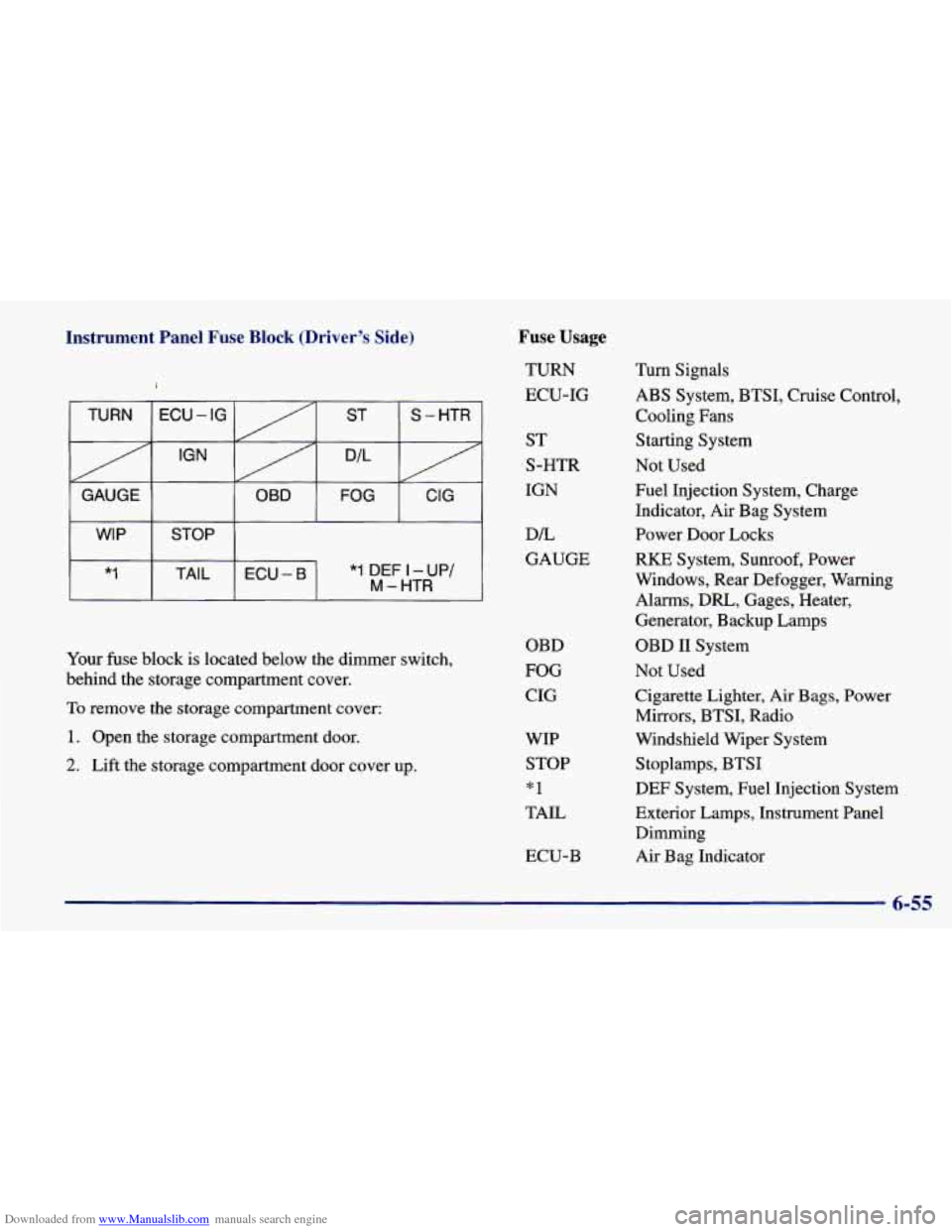
Downloaded from www.Manualslib.com manuals search engine Instrument Panel Fuse Block (Driver's Side)
1
TURN S - HTR ST ECU - IG
IGN D/L
GAUGE CIG FOG OBD
WIP STOP
*I DEF I - UP/
M - HTR
Your fuse block is located below the dimmer switch,
behind the storage compartment cover.
To remove the storage compartment cover:
1. Open the storage compartment door.
2. Lift the storage compartment door cover up.
Fuse Usage
TURN
ECU-IG
ST
S-HTR
IGN
DL
GAUGE
OBD
FOG
CIG
WIP STOP
"1
TAIL
ECU-B
Turn Signals
ABS System, BTSI, Cruise Control,
Cooling Fans
Starting System
Not Used
Fuel Injection System, Charge
Indicator, Air Bag System Power Door
Locks
RKE System, Sunroof, Power
Windows, Rear Defogger, Warning Alarms,
DRL, Gages, Heater,
Generator, Backup Lamps
OBD 11 System
Not Used
Cigarette Lighter, Air Bags, Power
Mirrors, BTSI, Radio
Windshield Wiper System
Stoplamps, BTSI
DEF System, Fuel Injection System
Exterior Lamps, Insmment Panel
Dimming
Air Bag Indicator
6-55