Page 237 of 364
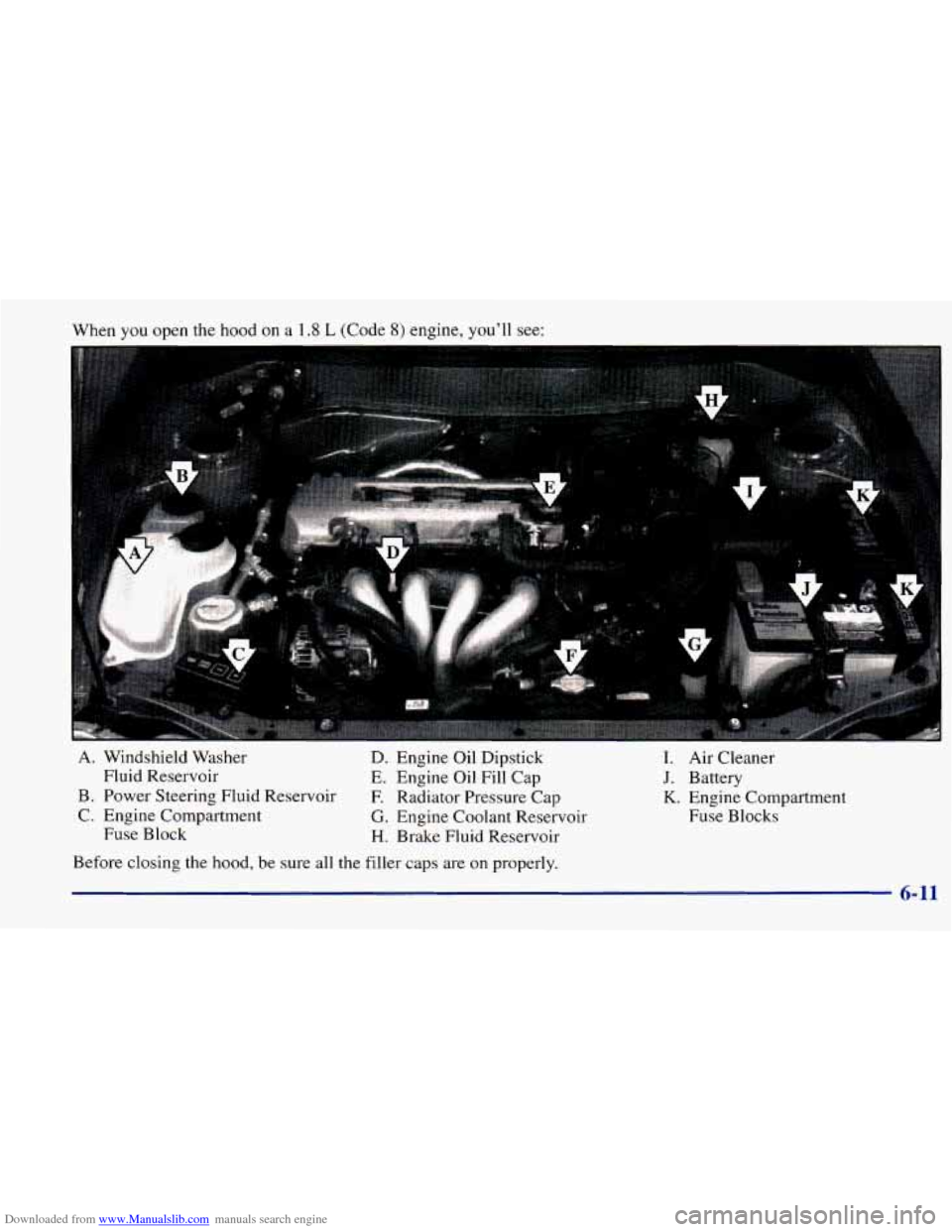
Downloaded from www.Manualslib.com manuals search engine When you open the hood on a 1.8 L (Code 8) engine, you'll see:
A. Windshield Washer
D. Engine Oil Dipstick I. Air Cleaner
Fluid Reservoir
E. Engine Oil Fill Cap
J. Battery
B. Power Steering Fluid Reservoir
F. Radiator Pressure Cap K. Engine Compartment
C. Engine Compartment
G. Engine Coolant Reservoir Fuse Blocks
Fuse Block
H. Brake Fluid Reservoir
Before closing the hood, be sure all the filler caps are on properly.
6-11
Page 250 of 364
Downloaded from www.Manualslib.com manuals search engine NOTICE:
If you use an improper coolant mixture, your
engine could overheat and be badly damaged.
The repair cost wouldn’t be covered
by your
warranty. Too much water in the mixture can
freeze and crack the engine, radiator, heater
core and other parts.
If you have to add coolant more than four times a year,
lave
your dealer check your cooling system.
I NOTICE:
If you use the proper coolant, you don’t have to
add extra inhibitors or additives which claim to
improve the system. These can be harmful.
Checking Coolant
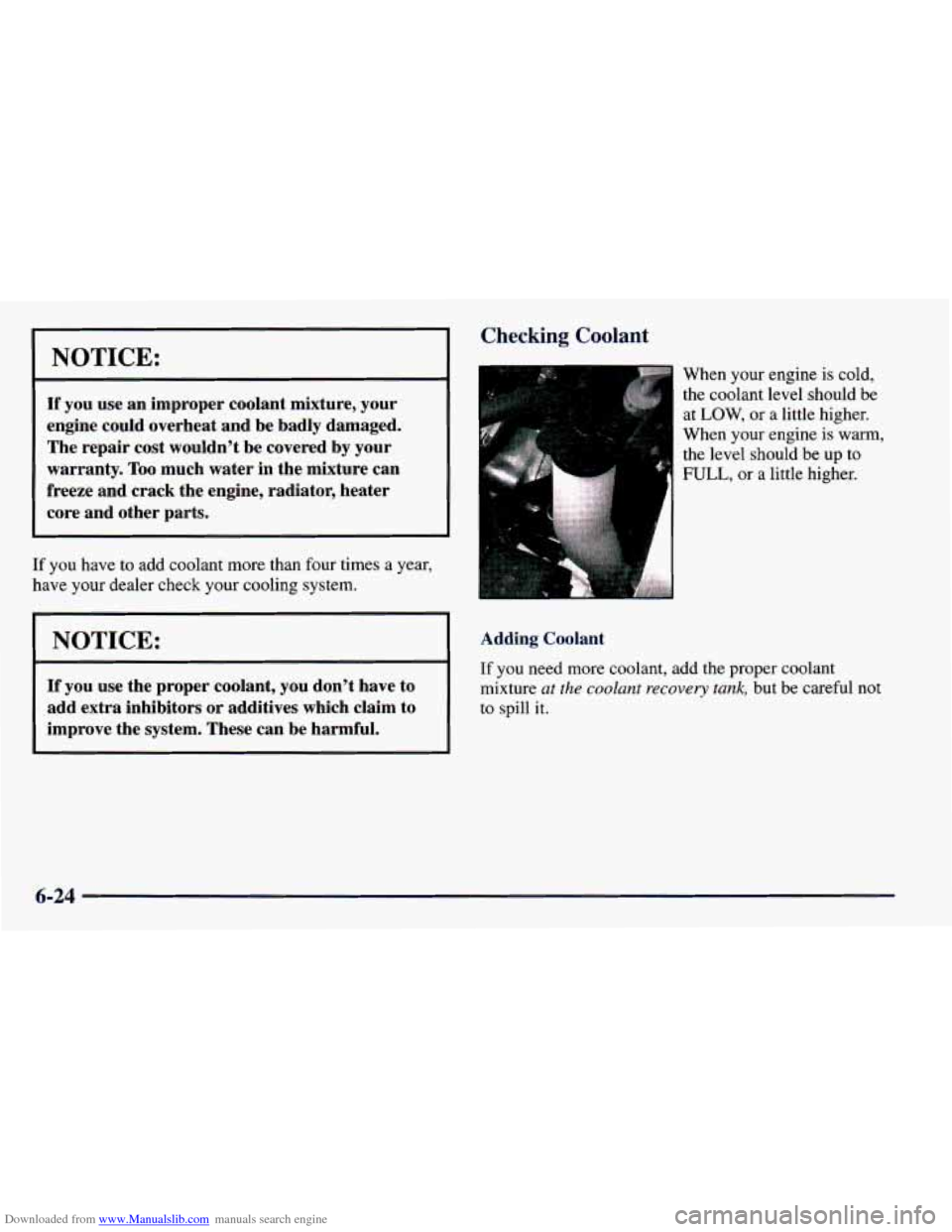
When your engine is cold,
the coolant level should be
at
LOW, or a little higher.
When your engine is warm,
the level should be up to
FULL, or a little higher.
Adding Coolant
If you need more coolant, add the proper coolant
mixture
at the coolant recovery tank, but be careful not
to spill it.
6-24
Page 251 of 364
Downloaded from www.Manualslib.com manuals search engine Radiator Pressure Cap
Wrning the radiator pressure cap when the
engine and radiator are hot can allow steam and
scalding liquids to blow out and burn you badly.
With the coolant recovery tank, you will almost
never have to add coolant
at the radiator.
Never turn the radiator pressure cap
-- even a
little -- when the engine and radiator are hot.
A CAUTION:
d if you spill coolant on hot
engine parts. Coolant contains ethylene glycol,
and it will burn if the engine parts are hot
enough. Don’t spill coolant on
a hot engine.
I NOTICE:
Your radiator cap is a 15 psi (105 kPa)
pressure-type cap and must be tightly installed to
prevent coolant loss and possible engine damage
from overheating. Be sure the arrows on the cap
line up with the overflow tube on the radiator
filler neck.
Thermostat
Engine coolant temperature is controlled by a thermostat
in the engine coolant system. The thermostat stops the
flow of coolant through the radiator until the coolant
reaches a preset temperature.
When you replace your thermostat, a General Motors@
thermostat is recommended.
6-25
Page 286 of 364

Downloaded from www.Manualslib.com manuals search engine Vehicle Dimensions
Wheelbase ................ .97.1 inches (247 cm)
Length
................... 175.0 inches (445 cm)
Width
.................... .66.7 inches (169 cm)
Height
.................... .53.5 inches (1 36 cm)
Tread Front
................... .57.9 inches (147 cm)
Rear
.................... -57.5 inches (146 cm)
Air Conditioning Refrigerants
Not all air conditioning refrigerants are the same.
If the air conditioning system
in your vehicle needs
refrigerant, be sure the proper refrigerant
is used. If
you’re not sure, ask your dealer.
Normal Maintenance
Replacement Parts
Air Cleaner Filter .......... GM Part No. 94853522
Battery
............................... .35-60
Engine Oil Filter .......... GM Part No. 25014441
Fuel Filter
................ GM Part No. 94854620
PCV Valve
............... GM Part No. 94853556
Radiator Pressure Cap
........... 15 psi (105 kPa)
Spark Plug*
Denso K16TR11 ........ 0.043 inch (1.1 mm) gap
NGK BKRSEKB-11
..... 0.043 inch (1.1 mm) gap
*Your engine is fitted
with twin ground electrode spark
plugs. Use
only twin ground electrode spark plugs for
better engine performance.
6-60
Page 299 of 364
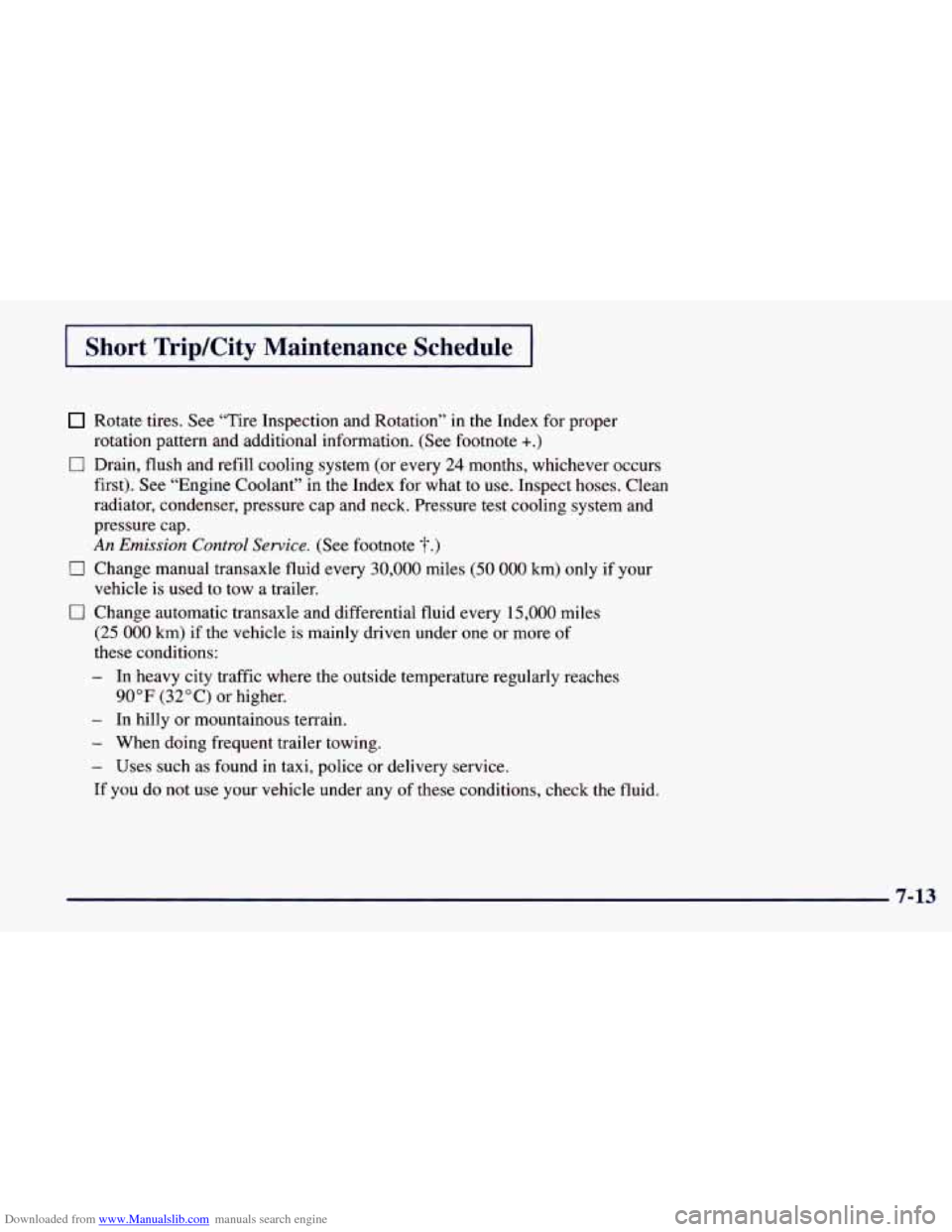
Downloaded from www.Manualslib.com manuals search engine Short TripKity Maintenance Schedule
Rotate tires. See “Tire Inspection and Rotation” in the Index for proper
0 Drain, flush and refill cooling system (or every 24 months, whichever occurs
rotation pattern and additional information. (See
footnote
+.)
first). See “Engine Coolant” in the Index for what to use. Inspect hoses. Clean
radiator, condenser, pressure cap and neck. Pressure test cooling system and
pressure cap.
An Emission Control Sewice. (See footnote “f)
0 Change manual transaxle fluid every 30,000 miles (50 000 km) only if your
vehicle is used to tow a trailer.
0 Change automatic transaxle and differential fluid every 15,000 miles
(25 000 km) if the vehicle is mainly driven under one or more of
these conditions:
- In heavy city traffic where the outside temperature regularly reaches
- In hilly or mountainous terrain.
- When doing frequent trailer towing.
- Uses such as found in taxi, police or delivery service.
90°F (32°C) or higher.
If you do not use your vehicle under any of these conditions, check the fluid.
7-13
Page 304 of 364
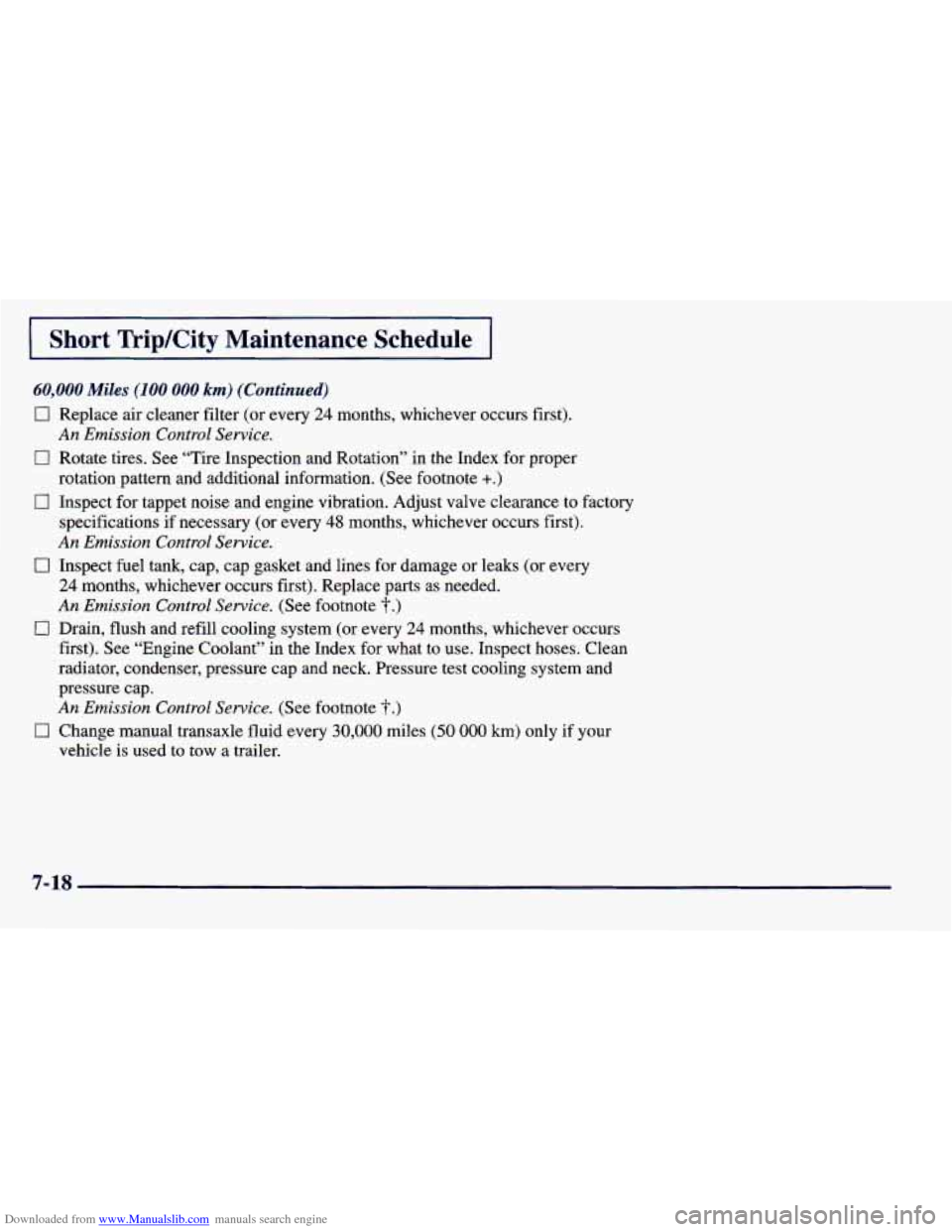
Downloaded from www.Manualslib.com manuals search engine I Short Trip/City Maintenancc 5chedule 1
60,000 Miles (100 000 km) (Continued)
0
0
0
0
0
0
Replace air cleaner filter (or every 24 months, whichever occurs first).
An Emission Control Service.
Rotate tires. See “Tire Inspection and Rotation” in the I\
ndex for proper
rotation pattern and additional information. (See footnote
+.)
Inspect for tappet noise and engine vibration. Adjust valve clearance to fa\
ctory
specifications if necessary (or every 48 months, whichever occurs first).
An Emission Control Service.
Inspect fuel tank, cap, cap gasket and lines for damage or leaks (or every
24 months, whichever occurs first). Replace parts as needed.
An Emission Control Service. (See footnote “f)
Drain, flush and refill cooling system (or every 24 months, w\
hichever occurs
first). See “Engine Coolant”
in the Index for what to use. Inspect hoses. Clean
radiator, condenser, pressure cap and neck. Pressure test coolin\
g system and pressure cap.
An Emission Control Service. (See footnote “f)
Change manual transaxle fluid every 30,000 miles (50 000 km) only if your
vehicle is used to tow a trailer.
7-18
Page 310 of 364
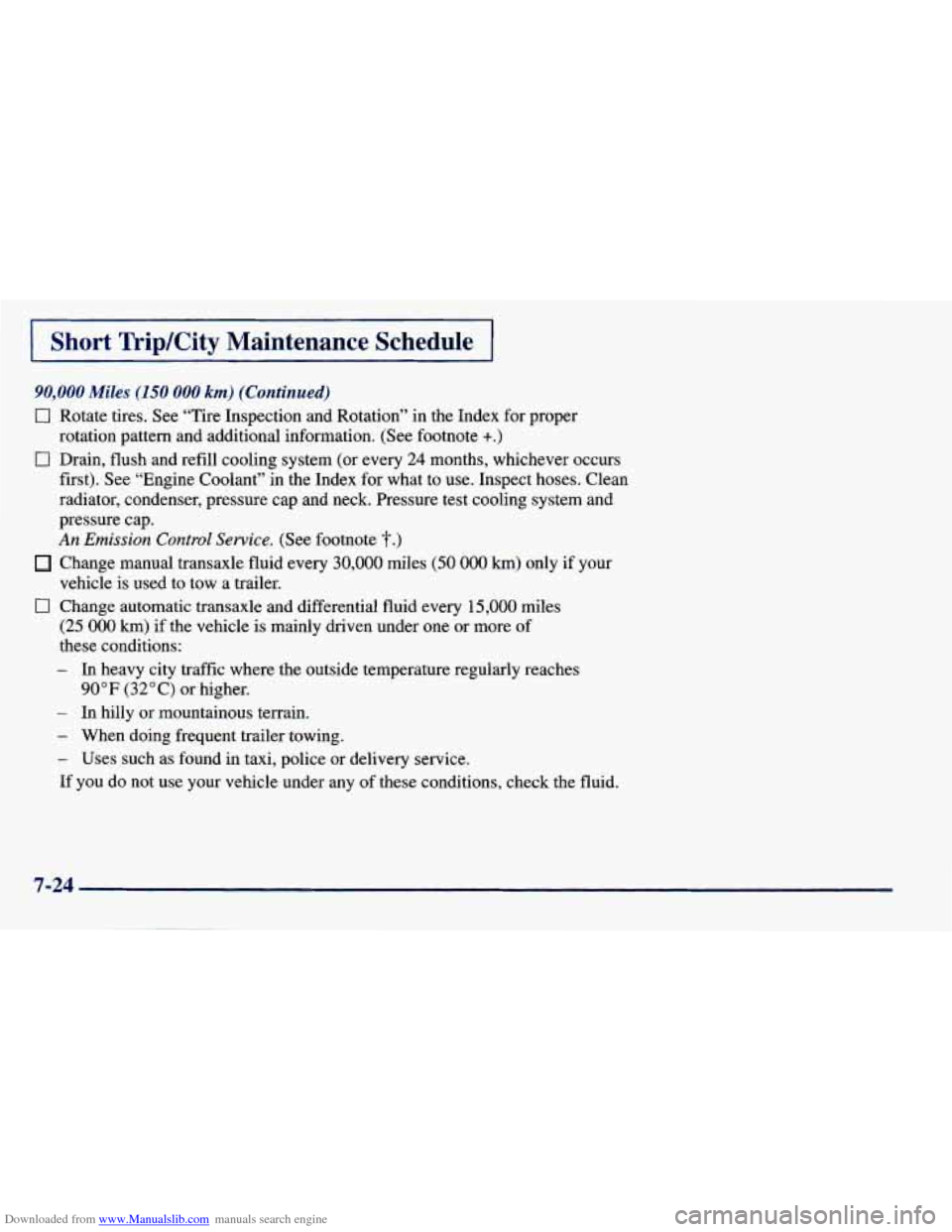
Downloaded from www.Manualslib.com manuals search engine I Short TripKity Maintenance Schedule I
90,000 Miles (150 000 km) (Continued)
0 Rotate tires. See “Tire Inspection and Rotation” in the Index for proper
0 Drain, flush and refill cooling system (or every 24 months, whichever occurs
rotation pattern and additional information. (See footnote
+.)
first). See
“Engine Coolant’’ in the Index for what to use. Inspec\
t hoses. Clean
radiator, condenser, pressure cap and neck. Pressure test cooling system and
pressure cap.
An Emission Control Sewice. (See footnote “f)
Change manual transaxle fluid every 30,000 miles (50 000 km) only if your
vehicle
is used to tow a trailer.
0 Change automatic transaxle and differential fluid every 15,000 miles
(25 000 km) if the vehicle is mainly driven under one or more of
these conditions:
- In heavy city traffic where the outside temperature regularly reaches
90 OF (32 O C) or higher.
- In hilly or mountainous terrain.
- When doing frequent trailer towing.
- Uses such as found in taxi, police or delivery service.
If you do not use your vehicle under any of these conditions, check the \
fluid.
7-24
Page 315 of 364
Downloaded from www.Manualslib.com manuals search engine I Long Tripmighway .Maintenance Schedule
0 Drain, flush and refill cooling system (or every 24 months, whichever occurs
first). See “Engine Coolant’’ in the Index
for what to use. Inspect hoses. Clean
radiator, condenser, pressure cap and neck. Pressure test cooling system and
pressure cap.
An Emission Control Service. (See footnote T.)
Change manual transaxle fluid every 30,000 miles (50 000 km) only if your
vehicle is used to tow a trailer.
Change automatic transaxle and differential fluid every 15,000 miles
(25 000 km) if the vehicle is mainly driven under one or more of
these conditions:
- In heavy city traffic where the outside temperature regularly r\
eaches
90°F (32°C) or higher.
- In hilly or mountainous terrain.
- When doing frequent trailer towing.
- Uses such as found in taxi, police or delivery service.
If you do not use your vehicle under any of these conditions, check the fluid.
7-29