Page 285 of 362
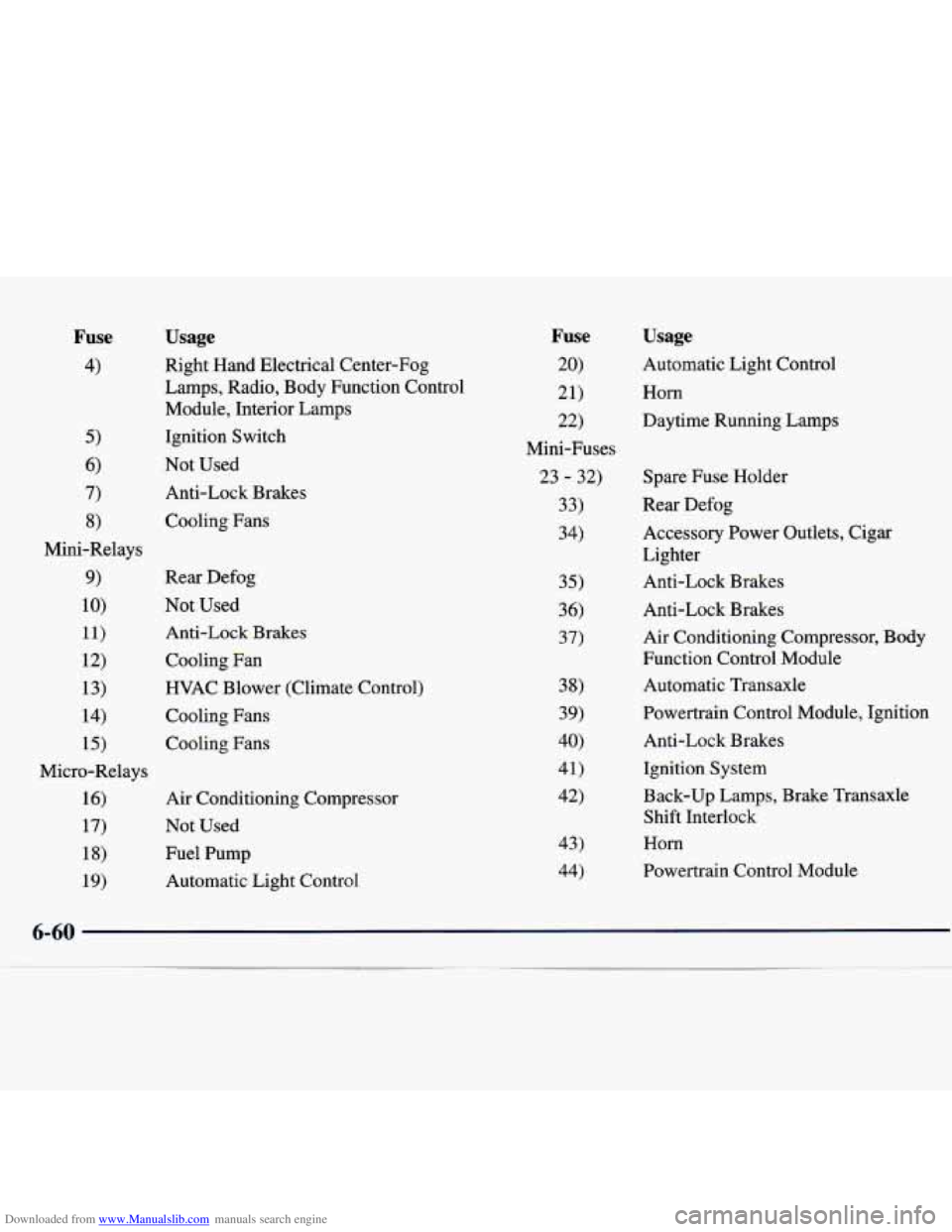
Downloaded from www.Manualslib.com manuals search engine Fuse
4)
Usage
Right Hand Electrical Center-Fog
Lamps, Radio, Body Function Control
Module, Interior Lamps
Ignition Switch
Not Used
Anti-Lock Brakes
Cooling Fans
Mini-Relays
9) Rear Defog
10) Not Used
11) Anti-Lock Brakes
12) Cooling Fan
13) HVAC Blower (Climate Control)
14) Cooling Fans
15) Cooling Fans
16) Air Conditioning Compressor
17) Not Used
1% Fuel Pump
19) Automatic Light Control
Micro-Relays
Fuse
20)
21)
22)
Mini-Fuses
23
- 32)
33)
34)
35)
36)
37)
43)
44)
Usage
Automatic Light Control
Horn
Daytime Running
Lamps
Spare Fuse Holder
Rear Defog
Accessory Power Outlets, Cigar
Lighter
Anti-Lock Brakes
Anti-Lock Brakes
Air Conditioning Compressor, Body
Function Control Module
Automatic Transaxle
Powertrain Control Module, Ignition Anti-Lock Brakes
Ignition System Back-up Lamps, Brake Transaxle
Shift Interlock
Horn
Powertrain Control Module
Page 286 of 362
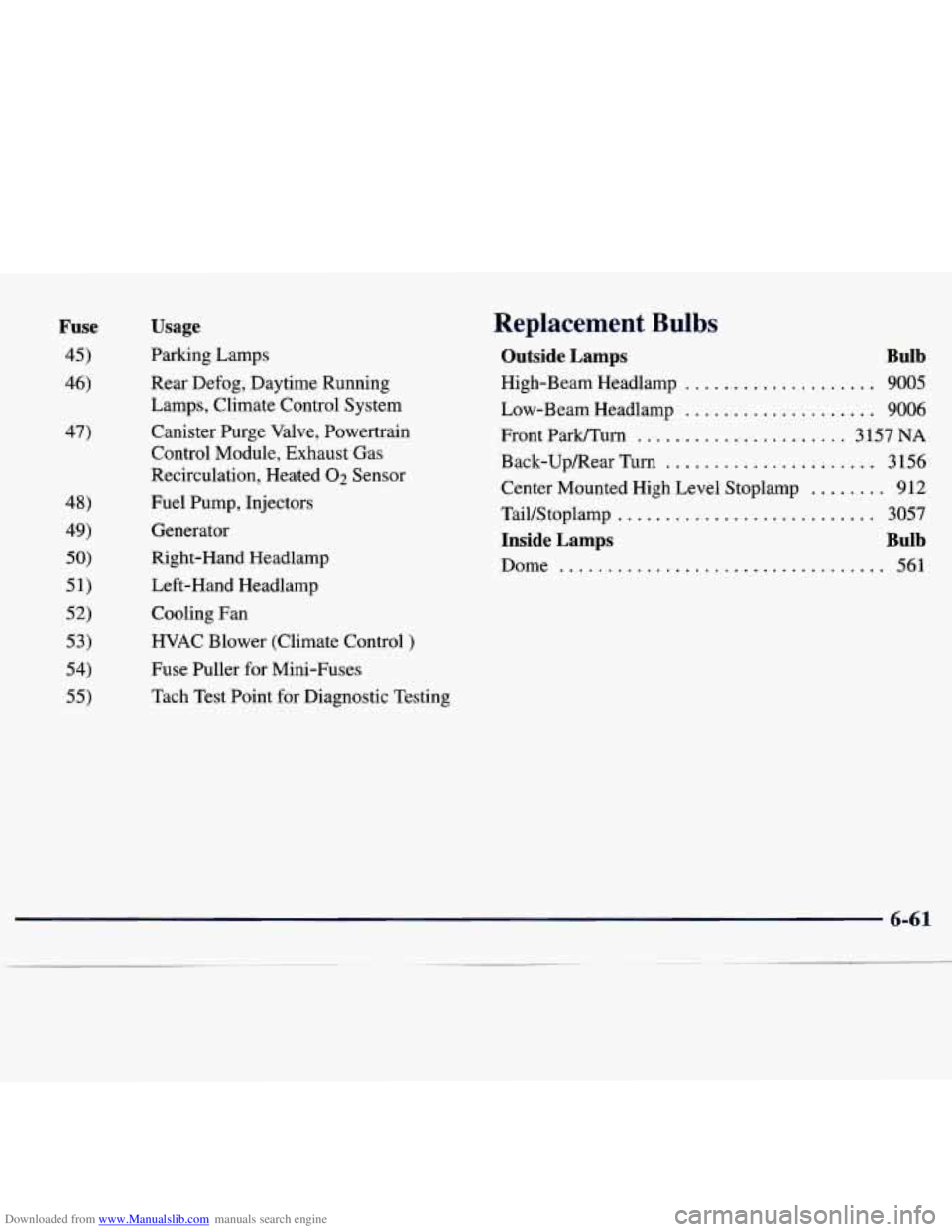
Downloaded from www.Manualslib.com manuals search engine Fuse
45)
46)
47)
Usage
Parking Lamps
Rear Defog, Daytime Running
Lamps, Climate Control System
Canister Purge Valve, Powertrain
Control Module, Exhaust Gas
Recirculation, Heated
02 Sensor
Fuel Pump, Injectors
Generator
Right-Hand Headlamp
Left-Hand Headlamp
Cooling Fan
HVAC Blower (Climate Control
)
Fuse Puller for Mini-Fuses
Tach Test Point
for Diagnostic Testing
Replacement Bulbs
Outside Lamps Bulb
High-Beam Headlamp .................... 9005
Low-Beam Headlamp
.................... 9006
Front Park/Turn
...................... 3157 NA
Back-UpRear Turn ...................... 3156
Center Mounted High Level Stoplamp
........ 912
Tail/Stoplamp
........................... 3057
Inside Lamps Bulb
Dome .................................. 561
6-61
Page 287 of 362
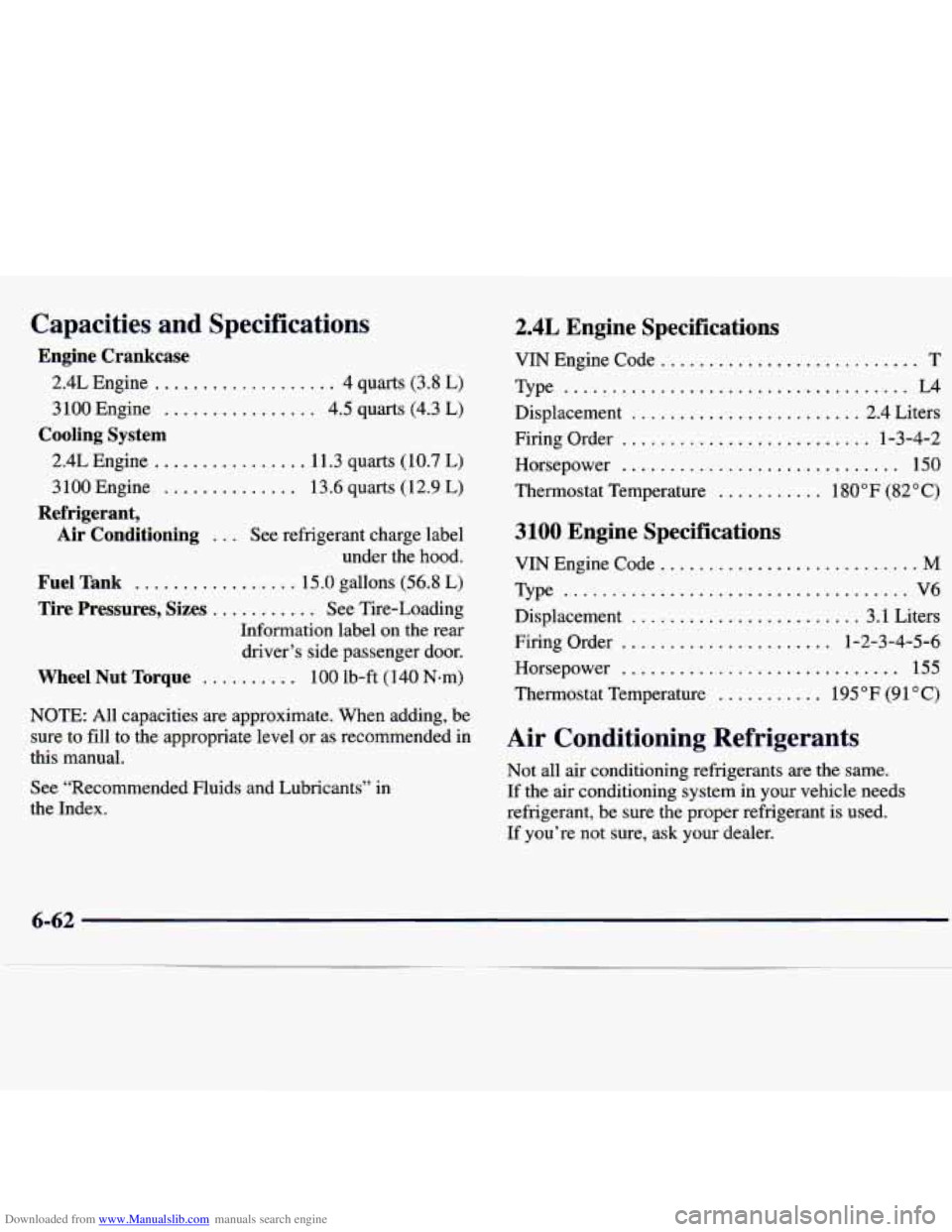
Downloaded from www.Manualslib.com manuals search engine Capacities and Specifications
Engine Crankcase
2.4L Engine ................... 4 quarts (3.8 L)
3 100 Engine
................ 4.5 quarts (4.3 L)
2.4LEngine ................ 11.3quarts(10.7L)
3100 Engine .............. 13.6 quarts (12.9 L)
Air Conditioning ... See refrigerant charge label
under the hood.
Fuel Tank ................. 15.0 gallons (56.8 L)
Information label on the rear
driver’s side passenger door.
Wheel Nut Torque .......... 100 lb-ft (140 Nsm)
Cooling System
Refrigerant,
Tire Pressures, Sizes
........... See Tire-Loading
NOTE: All capacities are approximate. When adding, be
sure to fill
to the appropriate level or as recommended in
this manual.
See “Recommended Fluids and Lubricants” in
the Index.
2.4L Engine Specifications
VIN Engine Code ........................... T
Type .................................... L4
Displacement ........................ 2.4 Liters
Firing Order
.......................... 1-3-4-2
Horsepower
............................. 150
Thermostat Temperature ........... 180°F (82°C)
3100 Engine Specifications
VIN Engine Code ........................... M
Type .................................... V6
Displacement
........................ 3.1 Liters
Firing Order
...................... 1-2-3-4-5-6
Horsepower
............................. 155
Thermostat Temperature
........... 195 OF (9 1 O C)
Air Conditioning Refrigerants
Not all air conditioning refrigerants are the same.
If the air conditioning system in your vehicle needs
refrigerant,
be sure the proper refrigerant is used.
If you’re not sure, ask your dealer.
6-62
Page 296 of 362
Downloaded from www.Manualslib.com manuals search engine Maintenance Schedule
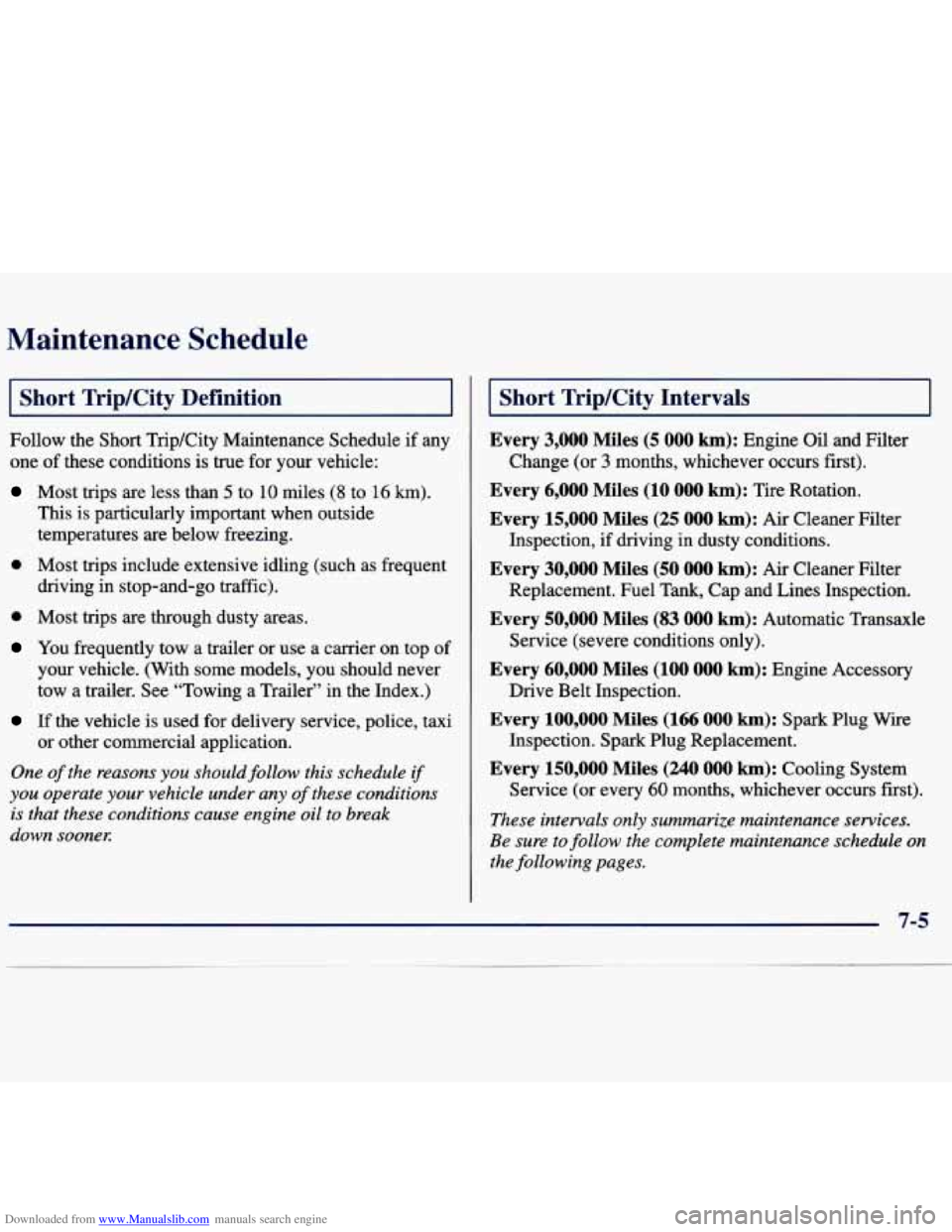
I Short Trip/City Definition I
Follow the Short TripKity Maintenance Schedule if any
one of these conditions is true for your vehicle:
Most trips are less than 5 to 10 miles (8 to 16 km).
This is particularly important when outside
temperatures are below freezing.
0 Most trips include extensive idling (such as frequent
driving in stop-and-go traffic).
0 Most trips are through dusty areas.
You frequently tow a trailer or use a carrier on top of
your vehicle. (With some models, you should never
tow a trailer. See “Towing a Trailer”
in the Index.)
If the vehicle is used for delivery service, police, taxi
or other commercial application.
One of the reasons you should follow this schedule if
you operate your vehicle under any of these conditions
is that these conditions cause engine
oil to break
down soonex
Short Trip/City Intervals
Every 3,000 Miles (5 000 km): Engine Oil and Filter
Change (or
3 months, whichever occurs first).
Every 6,000 Miles (10 000 km): Tire Rotation.
Every 15,000 Miles (25 000 km): Air Cleaner Filter
Inspection, if driving in dusty conditions.
Every 30,000 Miles (50 000 km): Air Cleaner Filter
Replacement. Fuel Tank, Cap
and Lines Inspection.
Every 50,000 Miles (83 000 km): Automatic Transaxle
Service (severe conditions only).
Every 60,000 Miles (100 000 km): Engine Accessory
Drive Belt Inspection.
Every 100,000 Miles (166 000 km): Spark Plug Wire
Inspection. Spark Plug Replacement.
Every 150,000 Miles (240 000 km): Cooling System
Service (or every
60 months, whichever occurs first).
These intervals only summarize maintenance services.
Be sure
to follow the complete maintenance schedule on
the following pages.
7-5
Page 297 of 362
Downloaded from www.Manualslib.com manuals search engine Maintenance Schedule
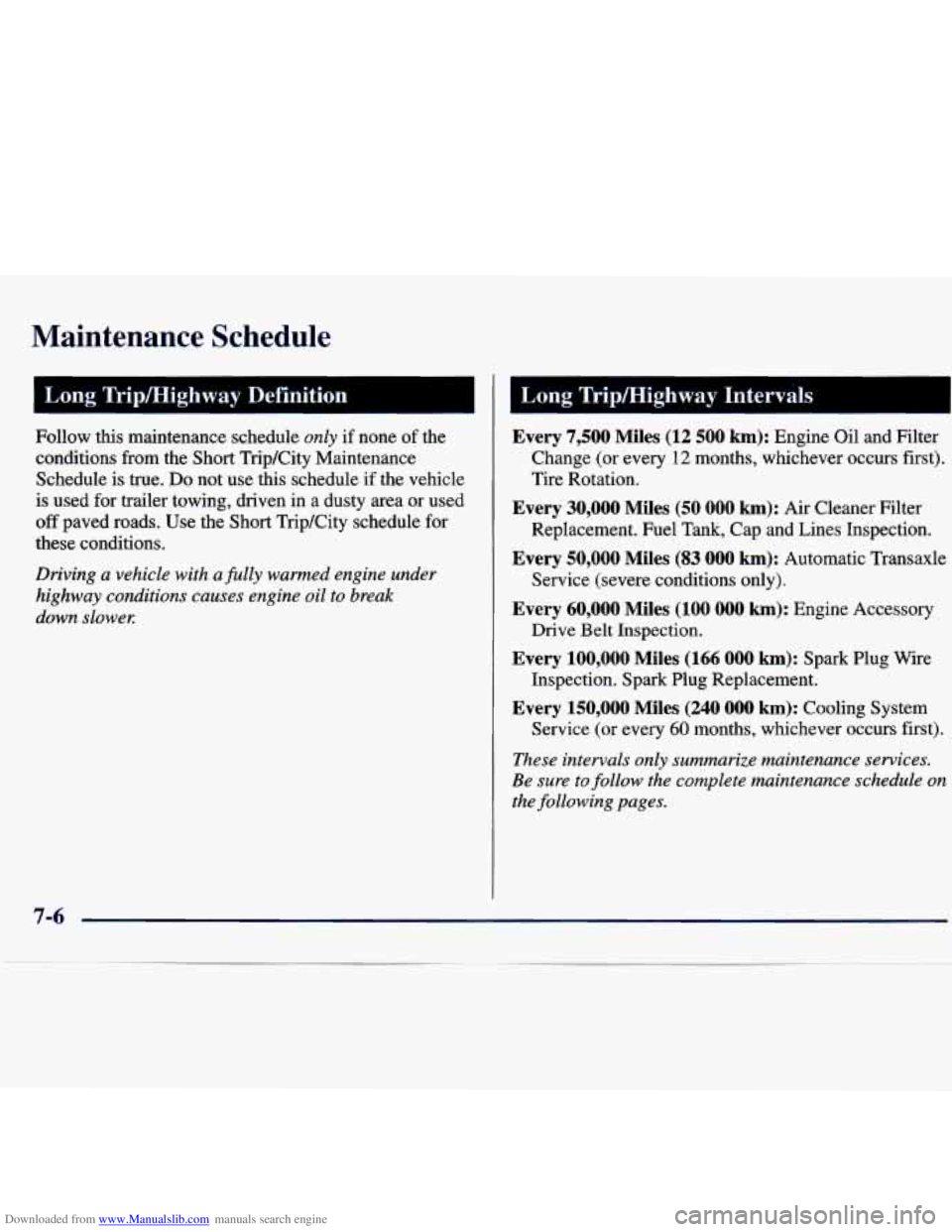
Follow this maintenance schedule only if none of the
conditions from the Short Trip/City Maintenance
Schedule is true.
Do not use this schedule if the vehicle
is used for trailer towing, driven in a dusty area
or used
off paved roads. Use the Short TripKity schedule for
these conditions.
Driving a vehicle with afully warned engine under
highway conditions causes engine oil to break
down slowex
1 Long Trip/HiPhwav Intervals
Every 7,500 Miles (12 500 km): Engine Oil and Filter
Change (or every 12 months, whichever occurs first).
Tire Rotation.
Every 30,000 Miles (50 000 km): Air Cleaner Filter
Replacement. Fuel Tank, Cap and Lines Inspection.
Every 50,000 Miles (83 000 km): Automatic Transaxle
Service (severe conditions only).
Every 60,000 Miles (100 000 km): Engine Accessory
Drive Belt Inspection.
Every 100,000 Miles (166 000 km): Spark Plug Wire
Inspection.
Spark Plug Replacement.
Every 150,000 Miles (240 000 km): Cooling System
Service (or every
60 months, whichever occurs first).
These intervals only summarize maintenance services.
Be sure
to follow the complete maintenance schedule on
the following pages.
7-6
Page 311 of 362
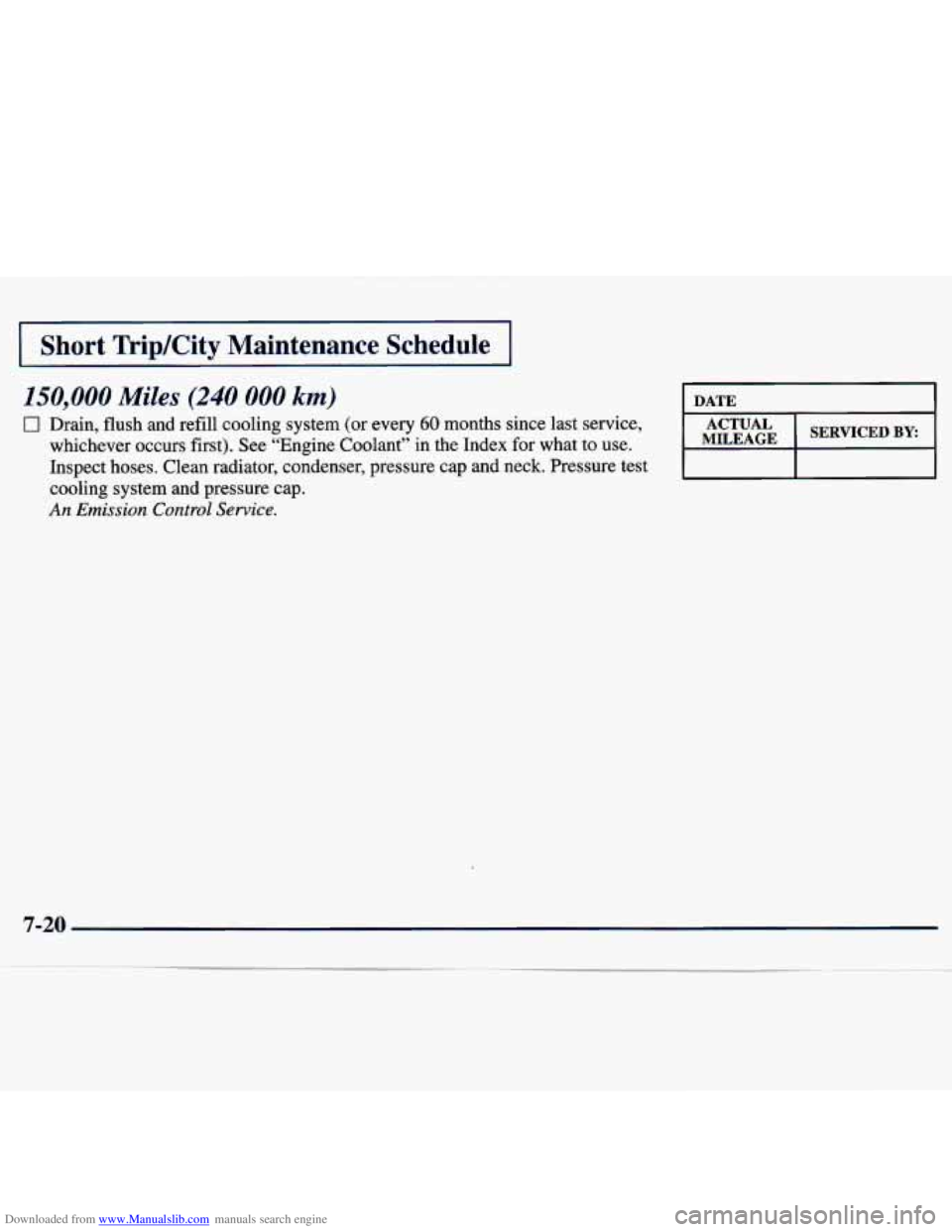
Downloaded from www.Manualslib.com manuals search engine I Short Trip/City Maintenance Schedule I
150,000 Miles (240 000 km)
C 1 Drain, flush and refill cooling system (or every 60 months since last service,
whichever occurs first). See “Engine Coolant” in the Index for what to use.
Inspect hoses. Clean radiator, condenser, pressure cap and neck. Pressure test
cooling system and pressure cap.
An Emission Control Service.
DATE I
MILEAGE
7-20
Page 319 of 362
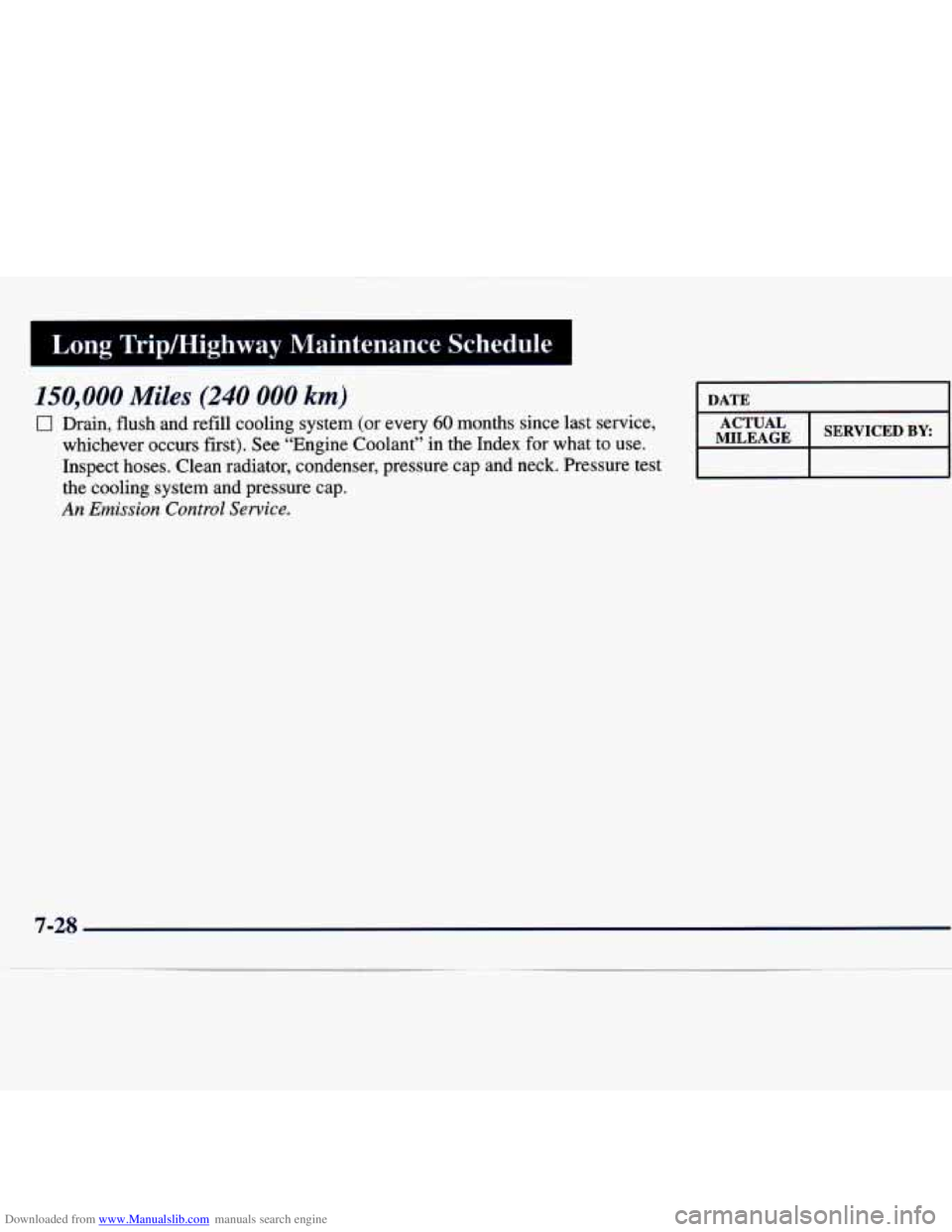
Downloaded from www.Manualslib.com manuals search engine Long Trip/Highway Maintenance Schedule I
I
150,000 Miles (240 000 km)
0 Drain, flush and refill cooling system (or every 60 months since last service,
whichever occurs first). See “Engine Coolant” in the Index for what to use.
Inspect hoses. Clean radiator, condenser, pressure cap and neck.\
Pressure test
the cooling system and pressure cap.
An Emission Control Sewice.
DATE
Page 324 of 362
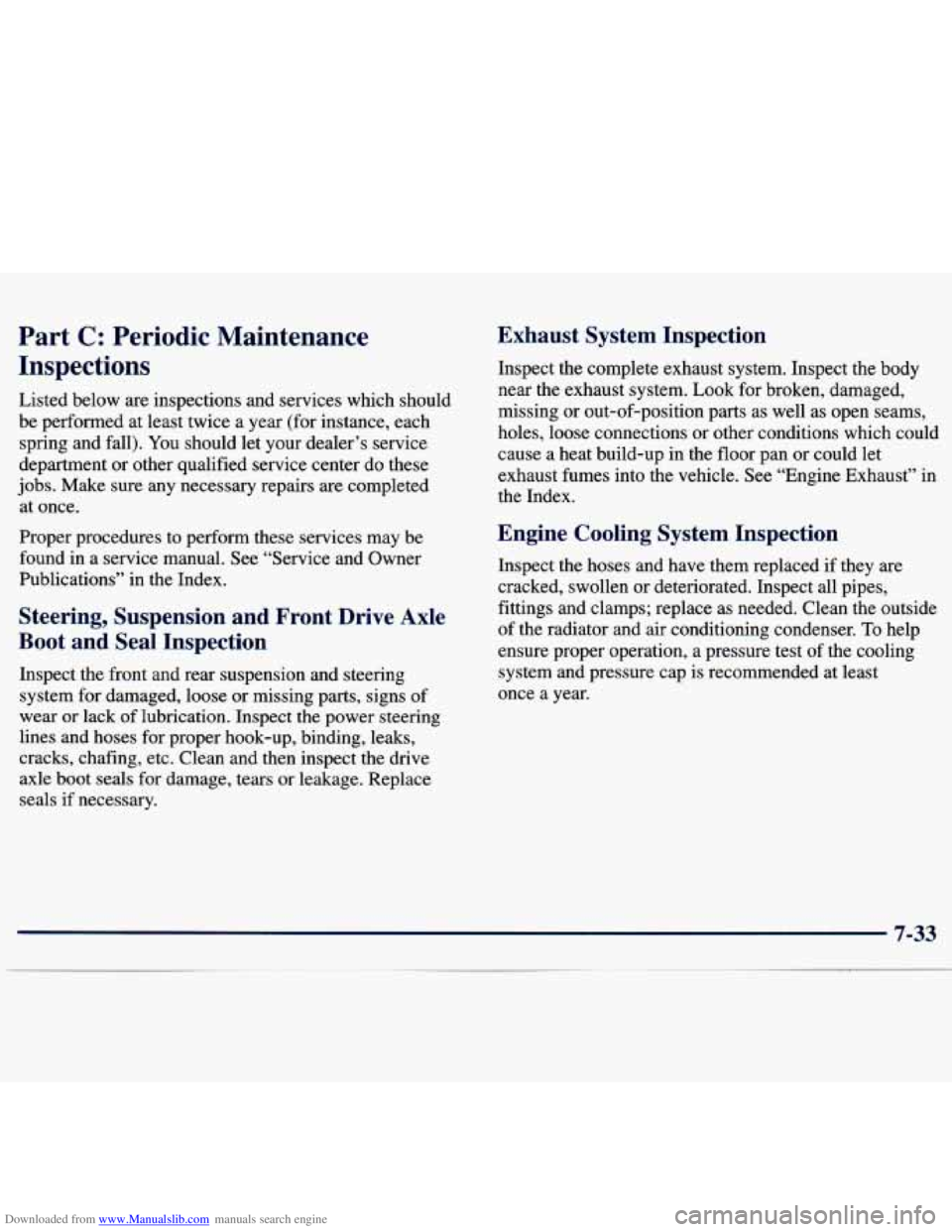
Downloaded from www.Manualslib.com manuals search engine Part C: Periodic Maintenance
Inspections
Listed below are inspections and services which should
be performed at least twice a year (for instance, each
spring and fall). You should let your dealer’s service
department or other qualified service center do these
jobs. Make sure any necessary repairs are completed
at once.
Proper procedures to perform these services may be
found in a service manual. See “Service and Owner
Publications” in the Index.
Steering, Suspension and Front Drive Axle
Boot and Seal Inspection
Inspect the front and rear suspension and steering
system for damaged, loose or missing parts, signs of
wear or lack
of lubrication. Inspect the power steering
lines and hoses for proper hook-up, binding, leaks,
cracks, chafing, etc. Clean and then inspect the drive
axle boot seals
for damage, tears or leakage. Replace
seals if necessary.
Exhaust System Inspection
Inspect the complete exhaust system. Inspect the body
near the exhaust system. Look for broken, damaged,
missing or out-of-position parts as well as open seams,
holes, loose connections or other conditions which could
cause a heat build-up in the floor pan or could let
exhaust fumes into the vehicle. See “Engine Exhaust”
in
the Index.
Engine Cooling System Inspection
Inspect the hoses and have them replaced if they are
cracked, swollen or deteriorated. Inspect all pipes,
fittings and clamps; replace as needed. Clean the outside
of the radiator and air conditioning condenser.
To help
ensure proper operation, a pressure test of the cooling
system and pressure cap
is recommended at least
once a year.